
Items related to Children Achieving: Best Practices in Early Literacy
Synopsis
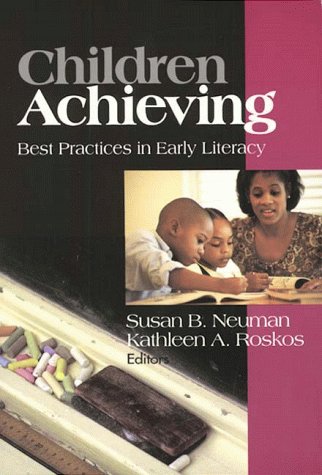
Addressing a wide range of individual variation among young children has become increasingly complex in our schools. How do we provide instruction that meets the diverse needs of our children? The contributors to this book address this important question. Each of the 13 chapters frames a critical issue in early literacy, examines what we know about it, and describes literacy practices suggested from this existing knowledge base. The focus is on issues of theory and practice appropriate for children ages 2 through 8 in classrooms ranging from prekindergarten to third grade.
"synopsis" may belong to another edition of this title.
About the Author
Susan B. Neuman is an associate professor at Temple University, Philadelphia, Pennsylvania, USA.
Kathleen A. Roskos is a professor and Chairperson of the Department of Education and Allied Studies, John Carroll University, University Heights, Ohio, USA.
From the Back Cover
A developmental perspective of how children grow and learn about literacy does not come without new challenges. Addressing a wide range of individual variation among young children in our schools today has become increasingly complex. How do we provide instruction that meets the diverse needs of our children? How can we ensure that children receive the skills they most need?
The contributors to "Children Achieving" address these important questions. Each of the 13 chapters frames a critical issue in early literacy, examines what we know about it, and describes literacy practices suggested from this existing knowledge base. The issues that are addressed include providing inclusive early literacy instruction for children with disabilities, providing culturally responsive instruction, fostering children's early literacy development through parent involvement, recognizing the role of computer-related technology in early literacy, and assessing young children's literacy learning. The focus is on issues of theory and practice appropriate for children ages 2 through 8 in classrooms ranging from prekindergarten to third grade. The authors recognize that literacy development begins early and is continuous throughout a lifetime.
This book will inspire researchers and practitioners to continue their search for better ways to ensure that all children do achieve and discover and experience the joys of learning about literacy.
Excerpt. © Reprinted by permission. All rights reserved.
from Chapter 1
In many ways we are at a critical crossroads in early literacy education. Great strides have been made toward a richer conceptualization of young children as early literacy learners. Old notions of reading readiness have given way to new theories of young children as active meaning-makers and seekers who are involved in a process of learning about literacy. As a result, literacy learning now is considered a cultural, social, and cognitive achievement, reflecting the mastery of a complex set of attitudes, expectations, behaviors, and skills related to written language.
How can educators translate this sociocultural, developmentalist perspective to instructional practices that benefit all children? Some of the instructional issues that teachers grapple with are indeed mind-boggling. How do we teach in a school where there are 32 different languages spoken? How can we involve parents more integrally in our schools? How can we become culturally responsive to children of many different cultures in a classroom? These are just some of the questions that teachers and caregivers must deal with in classrooms on a daily basis. The following section draws from prevailing research, detailing what we know about literacy learning in these early years. Sound instructional practices may be based on our understanding of basic characteristics of children's development.
Diversity is inherent in all aspects of teaching children.
Although learning to read and write begins very early in life (McLane & McNamee, 1990; Teale & Sulzby, 1989), there is considerable variation in patterns of early literacy development. In their home and preschool experiences, children encounter many different resources and types and degrees of support for early literacy. Some children may have ready access to a range of writing and reading materials, while others may not; some children observe their parents writing and reading frequently, while others observe this only occasionally; some children receive direct, didactic instruction, while others receive much more casual informal assistance. This means that some children will be better prepared for literacy instruction than others. Consequently, no one method or approach is likely to work for all children. Because children's development varies, so too must our instructional strategies. It is imperative for teachers to be familiar with a wide variety of explicit teaching approaches, materials , and strategies to enrich children's understanding of literacy.
Social interaction fosters children's motivation and ability to use literacy in fulfilling and productive ways.
Especially in these early years, literacy is a profoundly social process that enters young children's lives through their interactions in a variety of activities and relationships with other people. Close observations suggest that children often become interested in writing and reading because it can be useful to them in their social relationships; it can give them power, help them to better understand the world around them, and enable them to express their feelings of friendship or frustration. As they learn about written language and how to use it in contexts and activities that are personally meaningful, children will even seek help from others who are more competent and who can serve as spontaneous apprentices.
The processes that have served children so well in these early years are often discouraged when they begin formal schooling. In many cases children are encouraged to work alone, not to share their answers and not to talk or work with others, even though these positive social and working relationships have provided the foundation for what they already know. In my studies with Roskos (Neuman & Roskos, 1992; Neuman & Roskos, 1997), we found very young children often engaging in parallel play; for slightly older children, more collaborative activity was observed. In these social contexts, we found children testing their problems and solutions, sharing their expertise, and assisting one another -- just like adults tend to do. Although there are times when independence is important, young children often thrive intellectually through social activity.
"About this title" may belong to another edition of this title.
Search results for Children Achieving: Best Practices in Early Literacy

Stock Image
Children Achieving: Best Practices in Early Literacy
Seller: Hastings of Coral Springs, Altamonte Springs, FL, U.S.A.
Seller rating 5 out of 5 stars

Soft cover. Condition: Good. No Jacket. 324 pages including index, illustrated. References at the end of each chapter. The backstrip is creased and worn. The rear cover is creased. The last page has a dog-eared top corner. Seller Inventory # 23636
Stock Image
Children Achieving: Best Practices in Early Literacy
Published by
Intl Literacy Assn (edition ), 1998
ISBN 10: 0872071936
ISBN 13: 9780872071933
Used
Paperback
Seller: BooksRun, Philadelphia, PA, U.S.A.
Seller rating 5 out of 5 stars
Paperback. Condition: Very Good. It's a well-cared-for item that has seen limited use. The item may show minor signs of wear. All the text is legible, with all pages included. It may have slight markings and/or highlighting. Seller Inventory # 0872071936-11-18
Stock Image
Children Achieving: Best Practices in Early Literacy
Seller: Wonder Book, Frederick, MD, U.S.A.
Seller rating 5 out of 5 stars
Condition: Good. Good condition. A copy that has been read but remains intact. May contain markings such as bookplates, stamps, limited notes and highlighting, or a few light stains. Seller Inventory # V07A-04826
Stock Image
Children Achieving: Best Practices in Early Literacy
Seller: Greenworld Books, Arlington, TX, U.S.A.
Seller rating 5 out of 5 stars
Condition: very_good. Fast Free Shipping â" Very Good condition book with a firm cover and clean pages. Shows normal use and some light wear or limited notes markings. A solid, nice copy to enjoy. Seller Inventory # GWV.0872071936.VG
Stock Image
Children Achieving: Best Practices in Early Literacy
Seller: Greenworld Books, Arlington, TX, U.S.A.
Seller rating 5 out of 5 stars
Condition: good. Fast Free Shipping â" Good condition. It may show normal signs of use, such as light writing, highlighting, or library markings, but all pages are intact and the book is fully readable. A solid, complete copy that's ready to enjoy. Seller Inventory # GWV.0872071936.G
Stock Image
Children Achieving : Best Practices in Early Literacy
Published by
International Literacy Association, 1998
ISBN 10: 0872071936
ISBN 13: 9780872071933
Used
Softcover
Seller: Better World Books, Mishawaka, IN, U.S.A.
Seller rating 5 out of 5 stars
Condition: Good. Pages intact with minimal writing/highlighting. The binding may be loose and creased. Dust jackets/supplements are not included. Stock photo provided. Product includes identifying sticker. Better World Books: Buy Books. Do Good. Seller Inventory # 2569795-6
Stock Image
Children Achieving: Best Practices in Early Literacy
Seller: ThriftBooks-Dallas, Dallas, TX, U.S.A.
Seller rating 5 out of 5 stars
Paperback. Condition: Good. No Jacket. Pages can have notes/highlighting. Spine may show signs of wear. ~ ThriftBooks: Read More, Spend Less. Seller Inventory # G0872071936I3N00
Stock Image
Children Achieving: Best Practices in Early Literacy
Seller: SHIMEDIA, Brooklyn, NY, U.S.A.
Seller rating 4 out of 5 stars

Condition: New. Satisfaction Guaranteed or your money back. Seller Inventory # 0872071936
Stock Image
Children Achieving: Best Practices in Early Literacy
Seller: BennettBooksLtd, Los Angeles, CA, U.S.A.
Seller rating 5 out of 5 stars
Paperback. Condition: New. In shrink wrap. Looks like an interesting title! Seller Inventory # Q-0872071936