
Items related to Special Educator's Complete Guide to 109 Diagnostic...
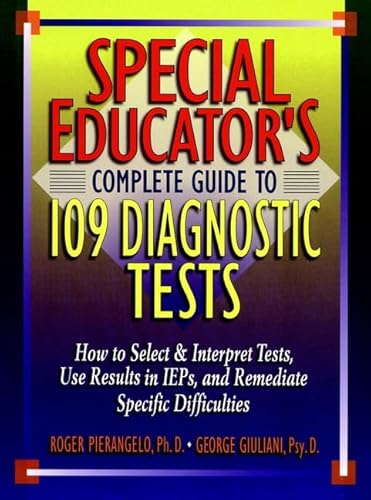
Synopsis
For anyone involved in the special education process, here is a comprehensive practical guide to the most frequently used and helpful tests for diagnosing suspected disabilities of all kings intellectual, perceptual, language, achievement, psychosocial and social maturity from the early childhood years through adolescence.
"synopsis" may belong to another edition of this title.
About the Author
Dr. Roger Pierangelo has over 25 years of experience as a regular classroom teacher, school psychologist in the Herricks Public School system in New Hyde Park, NY, administrator of special education programs, full professor in the graduate special education department at Long Island University, private practitioner in psychology, member of committees on Special Education, evaluator for the New York State Education Department, director of a private clinic, and consultant to numerous private and public schools, PTA and SEPTA groups.
Dr. George A. Giuliani is a full-time Assistant Professor at St. Joseph's College in the Psychology department. Dr. Giuliani earned his B.A. from the College of the Holy Cross, M.S. from St. John's University, J.D. from City University of New York Law School, and Psy.D. (Doctor of Psychology) from Rutgers University? The Graduate School of Applied and Professional Psychology. Besides college teaching, Dr. Giuliani is involved in Early Intervention for children with special needs and is a consultant for school districts and early childhood agencies. Dr. Giuliani has provided numerous workshops for parents and teachers on a variety of psychological and educational topics. Dr. Giuliani is a member of the New York Association of School Psychologists and the National Association of School Psychologists.
From the Back Cover
For anyone involved in the special education process, here is a comprehensive practical guide to the most frequently used and helpful tests for diagnosing suspected disabilities of all kinds — intellectual, perceptual, language, achievement, psychosocial and social maturity — from the early childhood years through adolescence.
You'll find detailed information on the make-up and purpose of each of 109 different tests, including subtests, scoring diagnostic patterns if any and specific strengths and weaknesses, all conveniently organized into the following sections:
- Wechsler Scales of Intelligence. This section covers the three most commonly used individual intelligence tests in education, which measure a variety of intellectual areas and compute a Verbal Performance and Full-Scale IQ.
- Intellectual Assessment Measures. Nine different tests measuring skills such as perceptual organization, processing speed, and long and short term memory skills are described here, including the Stanford-Binet Intelligence Scale, Kaufman Assessment Battery for Children, Columbia Mental Maturity Scales, Slosson Intelligence Test-Revised, and five others.
- Achievement Assessment Measures. 31 measures of reading, spelling, writing, and math achievement are covered, including tests such as the Gray Oral Reading Test-3, Woodcock Reading Mastery Tests-R, Test of Early Written Language-2, Test of Written Spelling-3, Key Math-R, and Wide Range Achievement-3.
- Perceptual Measures. The 14 tests in this section help diagnose process and modality strengths and weaknesses and include measures like the Bender Visual Motor Gestalt Test, Test of Auditory Perceptual Skills- R, and the Woodcock Johnson Psychoeducational Battery-R.
- Language, Psychological & Social and Adaptive Measures. This section describes 25 tests in the areas of language, behavior, emotional and social development, such as the Peaboy Picture Vocabulary Test-3, Conners' Parent and Teacher Rating Scales, and Vineland Adaptive Behavior Scale.
- Early Childhood, Hearing Impaired, Occupational & Physical Therapy, and Bilingual Tests. The 29 tests in this section are concerned with a variety of potential disabilities and include measures such as the Denver Developmental Screening Test-R, Carolina Picture Vocabulary Test for Deaf and Hearing Impaired, Purdue Perceptual Motor Survey, and ESL Literacy Scale.
In addition, the Guide thoroughly covers the various stages of evaluation, interpretation, diagnosis, prescription, and remediation and offer up-to-date guidance on gathering information, the parents' role in the assessment process, understanding children's behavior during testing, writing and developing IEPs, and implementing remediation techniques in the classroom.
The valuable appendices at the end of the Guide give you the names, addresses, phone and fax numbers of test publishers... test reference guide by category and by name...a glossary of test & measurement, special education, psychological, and occupational therapy terms...and special education abbreviations.
As the authors point out, "With the proper tests and their proper interpretation, many problems exhibited by students with special needs can be more rapidly and appropriately addressed. As with any event, early diagnosis and intervention can mean all the difference in an individual's life."
Excerpt. © Reprinted by permission. All rights reserved.
ABOUT THIS GUIDE Special Educator's Complete Guide to 109 Diagnostic Tests has been developed to provide any individual involved in the special education process with a comprehensive overview of the most frequently used tests for diagnosing suspected disabilities-including intelligence, perception, and language to achievement, psycho/social behavior, and social maturity-from the early childhood years to adolescence.
Filled with practical tools, information, and suggestions, the Guide thoroughly covers the various stages of evaluation, interpretation, diagnosis, prescription, and remediation for those unfamiliar with this process. In addition, it offers up-to-date guidance on gathering information, the parents' role during the assessment process, understanding a subject's behavior during testing, writing and developing IEPs, and implementing remediation techniques in the classroom.
Furthermore, the Guide contains the following test information designed to assist readers in selecting and understanding the wide range of tests available to them today:
Thorough explanations of the most commonly used diagnostic tests
In-depth coverage of the areas measured by each test
Easy-to-understand interpretation of test patterns for commonly used measures
Diagnostic categories frequently exhibited by test patterns
Strengths and weaknesses of each test
How results/scores are evaluated for each test
Helpful and Unique Features
Most current books on test information do not deal with the practical, day-to-day needs of the special education teacher as a diagnostician. They either explain the tests or cite statistical information, yet rarely include information on what scores mean or how to utilize their results.
The most commonly used measures found in the Guide offer teachers everything necessary to go from interpretation to remediation in one book. All 14 sections of the Guide have been designed to make readers more secure and aware about the often overwhelming process of special education testing and interpretation.
Following are several additional features:
Developmental, step-by-step approach takes readers through a variety of topics and procedures necessary for a realistic, complete awareness of children with disabilities.
Easy-to-read format contains a wealth of information and proven suggestions taken from the authors' extensive experiences.
Material is presented in such a way as to help readers utilize its content to provide students with the most appropriate education available in the least restrictive environment.
An overview of the issues associated with assessing students who are culturally or linguistically diverse is presented.
Charts and tables help clarify often confusing topics.
Useful information can be applied immediately to the various experiences that teachers encounter in the classroom.
Thorough appendices contain tests organized by category (intelligence, perception, achievement, etc.) and also alphabetically, a list of test publishers with their addresses, phone and fax numbers, a complete glossary of testing terms, and references to readings on assessment.
In Closing
From our experiences, we know that educational diagnosticians and teachers need assistance in understanding the etiology (cause), nature, and meaning of the vast amount of diagnostic material available to them. With the proper tests and the proper interpretation, many problems exhibited by students with special needs can be more rapidly and appropriately addressed. As with any event, early diagnosis and intervention can mean all the difference in an individual's life. Roger Pierangelo & George Giuliani
"About this title" may belong to another edition of this title.
Search results for Special Educator's Complete Guide to 109 Diagnostic...

Seller Image
Special Educator's Complete Guide to 109 Diagnostic Tests
Seller: Reliant Bookstore, El Dorado, KS, U.S.A.
Seller rating 5 out of 5 stars

Condition: good. This book is in good condition with very minimal damage. Pages may have minimal notes or highlighting. Cover image on the book may vary from photo. Ships out quickly in a secure plastic mailer. Seller Inventory # RDV.087628893X.G
Seller Image
Special Educator's Complete Guide to 109 Diagnostic Tests
Seller: Greenworld Books, Arlington, TX, U.S.A.
Seller rating 5 out of 5 stars
Condition: good. Fast Free Shipping â" Good condition. It may show normal signs of use, such as light writing, highlighting, or library markings, but all pages are intact and the book is fully readable. A solid, complete copy that's ready to enjoy. Seller Inventory # GWV.087628893X.G
Stock Image
Special Educator's Complete Guide to 109 Diagnostic Tests
Seller: ThriftBooks-Atlanta, AUSTELL, GA, U.S.A.
Seller rating 5 out of 5 stars
Paperback. Condition: Good. No Jacket. Pages can have notes/highlighting. Spine may show signs of wear. ~ ThriftBooks: Read More, Spend Less. Seller Inventory # G087628893XI3N00
Stock Image
Special Educator's Complete Guide to 109 Diagnostic Tests : How to Select and Interpret Tests, Use Results in IEPs and Remediate Specific Difficulties
Published by
Wiley & Sons, Incorporated, John, 1998
ISBN 10: 087628893X
ISBN 13: 9780876288931
Used
Softcover
Seller: Better World Books, Mishawaka, IN, U.S.A.
Seller rating 5 out of 5 stars
Condition: Good. Former library copy. Pages intact with minimal writing/highlighting. The binding may be loose and creased. Dust jackets/supplements are not included. Includes library markings. Stock photo provided. Product includes identifying sticker. Better World Books: Buy Books. Do Good. Seller Inventory # 6392301-6
Stock Image
Special Educator's Complete Guide to 109 Diagnostic Tests : How to Select and Interpret Tests, Use Results in IEPs and Remediate Specific Difficulties
Published by
Wiley & Sons, Incorporated, John, 1998
ISBN 10: 087628893X
ISBN 13: 9780876288931
Used
Softcover
Seller: Better World Books, Mishawaka, IN, U.S.A.
Seller rating 5 out of 5 stars
Condition: Good. Pages intact with minimal writing/highlighting. The binding may be loose and creased. Dust jackets/supplements are not included. Stock photo provided. Product includes identifying sticker. Better World Books: Buy Books. Do Good. Seller Inventory # 1110120-6
Stock Image
Special Educator's Complete Guide to 109 Diagnostic Tests
Published by
Jossey-Bass (edition 1), 2005
ISBN 10: 087628893X
ISBN 13: 9780876288931
Used
Paperback
Seller: BooksRun, Philadelphia, PA, U.S.A.
Seller rating 5 out of 5 stars
Paperback. Condition: Very Good. 1. It's a well-cared-for item that has seen limited use. The item may show minor signs of wear. All the text is legible, with all pages included. It may have slight markings and/or highlighting. Seller Inventory # 087628893X-11-18
Seller Image
Special Educator's Complete Guide to 109 Diagnostic Tests
Seller: Goodbookscafe, Macon, GA, U.S.A.
Seller rating 5 out of 5 stars
Condition: very_good. Used with minimal wear, no writing or markings, corners maybe bent, few crease lines. Seller Inventory # MGV.087628893X.VG
Stock Image
Special Educator's Complete Guide to 109 Diagnostic Tests
Published by
Jossey-Bass, 2005
ISBN 10: 087628893X
ISBN 13: 9780876288931
New
Soft cover
First Edition
Seller: Novelco Books, Davidson, NC, U.S.A.
Seller rating 4 out of 5 stars

Soft cover. Condition: New. 1st Edition. Seller Inventory # NVB162
Stock Image
Special Educator's Complete Guide to 109 Diagnostic Tests
Seller: SHIMEDIA, Brooklyn, NY, U.S.A.
Seller rating 4 out of 5 stars
Condition: New. Satisfaction Guaranteed or your money back. Seller Inventory # 087628893X
Stock Image
Special Educator's Complete Guide to 109 Diagnostic Tests
Seller: BennettBooksLtd, Los Angeles, CA, U.S.A.
Seller rating 5 out of 5 stars
paperback. Condition: New. In shrink wrap. Looks like an interesting title! Seller Inventory # Q-087628893x