
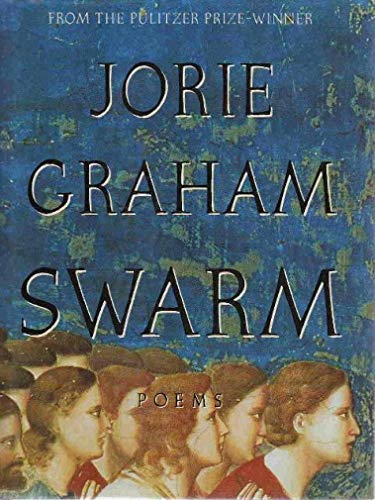
Synopsis
With Swarm, her first new collection since The Errancy, Pulitzer Prize-winner Jorie Graham has given us a book-length sequence of poems stunning in its sober encounter with destiny, eros, and law. The narrator, at times almost vertigo-ridden by the problem of who is addressed-whom there still is to address-negotiates passionately with those powers human beings feel themselves to be "underneath": God, matter, law, custom, the force of love.
To "swarm" is to leave an originating organism'a hive, a home country, a stable sense of one's body, a stable hierarchy of values -- in an attempt, by coming apart, to found a new form that will hold. The Roman Empire, its distillation in the Forum's remains, the Romantic imagination of that buried past ("underneath"), as well as the collapse of the erotic border between lovers' bodies, are persistent metaphors for the destabilization and reformation of the idea and sensation of personhood.
The "first" person and "enjambment" are characters in this book, as are the fragment, the gap, the sentence. And everywhere lovers seek to find the borders that must break as well as those that must at all cost hold. Clytemnestra await-ing Agamemnon, Calypso veiling Ulysses, Daphne accepting Apollo -- a variety of mythological characters reappear here, ea-ger to plead their stories into sense, desper-ate for some insight into the buried justice of natural law.
"synopsis" may belong to another edition of this title.
About the Author
Jorie Graham is the author of fourteen collections of poems. She has been widely translated and has been the recipient of numerous awards, among them the Pulitzer Prize, the Forward Prize, the Los Angeles Times Book Award, and the International Nonino Prize. She lives in Massachusetts and teaches at Harvard University.
Reviews
If Graham's last book, The Errancy (1997), was a self-consciously Eliotic attempt to find moral structure that came up frustrated, then Swarm is the plague that follows. And if the previous book was watched over by the many angels of its titles, this seventh collection is presided over by the peculiar Western fusion of classical drama and a Judeo-Christian God: "At the front end, the meanwhile: God's laughter./ Are you still waiting for the true story? (God's laughter)/ The difference between what is and could be? (God's laughter)/ In this dance the people do not move." The flap copy and end notes together indicate that the collection is to be read as a book-length sequence of poems, one which calls on Eurydice, Calypso, Daphne and Eve as masks through which the poet again questions the possibility of morality, this time coming down firmly on the side of fate in the face of law: "To be told best not to touch./ To touch./ For the farewell of it./ And the further replication./ And the atom/ saturated with situation." The pun on "atom," along with a forbidding quality to many of the love poems here, make the book feel like an elaborate justification for the abandonment of an unnamed Eden or a significant other. Numerous poems are titled "Underneath" and interrogate, with Graham's characteristic energy, various forms of self-suppression and dissolution--through text, sex, violence and history. Graham is such a good writer that she at times attains the harsh, Sophoclean abstraction of the "I" she seems to be aiming for, but she can't quite make the indiscretions of that "I" take on the cumulative force of the figures she uses to back it. Readers will revel in Graham's sharply fragmentary powers of description, but the stakes are high enough here that some will wonder whether the poems' emotional permutations spring from a desire for truth or for self-validation. Poetry Book Club Main Selection. (Jan.)
Copyright 1999 Reed Business Information, Inc.
Swarm marks a stylistic change for Graham, whose work over the last two decades has garnered a Pulitzer Prize, favorable comparisons to Wallace Stevens, and other accolades. While her concerns remain metaphysical and ontological and her perspective still unapologetically solipsistic, the richly expansive lines that characterized her poems as recently as The Errancy (LJ 6/15/97) have given way to a fragmented minimalism, to feints and half-steps constricted by the imperative mood ("Interrupt belief./ Write downhope./ Move lips in sleep./ Widen"), broken by parentheticals and extended spacings, thinned by abstraction, or muted with a self-conscious reverence toward an unnamed (God? the poet herself?) "you." These pieces are nothing if not prayers, but prayers meant to echo only within the chancel of the subject's mind, so that to read them is to feel like an eavesdropper. In her notes, Graham acknowledges the influence of experimental poets like Susan Howe and Michael Palmer, but her appropriation of postmodern techniques creates a surface out of synch with the spiritual--almost quaintly Miltonic--ambitions glimmering at the center of these poems.
-Fred Muratori, Cornell Univ. Lib., Ithaca, NY
Copyright 2000 Reed Business Information, Inc.
Excerpt. © Reprinted by permission. All rights reserved.
from The Reformation Journal
The wisdom I have heretofore trusted was cowardice, the leaper.
I am not lying. There is no lying in me,
I surrender myself like the sinking ship,
a burning wreck from which the depths will get theirs when the heights have gotten theirs.
My throat is an open grave. I hide my face.
I have reduced all to lower case.
I have crossed out passages.
I have severely trimmed and cleared.
Locations are omitted.
Uncertain readings are inserted silently.
Abbreviations silently expanded.
A "he" referring to God may be capitalized or not.
(is crying now) show me
is crying now (what's wrong)
in a strange tree of atoms of
too few more no wonder
Give me the glassy ripeness
Give me the glassy ripeness in failure
Give me the atom laying its question at the bottom of nature
Send word Clear fields
Make formal event Walk
Turn back
Reduce all to lower case Have reduced all
Cross out passages Have inserted silently
is there a name for?
glassy ripeness
in failure
born and raised
and you?
(go back) (need more)
having lived it leaves it possible
fear lamentation shame ruin believe me
explain given to
explain born of
Absence is odious to God
I'm asking
Unseen unseen the treasure unperceived
Unless you compare the treasure may be lost
Oh my beloved I'm asking
More atoms, more days, the noise of the sparrows, of the universals
Yet colder here now than in
the atom still there at the bottom of nature
that we be founded on infinite smallness
which occasions incorruption or immortality"
(incorruption because already as little as it can be)
(escape square, wasted square, safety square, hopeless square)
"to all except anguish the mind soon adjusts"
have reduced, have trimmed, have cleared, have omitted
have abbreviations silently expanded
to what avail
explain asks to be followed
explain remains to be seen
"About this title" may belong to another edition of this title.
Other Popular Editions of the Same Title

Search results for Swarm: Poems

Stock Image
Swarm : Poems
Published by
HarperCollins Publishers, 1999
ISBN 10: 0880016957
ISBN 13: 9780880016957
Used
Hardcover
First Edition
Seller: Better World Books, Mishawaka, IN, U.S.A.
Seller rating 5 out of 5 stars

Condition: Good. 1st ed. Former library copy. Pages intact with minimal writing/highlighting. The binding may be loose and creased. Dust jackets/supplements are not included. Includes library markings. Stock photo provided. Product includes identifying sticker. Better World Books: Buy Books. Do Good. Seller Inventory # GRP102318947
Stock Image
Swarm: Poems
Seller: World of Books (was SecondSale), Montgomery, IL, U.S.A.
Seller rating 5 out of 5 stars
Condition: Good. Item in good condition. Textbooks may not include supplemental items i.e. CDs, access codes etc. Seller Inventory # 00104057090
Stock Image
Swarm: Poems
Seller: St Vincent de Paul of Lane County, Eugene, OR, U.S.A.
Seller rating 5 out of 5 stars
Condition: Good. FORMER LIBRARY COPY. Former Library book. Hardcover This item shows wear from consistent use but remains in good readable condition. It may have marks on or in it, and may show other signs of previous use or shelf wear. May have minor creases or signs of wear on dust jacket. Packed with care, shipped promptly. Seller Inventory # G-02-4327
Stock Image
Swarm: Poems
Seller: ThriftBooks-Dallas, Dallas, TX, U.S.A.
Seller rating 5 out of 5 stars
Hardcover. Condition: Very Good. No Jacket. Former library book; May have limited writing in cover pages. Pages are unmarked. ~ ThriftBooks: Read More, Spend Less. Seller Inventory # G0880016957I4N10
Stock Image
Swarm: Poems
Seller: ThriftBooks-Atlanta, AUSTELL, GA, U.S.A.
Seller rating 5 out of 5 stars
Hardcover. Condition: Very Good. No Jacket. May have limited writing in cover pages. Pages are unmarked. ~ ThriftBooks: Read More, Spend Less. Seller Inventory # G0880016957I4N00
Stock Image
Swarm: Poems
Seller: ThriftBooks-Reno, Reno, NV, U.S.A.
Seller rating 5 out of 5 stars
Hardcover. Condition: Very Good. No Jacket. Former library book; May have limited writing in cover pages. Pages are unmarked. ~ ThriftBooks: Read More, Spend Less. Seller Inventory # G0880016957I4N10
Stock Image
Swarm: Poems
Seller: ThriftBooks-Atlanta, AUSTELL, GA, U.S.A.
Seller rating 5 out of 5 stars
Hardcover. Condition: Good. No Jacket. Pages can have notes/highlighting. Spine may show signs of wear. ~ ThriftBooks: Read More, Spend Less. Seller Inventory # G0880016957I3N00
Stock Image
Swarm: Poems
Seller: ThriftBooks-Atlanta, AUSTELL, GA, U.S.A.
Seller rating 5 out of 5 stars
Hardcover. Condition: Very Good. No Jacket. Former library book; May have limited writing in cover pages. Pages are unmarked. ~ ThriftBooks: Read More, Spend Less. Seller Inventory # G0880016957I4N10
Stock Image
Swarm
Seller: Abacus Bookshop, Pittsford, NY, U.S.A.
Seller rating 5 out of 5 stars
hardcover. Condition: Fine copy in fine dust jacket. 2nd prt. 8vo, 114 pp., Remainder mark lower edge. Seller Inventory # 019823
Stock Image
Swarm: Poems
Seller: Montana Book Company, Fond du Lac, WI, U.S.A.
Seller rating 5 out of 5 stars
Cloth. Condition: Near Fine. 114 pp. Tightly bound. Corners not bumped. Text is free of markings. No ownership markings. First Edition / First Printing 10,9,8,7,6,5,4,3,2,1. Seller Inventory # 067395