
Items related to Adult ADD: A Reader Friendly Guide to Identifying,...
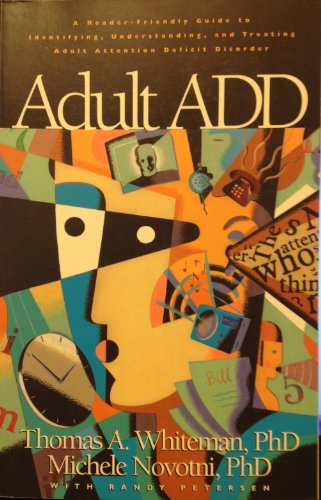
Adult ADD: A Reader Friendly Guide to Identifying, Understanding, and Treating Adult Attention Deficit Disorder - Softcover
Synopsis
WHY DON'T YOU THINK BEFORE YOU ACT?
ARE YOU EVEN LISTENING?
CAN'T YOU JUST RELAX AND TAKE IT EASY?
These are the kinds of comments and criticisms that adults with Attention Deficit Disorder hear again and again. So what's the problem? The truth is, inattentiveness, unfinished projects, inconsistency, impulsivity, and short attention spans are not chosen behaviors designed to drive others crazy. They're common symptoms of a much greater problem-Attention Deficit Disorder (ADD), from which as many as 28 million adults may suffer.
If these behaviors describe you or someone you know, Adult ADD can help. It identifies, explains, and dispels the myths surrounding this disorder. Adult ADD also examines the symptoms of ADD and gives a reasonable method for diagnosis, while emphasizing the importance of being professionally tested. It explores a variety of treatments and provides practical help for overcoming ADD difficulties.
Written especially for adults who suffer from ADD, this book works with the reader-providing highlighted summaries and true stories to illustrate the information. A valuable resource, Adult ADD also brings a better understanding of adult ADD to professional caregivers and the families, friends, and coworkers of ADD sufferers.
"ADD is the most over-and under-diagnosed mental issue today. To clarify this dilemma, Dr. Tom Whiteman and Dr. Michele Novotni have combined their insights to produce a work that walks one through the gaps from the identification to the treatment of ADD by presenting specific and timely self-help ideas."-Dr. Richard Fowler, author of Honey, Are You Listening? How Attention Deficit Disorder Could Be Affecting Your Marriage
"synopsis" may belong to another edition of this title.
About the Author
THOMAS A. WHITEMAN, Ph.D., is the president of Fresh Start seminars, a non-profit organization which conducts over 50 divorce recovery seminars a year for both adults and children throughout the United States. He is a licensed psychologist and the founder and president of Life Counseling Services. He has authored or co-authored several books including Victim of Love? and The Marriage Mender (both Pinon Press), and The Complete Stress Management Workbook (Zondervan). He earned his degree from Bryn Mawr College and lives with his wife and three children in Paoli, Pennsylvania.
MICHELE NOVOTNI, Ph.D., is a psychologist in private practice and a frequent speaker on the topic of adult ADD. She has more than 20 years experience in dealing with both child and adult ADD. Both her son and her father have ADD.
Reviews
It's an explanation, not an excuse, say clinical psychologists Whiteman and Michele Novotini about adult attention deficit disorder (ADD), a problem that has recently received extensive coverage and almost faddish acceptance. Although the authors acknowledge the reality of the neurobiological disorder and the mayhem it can cause in sufferers' lives, they feel that those with ADD must take responsibility for the disorder that plagues their work, relationships, learning, and self-esteem by seeking proper diagnosis (a complex process) and treatment (medication, counseling, behavior modification). To that end, concise, punchy chapters cover the subject with helpful factual information, alternating with identifiable personal stories. The authors move clearly and logically through their discussion, highlighting the process, professionals, and problems involved. Drawing on their personal as well as professional knowledge of ADD, they suggest specific ways to deal with organization, learning, relationships, and work. In their lucid, concrete guidance (citing many leading authorities and resource organizations), the authors see a positive attitude, acceptance, and action as the best way to overcome and live more successfully with the disorder. Irene Wood
"About this title" may belong to another edition of this title.
Search results for Adult ADD: A Reader Friendly Guide to Identifying,...

Stock Image
Adult A.D.D.: A Reader Friendl
Seller: World of Books (was SecondSale), Montgomery, IL, U.S.A.
Seller rating 5 out of 5 stars

Condition: Very Good. Item in very good condition! Textbooks may not include supplemental items i.e. CDs, access codes etc. Seller Inventory # 00102639062
Stock Image
Adult A.D.D.: A Reader Friendl
Seller: World of Books (was SecondSale), Montgomery, IL, U.S.A.
Seller rating 5 out of 5 stars
Condition: Good. Item in good condition. Textbooks may not include supplemental items i.e. CDs, access codes etc. Seller Inventory # 00091657200
Stock Image
Adult A.D.D.: A Reader Friendl
Seller: World of Books (was SecondSale), Montgomery, IL, U.S.A.
Seller rating 5 out of 5 stars
Condition: Acceptable. Item in acceptable condition! Textbooks may not include supplemental items i.e. CDs, access codes etc. Seller Inventory # 00102623246
Stock Image
Adult ADD: A Reader Friendly Guide to Identifying, Understanding, and Treating Adult Attention Deficit Disorder
Published by
Pinon Pr (edition First Edition), 1995
ISBN 10: 0891099069
ISBN 13: 9780891099062
Used
Paperback
First Edition
Seller: BooksRun, Philadelphia, PA, U.S.A.
Seller rating 5 out of 5 stars
Paperback. Condition: Very Good. First Edition. It's a well-cared-for item that has seen limited use. The item may show minor signs of wear. All the text is legible, with all pages included. It may have slight markings and/or highlighting. Seller Inventory # 0891099069-8-1
Stock Image
Adult ADD: A Reader Friendly Guide to Identifying, Understanding, and Treating Adult Attention Deficit Disorder
Seller: Wonder Book, Frederick, MD, U.S.A.
Seller rating 5 out of 5 stars
Condition: Very Good. Very Good condition. A copy that may have a few cosmetic defects. May also contain light spine creasing or a few markings such as an owner's name, short gifter's inscription or light stamp. Seller Inventory # E10K-00920
Stock Image
Adult ADD: A Reader Friendly Guide to Identifying, Understanding, and Treating Adult Attention Deficit Disorder
Seller: HPB-Ruby, Dallas, TX, U.S.A.
Seller rating 5 out of 5 stars
paperback. Condition: Very Good. Connecting readers with great books since 1972! Used books may not include companion materials, and may have some shelf wear or limited writing. We ship orders daily and Customer Service is our top priority! Seller Inventory # S_427709981
Stock Image
Adult Add: A Reader Friendly Guide to Identifying, Understanding, and Treating Adult Attention Deficit Disorder
Seller: World of Books Inc, Montgomery, IL, U.S.A.
Seller rating 4 out of 5 stars

Paperback. Condition: Very Good. Seller Inventory # CIN0891099069VG
Stock Image
Adult Add: A Reader Friendly Guide to Identifying, Understanding, and Treating Adult Attention Deficit Disorder
Seller: World of Books Inc, Montgomery, IL, U.S.A.
Seller rating 4 out of 5 stars
Paperback. Condition: Good. Seller Inventory # CIN0891099069G
Stock Image
Adult Add: A Reader Friendly Guide to Identifying, Understanding, and Treating Adult Attention Deficit Disorder
Seller: World of Books Inc, Montgomery, IL, U.S.A.
Seller rating 4 out of 5 stars
Paperback. Condition: Fair. Seller Inventory # CIN0891099069A
Stock Image
Adult ADD: A Reader Friendly Guide to Identifying, Understanding, and Treating Adult Attention Deficit Disorder
Seller: ThriftBooks-Dallas, Dallas, TX, U.S.A.
Seller rating 5 out of 5 stars
Paperback. Condition: Very Good. No Jacket. May have limited writing in cover pages. Pages are unmarked. ~ ThriftBooks: Read More, Spend Less. Seller Inventory # G0891099069I4N00