
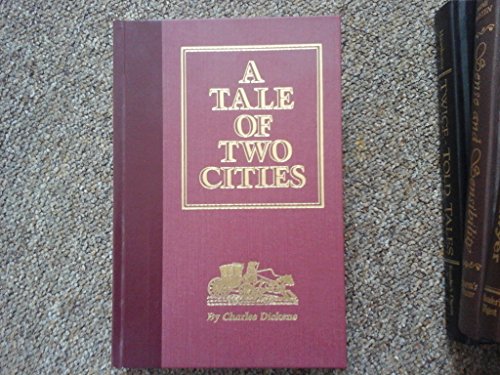
Items related to A Tale of Two Cities (The World's Best Reading)
Synopsis
It was the time of the French Revolution — a time of great change and great danger. It was a time when injustice was met by a lust for vengeance, and rarely was a distinction made between the innocent and the guilty. Against this tumultuous historical backdrop, Dickens' great story of unsurpassed adventure and courage unfolds. Unjustly imprisoned for 18 years in the Bastille, Dr. Alexandre Manette is reunited with his daughter, Lucie, and safely transported from France to England. It would seem that they could take up the threads of their lives in peace. As fate would have it though, the pair are summoned to the Old Bailey to testify against a young Frenchman — Charles Darnay — falsely accused of treason. Strangely enough, Darnay bears an uncanny resemblance to another man in the courtroom, the dissolute lawyer's clerk Sydney Carton. It is a coincidence that saves Darnay from certain doom more than once. Brilliantly plotted, the novel is rich in drama, romance, and heroics that culminate in a daring prison escape in the shadow of the guillotine. “It was the best of times, it was the worst of times”, those days in which your English Literature professor ordered you to read “A Tale of Two Cities” by Charles Dickens. You were immediately confounded by the perplexity of the story and confused by the language of the times. In your despair, you struggled, endeavored and persevered to reach the conclusion of the classic novel. Having satisfactorily completed the requirements of that difficult semester, you vowed to never again read classic English literature. As the years accumulated, you garnered wisdom and spirituality as you aged and you gathered far greater literary acumen. Your mind was transformed and you began to yearn for the great stories that could only be told by the true masters. Anon, you found yourself immersed in the incredible classic writings of Charles Dickens. For no one could so completely transport you to the mean filthy streets of Oliver Twist’s London or the horror and dread of The Reign of Terror in that unfortunate tale of London and Paris in the year one thousand seven hundred and ninety-three. No other writer could place you so deeply into the mind of a tyrannical boss such as Ebenezer Scrooge or imbue the viciousness of a violent revolutionary the likes of Madame Defarge. Contemporary writers only wish they had the amazing ability to create magnificent unlikely heroes and fantastic characters whose flame of eternal hope burned against an all consuming darkness.
"synopsis" may belong to another edition of this title.
About the Author
After a childhood blighted by poverty, commercial success came early to Charles Dickens (1812-70). By the age of 24, he was an international sensation whose new novels were eagerly anticipated. Two centuries later, Dickens' popularity endures as readers revel in the warm humanity and rollicking humor of his tales of self-discovery.
From the Back Cover
It was the time of the French Revolution a time of great change and great danger. It was a time when injustice was met by a lust for vengeance, and rarely was a distinction made between the innocent and the guilty. Against this tumultuous historical backdrop, Dickens' great story of unsurpassed adventure and courage unfolds.
Unjustly imprisoned for 18 years in the Bastille, Dr. Alexandre Manette is reunited with his daughter, Lucie, and safely transported from France to England. It would seem that they could take up the threads of their lives in peace. As fate would have it though, the pair are summoned to the Old Bailey to testify against a young Frenchman Charles Darnay falsely accused of treason. Strangely enough, Darnay bears an uncanny resemblance to another man in the courtroom, the dissolute lawyer's clerk Sydney Carton.
Brilliantly plotted, the novel is rich in drama, romance, and heroics that culminate in a daring prison escape in the shadow of the guillotine.
From the Inside Flap
With his sublime parting words, "It is a far, far better thing that I do, than I have ever done..." Sidney Carton joins that exhalted group of Dickensian characters who have earned a permanent place in the popular literary imagination. His dramatic story, set against the volcanic fury of the French Revolution and pervaded by the ominous rumble of the death carts trundling toward the guillotine, is the heart-stirring tale of a heroic soul in an age gone mad. A masterful pageant of idealism, love, and adventure -- in a Paris bursting with revolutionary frenzy, and a London alive with anxious anticipation -- "A Tale of Two Cities is one of Dickens's most energetic and exciting works.
Reviews
Grade 9 Up—Charles Dickens's classic tale of one family's suffering during the French Revolution is brought to life in this audio adaptation. The voice of Audie Award-winning narrator Simon Vance sets the tone for the characters and creates the Dickensesqe mood of the times when the rich and the poor were far apart and no one was exempt from the ensuing wrath during the Revolution. Vance's stone varies from soothing to animated while creating different voices for the characters and using appropriate accents. A bonus feature on the last CD is an e-book in pdf format that can be printed or used as a read-along while listening to the audio. This easily navigated feature would be particularly helpful for struggling readers.—Jeana Actkinson, Bridgeport High School, TX
Copyright © Reed Business Information, a division of Reed Elsevier Inc. All rights reserved.
Anton Lesser reads Dickens's historical romance about a French-English family caught up in the French Revolution in a voice fraught with incipient emotion, acting out roles with intensity but without becoming tiresome. A one-man ensemble, he distinguishes characters clearly yet effortlessly, without crudely broad strokes. He renders moments of quiet emotion with delicacy, perhaps even more effectively than big emotions, though he gives rioting Parisians their due. He manages, almost without faltering, to keep the novel vivid and intimate, pressing it into the listener's heart and mind, though at times Dickens's sentimentality and melodrama are hard to take. This is as fine a performance as one can reasonably expect from a narrator. W.M. Winner of AudioFile Earphones Award, 2006 Audie Award Finalist © AudioFile 2006, Portland, Maine-- Copyright © AudioFile, Portland, Maine
Excerpt. © Reprinted by permission. All rights reserved.
From Gillen D'Arcy Wood's Introduction to A Tale of Two Cities
When Dickens expressed to A. H. Layard his fear of revolution in Britain in 1855, he only echoed many dozens of commentators over the preceding six decades, who wondered why mob violence could not simply cross the English Channel and turn the streets of London into a bloodbath of class retribution. The textbook historian's answer points to the bloodless coup of 1688, the so-called Glorious Revolution, which saw the tyrant James II forced into exile, and William and Mary inaugurate a form of managerial rule in Britain, a constitutional, "mixed" monarchy where many absolute powers of the Crown were ceded to Parliament. With the consolidation of that legislative body, however unrepresentative, Britain's nobility insured itself against the apocalyptic disaster that was to befall their French counterparts. The divergent tale of the two cities thus begins in 1688.
But as a novelist, Dickens, who loved Paris and traveled there often, offers more intuitive, closely observed reasons for the untranslatable quality of that city's Revolution. In an 1856 article for his weekly magazine, Household Words, he calls Paris "the Moon," and describes a culture of spectacle implicitly alien to his London readers. On the grand Parisian boulevards, Dickens watches the upper classes put on "a mighty show." Later, he takes coffee and a cigar at one of Paris's ubiquitous cafés, and participates in a kind of collective voyeurism unfamiliar to the English capital:
The place from which the shop front has been taken makes a gay proscenium; as I sit and smoke, the street becomes a stage, with an endless procession of lively actors crossing and re-crossing. Women with children, carts and coaches, men on horseback, soldiers, water-carriers with their pails, family groups, more soldiers, lounging exquisites, more family groups (coming past, flushed, a little late for the play). . . . We are all amused, sitting seeing the traffic in the street, and the traffic in the street is in its turn amused by seeing us ("Railway Dreaming," pp. 373-374). Paris is a society of spectacle, a glamorous outdoor "stage" where citizens are both actors and audience. Later in the article, however, Dickens describes a more sinister aspect of this culture of display when he is jostled by the crowds at the Paris morgue, whose "bodies lie on inclined planes within a great glass window, as though Holbein should represent Death, in his grim Dance, keeping a shop, and displaying his goods like a Regent Street or boulevard linen-draper" (p. 375). Dickens is unnerved here, as he was at Horsemonger Lane, by a society that places no restraints on visibility, even to preserve the solemnity of the dead.It is a short step in Dickens's imagination from the peep-show atmosphere of the Paris morgue in 1856 to the ritual slaughter in the Place de la Révolution during Robespierre's "Reign of Terror" of 1793-1794. A Tale of Two Cities shows the dark side of urban theatricality, that a public appetite for glamorous "show" can rapidly degenerate into an insatiable hunger for "scenes of horror and demoralization." The essentially theatrical quality of Parisian social life produces a theatrical Revolution. At the revolutionary "trials" at the Hall of Examination, Madame Defarge, we are told, "clapped her hands as at a play." There is something uniquely Parisian, too, in the spectacle of the liberation of the Bastille (with only seven prisoners inside) and in the rituals of the Terror itself, as the tumbrils roll daily to the guillotine watched by knitting ladies, who take up seats in their favored spots each morning as if at a sideshow or circus. As Dickens describes it, even the victims of the Terror cannot escape the theatrical atmosphere of the proceedings. Among the condemned, "there are some so heedful of their looks that they cast upon the multitude such glances as they have seen in theatres, and in pictures." Contrast this with Charles Darnay, who, on trial for his life earlier in the novel, disdains "the play at the Old Bailey": He "neither flinched from the situation, nor assumed any theatrical air in it." Our hero disappoints us on occasion, but here, by resisting being converted into a spectacle, he defends the most important social principle of the novel: the dignity of the private citizen in the face of the howling mob.
"About this title" may belong to another edition of this title.
Search results for A Tale of Two Cities (The World's Best Reading)

Stock Image
A Tale of Two Cities
Published by
Reader's Digest (Australia) Pty Ltd, 1985
ISBN 10: 0895771799
ISBN 13: 9780895771797
Used
Hardcover
Seller: World of Books (was SecondSale), Montgomery, IL, U.S.A.
Seller rating 5 out of 5 stars

Hardback. Condition: Fair. Hablot Knight Browne (illustrator). Seller Inventory # 00107927087
Stock Image
A Tale of Two Cities (The World's Best Reading)
Published by
The Readers Digest Association, Inc. (edition First Edition), 1984
ISBN 10: 0895771799
ISBN 13: 9780895771797
Used
Hardcover
First Edition
Seller: BooksRun, Philadelphia, PA, U.S.A.
Seller rating 5 out of 5 stars
Hardcover. Condition: Fair. Hablot Knight Browne (illustrator). First Edition. The item might be beaten up but readable. May contain markings or highlighting, as well as stains, bent corners, or any other major defect, but the text is not obscured in any way. Seller Inventory # 0895771799-7-1
Stock Image
A Tale of Two Cities (The World's Best Reading)
Published by
The Readers Digest Association, Inc., 1984
ISBN 10: 0895771799
ISBN 13: 9780895771797
Used
Hardcover
Seller: ThriftBooks-Reno, Reno, NV, U.S.A.
Seller rating 5 out of 5 stars
Hardcover. Condition: Good. No Jacket. Hablot Knight Browne (illustrator). Missing dust jacket; Pages can have notes/highlighting. Spine may show signs of wear. ~ ThriftBooks: Read More, Spend Less. Seller Inventory # G0895771799I3N01
Stock Image
A Tale of Two Cities (The World's Best Reading)
Published by
The Readers Digest Association, Inc., 1984
ISBN 10: 0895771799
ISBN 13: 9780895771797
Used
Hardcover
Seller: ThriftBooks-Phoenix, Phoenix, AZ, U.S.A.
Seller rating 5 out of 5 stars
Hardcover. Condition: Good. No Jacket. Hablot Knight Browne (illustrator). Missing dust jacket; Pages can have notes/highlighting. Spine may show signs of wear. ~ ThriftBooks: Read More, Spend Less. Seller Inventory # G0895771799I3N01
Stock Image
A Tale of Two Cities (The World's Best Reading)
Published by
The Readers Digest Association, Inc., 1984
ISBN 10: 0895771799
ISBN 13: 9780895771797
Used
Hardcover
Seller: ThriftBooks-Dallas, Dallas, TX, U.S.A.
Seller rating 5 out of 5 stars
Hardcover. Condition: Good. No Jacket. Hablot Knight Browne (illustrator). Pages can have notes/highlighting. Spine may show signs of wear. ~ ThriftBooks: Read More, Spend Less. Seller Inventory # G0895771799I3N00
Stock Image
A Tale of Two Cities (The World's Best Reading)
Published by
The Readers Digest Association, Inc., 1984
ISBN 10: 0895771799
ISBN 13: 9780895771797
Used
Hardcover
Seller: ThriftBooks-Atlanta, AUSTELL, GA, U.S.A.
Seller rating 5 out of 5 stars
Hardcover. Condition: Good. No Jacket. Hablot Knight Browne (illustrator). Pages can have notes/highlighting. Spine may show signs of wear. ~ ThriftBooks: Read More, Spend Less. Seller Inventory # G0895771799I3N00
Stock Image
A Tale of Two Cities (The World's Best Reading)
Published by
The Readers Digest Association, Inc., 1984
ISBN 10: 0895771799
ISBN 13: 9780895771797
Used
Hardcover
Seller: ThriftBooks-Atlanta, AUSTELL, GA, U.S.A.
Seller rating 5 out of 5 stars
Hardcover. Condition: Very Good. No Jacket. Hablot Knight Browne (illustrator). Missing dust jacket; May have limited writing in cover pages. Pages are unmarked. ~ ThriftBooks: Read More, Spend Less. Seller Inventory # G0895771799I4N01
Stock Image
A Tale of Two Cities (The World's Best Reading)
Published by
The Readers Digest Association, Inc., 1984
ISBN 10: 0895771799
ISBN 13: 9780895771797
Used
Hardcover
Seller: ThriftBooks-Dallas, Dallas, TX, U.S.A.
Seller rating 5 out of 5 stars
Hardcover. Condition: Very Good. No Jacket. Hablot Knight Browne (illustrator). Missing dust jacket; May have limited writing in cover pages. Pages are unmarked. ~ ThriftBooks: Read More, Spend Less. Seller Inventory # G0895771799I4N01
Stock Image
A Tale of Two Cities (The World's Best Reading)
Published by
The Readers Digest Association, Inc., 1984
ISBN 10: 0895771799
ISBN 13: 9780895771797
Used
Hardcover
Seller: ThriftBooks-Atlanta, AUSTELL, GA, U.S.A.
Seller rating 5 out of 5 stars
Hardcover. Condition: Good. No Jacket. Hablot Knight Browne (illustrator). Missing dust jacket; Pages can have notes/highlighting. Spine may show signs of wear. ~ ThriftBooks: Read More, Spend Less. Seller Inventory # G0895771799I3N01
Stock Image
A Tale of Two Cities (The World's Best Reading)
Published by
The Readers Digest Association, Inc., 1984
ISBN 10: 0895771799
ISBN 13: 9780895771797
Used
Hardcover
Seller: ThriftBooks-Dallas, Dallas, TX, U.S.A.
Seller rating 5 out of 5 stars
Hardcover. Condition: Good. No Jacket. Hablot Knight Browne (illustrator). Missing dust jacket; Pages can have notes/highlighting. Spine may show signs of wear. ~ ThriftBooks: Read More, Spend Less. Seller Inventory # G0895771799I3N01