
Items related to Creating Miracles: Understanding the Experience of...
Synopsis
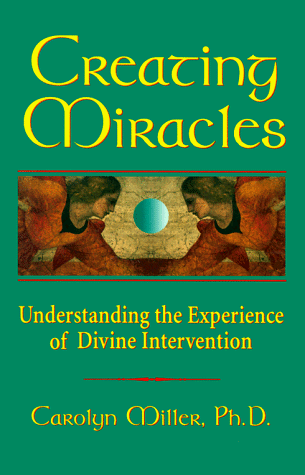
A scientific, unsentimental look at miracles by a research scientist documents dozens of awe-inspiring stories of people who emerged unharmed from extreme danger, includes a method for attracting miraculous experiences, and reaches surprising conclusions. Original. IP.
"synopsis" may belong to another edition of this title.
About the Author
I love a good story, says author and clinical psychologist Dr. Carolyn Miller. Her book Creating Miracles: Understanding the Experience of Divine Intervention, is full of fascinating stories of extraordinary escapes from danger.
Beginning with her own miraculous experience, Dr. Millers remarkable collection of anecdotes started to grow, as people shared with her their unusual, yet strikingly similar incidents. As intriguing as these stories were, Dr. Miller admits, I dont believe that I would have recognized their underlying significance if I had not been a student of spirituality as well as a psychologist.
Carolyn Miller holds a doctorate in experimental psychology with specialization in the neurophysiology of motivation and emotion. A licensed clinical psychologist in California since 1984, Dr. Miller has a thriving practice in Los Angeles.
The New York native received her B.A. in Philosophy from the University of Wisconsin, Madison, and her M.A. in Psychology from the University of South Florida, Tampa. Three years later she received her Ph.D. in Experimental Psychology at the University of South Florida, before moving west and completing her post-doctoral training in clinical psychology at the United States International University in San Diego, California.
Dr. Miller has written and presented papers on topics which vary from obesity to humor, sexual abuse to healing relationships, as well as investigative papers on the subject of miracles. She has also written numerous professional articles and co-authored a book on the psychology of humor, The Antioch Humor Test: Making Sense of Humor.
For more than 15 years, Dr. Miller has taught a broad range of graduate and undergraduate courses in scientific methodology, neurophysiology, statistics, and personality theory. She has helped train hundreds of psychotherapists and supervised dozens of clinical interns.
Carolyn Miller was appointed a member of the Governors Advisory Commission on Drug and Alcohol Abuse in Madison, Wisconsin. Dr. Miller received a General Research Support Grant in 1978 from the University of South Florida School of Medicine, and a research fellowship in 1975-77 from the National Institute of Mental Health. In 1976 she was elected to Sigma Xi: The Scientific Research Society of North America.
Dr. Miller is also, along with her husband, Arnold Weiss, Ph.D., a founding director of the Los Angeles-based Foundation and Institute for the Study of A Course in Miracles, a nonprofit organization dedicated to spiritual psychotherapy and education. She is widely recognized as an expert on miracles. Her lively and entertaining lectures, classes, and workshops help participants actualize their own miracle-working potential.
Excerpt. © Reprinted by permission. All rights reserved.
Discovering Deliverance: I had driven up to the mountains near Los Angeles to enjoy the winter weather. The air in the city was balmy, but as I climbed the Angeles Crest Highway, it got colder. Patches of snow began to appear, and I got out to make snowballs and savor the season.
Back on the road, I was rounding a tight curve when I heard a bang and the car suddenly went out of control. As I pieced things together later, I realized that one of my rear tires had blown out on a turn, just as I was crossing a patch of black ice. I must have been going thirty-five or forty miles per hour.
The car went wild. I was briefly grateful for the fact that there was no one coming from the opposite direction as I skidded across the other lane. However, it was soon clear that my gratitude had been premature. Beyond the lane for oncoming traffic was a narrow scenic overlook area. And beyond that was the edge of a cliff. I was now hurtling sideways across the deserted parking area on a trajectory that would inevitably take my car over the brink.
Its hard to explain the next part, especially since its difficult to see how there could have been time for so many thoughts and reactions. All I can say is that time seemed to expand.
I remember being surprised by the fact that I was about to die. Hoping that I was mistaken, I looked the situation over again, but it was clear that I had more than enough momentum to skid over the edge. . . . I wondered what dying was going to be like. Maybe I would suffer. Maybe the car would burst into flames the way cars do in the movies when they go over cliffs. But then I thought, It wont matter. Ill be out of my body by then. And another part piped up with, Oh yeah! Like you know all about it!
I vaguely regretted the fact that I had to die now. I wished that there were something I could do to get out of it. And then another part of my mind said, Well, why dont you see if there is?
So I searched my memory to see if there was anything I knew that might be useful. But all I could come up with was the idea that when you are skidding, you are supposed to steer into the skid. Had I read that in the manual for the driving test? I wasnt sure of the source, but I did recall that that was what experts say to do.
Well, thats of no use here, I told myself. Im already really close to the edge. I turn the wheels in that direction, Ill just go over sooner.
But then I thought, Well, what have you got to lose by trying? Its not as though you have a lot of options here. So I figured, What the hell! and turned the wheel into the skid.
By now I was practically at the edge. I figured that if there was any chance at all, I would have to steer into the skid until the last possible moment and then turn the wheel away from the precipice. And when I turned, it would have to be fast, but not too fast or I would skid again. How would I recognize the ultimate moment when turning would still be possible? It was probably already too late.
I became incredibly focused upon the feel of the car and the sight of the approaching cliff. It was as if the whole world had narrowed to this one problem. I was perfectly calm, as though it were some sort of totally absorbing intellectual exercisefiguring out just when and how to turn the wheel. And all the time I was watching myself with a sense of irony, since it clearly wasnt going to make any difference what I did.
I sat there steering toward the cliff for what seemed like a very long time as the brink approached in slow motion. The ground had actually disappeared from view in front of me before a voice in my head said, Now!
At this signal, I turned the wheel smoothly to the rightfast, but not too fast. And to my astonishment, the car followed the wheel. I was out of the skid, and I swept gracefully away from the brink and back across the highway. With most of its momentum now exhausted, my car ran up on some boulders at the base of the cliff on the other side, and it was over.
I got out to survey the damage. The bumper was a little bent where I had run up on the rocks, and of course, my tire was flat, but otherwise the car was fine. Then I crossed the highway and looked at the skid marks in the dirt. The distance between the road and the edge of the cliff was about thirty feet. At the point where I had turned, the tire marks came within three feet of the brink.
How long did it take my car to skid to the edge of the cliff? A car going thirty miles per hour covers forty-four feet per second. If I started the skid at about thirty-five miles per hour and the edge was some thirty feet away, it cannot realistically have taken much more than a second. Yet it was the longest second of my life. I felt as though I had had all the time in the world to think things out, make decisions, and execute them.
A few moments later, cars appeared from both directions and pulled over to help. Two me dragged my car off the rocks and whipped on my spare tire. Within minutes, I was starting for home as though nothing had even happened.
When I thought about the incident on the way back to Los Angeles, I was awed to realize that I had pulled off a driving maneuver no stunt driver would attempt. I also recognized that I could never have hoped to do it in ordinary consciousness. There was something about my oddly peaceful altered state that allowed me to put total concentration into my driving. Combined with the slow-motion effect, it permitted me to calculate my reactions to a fraction of a second. The fearlessness Id experienced in that state had also been critical. If I had been afraid as I approached the edge, I could not have thought clearly or held the car on course as long as was needed, and I would inevitably have skidded over the cliff.:
"About this title" may belong to another edition of this title.
Search results for Creating Miracles: Understanding the Experience of...

Stock Image
Creating Miracles: Understanding the Experience of Divine Intervention
Seller: World of Books (was SecondSale), Montgomery, IL, U.S.A.
Seller rating 5 out of 5 stars

Paperback. Condition: Good. A scientific, unsentimental look at miracles by a research scientist documents dozens of awe-inspiring stories of people who emerged unharmed from extreme danger, includes a method for attracting miraculous experiences, and reaches surprising conclusions. Original. IP. Seller Inventory # 00095584052
Stock Image
Creating Miracles: Understanding the Experience of Divine Intervention
Seller: Gulf Coast Books, Cypress, TX, U.S.A.
Seller rating 5 out of 5 stars
paperback. Condition: Fair. Seller Inventory # 0915811626-4-32745511
Stock Image
Creating Miracles : Understanding the Experience of Divine Intervention
Published by
Kramer Incorporated, H. J., 1995
ISBN 10: 0915811626
ISBN 13: 9780915811625
Used
Softcover
Seller: Better World Books, Mishawaka, IN, U.S.A.
Seller rating 5 out of 5 stars
Condition: Good. First Edition, First Printing. Pages intact with minimal writing/highlighting. The binding may be loose and creased. Dust jackets/supplements are not included. Stock photo provided. Product includes identifying sticker. Better World Books: Buy Books. Do Good. Seller Inventory # 1190763-6
Stock Image
Creating Miracles : Understanding the Experience of Divine Intervention
Published by
Kramer Incorporated, H. J., 1995
ISBN 10: 0915811626
ISBN 13: 9780915811625
Used
Softcover
Seller: Better World Books, Mishawaka, IN, U.S.A.
Seller rating 5 out of 5 stars
Condition: Very Good. First Edition, First Printing. Former library copy. Pages intact with possible writing/highlighting. Binding strong with minor wear. Dust jackets/supplements may not be included. Includes library markings. Stock photo provided. Product includes identifying sticker. Better World Books: Buy Books. Do Good. Seller Inventory # 13145506-75
Seller Image
Creating Miracles: Understanding the Experience of Divine Intervention
Seller: -OnTimeBooks-, Phoenix, AZ, U.S.A.
Seller rating 5 out of 5 stars
Condition: good. A copy that has been read, remains in good condition. All pages are intact, and the cover is intact. The spine and cover show signs of wear. Pages can include notes and highlighting and show signs of wear, and the copy can include "From the library of" labels or previous owner inscriptions. 100% GUARANTEE! Shipped with delivery confirmation, if you're not satisfied with purchase please return item! Ships via media mail. Seller Inventory # OTV.0915811626.G
Stock Image
Creating Miracles: Understanding the Experience of Divine Intervention
Seller: Wonder Book, Frederick, MD, U.S.A.
Seller rating 5 out of 5 stars
Condition: Good. Good condition. A copy that has been read but remains intact. May contain markings such as bookplates, stamps, limited notes and highlighting, or a few light stains. Bundled media such as CDs, DVDs, floppy disks or access codes may not be included. Seller Inventory # P03B-02788
Stock Image
Creating Miracles: Understanding the Experience of Divine Intervention
Seller: Wonder Book, Frederick, MD, U.S.A.
Seller rating 5 out of 5 stars
Condition: Very Good. Very Good condition. A copy that may have a few cosmetic defects. May also contain light spine creasing or a few markings such as an owner's name, short gifter's inscription or light stamp. Seller Inventory # H16A-03503
Stock Image
Creating Miracles: Understanding the Experience of Divine Intervention
Seller: World of Books Inc, Montgomery, IL, U.S.A.
Seller rating 4 out of 5 stars

Paperback. Condition: Good. A scientific, unsentimental look at miracles by a research scientist documents dozens of awe-inspiring stories of people who emerged unharmed from extreme danger, includes a method for attracting miraculous experiences, and reaches surprising conclusions. Original. IP. Seller Inventory # CIN0915811626G
Stock Image
Creating Miracles: Understanding the Experience of Divine Intervention
Seller: ThriftBooks-Dallas, Dallas, TX, U.S.A.
Seller rating 5 out of 5 stars
Paperback. Condition: As New. No Jacket. Pages are clean and are not marred by notes or folds of any kind. ~ ThriftBooks: Read More, Spend Less. Seller Inventory # G0915811626I2N00
Stock Image
Creating Miracles: Understanding the Experience of Divine Intervention
Seller: WorldofBooks, Goring-By-Sea, WS, United Kingdom
Seller rating 5 out of 5 stars
Paperback. Condition: Very Good. The book has been read, but is in excellent condition. Pages are intact and not marred by notes or highlighting. The spine remains undamaged. Seller Inventory # GOR002922003
Buy Used
US$ 4.50
US$ 7.41 shipping
Ships from United Kingdom to U.S.A.
Ships from United Kingdom to U.S.A.
Quantity: 1 available