
Items related to To Kill a Mockingbird: A Teaching Guide
Synopsis
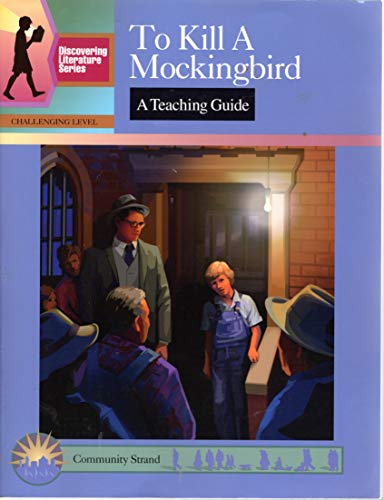
The challenging level focuses on a variety of reading strategies to help students construct a meaningful literature experience as well as develop critical thinking and academic skills.
Table of Contents
Notes to the Teacher
About the Organization of This Literature Guide
o Chapter Pages
o Strategy Pages
o Tests
o Writer s Forum Pages
o History of Social Thought Pages
o Theme Pages
The Groupings of Literature
Introducing the Literature
Sample Lesson Plan
Quick Find Legal Vocabulary
Book Order
Alphabetical Order
Quick Find Chapter Index
Bibliography
Note: The chapters in this book are untitled: the phrases after each title are placed as guides
Part One:
Strategy 1: Beginning a Book
Strategy 2: Marking a Text
Chapter 1: Dill Arrives
Strategy 3: References and Allusions Consulting Outside Sources
Strategy 4: Plot The Design of a Story
Strategy 5: Forming Hypotheses
Strategy 6: Rhetorical Figures
Chapter 2: Scout s First Day of School
Strategy 7: Characterization
Writer s Forum 1: Description
Strategy 8: Plot Conflict
Writer s Forum 2: Journal
Chapter 3: Walter Cunningham and Burris Ewell
Strategy 9: Irony
Strategy 10: Point of View
Writer s Forum 3: Compare and Contrast Essay
Chapter 4: Gum in the Oak Tree
Strategy 11: Setting and Mood
Strategy 12: Foreshadowing and Flashback
Chapter 5: Miss Maudie; The Fishing Pole Note
Strategy 13: Dialogue
Writer s Forum 4: Dialogue
Test 1: Chapters 1-5
Chapter 6: Jem Loses His Pants...and Recovers them
Writer s Forum 5: Persuasion
Chapter 7: Soap Figures; Thank you; Filing the Knot-Hole
Writer s Forum 6: Thank-you Note
Chapter 8: Snow and Fire
Writer s Forum 7: Parody
Chapter 9: Atticus Accepts the Robinson Case; Scout Fights Francis
Strategy 14: Names and Characterizating Terms
Chapter 10: Mad Dog
Strategy 15: Characterization Continuum
Chapter 11: Mrs. Dubose
Writer s Forum 8: Definition
Test 2: Chapters 6-11
Part Two
Chapter 12: Calpurnia s Church
Strategy 16: Prior Knowledge
Chapter 13: Aunt Alexandra Comes to Stay
Strategy 17: Distinguishing Fact and Opinion
Chapter 14: Dill Runs Away
Chapter 15: Friends in the Yard; Mob at the Jail
Strategy 18: Historical Fiction/Autobiography
Test 3: Chapters 12-15
Chapter 16: The Courtroom
Chapter 17: Heck Tate and Robert E. Lee Ewell Testify
Strategy 19: Sensory Language
Chapter 18: Mayella Ewell Testifies
Strategy 20: Imaging
Chapter 19: Tom Robinson Testifies
Chapter 20: Dill and Mr. Dolphus Raymond Meet; Atticus s Closing Speech
Strategy 21: Revising Hypotheses
Chapter 21: The Jury Decides
Writer s Forum 9: News Article
Test 4: Chapters 16-21
Chapter 22: Reactions to the Verdict; Bob Ewell Threatens Atticus
Chapter 23: Picking the Jury in Retrospect; Folks
Writer s Forum 10: Summary
Chapter 24: Missionary Circle Meeting
Strategy 22: Stock Characters and Character Foils
Chapter 25: The Death of Tom Robinson
Writer s Forum 11: Eulogy/Anecdote
Chapter 26: Hitler and Democracy
Test 5: Chapters 22-26
Chapter 27: Bob Ewell Trespasses at Judge Taylor s, Trails Helen
Writer s Forum 12: Possible Ending
Chapter 28: Halloween Pageant and Return Home
Strategy 23: Adjusting Reading Rate
Chapter 29: Scout Tells Her Story and Meets Boo
Strategy 24: Logical Fallacies
Chapter 30: Heck Tate Decides
Writer s Forum 13: Evaluation
Chapter 31: Scout Takes Boo Home; Last View of the Finch Family
"synopsis" may belong to another edition of this title.
About the Author
Mary Elizabeth is a teacher and writer specializing in educational materials for students and teachers in settings ranging from kindergarten to college. She takes a novel approach to core educational outcomes and brings a freshness and thoroughness that is central to all of her work. As a teacher and writer of K higher education materials and a software content developer, Mary Elizabeth strives to provide the tools, skills, strategies, knowledge, and experience learners need to do whatever it is they will eventually do with their lives, using media that provide rich, memorable learning.
The products she develops are rooted in her training at the University of Chicago (B.A.) as a writer and at the University of Vermont (M. Ed.) as a reading clinician, as well as her own classroom, private tutoring session, and homeschooling experiences. Working both on her own and in collaboration with others, her goal is to design and bring to fruition products that contribute to essential learning in new ways and fill a gap in the market.
"About this title" may belong to another edition of this title.
Search results for To Kill a Mockingbird: A Teaching Guide

Stock Image
To Kill a Mockingbird: A Teaching Guide
Seller: World of Books (was SecondSale), Montgomery, IL, U.S.A.
Seller rating 5 out of 5 stars

Condition: Acceptable. Kathy Kifer (illustrator). Item in acceptable condition! Textbooks may not include supplemental items i.e. CDs, access codes etc. Seller Inventory # 00104299252
Stock Image
To Kill a Mockingbird: A Teaching Guide
Published by
Garlic Press (edition Teaching Guide ed.), 2002
ISBN 10: 0931993741
ISBN 13: 9780931993749
Used
Paperback
Seller: BooksRun, Philadelphia, PA, U.S.A.
Seller rating 5 out of 5 stars
Paperback. Condition: Very Good. Kathy Kifer (illustrator). Teaching Guide ed. It's a well-cared-for item that has seen limited use. The item may show minor signs of wear. All the text is legible, with all pages included. It may have slight markings and/or highlighting. Seller Inventory # 0931993741-8-1
Stock Image
To Kill a Mockingbird
Seller: Better World Books, Mishawaka, IN, U.S.A.
Seller rating 5 out of 5 stars
Condition: Good. Kathy Kifer (illustrator). Former library copy. Pages intact with minimal writing/highlighting. The binding may be loose and creased. Dust jackets/supplements are not included. Includes library markings. Stock photo provided. Product includes identifying sticker. Better World Books: Buy Books. Do Good. Seller Inventory # 17786841-6
Stock Image
To Kill a Mockingbird: A Teaching Guide
Seller: World of Books Inc, Montgomery, IL, U.S.A.
Seller rating 4 out of 5 stars

Paperback. Condition: Fair. Kathy Kifer (illustrator). The challenging level focuses on a variety of reading strategies to help students construct a meaningful literature experience as well as develop critical thinking and academic skills. Seller Inventory # CIN0931993741A
Seller Image
To Kill a Mockingbird: A Teaching Guide
Seller: ShowMe D Books, WALNUT GROVE, MO, U.S.A.
Seller rating 5 out of 5 stars
Paperback. Condition: Good. Kathy Kifer (illustrator). Hand inspected by live bookworms! Cover shows a little wear, but the book is in good condition. May have some writing or highlighting. Ships fast! Same or next business day! Thanks for supporting a small family business! Satisfaction guaranteed! Seller Inventory # C5FFYUXL5JR2
Stock Image
To Kill a Mockingbird: A Teaching Guide
Seller: ThriftBooks-Atlanta, AUSTELL, GA, U.S.A.
Seller rating 5 out of 5 stars
Paperback. Condition: Good. No Jacket. Kathy Kifer (illustrator). Pages can have notes/highlighting. Spine may show signs of wear. ~ ThriftBooks: Read More, Spend Less. Seller Inventory # G0931993741I3N00
Seller Image
To Kill a Mockingbird: A Teaching Guide
Seller: Goodwill Books, Hillsboro, OR, U.S.A.
Seller rating 5 out of 5 stars
Condition: acceptable. Kathy Kifer (illustrator). Fairly worn, but readable and intact. If applicable: Dust jacket, disc or access code may not be included. Seller Inventory # GICWV.0931993741.A
Seller Image
To Kill a Mockingbird: A Teaching Guide
Published by
Garlic Press, Bloomington, IN, 2002
ISBN 10: 0931993741
ISBN 13: 9780931993749
Used
Paperback
First Edition
Seller: Dorley House Books, Inc., Hagerstown, MD, U.S.A.
Seller rating 4 out of 5 stars
Paperback. Condition: Near Fine. Kathy Kifer (illustrator). 1st. 1st printing; 201/clean, unmarked pages+ads. Seller Inventory # 095029
Stock Image
To Kill a Mockingbird: A Teaching Guide
Seller: Revaluation Books, Exeter, United Kingdom
Seller rating 5 out of 5 stars
Paperback. Condition: Brand New. Kathy Kifer (illustrator). teaching guide ed. edition. 208 pages. 10.50x8.25x0.50 inches. In Stock. Seller Inventory # 0931993741
Buy New
US$ 35.20
US$ 13.33 shipping
Ships from United Kingdom to U.S.A.
Ships from United Kingdom to U.S.A.
Quantity: 1 available
Stock Image
To Kill a Mockingbird: A Teaching Guide
Seller: BennettBooksLtd, Los Angeles, CA, U.S.A.
Seller rating 5 out of 5 stars
Paperback. Condition: New. Kathy Kifer (illustrator). In shrink wrap. Looks like an interesting title! Seller Inventory # Q-0931993741