
Items related to Executive Leadership: A Practical Guide to Managing...
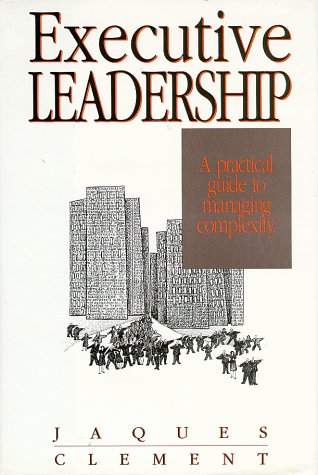
Synopsis
A no-nonsense approach to managerial leadership, establishing that every managerial role must, as an absolute requirement, be filled by a person with the necessary competence to carry the accountabilities in the role, including the leadership accountability.
"synopsis" may belong to another edition of this title.
About the Author
Jaques is Visiting Research Professor in Management Science at George Washington University. He has been engaged in practical field work over the past 50 years in the development and real life testing of a comprehensive theory-based system of organizational structure and managerial processes, including fundamental developments in our understanding of the meaning of work. This system calls for sweeping changes in approach to organizational development work and in the evaluation and development of individuals engaged in work.
This development work has been carried out in projects in industry and commerce, in government, in social, educational and health services, in the Church of England and the U.S. Army. In this latter connection Elliott Jaques was awarded the Joint Staff Certificate of Appreciation by General Colin Powell on behalf of the Joint Chiefs of Staff of the U.S. Armed Forces for "outstanding contributions in the field of military leadership theory and instruction to all of the service departments of the United States."
Throughout his career, Jaques has continuously combined work with organizations and with individuals against the background of a B.A. Honors Science degree from the University of Toronto, an M.D. from Johns Hopkins Medical School, a Ph.D. in Social Relations from Harvard, and qualification as a psychoanalyst at the British Psychoanalytical Society. He is a Fellow of the Royal College of Psychiatry. Author of 18 books, including Requisite Organization, 1996, Human Capability, 1994 (with K. Cason), and Executive Leadership, 1991 (with S. Clement).
Jaques served as a Major in the Canadian Army during WWII as liaison to the British Army War Officer Selection Board (WOSB). He remained in England after the war. He was a founding member of the Tavistock Institute of Human Relations but quickly found that the group dynamics approach did not accurately reflect the reality of managerial accountabilities.1 In 1964, he was invited, as Head of School, to develop the School of Social Sciences at Brunel University in London, and its Research Institute of Organizational Studies.
During his career, Jaques has been responsible for a series of major discoveries in the social sciences, contributing in a significant way to our understanding of human nature and social institutions. The most well known is his formulation of the mid-life crisis, but others with very significant implications include: - a method for objectively measuring the complexity of work roles, that in turn made possible the discovery of the unexpected existence of universal norms of fair pay for work, which upturns our current assumptions about human greed in relation to pay; - an objective understanding of the nature of human potential capability, and of its maturation throughout life from infancy through old age, that will change the basis of developmental psychology, and our approach to education; - the detailed specifications of a range of different organizational systems for industry and commerce, public service, churches, schools and universities, hospitals, and the military, that are requisite in the sense that they provide both for efficient work and for socially healthy settings for human relationships and individual growth.
These developments and many others will make a substantial contribution to the betterment of society and its values. 1 See "On Leaving the Tavistock Institute". Human Relations, Vol. #51, No. 3, 1998, pp. 251-257.
Stephen Clement has worked in the field of leadership development for more than 15 years, lecturing throughout the US and authoring numerous articles and papers on the subject. Col. (RET) Clement retired in 1985 from the U.S. Army where he was instrumental in developing the current policy pertaining to leadership training. While on the faculty at West Point, he taught courses on leadership and supervised leadership development programs. As President of Organizational Design, Inc. he consults to international organizations, specializing in the application of organizational design principles and the development of leadership training materials.
He received the B.S. degree in Engineering from the United States Military Academy at West Point; the M.S. degree in Industrial Relations and the Ph.D. degree in OrganIzational Communications from Perdue University
From the Back Cover
"Jaques and Clement have provided a new and powerful system for helping to manage the corporate talent pool and for developing executive leaders. What they have come up with doesn't make my work any easier, but it certainly adds value to the effectiveness of our leadership development efforts!" David R. Whitwam Chairman of the Board, President, and Chief Executive Officer Whirlpool Corporation
"Burn all your other management books; they are only placebos. While they might give you the latest business buzzwords, they are otherwise not much use. Jaques and Clement provide a scientific approach to management based upon excellent research and lifetimes of devotion." Mark Kaminski President, Commonwealth Aluminum
"This book by Jaques and Clement is based upon Jaques' stunning discoveries about human capability, creativity, and problem solving which promise to alter drastically our deeply imbedded notions about human development, education, and social relations, not only in the workplace but in our society in general. In the century ahead, this work will surely stimulate debate and social movements with far reaching consequences." Ralph J. Olmo, Comptroller, George Washington University, and formerly, Chief Finance Officer and Comptroller, U.S. Department of Education
Excerpt. © Reprinted by permission. All rights reserved.
Preface
The aim of this book is to provide a foundation for decisive, value-adding managerial leadership. In order to do so, we propose to bring the subject of leadership down to earth into practical everyday usable form. We shall thus limit ourselves to managerial leadership. There are many different roles-political, religious, and others-in which leadership accountability is to be found, and in each of which the nature of the leadership work is very different. By thus limiting ourselves to managerial work we hope to provide a sharp focus that will be of genuine help to business organizations and to managers at all levels.
Decisive value-adding managerial leadership is the true key to competitive effectiveness in business. It is what gives the drive, the imaginativeness, the zest, the personal satisfaction, the good working relationships; above all, it gives the productive working effectiveness at all levels from top to bottom of the managerial organization that produces a continuously successful business, thrusting into the future, and makes working a pleasure.
But everyone is familiar with the fact that we have become hamstrung by excessively bureaucratic organizational structures and practices that stymie decisiveness and make it very difficult for managers to add value to the work of their subordinates. The difficulty is that most of the organizational and human resourcing and procedures that we use, and the so-called managerial and leadership training that is provided, are seriously counter-productive. They serve to undermine and destroy managerial leadership, leaving our businesses to do the best they can in spite of the contribution of the leadership field rather than with its help. Democratic Values in the Workplace
In addressing the subject of managerial leadership, therefore, one of our prime values is that of business effectiveness and profitability through time. But whereas this business value is an essential element in free enterprise democracy, there are certain other basic ethical values that must be assumed, values that exist in their own right and that have an overriding priority in their own right. These basic ethical values lie at the very core of free enterprise democracy, and are further discussed in Chapter 10. They include such primary values as the dignity and integrity of the individual, the establishment of mutual trust and confidence, fairness and justice, openness, and absence of fear and autocratic decree. The acceptance of these values is taken for granted as the basic philosophy essential for sound managerial leadership.
These values are not, however, merely taken for granted and left at that. We believe that the requisite managerial leadership practices that we shall describe in Part II express the essence of democratic values applied to the managerial hierarchy. Thus our approach contrasts sharply with the approach that is, unfortunately, prevalent today; namely, that the managerial hierarchy is not only outdated, outmoded and limping along on its last legs, but that it needs to be dead and buried and replaced by some kind of non-hierarchical organization.
This "non-hierarchical" organization is variously described in terms of self-management teams, network organization, continuous improvement councils, quality circles, cluster organization, matrix frames of mind, adhocracy, information-generated project teams, and semi-autonomous work groups. Underlying these proposals are good democratic-value intentions. It is too bad that they have to be linked to a "down with hierarchy" slogan, presumably because all authority is seen as inevitably evil, and managerial hierarchy and managerial roles are thus seen as coercively autocratic and democratically beyond the pale.
The fact is, however, that none of these schemes ever gets rid of hierarchy. That they are thought to do so is mere wishful fantasy. Nor, as we shall argue, is the managerial hierarchy likely to disappear in the foreseeable future. It is an essential form of organization for effective and efficient democratic free-enterprise societies.
What needs to be done is to recognize that all authority is far from necessarily evil and that managerial leadership, to be effective, must be authoritative and not autocratic. We shall show that our requisite managerial leadership practices accomplish just such an outcome. They accomplish all that democracy-wishers could possibly seek-and more-in the way of valuing of individual dignity and participation. And they do so in such a way as to strengthen the constructive use of the managerial hierarchy. That is what we mean by requisite. This view is easily tested by examining whether or not our requisite practices really do provide for full-scale participation and team-working. We think they do, fulsomely so, and for the right reasons economically, socially and psychologically. The False Concern with "Personality"
The book may seem strange to those who take it for granted that leadership derives from certain key personality characteristics that are said to be possessed by good leaders. We believe that effective managerial leadership is connected not with personality make-up but with managerial competence based upon cognitive capability, values and knowledge and wisdom (so long as there are no seriously deleterious personality characteristics), which are all used in a requisite organization with requisite procedures.
Our view is that far too much emphasis is being placed upon personality make-up these days, and that far too many of the problems of management and of managerial leadership are being seen in terms of interpersonal relationships and interpersonal conflict. It is impossible to tell how much an apparent interpersonal conflict is the result of a clash of personality or of inadequate managerial organization. In the vast majority of cases it is the latter. A good rule of thumb to use is that, until and unless a requisite organization has been established, it is fair to assume that interpersonal stresses and strains and inadequate managerial leadership are the products of poor organization rather than of personality problems. "Cherchez l'organisation" every time.
"About this title" may belong to another edition of this title.
Search results for Executive Leadership: A Practical Guide to Managing...

Stock Image
Executive Leadership: A Practical Guide to Managing Complexity
Seller: ThriftBooks-Reno, Reno, NV, U.S.A.
Seller rating 5 out of 5 stars

Hardcover. Condition: Good. No Jacket. Pages can have notes/highlighting. Spine may show signs of wear. ~ ThriftBooks: Read More, Spend Less. Seller Inventory # G0962107018I3N00
Stock Image
Executive Leadership: A Practical Guide to Managing Complexity
Seller: ThriftBooks-Atlanta, AUSTELL, GA, U.S.A.
Seller rating 5 out of 5 stars
Hardcover. Condition: Good. No Jacket. Pages can have notes/highlighting. Spine may show signs of wear. ~ ThriftBooks: Read More, Spend Less. Seller Inventory # G0962107018I3N00
Stock Image
Executive Leadership: A Practical Guide to Managing Complexity
Seller: ThriftBooks-Atlanta, AUSTELL, GA, U.S.A.
Seller rating 5 out of 5 stars
Hardcover. Condition: Fair. No Jacket. Readable copy. Pages may have considerable notes/highlighting. ~ ThriftBooks: Read More, Spend Less. Seller Inventory # G0962107018I5N00
Stock Image
Executive Leadership: A Practical Guide to Managing Complexity
Seller: ThriftBooks-Dallas, Dallas, TX, U.S.A.
Seller rating 5 out of 5 stars
Hardcover. Condition: Good. No Jacket. Pages can have notes/highlighting. Spine may show signs of wear. ~ ThriftBooks: Read More, Spend Less. Seller Inventory # G0962107018I3N00
Stock Image
Executive Leadership: A Practical Guide to Managing Complexity
Seller: ThriftBooks-Atlanta, AUSTELL, GA, U.S.A.
Seller rating 5 out of 5 stars
Hardcover. Condition: Good. No Jacket. Missing dust jacket; Pages can have notes/highlighting. Spine may show signs of wear. ~ ThriftBooks: Read More, Spend Less. Seller Inventory # G0962107018I3N01
Stock Image
Executive Leadership: A Practical Guide to Managing Complexity
Seller: ThriftBooks-Phoenix, Phoenix, AZ, U.S.A.
Seller rating 5 out of 5 stars
Hardcover. Condition: Good. No Jacket. Pages can have notes/highlighting. Spine may show signs of wear. ~ ThriftBooks: Read More, Spend Less. Seller Inventory # G0962107018I3N00
Stock Image
Executive Leadership: A Practical Guide to Managing Complexity
Seller: World of Books (was SecondSale), Montgomery, IL, U.S.A.
Seller rating 5 out of 5 stars
Hardback. Condition: Good. Seller Inventory # 00093828073
Seller Image
Executive Leadership: A Practical Guide to Managing Complexity
Seller: Goodwill Books, Hillsboro, OR, U.S.A.
Seller rating 5 out of 5 stars
Condition: acceptable. Fairly worn, but readable and intact. If applicable: Dust jacket, disc or access code may not be included. Seller Inventory # GICWV.0962107018.A
Stock Image
Executive Leadership: A Practical Guide to Managing Complexity
Seller: Wonder Book, Frederick, MD, U.S.A.
Seller rating 5 out of 5 stars
Condition: Very Good. Very Good condition. Good dust jacket. A copy that may have a few cosmetic defects. May also contain light spine creasing or a few markings such as an owner's name, short gifter's inscription or light stamp. Seller Inventory # M05G-01818
Stock Image
Executive Leadership : A Practical Guide to Managing Complexity
Published by
Cason Hall & Company, Publishers, 1991
ISBN 10: 0962107018
ISBN 13: 9780962107016
Used
Hardcover
Seller: Better World Books, Mishawaka, IN, U.S.A.
Seller rating 5 out of 5 stars
Condition: Good. Pages intact with minimal writing/highlighting. The binding may be loose and creased. Dust jackets/supplements are not included. Stock photo provided. Product includes identifying sticker. Better World Books: Buy Books. Do Good. Seller Inventory # GRP97597040