
Items related to The Anatomy of Fascism
Synopsis
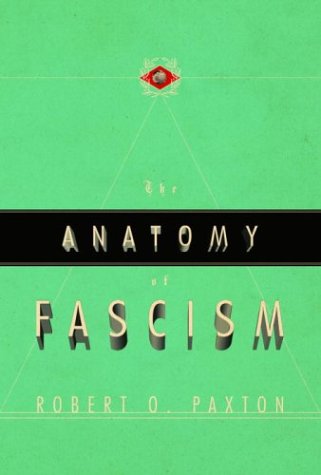
From the author of Vichy France, a fascinating, authoritative history of fascism in all its manifestations, and how and why it took hold in certain countries and not in others.
What is fascism? Many authors have proposed succinct but abstract definitions. Robert O. Paxton prefers to start with concrete historical experience. He focuses more on what fascists did than on what they said. Their first uniformed bands beat up “enemies of the nation,” such as communists and foreign immigrants, during the tense days after 1918 when the liberal democracies of Europe were struggling with the aftershocks of World War I. Fascist parties could not approach power, however, without the complicity of conservatives willing to sacrifice the rule of law for security.
Paxton makes clear the sequence of steps by which fascists and conservatives together formed regimes in Italy and Germany, and why fascists remained out of power elsewhere. Fascist regimes were strained alliances. While fascist parties had broad political leeway, conservatives preserved many social and economic privileges. Goals of forced national unity, purity, and expansion, accompanied by propaganda-driven public excitement, held the mixture together. War opened opportunities for fascist extremists to pursue these goals to the point of genocide. Paxton shows how these opportunities manifested themselves differently in France, in Britain, in the Low Countries, and in Eastern Europe–and yet failed to achieve supreme power. He goes on to examine whether fascism can exist outside the specific early-twentieth-century European setting in which it emerged, and whether it can reappear today. This groundbreaking book, based on a lifetime of research, will have a lasting impact on our understanding of twentieth-century history.
"synopsis" may belong to another edition of this title.
About the Author
Robert O. Paxton taught at Columbia University. His other books include Vichy France, Vichy France and the Jews (with Michael Marrus), Europe in the Twentieth Century, and French Peasant Fascism. He lives in New York City.
From the Inside Flap
From the author of <i>Vichy France,</i> a fascinating, authoritative history of fascism in all its manifestations, and how and why it took hold in certain countries and not in others.<br><br>What <i>is</i> fascism? Many authors have proposed succinct but abstract definitions. Robert O. Paxton prefers to start with concrete historical experience. He focuses more on what fascists did than on what they said. Their first uniformed bands beat up “enemies of the nation,” such as communists and foreign immigrants, during the tense days after 1918 when the liberal democracies of Europe were struggling with the aftershocks of World War I. Fascist parties could not approach power, however, without the complicity of conservatives willing to sacrifice the rule of law for security. <br><br>Paxton makes clear the sequence of steps by which fascists and conservatives together formed regimes in Italy and Germany, and why fascists remained out of power elsewhere. Fascist regimes were strained alliances. While fascist parties had broad political leeway, conservatives preserved many social and economic privileges. Goals of forced national unity, purity, and expansion, accompanied by propaganda-driven public excitement, held the mixture together. War opened opportunities for fascist extremists to pursue these goals to the point of genocide. Paxton shows how these opportunities manifested themselves differently in France, in Britain, in the Low Countries, and in Eastern Europe–and yet failed to achieve supreme power. He goes on to examine whether fascism can exist outside the specific early-twentieth-century European setting in which it emerged, and whether it can reappear today. This groundbreaking book, based on a lifetime of research, will have a lasting impact on our understanding of twentieth-century history.
Reviews
A scholar of Vichy France, Paxton focuses here on the literature about fascism. The term is used with abandon in contemporary political discourse, reflecting scholarly disagreement about how to define it. His historical source material predominantly emanates from Mussolini in Italy and Hitler in Germany, an obvious but necessary observation since the "fascist" status of other authoritarian regimes is contentious. Paxton does integrate biographies of the two ur-fascists into his dissection, but he comments frequently that a researcher's fixation on the leader obscures rather than clarifies the rise of his party, as does a propensity to focus on the party's ideology instead of its actions, and he follows the significantly different trajectories of radicalism taken by the Fascists and the Nazis. Formulating a five-stage life cycle of fascism from birth in "mobilizing passions" provoked by World War I to its destructiveness in power, Paxton wants his intricate but readable work to "rescue the concept [of fascism] for meaningful use," a laudable goal largely achieved. Gilbert Taylor
Copyright © American Library Association. All rights reserved
Excerpt. © Reprinted by permission. All rights reserved.
Chapter 1
Introduction
The Invention of Fascism
Fascism was the major political innovation of the twentieth century, and the source of much of its pain. The other major currents of modern Western political culture—conservatism, liberalism, socialism—all reached mature form between the late eighteenth century and the mid-nineteenth century. Fascism, however, was still unimagined as late as the 1890s. Friedrich Engels, writing a preface in 1895 for his new edition of Karl Marx’s The Class Struggles in France, clearly believed that wider suffrage would inexorably deliver more votes to the Left. Both time and numbers, Engels was certain, were on the socialists’ side. “If it [the growing socialist vote] continues in this fashion, by the end of this [nineteenth] century we [socialists] shall conquer the major part of the middle strata of society, petty bourgeois and peasants, and grow into the decisive power in the land.” Conservatives, Engels wrote, had noticed that legality was work- ing against them. By contrast, “we [socialists], under this legality, get firm muscles and rosy cheeks and look like life eternal. There is nothing for them [the conservatives] to do but break through this legality themselves.” While Engels thus expected that the Left’s enemies would launch a preemptive attack, he could not imagine in 1895 that this might win mass approval. Dictatorship against the Left amidst popular enthusiasm—that was the unexpected combination that fascism would manage to put together one short generation later.
There were only a few glimmers of premonition. One came from an inquisitive young French aristocrat, Alexis de Tocqueville. Although Tocqueville found much to admire on his visit to the United States in 1831, he was troubled by the majority’s power in a democracy to impose conformity by social pressure, in the absence of an independent social elite.
The kind of oppression with which democratic peoples are threatened will resemble nothing that had preceded it in the world; our contemporaries would not find its image in their memories. I myself seek in vain an expression that exactly reproduces the idea that I form of it for myself and that contains it; the old words despotism and tyranny are not suitable. The thing is new, therefore I must try to define it, since I can not name it.
Another premonition came at the eleventh hour from a French engineer turned social commentator, Georges Sorel. In 1908 Sorel criticized Marx for failing to notice that “a revolution accomplished in times of decadence” could “take a return to the past or even social conservation as its ideal.”
The word fascism has its root in the Italian fascio, literally a bundle or sheaf. More remotely, the word recalled the Latin fasces, an axe encased in a bundle of rods that was carried before the magistrates in Roman public processions to signify the authority and unity of the state. Before 1914, the symbolism of the Roman fasces was usually appropriated by the Left. Marianne, symbol of the French Republic, was often portrayed in the nineteenth century carrying the fasces to represent the force of Republican solidarity against her aristocratic and clerical enemies. Fasces are prominently displayed on Christopher Wren’s Sheldonian Theater (1664–69) at Oxford University. They appeared on the Lincoln Memorial in Washington (1922) and on the United States quarter minted in 1932.
Italian revolutionaries used the term fascio in the late nineteenth century to evoke the solidarity of committed militants. The peasants who rose against their landlords in Sicily in 1893–94 called themselves the Fasci Siciliani. When in late 1914 a group of left-wing nationalists, soon joined by the socialist outcast Benito Mussolini,sought to bring Italy into World War I on the Allied side, they chose a name designed to communicate both the fervor and the solidarity of their campaign: the Fascio Rivoluzionario d’Azione Interventista (Revolutionary League for Interventionist Action).At the end of World War I, Mussolini coined the term fascismo to describe the mood of the little band of nationalist ex-soldiers and pro-war syndicalist revolutionaries that he was gathering around himself. Even then, he had no monopoly on the word fascio, which remained in general use for activist groups of various political hues.
Officially, Fascism was born in Milan on Sunday, March 23, 1919. That morning, somewhat more than a hundred persons, including war veterans, syndicalists who had supported the war, and Futurist intellectuals, plus some reporters and the merely curious, gathered in the meeting room of the Milan Industrial and Commercial Alliance, overlooking the Piazza San Sepolcro, to “declare war against socialism . . . because it has opposed nationalism.” Now Mussolini called his movement the Fasci di Combattimento, which means, very approximately, “fraternities of combat.”
The Fascist program, issued two months later, was a curious mixture of veterans’ patriotism and radical social experiment, a kind of “national socialism.” On the national side, it called for fulfilling Italian expansionist aims in the Balkans and around the Mediterranean that had just been frustrated a few months before at the Paris Peace Conference. On the radical side, it proposed women’s suffrage and the vote at eighteen, abolition of the upper house, convocation of a constituent assembly to draft a new constitution for Italy (presumably without the monarchy), the eight-hour workday, worker participation in “the technical management of industry,” the “partial expropriation of all kinds of wealth” by a heavy and progressive tax on capital, the seizure of certain Church properties, and the confiscation of 85 percent of war profits.
Mussolini’s movement was not limited to nationalism and assaults on property. It boiled with the readiness for violent action, anti-intellectualism, rejection of compromise, and contempt for established society that marked the three groups who made up the bulk of his first followers—demobilized war veterans, pro-war syndicalists, and Futurist intellectuals.
Mussolini—himself an ex-soldier who boasted of his forty wounds—hoped to make his political comeback as a veterans’ leader. A solid core of his followers came from the Arditi—select commando units hardened by front-line experience who felt entitled to rule the country they had saved.
The pro-war syndicalists had been Mussolini’s closest associates during the struggle to bring Italy into the war in May 1915. Syndicalism was the main working-class rival to parliamentary socialism in Europe before World War I. While most socialists by 1914 were organized in electoral parties that competed for parliamentary seats, syndicalists were rooted in trade unions (“syndicates”). Whereas parliamentary socialists worked for piecemeal reforms while awaiting the historical development that Marxists predicted would make capitalism obsolete, syndicalists, scornful of the compromises required by parliamentary action and of most socialists’ commitment to gradual evolution, believed they could overthrow capitalism by the force of their will. By concentrating on their ultimate revolutionary goal rather than on each trade’s petty workplace concerns, they could form “one big union” and bring down capitalism all at once in one momentous general strike. After capitalism’s collapse, workers organized within their “syndicates” would remain as the sole functioning units of production and exchange in a free collectivist society. By May 1915, while all Italian parliamentary socialists and most Italian syndicalists ada- mantly opposed Italian entry into World War I, a few ardent spirits around Mussolini concluded that warfare would drive Italy further toward social revolution than would remaining neutral. They had become “national syndicalists.”
The third component of Mussolini’s first Fascists were young antibourgeois intellectuals and aesthetes such as the Futurists. The Futurists were a loose association of artists and writers who espoused Filippo Tommaso Marinetti’s “Futurist Manifestos,” the first of which had been published in Paris in 1909. Marinetti’s followers dismissed the cultural legacy of the past collected in museums and libraries and praised the liberating and vitalizing qualities of speed and violence. “A racing automobile . . . is more beautiful than the Victory of Samothrace.” They had been eager for the adventure of war in 1914, and they continued to follow Mussolini in 1919.
Another intellectual current that provided recruits for Mussolini consisted of critics of the tawdry compromises of Italian parliamentarism who dreamed of a “second Risorgimento.” The first Risorgimento, in their view, had left Italy in the hands of a narrow oligarchy whose soulless political games were inappropriate for Italian cultural prestige and Great Power ambitions. It was time to complete the “national revolution” and give Italy a “new state” capable of summoning up the energetic leadership, motivated citizenry, and united national community that Italy deserved. Many of these advocates of a “second Risorgimento” wrote for the Florentine cultural review La Voce, to which the young Mussolini subscribed and with whose editor, Giovanni Prezzolini, he corresponded. After the war, their approval gave respectability to the rising Fascist movement and spread acceptance of a radical “national revolution” among middle-class nationalists.
On April 15, 1919, soon after Fascism’s founding meeting at the Piazza San Sepolcro, a band of Mussolini’s friends including Marinetti and the chief of the Arditi, Ferruccio Vecchi, invaded the Milan offices of the socialist daily newspaper Avanti, of which Mussolin...
"About this title" may belong to another edition of this title.
Search results for The Anatomy of Fascism

Stock Image
The Anatomy of Fascism
Seller: ThriftBooks-Atlanta, AUSTELL, GA, U.S.A.
Seller rating 5 out of 5 stars

Hardcover. Condition: Very Good. No Jacket. Former library book; May have limited writing in cover pages. Pages are unmarked. ~ ThriftBooks: Read More, Spend Less. Seller Inventory # G1400040949I4N10
Seller Image
The Anatomy of Fascism
Seller: ebooks Keystone, Reading, PA, U.S.A.
Seller rating 4 out of 5 stars

Condition: good. This book is in good condition, with minimal signs of wear and tear. Seller Inventory # GWKV.1400040949.G
Seller Image
The Anatomy of Fascism
Seller: Goodwill of Silicon Valley, SAN JOSE, CA, U.S.A.
Seller rating 4 out of 5 stars
Condition: good. Supports Goodwill of Silicon Valley job training programs. The cover and pages are in Good condition! Any other included accessories are also in Good condition showing use. Use can include some highlighting and writing, page and cover creases as well as other types visible wear. Seller Inventory # GWSVV.1400040949.G
Stock Image
The Anatomy of Fascism
Seller: BooksRun, Philadelphia, PA, U.S.A.
Seller rating 5 out of 5 stars
Hardcover. Condition: Very Good. With dust jacket. It's a well-cared-for item that has seen limited use. The item may show minor signs of wear. All the text is legible, with all pages included. It may have slight markings and/or highlighting. Seller Inventory # 1400040949-11-1-29
Stock Image
The Anatomy of Fascism
Seller: World of Books (was SecondSale), Montgomery, IL, U.S.A.
Seller rating 5 out of 5 stars
Hardback. Condition: Good. What is fascism? By focusing on the concrete: what the fascists did, rather than what they said, the esteemed historian Robert O. Paxton answers this question. From the first violent uniformed bands beating up enemies of the state, through Mussolini's rise to power, to Germany's fascist radicalization in World War I, Paxton shows clearly why fascists came to power in some countries and not others, and explores whether fascism could exist outside the early-twentieth-century European setting in which it emerged. A deeply intelligent and very readable book. . . . Historical analysis at its best. -The Economist The Anatomy of Fascism will have a lasting impact on our understanding of modern European history, just as Paxton's classic Vichy France redefined our vision of World War I. Based on a lifetime of research, this compelling and important book transforms our knowledge of fascism-the major political innovation of the twentieth century, and the source of much of its pain. Seller Inventory # CIN1400040949G
Stock Image
The Anatomy of Fascism
Seller: World of Books (was SecondSale), Montgomery, IL, U.S.A.
Seller rating 5 out of 5 stars
Hardback. Condition: Very Good. What is fascism? By focusing on the concrete: what the fascists did, rather than what they said, the esteemed historian Robert O. Paxton answers this question. From the first violent uniformed bands beating up enemies of the state, through Mussolini's rise to power, to Germany's fascist radicalization in World War I, Paxton shows clearly why fascists came to power in some countries and not others, and explores whether fascism could exist outside the early-twentieth-century European setting in which it emerged. A deeply intelligent and very readable book. . . . Historical analysis at its best. -The Economist The Anatomy of Fascism will have a lasting impact on our understanding of modern European history, just as Paxton's classic Vichy France redefined our vision of World War I. Based on a lifetime of research, this compelling and important book transforms our knowledge of fascism-the major political innovation of the twentieth century, and the source of much of its pain. Seller Inventory # 00110429560
Stock Image
The Anatomy of Fascism
Seller: World of Books Inc, Montgomery, IL, U.S.A.
Seller rating 4 out of 5 stars
Hardback. Condition: Good. What is fascism? By focusing on the concrete: what the fascists did, rather than what they said, the esteemed historian Robert O. Paxton answers this question. From the first violent uniformed bands beating up enemies of the state, through Mussolini's rise to power, to Germany's fascist radicalization in World War I, Paxton shows clearly why fascists came to power in some countries and not others, and explores whether fascism could exist outside the early-twentieth-century European setting in which it emerged. A deeply intelligent and very readable book. . . . Historical analysis at its best. -The Economist The Anatomy of Fascism will have a lasting impact on our understanding of modern European history, just as Paxton's classic Vichy France redefined our vision of World War I. Based on a lifetime of research, this compelling and important book transforms our knowledge of fascism-the major political innovation of the twentieth century, and the source of much of its pain. Seller Inventory # CIN1400040949G
Stock Image
The Anatomy of Fascism
Seller: World of Books Inc, Montgomery, IL, U.S.A.
Seller rating 4 out of 5 stars
Hardback. Condition: Very Good. What is fascism? By focusing on the concrete: what the fascists did, rather than what they said, the esteemed historian Robert O. Paxton answers this question. From the first violent uniformed bands beating up enemies of the state, through Mussolini's rise to power, to Germany's fascist radicalization in World War I, Paxton shows clearly why fascists came to power in some countries and not others, and explores whether fascism could exist outside the early-twentieth-century European setting in which it emerged. A deeply intelligent and very readable book. . . . Historical analysis at its best. -The Economist The Anatomy of Fascism will have a lasting impact on our understanding of modern European history, just as Paxton's classic Vichy France redefined our vision of World War I. Based on a lifetime of research, this compelling and important book transforms our knowledge of fascism-the major political innovation of the twentieth century, and the source of much of its pain. Seller Inventory # CIN1400040949VG
Stock Image
The Anatomy of Fascism
Seller: Midtown Scholar Bookstore, Harrisburg, PA, U.S.A.
Seller rating 5 out of 5 stars
hardcover. Condition: Good. Torn/worn dj. Good hardcover with some shelfwear; may have previous owner's name inside. Standard-sized. Seller Inventory # mon0000357252
Seller Image
The Anatomy of Fascism
Seller: ThriftBooksVintage, Tukwila, WA, U.S.A.
Seller rating 5 out of 5 stars
Hardcover. Condition: Very Good. Dust Jacket Condition: Good. Dust jacket in good condition. Minor shelf and handling wear, overall a clean solid copy with minimal signs of use. Mark made on one of the pages. Secure packaging for safe delivery. Seller Inventory # 1784057378