
Items related to The Tomorrow Trap: Unlocking the Secrets of the Procrastinat...
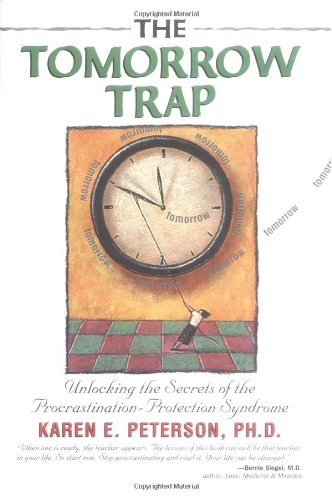
Synopsis
The Procrastination-Protection Syndrome explains why we:
Borrowing equally from her own story of recovery from procrastination, composite clinical case examples, psychological research, and interviews with highly productive individuals such as Dr. Bernie Siegel, Dr. Peterson offers a way out of the tomorrow trap so that we can finally take charge of our lives, savor success and embrace our essential destinies.
"synopsis" may belong to another edition of this title.
About the Author
Karen E. Peterson, Ph.D., is a psychologist in private practice, humor and stress-management consultant, and international public speaker. A former college writing instructor, she has conducted research on 20 years of public-speaking experience, she has presented general and keynote sessions for various corporate, community, university and professional audiences. In promoting her message of using humor and avoiding procrastination in order to maintain a healthy balance in life, Dr. Peterson tries to practice what she preaches by always remembering to "bargain in good faith with destiny."
Excerpt. © Reprinted by permission. All rights reserved.
Earth or Bust:
Understanding the Procrastination-Projection
Syndrome
Beyond talent lie all the
usual words, discipline, love, luck,
but, most of all, endurance.
— James Baldwin
Ever watch Star Trek? Well, even if youÆre not a science fiction fan, youÆll probably see yourself aboard the Starship Enterprise by the end of this story. During one recent episode, I was instantly reminded of the vicious cycle of what I call the ôpsycho-evolutionaryö pattern of humanity.
As I watched Captain Picard and his fearless crew trapped in a space/time distortion, unwittingly repeating the same events for 17 days in a row, I felt increasingly upset each time their ôdayö ended in complete destruction of the ship and its crew. I wanted to reach through the TV screen and say, ôBut wait, you donÆt have to keep repeating the same events that will result in your total destruction!ö
As Captain Picard and his crew became increasingly alert for signs of déjà vu moments, trusting that their instincts were correct, they were finally able to give themselves a clue to avoid the inevitable collision in this repeated ôday,ö and out of the loop they went —free at last from the ôthe tomorrow trap.ö However, after the ship had broken out of the space/time distortion, Captain Picard hailed the captain of the other ship and quickly realized that the other shipÆs crew was as yet completely unaware that they, too, had been repeating the same day — but for over 80 years.
So whatÆs all this going around in circles have to do with procrastination? Essentially, this book is the ôclueö I needed to give myself 20 years ago, when I was stuck in the repetitive, destructive cycle of procrastination. With an intense desire to write, I knew that something was wrong with my life, but I couldnÆt begin to figure out what or why. Although I saw a variety of fine therapists over the years, none was able to help with my procrastination regarding the writing process until I was ready to deal with underlying issues.
As an English composition teacher, I was also aware that some of my students had problems with writerÆs block and procrastination, and it seemed to have more to do with the student than with the writing project per se.
During those years, I searched for information to help sort this all out. I found some interesting books and excellent research material, but none of them started me writing again.
My earliest clues regarding what I now feel is the true source of procrastination came while researching my doctoral dissertation in psychology — a project in which I studied the relationship between ôself-monitoring styleö (how much of oneÆs ôtrue selfö is shown to others) and oneÆs level of writing anxiety, writerÆs block or procrastination.
This book is a composite of all that IÆve learned about procrastination — both as a survivor of this negative pattern and as a psychologist who has worked with procrastinators for the past 10 years. In my workshops across the country, I have seen the same patterns over and over again that have plagued me, as well as my clients. And just as Captain Picard invited the other starshipÆs captain aboard to help him out of his 80-year entrapment, so, too, I offer you this book to help you out of your particular prison of procrastination, a prison that does indeed protect you from facing the real issues underlying procrastination, but that also keeps you caught in the teeth of the tomorrow trap.
The two types of Procrastination
LetÆs examine briefly the level to which you feel ensnared by the tomorrow trap. Try to respond to the items that follow with your first gut-level reaction. Once you have assessed your particular pattern of procrastination, weÆll know which of the two types of procrastination is keeping you trapped in this uncomfortable pattern.
Procrastination Pattern Quiz
- I procrastinate regarding:
Making decisions
Paperwork
Creative activities
Academic activities
My job
Household tasks
Financial matters
My personal relationships
Self-care
Relaxation and leisure time
My hobbies
My hopes and dreams
Other:_________________
- When I hear the word ôprocrastination,ö I think of:___________________
- When I hear the word ôprocrastination,ö I feel:______________________
- When other people procrastinate, I feel and I think:__________________
- I procrastinate _____________ percent of the time
- I procrastinate mostly when it comes to ___________, and __________ and __________
- I rarely procrastinate when it comes to ____________, or _____________ or __________
- What bothers me the most about my procrastination is _________________
- Procrastination has caused me trouble in terms of my: _____________ job _______________ relationships __________________ self-esteem _______________ fulfillment of my dreams.
- The reasons that I think I havenÆt stopped procrastinating are: ____________________
In looking at your answers to item #1, notice whether your procrastination related to one area, a few or many. If your problems are just with one area, you could be dealing primarily with a simple case of what I call ôtask-related procrastinationö (TRP). This suggests boredom and low frustration tolerance regarding an aversive task. In this case, the application of time management principles would help.
However, the more negative your responses were to items #2-10, the more likely it is that you may be experiencing what I call ôperson-related procrastinationö (PRP). This suggests the possibility of unresolved interpersonal issues (issues between you and another person) or unresolved intrapersonal issues (issues residing within you from previous life experiences). And yes, if youÆre really lucky, like most of us, you can have both TRP and PRP at the same time.
A few case examples will illustrate:Robert, a 45-year-old architect, relocated to Florida to accept a management position with a large architectural firm. He came for counseling at the suggestion of his employer, who had noticed that Robert had a difficult time completing tasks that involved minor paperwork or conducting meetings.When I questioned Robert, it appeared that he had no other problems with procrastination outside these to areas at work. Prior to being promoted to manager, Robert had shown no evidence of postponing tasks or low morale. He enjoyed the creative aspects of being an architect.
However, when it came to writing memos to or setting up meetings with the junior members of the firm, Robert tended to put off the chore. Although he would never be so blunt with his employer, Robert stated to me that these were ôboring and meaninglessö tasks that ôdistractedö him from his real purpose: creatively designing buildings and other structures. He added that although he appreciated the substantial hike in salary, he yearned for the old days when he could focus more closely on being creative, rather than on such boring tasks that he now ôhadö to do.
RobertÆs case is a clear example of task-related procrastination. On a daily basis he faced aversive tasks that prevented him from doing when he enjoyed. When we explored the fact that he was in a management position by choice, even with all the ôaversive tasks,ö Robert began to see his situation in a different light.
When I asked if heÆd like to step down from his new lucrative positive, exclaimed ôno.ö He said that with two sons in college, he and his wife had never had the money to travel. With his new salary, they were already planning a trip to Europe. I pointed out that perhaps all the paperwork was worth it, given the financial results of his management position. Reluctantly, he agreed.
What Robert needed was a daily reminder of these positive consequences regarding the performance of such ômeaninglessö tasks. I suggested a form of time management, a behavior therapy technique called ôcontingency management,ö in which a reward for behavior depends upon performance. It calls for breaking an aversive task into manageable steps, then rewarding oneself after each step is completed. Robert needed immediate and tangible gratification after each bout of ôboringö paperwork.
We decided to try breaking his tasks into half-hour blocks. He agreed that for each half-hour of time he spent writing memos, heÆd deposit $ 25 in a new European vacation savings account. For each half-hour spent conducting staff meetings, an additional $ 25 would be put in an account for one getaway trip each month for Robert and his wife.
Once Robert realized he was being amply rewarded for performing these relatively unpleasant tasks, he was able to execute his job well without the need to procrastinate.
Such cases of task-related procrastination are usually fairly clear-cut and relatively easy to remedy. However, in cases of person-related procrastination the causes and solutions are more complex. Another case example will illustrate.
Cynthia, a 2year-old computer whiz, yearned to be a writer. Although she had a comprehensive library of motivational tapes and books on time management, Cynthia was a classic case of procrastination. Not only did she put off expressing herself via her writing, she also delayed doing her job since she saw her work as an obstacle to writing her novel. To deal with her frustration, Cynthia often ate compulsively; she had gained 75 pounds since completing graduate school. As a result of her weight gain, she put off joining clubs and professional groups where she could meet men. She feared rejection based on her appearance.
Upon closer inquiry, it became apparent that Cynthia was trying to maintain her balance on a tightrope of approval — with one parent at each end. Her father, who had insisted that Cynthia follow his career path, was always reminding her that if she did well enough, she might take over his multi-million-dollar business. He also constantly admonished her and was never forthcoming with praise or approval — a negative pattern that had started when Cynthia was a small child. Cynthia was sure he would ôpractically disownö her if she spent time on such a ôfrivolousö activity as writing a novel.
Similarly, Cynthia was unable to reap any approval from her mother — an aloof woman who spent the bulk of her time pampering herself. She constantly reminded Cynthia that it would be ôimpossible to get a manÆ because of CynthiaÆs weight.
Unlike RobertÆs task-oriented procrastination, CynthiaÆs problem was more complex. It required focusing on her interpersonal issues with her parents, as well as on her feelings regarding her own sense of shame, low self-esteem and lack of independence.
More often than not, procrastination is usually a mixture of task-related and person-related factors.
For example, suppose your supervisor is on vacation and you must write a report — a task you find aversive. The president of the company is expecting the report for the annual meeting in a week.
If you are in this situation, most likely every time you thought about this project, you would start to feel ____________________, and youÆd probably be thinking thoughts such as: __________________________, or ________________________, or ____________________.
If your feeling about the report is solely related to the task itself, then you probably would experience the sensation of being overwhelmed, overworked or frustrated. You might think:
Compare these five statements to your responses with the fill-in-the-blank statements in the previous paragraph. The five statements above are focused on the fact that you must perform an arduous and unpleasant task. Your negative feelings and thoughts are focused upon the task itself. This would be a clear example of pure task-related procrastination, Your responses, however, may suggest a deeper form of procrastination.
The project may also produce a form of procrastination that is interpersonal or intrapersonal in nature — a case of person-related procrastination (PRP). When you start to feel extremely angry, victimized or helpless, you may be experiencing a deeper form of procrastination.
Perhaps you think your supervisor takes too many vacation days, and that this report is another example of his or her selfish expectations that you will ôcover.ö Naturally, you would not want to jump headlong into this project, let alone complete it on time. Or perhaps you just donÆt want to write this report because you feel resentful toward the companyÆs president for commanding you to write it, instead of asking politely. Why would you want to start or finish an aversive task (TRP) for two people who are treating you badly (PRP)? This would be a perfect example of procrastination due to interpersonal factors as well as task-related factors.
But suppose you feel so enraged that you cannot work on the project even if you want to. Then itÆs no longer just a case of ôIÆll do it later.ö This incapacitation mat be because your supervisor reminds you of your mother, who has never been supportive of you, left most of the housework for you to do, and never had to answer for it. And suppose that the companyÆs president reminds you of your father, who constantly assigned tasks without ever asking politely. In such a case, procrastination would also be classified as intrapersonal because the task of writing the report is forcing you to tap into unresolved feelings from the past that still reside within you.
As a result of these unresolved feelings about your parentsÆ dysfunctional behaviors, you have probably internalized their voices, so that now you are your own worst enemy. This is where a case of serious procrastination can develop, often with severe consequences. Once we understand that procrastination protects us from other issues not yet faced, then we are already on the road to recovery.
¬1996 Karen E. Peterson. All rights reserved. Reprinted from The Tomorrow Trap by Karen E. Peterson, Ph.D. No part of this publication may be reproduced, stored in a retrieval system or transmitted in any form or by any means, without the written permission of the publisher. Publisher: Health Communications, Inc., 3201 SW 15th Street, Deerfield Beach, FL 33442.
"About this title" may belong to another edition of this title.
Search results for The Tomorrow Trap: Unlocking the Secrets of the Procrastinat...

Stock Image
The Tomorrow Trap: Unlocking the Secrets of the Procrastination-protection Syndrome
Seller: World of Books (was SecondSale), Montgomery, IL, U.S.A.
Seller rating 5 out of 5 stars

Paperback. Condition: Fair. Tomorrow never comes, but the tomorrow trap is a perennial prison of postponement that ensnares most of us at one time or another - and many people all of the time. Missed opportunities, missed deadlines, missed lives. Procrastination is not the same thing as laziness. There is always an underlying, protective reason for putting off decisions, plans, and activities. This book helps readers unlock the hidden factors that makes people live the half-life of procrastination. The author draws from her own painful experiences in the tomorrow trap, from case studies, and from psychological research, to offer ways out of the tomorrow trap. Seller Inventory # 00098689834
Stock Image
The Tomorrow Trap: Unlocking the Secrets of the Procrastination-protection Syndrome
Seller: World of Books (was SecondSale), Montgomery, IL, U.S.A.
Seller rating 5 out of 5 stars
Paperback. Condition: Very Good. Tomorrow never comes, but the tomorrow trap is a perennial prison of postponement that ensnares most of us at one time or another - and many people all of the time. Missed opportunities, missed deadlines, missed lives. Procrastination is not the same thing as laziness. There is always an underlying, protective reason for putting off decisions, plans, and activities. This book helps readers unlock the hidden factors that makes people live the half-life of procrastination. The author draws from her own painful experiences in the tomorrow trap, from case studies, and from psychological research, to offer ways out of the tomorrow trap. Seller Inventory # 00108457128
Stock Image
The Tomorrow Trap: Unlocking the Secrets of the Procrastination-protection Syndrome
Seller: World of Books (was SecondSale), Montgomery, IL, U.S.A.
Seller rating 5 out of 5 stars
Paperback. Condition: Good. Tomorrow never comes, but the tomorrow trap is a perennial prison of postponement that ensnares most of us at one time or another - and many people all of the time. Missed opportunities, missed deadlines, missed lives. Procrastination is not the same thing as laziness. There is always an underlying, protective reason for putting off decisions, plans, and activities. This book helps readers unlock the hidden factors that makes people live the half-life of procrastination. The author draws from her own painful experiences in the tomorrow trap, from case studies, and from psychological research, to offer ways out of the tomorrow trap. Seller Inventory # 00107325110
Stock Image
The Tomorrow Trap: Unlocking the Secrets of the Procrastination-Protection Syndrome
Seller: Orion Tech, Kingwood, TX, U.S.A.
Seller rating 5 out of 5 stars
paperback. Condition: Very Good. Seller Inventory # 1558744177-2-35196451
Stock Image
The Tomorrow Trap: Unlocking the Secrets of the Procrastination-Protection Syndrome
Published by
Hci (edition First Thus), 1996
ISBN 10: 1558744177
ISBN 13: 9781558744172
Used
Paperback
Seller: BooksRun, Philadelphia, PA, U.S.A.
Seller rating 5 out of 5 stars
Paperback. Condition: Very Good. First Thus. It's a well-cared-for item that has seen limited use. The item may show minor signs of wear. All the text is legible, with all pages included. It may have slight markings and/or highlighting. Seller Inventory # 1558744177-8-1
Stock Image
The Tomorrow Trap: Unlocking the Secrets of the Procrastination-Protection Syndrome
Seller: ThriftBooks-Atlanta, AUSTELL, GA, U.S.A.
Seller rating 5 out of 5 stars
Paperback. Condition: Very Good. No Jacket. May have limited writing in cover pages. Pages are unmarked. ~ ThriftBooks: Read More, Spend Less. Seller Inventory # G1558744177I4N00
Stock Image
The Tomorrow Trap: Unlocking the Secrets of the Procrastination-Protection Syndrome
Seller: ThriftBooks-Dallas, Dallas, TX, U.S.A.
Seller rating 5 out of 5 stars
Paperback. Condition: Very Good. No Jacket. May have limited writing in cover pages. Pages are unmarked. ~ ThriftBooks: Read More, Spend Less. Seller Inventory # G1558744177I4N00
Stock Image
The Tomorrow Trap: Unlocking the Secrets of the Procrastination-Protection Syndrome
Seller: ThriftBooks-Reno, Reno, NV, U.S.A.
Seller rating 5 out of 5 stars
Paperback. Condition: Very Good. No Jacket. May have limited writing in cover pages. Pages are unmarked. ~ ThriftBooks: Read More, Spend Less. Seller Inventory # G1558744177I4N00
Stock Image
The Tomorrow Trap: Unlocking the Secrets of the Procrastination-Protection Syndrome
Seller: Wonder Book, Frederick, MD, U.S.A.
Seller rating 5 out of 5 stars
Condition: Very Good. Very Good condition. A copy that may have a few cosmetic defects. May also contain light spine creasing or a few markings such as an owner's name, short gifter's inscription or light stamp. Seller Inventory # N21C-03009
Stock Image
The Tomorrow Trap: Unlocking the Secrets of the Procrastination-protection Syndrome
Seller: World of Books Inc, Montgomery, IL, U.S.A.
Seller rating 4 out of 5 stars

Paperback. Condition: Good. Tomorrow never comes, but the tomorrow trap is a perennial prison of postponement that ensnares most of us at one time or another - and many people all of the time. Missed opportunities, missed deadlines, missed lives. Procrastination is not the same thing as laziness. There is always an underlying, protective reason for putting off decisions, plans, and activities. This book helps readers unlock the hidden factors that makes people live the half-life of procrastination. The author draws from her own painful experiences in the tomorrow trap, from case studies, and from psychological research, to offer ways out of the tomorrow trap. Seller Inventory # CIN1558744177G