
Items related to Web Design That Works: Secrets for Successful Web Design...
Synopsis
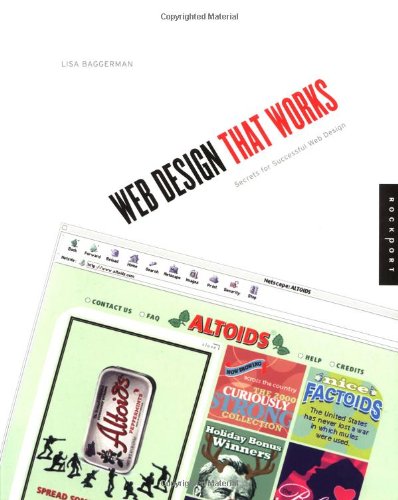
Web Design That Works provides an innovative approach to creating winning websites that combines pure graphic design elements with New Economy needs and solutions. It examines the most pressing challenges facing today's web designers, from how to answer the needs of diverse audiences and age groups; to how standard design elements such as usability, structure, navigation, interactivity, type, color, and layout work to make a site memorable. Through practical descriptions accompanied by screen-captures, author Lisa Baggerman closely examines twenty very diverse website designs to illustrate what makes each work, and why each is successful from a consumer, content, and design perspective. Delivering hands-on tools and valuable consumer and trend information, this cutting edge collection showcases the power of design to attract and keep a devoted Web audience.
"synopsis" may belong to another edition of this title.
About the Author
Lisa Baggerman, author of Design For Interaction: User Friendly Graphics, is web-site manager for Chronicle Books in San Francisco, California. Former senior editor of HOW magazine, she has written extensively on design and technology issues. She lives in San Francisco, California.
Shayne Bowman is a design and content consultant withHypergene.net in Dallas, Texas. Hypergene specializes in creating and displaying content that has one goal: to engage the audience. He lives in Carrolton, Texas.
Excerpt. © Reprinted by permission. All rights reserved.
Introduction:
It s the conundrum of Web design: There are millions of sites and so few worth visiting. The fact that anyone with a computer can publish a site is a big part of the problem and unfortunately for many companies, this is their only Web strategy.
A common misconception is that if you ve already worked in design and have learned the language, you can jump right into Internet design. But there s much more to Web design than code. The Web is vastly different from print, or any other design discipline, for that matter. Successful Web design means taking a different tack, considering the user experience first and embellishments second to create a dynamic, provocative, active destination.
Despite the fact that the number of people using the Web is growing exponentially literally the majority of the population the number of sites servicing this booming traffic will eventually shrink and the survivors will be the ones who have anticipated and met user needs. Here are some elements you ll find in successful sites.
TURN THE TABLES
If you ve ever been told that you never know someone until you take a walk in their shoes, you already know the first rule of successful Web design. Web design is about creating an active experience for your visitors, so it is paramount to not only research what your audience wants but to really pinpoint the specifics. By 2001 there will be an estimated one hundred million websites. This means that users will and are losing patience plowing through the numerous sites that turn up with each search, so you must offer a focused and well-organized site in order to survive.
CONTENT, CONTENT, CONTENT
Simply put, content is the most valuable resource any site has. The more, the better, just make sure it s good and always keep it updated. Content is the hook, and keeping it updated will keep users coming back.
NAVIGATION
A site can have the greatest, most innovative content ever, but without an intuitive site-navigation system, it will all be lost on users. Users simply won t spend time hunting for information they know there s always something somewhere else. The key is to keep the access to your content as intuitive and linear as possible. Link and cross link information, so there s more than one way to find it.
MAKE A CONNECTION
It doesn t matter who you are you ve got competition. With the millions of pages vying for visitors time, sites need to do more than passively post information. The site should be a point of interaction where users become active participants. This could include feedback forms, interactive games, or registering visitors and using their preferences to deliver a personalized experience. The important thing is engaging users as active participants.
All this makes for great advice in theory, but how do you put it into practice? Here are some sites that use their design to make their site a valuable tool.
"About this title" may belong to another edition of this title.
Search results for Web Design That Works: Secrets for Successful Web Design...

Stock Image
Web Design That Works: Secrets for Successful Web Design (Letterhead & Logo Design)
Seller: AwesomeBooks, Wallingford, United Kingdom
Seller rating 5 out of 5 stars

Paperback. Condition: Very Good. Web Design That Works: Secrets for Successful Web Design (Letterhead & Logo Design) This book is in very good condition and will be shipped within 24 hours of ordering. The cover may have some limited signs of wear but the pages are clean, intact and the spine remains undamaged. This book has clearly been well maintained and looked after thus far. Money back guarantee if you are not satisfied. See all our books here, order more than 1 book and get discounted shipping. Seller Inventory # 7719-9781564967732
Buy Used
US$ 5.10
US$ 5.51 shipping
Ships from United Kingdom to U.S.A.
Ships from United Kingdom to U.S.A.
Quantity: 2 available
Seller Image
Web Design That Works: Secrets for Successful Web Design (Letterhead & Logo Design)
Seller: Greenworld Books, Arlington, TX, U.S.A.
Seller rating 5 out of 5 stars
Condition: very_good. Fast Free Shipping â" Very Good condition book with a firm cover and clean pages. Shows normal use and some light wear or limited notes markings. A solid, nice copy to enjoy. Seller Inventory # GWV.1564967735.VG
Stock Image
Web Design That Works: Secrets for Successful Web Design (Letterhead & Logo Design)
Seller: Bahamut Media, Reading, United Kingdom
Seller rating 4 out of 5 stars

Paperback. Condition: Very Good. This book is in very good condition and will be shipped within 24 hours of ordering. The cover may have some limited signs of wear but the pages are clean, intact and the spine remains undamaged. This book has clearly been well maintained and looked after thus far. Money back guarantee if you are not satisfied. See all our books here, order more than 1 book and get discounted shipping. Seller Inventory # 6545-9781564967732
Buy Used
US$ 5.48
US$ 9.34 shipping
Ships from United Kingdom to U.S.A.
Ships from United Kingdom to U.S.A.
Quantity: 2 available
Seller Image
Web Design That Works: Secrets for Successful Web Design (Letterhead & Logo Design)
Published by
Rockport Publishers Inc., 2001
ISBN 10: 1564967735
ISBN 13: 9781564967732
Used
paperback
Seller: WeBuyBooks, Rossendale, LANCS, United Kingdom
Seller rating 5 out of 5 stars
paperback. Condition: Very Good. Most items will be dispatched the same or the next working day. A copy that has been read, but is in excellent condition. Pages are intact and not marred by notes or highlighting. The spine remains undamaged. Seller Inventory # rev2989375352
Buy Used
US$ 2.68
US$ 12.67 shipping
Ships from United Kingdom to U.S.A.
Ships from United Kingdom to U.S.A.
Quantity: 1 available
Stock Image
WEB DESIGN that WORKS: SECRETS for SUCCESSFUL WEB DESIGN *
Published by
Rockport Publishers, * * * * *, 2001
ISBN 10: 1564967735
ISBN 13: 9781564967732
Used
Soft cover
First Edition
Seller: L. Michael, North Hollywood, CA, U.S.A.
Seller rating 4 out of 5 stars
Soft cover. Condition: Fine. Lisa BOWMAN, Sidebars by. Book: Fine/As New/, 2001 (illustrator). 1st Edition. Book: Fine/As New/, $34.17 1564967735 WEB DESIGN that WORKS: SECRETS for SUCCESSFUL WEB DESIGN * BAGGERMAN, Lisa Lisa BOWMAN, Sidebars by. Rockport Publishers 2001 1sT Edition, 1sT Printing Tall Wide S/c White Spine, With Title In Black, Red And Small Grey Letters, Soft Cover Book: Fine/As New/, Slightest Shelf, Edge And Corner Wear. 143 Numbered Pages, UnOpened And UnRead, Printed On Off White Paper, In New/ Condition, Lightly Read, That Are Clean And Tight To The Spine, Slightest Shelf, Edge And Corner Wear. One Smudge On Rear Cover Stops This Book From Being `As New`. D/j: None. = No Odors, No Other Writing, No Names, No Rippling, Not Stuck Together, No Book Plate, Not X~Library, No Remainder Or Other Marks. Description Applies To This B00K, Only. = This B00K Is Hard To Find, Will Be Packaged And Shipped = Carefully, To Avoid Shipping Damage And Will Make It, An Excellent Addition To Your Own Personal Library Collection, Or As A Gift, For The Discriminating Reader / Collector. = WORLD WIDE SHIPPING, AVAILABLE *. Seller Inventory # 016100
Stock Image
Web Design That Works
Seller: Hamelyn, Madrid, M, Spain
Seller rating 5 out of 5 stars
Condition: Good. : Descubre los secretos para un diseño web exitoso con esta guía de Shayne Bowman y Lisa Baggerman. Aprende a crear sitios web impactantes y efectivos. Esta edición de bolsillo, publicada el 1 de diciembre de 2001, contiene 144 páginas llenas de consejos y técnicas esenciales para el diseño web. EAN: 9781564967732 Tipo: Libros Categoría: Tecnología Título: Web Design That Works Autor: Shayne Bowman| Lisa Baggerman Editorial: Rockport Publishers Idioma: en Páginas: 144 Formato: tapa blanda. Seller Inventory # Happ-2026-05-19-f0d267f6
Buy Used
US$ 16.19
US$ 10.07 shipping
Ships from Spain to U.S.A.
Ships from Spain to U.S.A.
Quantity: 1 available
Seller Image
Web Design That Works: Secrets for Successful Web Design
Seller: Bookbot, Prague, Czech Republic
Seller rating 5 out of 5 stars
Softcover. Condition: Fine. Leichte Gebrauchsspuren; Leichte Verschmutzung / Farbtonveränderung. Web Design That Works provides an innovative approach to creating winning websites that combines pure graphic design elements with New Economy needs and solutions. It examines the most pressing challenges facing today's web designers, from how to answer the needs of diverse audiences and age groups; to how standard design elements such as usability, structure, navigation, interactivity, type, color, and layout work to make a site memorable. Through practical descriptions accompanied by screen-captures, author Lisa Baggerman closely examines twenty very diverse website designs to illustrate what makes each work, and why each is successful from a consumer, content, and design perspective. Delivering hands-on tools and valuable consumer and trend information, this cutting edge collection showcases the power of design to attract and keep a devoted Web audience. Seller Inventory # 2f1d11b6-c694-415d-b3b3-87046219d3e8
Buy Used
US$ 7.13
US$ 21.27 shipping
Ships from Czech Republic to U.S.A.
Ships from Czech Republic to U.S.A.
Quantity: 1 available
Stock Image
Web Design That Works: Secrets for Successful Web Design
Published by
Rockport Publishers Inc., 2001
ISBN 10: 1564967735
ISBN 13: 9781564967732
Used
Softcover
Seller: Anybook.com, Lincoln, United Kingdom
Seller rating 5 out of 5 stars
Condition: Good. This is an ex-library book and may have the usual library/used-book markings inside.This book has soft covers. Clean from markings. In good all round condition. Please note the Image in this listing is a stock photo and may not match the covers of the actual item,750grams, ISBN:9781564967732. Seller Inventory # 8666030
Buy Used
US$ 12.92
US$ 17.44 shipping
Ships from United Kingdom to U.S.A.
Ships from United Kingdom to U.S.A.
Quantity: 1 available
Stock Image
Web Design That Works: Secrets for Successful Web Design (Letterhead & Logo Design)
Seller: Gulf Coast Books, Cypress, TX, U.S.A.
Seller rating 5 out of 5 stars
paperback. Condition: New. Seller Inventory # 1564967735-11-29432288
Stock Image
Web Design That Works: Secrets for Successful Web Design (Letterhead & Logo Design)
Seller: SHIMEDIA, Brooklyn, NY, U.S.A.
Seller rating 4 out of 5 stars
Condition: New. Satisfaction Guaranteed or your money back. Seller Inventory # 1564967735