
Items related to Nine-Note Recorder Method: Easy Duets for Beginners
Synopsis
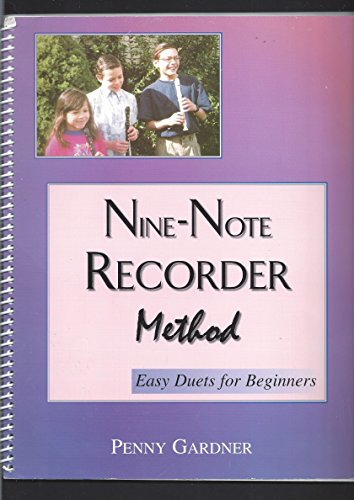
This collection of fresh duets and trios is designed especially for children and non-musicians. The large print and easy music makes it a practical way to learn and apply music-reading skills while learning to play the recorder. Ideal for home and classroom use.
"synopsis" may belong to another edition of this title.
About the Author
Penny Gardner, author of Charlotte Mason Study Guide: A Simplified Approach to a "Living" Education, has degrees in Elementary Education and Music Education. In this collection of duets and trios, she realizes a dream imagined years ago-to bring together her love of composing music and teaching children.
Excerpt. © Reprinted by permission. All rights reserved.
A Renaissance for Recorders Recorders deserve a renaissance in our homes and schools. The recorder was a popular instrument during Shakespeare's day. Later, the recorder was more or less replaced by the transverse flute, but interest in the recorder has continued through the ages. In Hamlet, Shakespeare wrote, "Come, some music! Come, the recorder..." Come, let's learn more about music and the recorder.
"Come, Some Music!" Learning to read music is an important skill that should be taught and practically applied on some instrument. A piano is a major purchase, usually followed by years of expensive lessons. If this option is out of your price range or if you just want the versatility of also learning a wind instrument, give the recorder a try. The recorder is often the springboard to further music study. Good quality plastic recorders may be purchased for $5 - $10 at your local music store. They are very easy to care for. All but the cheapest ones have a good tone. Later, if you like, you could look into purchasing wooden recorders. They are more expensive and need loving care. Buy soprano recorders; they are smaller with the holes closer together so children are physically able to play them. Many adults are musically illiterate; they don't know how to read music. The Nine-Note Recorder Method is the perfect resource to help you learn to read music. Have a musically literate friend make sure you understand the basics before you try to teach children how to play the recorder. Duets are songs in two parts. You can tell if a song is a duet when you see vertical lines connecting two staffs. When two notes on the two different-but-connected staffs are lined up, that means they are played at the same time. Trios are songs in three parts. Duets and trios are great fun for families and classrooms. You can split up into teams to perform these part songs. The resulting harmony can be very exciting. The Nine-Note Recorder Method contains 70 duets, trios, and rounds.
"Come, the Recorder..." Here are some tips to keep in mind as you learn to play the recorder. By incorporating these habits you will be able to play more musically: 1. Keep your arms relaxed and comfortably at your sides. Do not hold the recorder up in the air. Hold it fairly close to your chest. 2. Keep the recorder in front of your teeth. Some children try to hold the recorder between their teeth-that's a no-no! 3. Your left hand goes at the top of the recorder. Your right hand goes below with the thumb of the right hand supporting the recorder at all times. Don't tense up. 4. When you cover holes, be sure your fingers cover them completely. 5. Blow softly. Little air is required. Blowing too hard produces an obnoxious and unmusical noise. Experiment to find a beautiful tone. 6. Don't force children to learn too early. I've found that seven- or eight-year-olds often struggle with an instrument. The nine- or ten-year-old will pick it up more easily. Older children will be able to teach themselves independently. 7. Practice fifteen minutes every day to see improvement. Use a music stand for better posture. The Nine-Note Recorder Method is geared specifically for children. It uses only the nine easiest notes and the print is large. This book is almost entirely duets and trios-a novelty in beginning music books. Isn't it more fun to play with someone else? Making music in harmony with other family or class members is a most rewarding experience!
Come, the Renaissance The recorder is a lovely ancient instrument that deserves our musical attention. It is part of our musical history and heritage. Come, let's start a Renaissance in our homes and schools by learning to play the recorder. "Come, some music! Come, the Recorder..."
Adapted and reprinted by permission from The Nine-Note Recorder Method: Easy Duets for Beginners by Penny Gardner.
"About this title" may belong to another edition of this title.
Search results for Nine-Note Recorder Method: Easy Duets for Beginners

Stock Image
Nine-Note Recorder Method: Easy Duets for Beginners
Seller: ThriftBooks-Atlanta, AUSTELL, GA, U.S.A.
Seller rating 5 out of 5 stars

Unknown. Condition: Good. No Jacket. Pages can have notes/highlighting. Spine may show signs of wear. ~ ThriftBooks: Read More, Spend Less. Seller Inventory # G1576360571I3N00
Stock Image
Nine-Note Recorder Method: Easy Duets for Beginners
Seller: ThriftBooks-Reno, Reno, NV, U.S.A.
Seller rating 5 out of 5 stars
Unknown. Condition: Good. No Jacket. Pages can have notes/highlighting. Spine may show signs of wear. ~ ThriftBooks: Read More, Spend Less. Seller Inventory # G1576360571I3N00
Stock Image
Nine-Note Recorder Method: Easy Duets for Beginners
Seller: ThriftBooks-Dallas, Dallas, TX, U.S.A.
Seller rating 5 out of 5 stars
Unknown. Condition: Good. No Jacket. Pages can have notes/highlighting. Spine may show signs of wear. ~ ThriftBooks: Read More, Spend Less. Seller Inventory # G1576360571I3N00
Seller Image
Nine-Note Recorder Method: Easy Duets for Beginners
Seller: -OnTimeBooks-, Phoenix, AZ, U.S.A.
Seller rating 5 out of 5 stars
Condition: good. A copy that has been read, remains in good condition. All pages are intact, and the cover is intact. The spine and cover show signs of wear. Pages can include notes and highlighting and show signs of wear, and the copy can include "From the library of" labels or previous owner inscriptions. 100% GUARANTEE! Shipped with delivery confirmation, if you're not satisfied with purchase please return item! Ships via media mail. Seller Inventory # OTV.1576360571.G
Stock Image
Nine-Note Recorder Method: Easy Duets for Beginners
Seller: Wonder Book, Frederick, MD, U.S.A.
Seller rating 5 out of 5 stars
Condition: Very Good. Very Good condition. A copy that may have a few cosmetic defects. May also contain light spine creasing or a few markings such as an owner's name, short gifter's inscription or light stamp. Seller Inventory # SB06N-00347
Stock Image
Nine-Note Recorder Method: Easy Duets for Beginners
Published by
Penny Gardner, Sandy, Ut, 1998
ISBN 10: 1576360571
ISBN 13: 9781576360576
Used
Paperback
Signed
Seller: Burke's Books, Eugene, OR, U.S.A.
Seller rating 5 out of 5 stars
Paperback. Condition: Very Good. Signed by author. Unmarked copy. Spiral paperback. Signed by Author(s). Book. Seller Inventory # 37477
Seller Image
Nine-Note Recorder Method: Easy Duets for Beginners
Seller: Mom's Resale and Books, River Hills, WI, U.S.A.
Seller rating 5 out of 5 stars
Spiral-bound. Condition: As New. 1998 Soft Cover Spiral Bound Edition. Very light shelf wear to cover. Seller Inventory # 3C-7-29-22-28
Stock Image
Nine-Note Recorder Method: Easy Duets for Beginners
Seller: GoldBooks, Denver, CO, U.S.A.
Seller rating 5 out of 5 stars
Paperback. Condition: new. New Copy. Customer Service Guaranteed. Seller Inventory # 29H68_51_1576360571
Stock Image
Nine-Note Recorder Method: Easy Duets for Beginners
Seller: BennettBooksLtd, Los Angeles, CA, U.S.A.
Seller rating 5 out of 5 stars
Spiral-bound. Condition: New. In shrink wrap. Looks like an interesting title! Seller Inventory # Q-1576360571