
Items related to Machine Learning with R, the tidyverse, and mlr
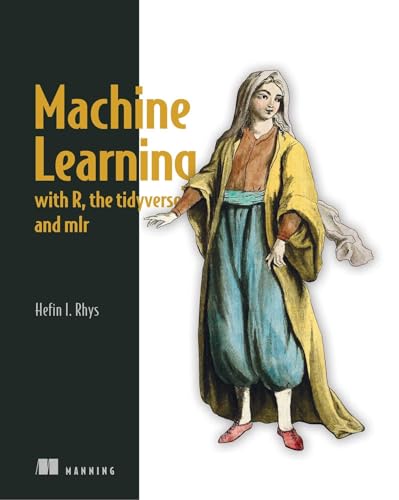
Synopsis
Summary
Machine learning (ML) is a collection of programming techniques for discovering relationships in data. With ML algorithms, you can cluster and classify data for tasks like making recommendations or fraud detection and make predictions for sales trends, risk analysis, and other forecasts. Once the domain of academic data scientists, machine learning has become a mainstream business process, and tools like the easy-to-learn R programming language put high-quality data analysis in the hands of any programmer. Machine Learning with R, the tidyverse, and mlr teaches you widely used ML techniques and how to apply them to your own datasets using the R programming language and its powerful ecosystem of tools. This book will get you started!
About the book
Machine Learning with R, the tidyverse, and mlr gets you started in machine learning using R Studio and the awesome mlr machine learning package. This practical guide simplifies theory and avoids needlessly complicated statistics or math. All core ML techniques are clearly explained through graphics and easy-to-grasp examples. In each engaging chapter, you’ll put a new algorithm into action to solve a quirky predictive analysis problem, including Titanic survival odds, spam email filtering, and poisoned wine investigation.
What's inside
Using the tidyverse packages to process and plot your data
Techniques for supervised and unsupervised learning
Classification, regression, dimension reduction, and clustering algorithms
Statistics primer to fill gaps in your knowledge
About the reader
For newcomers to machine learning with basic skills in R.
About the author
Hefin I. Rhys is a senior laboratory research scientist at the Francis Crick Institute. He runs his own YouTube channel of screencast tutorials for R and RStudio.
Table of contents:
PART 1 - INTRODUCTION
1.Introduction to machine learning
2. Tidying, manipulating, and plotting data with the tidyverse
PART 2 - CLASSIFICATION
3. Classifying based on similarities with k-nearest neighbors
4. Classifying based on odds with logistic regression
5. Classifying by maximizing separation with discriminant analysis
6. Classifying with naive Bayes and support vector machines
7. Classifying with decision trees
8. Improving decision trees with random forests and boosting
PART 3 - REGRESSION
9. Linear regression
10. Nonlinear regression with generalized additive models
11. Preventing overfitting with ridge regression, LASSO, and elastic net
12. Regression with kNN, random forest, and XGBoost
PART 4 - DIMENSION REDUCTION
13. Maximizing variance with principal component analysis
14. Maximizing similarity with t-SNE and UMAP
15. Self-organizing maps and locally linear embedding
PART 5 - CLUSTERING
16. Clustering by finding centers with k-means
17. Hierarchical clustering
18. Clustering based on density: DBSCAN and OPTICS
19. Clustering based on distributions with mixture modeling
20. Final notes and further reading
"synopsis" may belong to another edition of this title.
About the Author
Hefin Ioan Rhys is a senior laboratory research scientist in the Flow Cytometry Shared Technology Platform at The Francis Crick Institute. He spent the final year of his PhD program teaching basic R skills at the university. A data science and machine learning enthusiast, he has his own Youtube channel featuring screencast tutorials in R and R Studio.
From the Back Cover
Machine Learning with R, the tidyverse, and mlr gets you started in machine learning using R, RStudio and the awesome mlr machine learning package. This practical guide simplifies theory and needlessly complicated statistics or math. All core ML techniques are clearly explained through graphics and easy-to-grasp examples. In each engaging chapter, you'll put a new algorithm into action to solve a quirky predictive analysis problem, including Titanic survival odds, spam email filtering, and poisoned wine investigation.
What's Inside
● Using the tidyverse packages to process and plot your data
● Techniques for supervised and unsupervised learning
● Classification, regression, dimension reduction, and clustering algorithms
● Statistics primer to fill gaps in your knowledge
For newcomers to machine learning with basic skills in R.
From the Inside Flap
Thank you for purchasing Machine Learning with R, the tidyverse, and mlr! To get the most from this book, you should have basic R programming skills such as working with functions, objects, and data, and some very basic statistical knowledge.
During my PhD, I found that traditional statistical modeling approaches were not always sufficient for the types of data problems I was tackling. As the number of variables and complexity of the questions began to increase, I turned to machine learning techniques to extract meaningful predictions from my data instead. Working in academia, R was my tool of choice, and it has certainly come-of-age for machine learning applications with packages such as caret and mlr.
In this book you'll learn the basics of machine learning, and how many commonly used machine learning techniques work and how to apply them to your data. You'll learn all of this while using the mlr package in R, a modern and extremely flexible package that will simplify your learning process and get you building your own machine learning pipelines quickly. As building well-performing machine learning pipelines is about more than just training models, the book also incorporates and teaches tools from the tidyverse collection of packages, that help you transform, clean and plot your data ready for analysis. In fact, I devote an entire chapter to these tools near the start of the book, and use them in the code examples throughout the rest of the book.
After teaching you some basics of machine learning and tidyverse tools, each subsequent chapter in the book will teach a specific, commonly used machine learning technique. The start of each chapter will teach you what that technique does and how it works, in a graphical and non-mathematical way. Once you understand how the technique functions, you will code along with me, where we'll apply the technique to real data to make predictions on fun and interesting problems.
When you finish the book, you will have a mental tool kit of various modern machine learning techniques that you can apply to your own data. You will have the skills to apply each of these techniques correctly using the mlr package, to objectively compare the performance of these techniques for any given problem, and to prepare your data for analysis using tidyverse tools.
--Hefin Rhys
During my PhD, I found that traditional statistical modeling approaches were not always sufficient for the types of data problems I was tackling. As the number of variables and complexity of the questions began to increase, I turned to machine learning techniques to extract meaningful predictions from my data instead. Working in academia, R was my tool of choice, and it has certainly come-of-age for machine learning applications with packages such as caret and mlr.
In this book you'll learn the basics of machine learning, and how many commonly used machine learning techniques work and how to apply them to your data. You'll learn all of this while using the mlr package in R, a modern and extremely flexible package that will simplify your learning process and get you building your own machine learning pipelines quickly. As building well-performing machine learning pipelines is about more than just training models, the book also incorporates and teaches tools from the tidyverse collection of packages, that help you transform, clean and plot your data ready for analysis. In fact, I devote an entire chapter to these tools near the start of the book, and use them in the code examples throughout the rest of the book.
After teaching you some basics of machine learning and tidyverse tools, each subsequent chapter in the book will teach a specific, commonly used machine learning technique. The start of each chapter will teach you what that technique does and how it works, in a graphical and non-mathematical way. Once you understand how the technique functions, you will code along with me, where we'll apply the technique to real data to make predictions on fun and interesting problems.
When you finish the book, you will have a mental tool kit of various modern machine learning techniques that you can apply to your own data. You will have the skills to apply each of these techniques correctly using the mlr package, to objectively compare the performance of these techniques for any given problem, and to prepare your data for analysis using tidyverse tools.
--Hefin Rhys
"About this title" may belong to another edition of this title.
Search results for Machine Learning with R, the tidyverse, and mlr

Stock Image
Machine Learning with R, the tidyverse, and mlr
Seller: HPB-Red, Dallas, TX, U.S.A.
Seller rating 5 out of 5 stars

Paperback. Condition: Good. Connecting readers with great books since 1972! Used textbooks may not include companion materials such as access codes, etc. May have some wear or writing/highlighting. We ship orders daily and Customer Service is our top priority! Seller Inventory # S_476629106
Stock Image
Machine Learning with R
Seller: Basi6 International, Irving, TX, U.S.A.
Seller rating 5 out of 5 stars
Condition: Brand New. New. US edition. Expediting shipping for all USA and Europe orders excluding PO Box. Excellent Customer Service. Seller Inventory # ABEOCT25-12501
Stock Image
Machine Learning with R
Seller: Basi6 International, Irving, TX, U.S.A.
Seller rating 5 out of 5 stars
Condition: Brand New. New. US edition. Expediting shipping for all USA and Europe orders excluding PO Box. Excellent Customer Service. Seller Inventory # ABEOCT25-275435
Stock Image
Machine Learning with R
Seller: Romtrade Corp., STERLING HEIGHTS, MI, U.S.A.
Seller rating 5 out of 5 stars
Condition: New. This is a Brand-new US Edition. This Item may be shipped from US or any other country as we have multiple locations worldwide. Seller Inventory # ABBB-23205
Stock Image
Machine Learning with R, tidyverse, and mlr
Seller: WorldofBooks, Goring-By-Sea, WS, United Kingdom
Seller rating 5 out of 5 stars
Paperback. Condition: Very Good. The book has been read, but is in excellent condition. Pages are intact and not marred by notes or highlighting. The spine remains undamaged. Seller Inventory # GOR011689591
Buy Used
US$ 64.63
US$ 7.49 shipping
Ships from United Kingdom to U.S.A.
Ships from United Kingdom to U.S.A.
Quantity: 1 available
Stock Image
Machine Learning with R
Seller: SMASS Sellers, IRVING, TX, U.S.A.
Seller rating 4 out of 5 stars

Condition: New. Brand New Original US Edition. Customer service! Satisfaction Guaranteed. Seller Inventory # SNTNB-23205
Stock Image
Machine Learning with R, tidyverse, and mlr
Published by
Manning Publications Company, 2020
ISBN 10: 1617296570
ISBN 13: 9781617296574
New
Softcover
Seller: Books Puddle, Woodside, NY, U.S.A.
Seller rating 4 out of 5 stars
Condition: New. pp. 398. Seller Inventory # 26376558725
Stock Image
Machine Learning with R, tidyverse, and mlr
Published by
Manning Publications Company, 2020
ISBN 10: 1617296570
ISBN 13: 9781617296574
New
Softcover
Seller: Majestic Books, Hounslow, United Kingdom
Seller rating 4 out of 5 stars
Condition: New. pp. 398. Seller Inventory # 369519450
Buy New
US$ 69.36
US$ 8.69 shipping
Ships from United Kingdom to U.S.A.
Ships from United Kingdom to U.S.A.
Quantity: 2 available
Stock Image
Machine Learning with R, tidyverse, and mlr
Published by
Manning Publications Company, 2020
ISBN 10: 1617296570
ISBN 13: 9781617296574
New
Softcover
Seller: Biblios, Frankfurt am main, HESSE, Germany
Seller rating 4 out of 5 stars
Condition: New. pp. 398. Seller Inventory # 18376558735
Buy New
US$ 75.89
US$ 11.17 shipping
Ships from Germany to U.S.A.
Ships from Germany to U.S.A.
Quantity: 4 available
Stock Image
Machine Learning with R, tidyverse, and mlr
Seller: Studibuch, Stuttgart, Germany
Seller rating 5 out of 5 stars
paperback. Condition: Sehr gut. 511 Seiten; 9781617296574.2 Gewicht in Gramm: 1. Seller Inventory # 1461419
Buy Used
US$ 35.67
US$ 69.94 shipping
Ships from Germany to U.S.A.
Ships from Germany to U.S.A.
Quantity: 1 available