
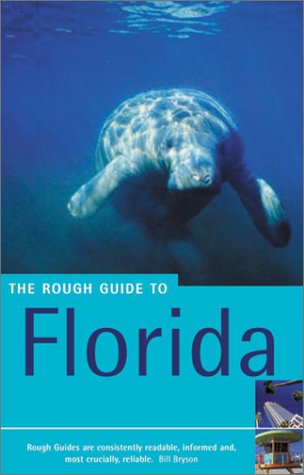
Items related to The Rough Guide to Florida (5th Edition)
Synopsis
INTRODUCTION The cut-rate package trips and photos of tanning flesh and Mickey Mouse that fill the pages of glossy holiday brochures ensure that everyone has an image of Florida – but seldom one that’s either accurate or complete. Pulling in nearly sixty million visitors each year to its beaches and theme parks, the aptly nicknamed "Sunshine State" is devoted to the tourist trade, yet it’s also among the least-understood parts of the US, with a history, character and diversity of landscape unmatched by any other region. Beyond the palm-fringed sands, hiking and canoeing trails wind through little-known forests and rivers, and the famed beaches themselves can vary wildly over a short distance – hordes of copper-toned revelers are often just a Frisbee’s throw from a deserted, pristine strand coveted by wildlife-watchers. Variations continue inland, where busy, modern cities are rarely more than a few miles away from steamy, primeval swamps.
In many respects, Florida is still evolving. Socially and politically, it hasn’t stayed still since the earliest days of US settlement: stimulating growth has always been the paramount concern, and with an average of a thousand people a day moving to the booming state, it’s currently the fourth most populous place in the nation. The changing demographics have helped overturn the common notion that Florida is dominated by retirees (though, coincidentally, the state song is a venerable spiritual entitled "Old Folks at Home"), or is part of the conservative Deep South, even if elements certainly do remain. The new Floridians tend to be a younger breed, taking advantage of the economic development along the Highway 4 corridor in the center of the state – and Florida’s lack of a state income tax. Immigration from outside the country is also on the increase, with Spanish- and French-Creole-speaking enclaves providing a reminder of geographic and economic ties to Latin America and the Caribbean. These links have proven almost as influential in raising the state’s material wealth over the past decade as the arrival of huge domestic businesses, including sections of the film industry that have opted for central Florida in preference to Hollywood.
Not all is rosy: in the past decade, Florida vigorously fought a reputation for violent crime against tourists; you’re highly unlikely to encounter any trouble, but the perception still lingers on a bit. The state also served as a major political battleground for the contested presidential election in 2000, rarely putting its best face forward as legal eagles and demonstrative protesters descended here en masse for the messy proceedings. A bit more behind the scenes, Florida is engaged in a struggle to provide enough houses, schools and roads for its growing population; levels of poverty in the rural areas can be severe; and in an increasingly multiethnic society, racial tensions frequently surface. Expanding towns without jeopardizing the environment is another hot issue; large amounts of land are under state or federal protection, and there are signs that the conservation lobby is gaining the upper hand. Nevertheless, uncontrolled development is posing serious ecological problems – not least to the Everglades.
"synopsis" may belong to another edition of this title.
Excerpt. © Reprinted by permission. All rights reserved.
WHERE TO GO
Heat-induced lethargy is no excuse not to get out and explore the different facets of Florida, as the state is compact enough to be toured easily and quickly. The essential stop is Miami, whose addictive, cosmopolitan vibe is enriched by its large Hispanic population, and where the much-photographed Art Deco district of Miami Beach provides an unmistakable backdrop for the state s liveliest nightclubs.
From Miami, a simple journey south brings you to the Florida Keys, a hundred-mile string of islands of which each has something to call its own, be it sport fishing, coral-reef diving, or a unique species of dwarf deer. The single road spanning the Keys comes to a halt at Key West, a blob of land that s legendary for its sunsets and anything-goes attitude. North from Miami, much of the Southeast Coast is a disappointingly urbanized strip commuter territory better suited for living in than visiting. Alongside the busy towns, however, beaches flow for many unbroken miles and finally escape the residential stranglehold along the Northeast Coast, where communities are often subservient to the sands that flank them.
When you tire of beach life and ocean views, make a short hop inland to Central Florida, whose verdant terrain features cattle farms, grassy hillsides, and isolated villages beside expansive lakes. The sole but rather dramatic disruption to this rural idyll is Walt Disney World, which practices tourism on the scale of the infinite. If you re in the mood, you can indulge in its ingenious fix of escapist fun; if not, the upfront commercialism may well encourage you to skip north to the deep forests of the Panhandle, Florida s link with the Deep South or to the art-rich towns and sunset-kissed beaches of the West Coast. Explore these at your leisure as you progress steadily south to the Everglades, a massive, alligator-filled swathe of sawgrass plain, mangrove islands and cypress swamp, which provides as definitive a statement of Florida s natural beauty as you ll encounter.
WHEN TO GO
You ll have to take into account Florida s climate and, of course, what your goals are when deciding on the best time for a visit. Florida is split into two climatic zones: subtropical in the south and warm temperate like the rest of the southeastern US in the north. These two zones determine the state s tourist seasons, and can affect costs accordingly. Anywhere south of Orlando experiences very mild winters (November to April), with pleasantly warm temperatures and a low level of humidity. This is the peak period for tourist activity, with prices at their highest and crowds at their thickest. It also marks the best time to visit the inland parks and swamps. The southern summer (May to October) seems hotter than it really is (New York is often warmer) because of the extremely high humidity, relieved only by afternoon thunderstorms and sometimes even hurricanes (though the chances of being there during one are remote); at this time of year you ll be lucky to see a blue sky. Lower prices and fewer tourists are the rewards for braving the mugginess, though mosquitoes can render the natural areas off-limits.
Winter is the off-peak period north of Orlando; in all probability, the only chill you ll detect is a slight nip in the evening air, though it s worth bearing in mind that at this time of year the sea is really too cold for swimming, and snow has been known to fall in the Panhandle. The northern Florida summer is when the crowds arrive, and when the days and the nights can be almost as hot and sticky as southern Florida.
"About this title" may belong to another edition of this title.
Search results for The Rough Guide to Florida (5th Edition)

Stock Image
Florida: The Rough Guide(5th Edn) (Rough Guide Travel Guides)
Seller: AwesomeBooks, Wallingford, United Kingdom
Seller rating 5 out of 5 stars

Paperback. Condition: Very Good. Florida: The Rough Guide(5th Edn) (Rough Guide Travel Guides) This book is in very good condition and will be shipped within 24 hours of ordering. The cover may have some limited signs of wear but the pages are clean, intact and the spine remains undamaged. This book has clearly been well maintained and looked after thus far. Money back guarantee if you are not satisfied. See all our books here, order more than 1 book and get discounted shipping. Seller Inventory # 7719-9781858287249
Buy Used
US$ 3.91
US$ 5.48 shipping
Ships from United Kingdom to U.S.A.
Ships from United Kingdom to U.S.A.
Quantity: 2 available
Stock Image
The Rough Guide to Florida
Published by
Dorling Kindersley Publishing, Incorporated, 2002
ISBN 10: 1858287243
ISBN 13: 9781858287249
Used
Softcover
Seller: Better World Books Ltd, Dunfermline, United Kingdom
Seller rating 5 out of 5 stars
Condition: Good. Former library copy. Pages intact with minimal writing/highlighting. The binding may be loose and creased. Dust jackets/supplements are not included. Includes library markings. Stock photo provided. Product includes identifying sticker. Better World Books: Buy Books. Do Good. Seller Inventory # 56198722-20
Buy Used
US$ 6.19
US$ 6.65 shipping
Ships from United Kingdom to U.S.A.
Ships from United Kingdom to U.S.A.
Quantity: 1 available
Stock Image
The Rough Guide to Florida (5th Edition)
Seller: HPB-Movies, Dallas, TX, U.S.A.
Seller rating 4 out of 5 stars

paperback. Condition: Very Good. Connecting readers with great books since 1972! Used books may not include companion materials, and may have some shelf wear or limited writing. We ship orders daily and Customer Service is our top priority! Seller Inventory # S_472618370
Stock Image
Florida: The Rough Guide(5th Edn) (Rough Guide Travel Guides)
Seller: Bahamut Media, Reading, United Kingdom
Seller rating 4 out of 5 stars
Paperback. Condition: Very Good. This book is in very good condition and will be shipped within 24 hours of ordering. The cover may have some limited signs of wear but the pages are clean, intact and the spine remains undamaged. This book has clearly been well maintained and looked after thus far. Money back guarantee if you are not satisfied. See all our books here, order more than 1 book and get discounted shipping. Seller Inventory # 6545-9781858287249
Buy Used
US$ 5.75
US$ 9.29 shipping
Ships from United Kingdom to U.S.A.
Ships from United Kingdom to U.S.A.
Quantity: 2 available
Stock Image
The Rough Guide to Florida (5th Edition)
Seller: The Maryland Book Bank, Baltimore, MD, U.S.A.
Seller rating 5 out of 5 stars
paperback. Condition: Very Good. Fifth Edition. Used - Very Good. Seller Inventory # 9-N-1-0256