
Items related to Chinese Musical Instruments (Chinese Music Monograph...
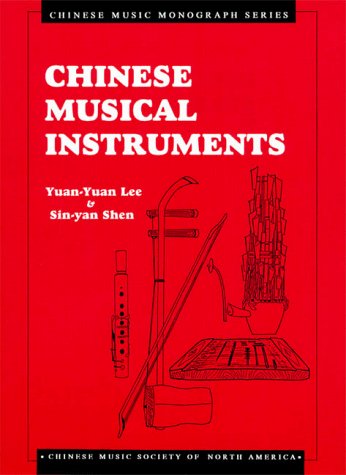
Excerpt. © Reprinted by permission. All rights reserved.
From Chapter 1: Years ago, while we were still developing the field of Cultural Acoustics, many colleagues asked me, "I've been playing the erhu for a while now - how come I still can't get the proper tone - It just doesn't sound Chinese!" There the connection between tone and cultural acoustics is but one aspect of the problem. The music of China is built on a specific harmonic system, and that harmonic system is not only different but also broader than what is known in the West, especially when the current prevalence of the equal-tempered scale system is included. Chinese music came from natural and physically just intervals. That is why Chinese string tuning is stacked fifth-fourth in all respects rather than the fifth-fifth stacking as is practiced in the West today, and exemplified by the violin family, which includes the violin, the viola, and the cello. The primary difference between musical systems of different culture is their preference for intervals, and thus a difference in the breadth of their harmonic system. Let me now explain the meaning of the breadth of one's harmonic system. In all compositions, there are intentional conflicts between harmony and discord. But what is harmonic and what is not is extremely culture- specific. In present-day European and American music, the second is a discord while it is not in China. Here we are dealing with specific intervals, but in reality it is always the combined effect of many intervals, while your brain still remembers them whether they are sounding at the same time or slightly apart, that causes your brain to be stimulated in desired fashion. In the performance of a single instrument, such harmonic stimulation comes into play in the interaction between the player and the instrument - thus his or her tone. Frequently, musicians do not think of the tone as a harmonic entity when it absolutely is. The cultural acoustical preferences of a race or a nationality determines the types of tones of instruments it accepts. This explains why certain instruments sound Chinese, whether you are familiar with it or not. However, with a Chinese instrument, the way you play it can still make it sound utterly bland and thus not Chinese. One example is to ask a violin player to play the erhu. Without becoming accustomed to the acoustical resonances of the erhu, the violin player may think it is just another string instrument on which you are to divide the strings. The erhu and the violin are wildly different instruments in that the performance of the erhu actually requires the production of acoustics that maximizes the contrast between its major resonance components, whereas the philosophy behind the development of the violin was to even out register differences as much as possible.
Chinese music is built on a totally consistent harmonic system which controls melodic progression, orchestration, and temperament use. It is perhaps the only major musical system in the world that has such all-encompassing requirements on all aspects of its music, and at the same time allowing the largest flexibility in the acceptance of harmonic intervals into music. In the 1960s and the early 1970s, through the work of the Chinese Music Society of North America, we discovered the cyclical harmonic skeletons known as zhi, shang, yu, jue, gong in the Chinese harmonic system. Before this work, those terms were for a long time referred to as scale steps. This set of harmonic skeletons is self generating, always in tune without equalizing temperaments because its system does not believe in the twelve tones alone. The same harmonic intervals which are the basis of the Chinese harmonic system were found to appear prominently in the design of the overtone structure of the ancient dual-pitched bronze zhong bells....
"About this title" may belong to another edition of this title.