
Items related to G Is for Googol: A Math Alphabet Book
Synopsis
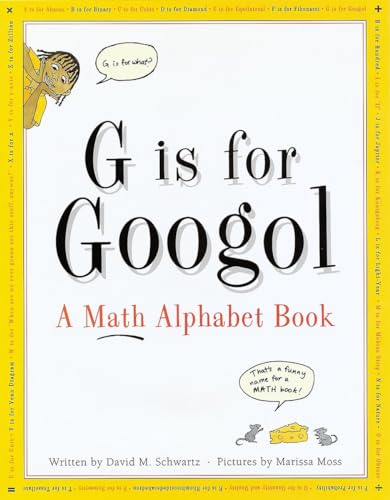
B is for Binary, F is for Fibonacci, P is for Probability... even a small sample begins to give you the idea that this is a math book unlike any other. Ranging freely from exponents to light-years to numbers found in nature, this smorgasbord of math concepts and trivia makes a perfect classroom companion or gift book for the budding young mathematician at home. Even the most reluctant math student will be drawn in by the author's trademark wit, Marissa Moss's quirky illustrations and funny captions, and the answers revealed in W is for " When are we ever gonna use this stuff, anyway?" Download the G is for Googol Teacher's Guide(300K)
"synopsis" may belong to another edition of this title.
About the Author
DAVID SCHWARTZ is the author of 50 children's books, including G IS FOR GOOGOL and Q IS FOR QUARK. He is a frequent guest speaker at schools in the US abroad. He lives with his wife-and co-author-YAEL SCHY in Oakland, California.
Marissa Moss was an honors math student and the only girl on her school math team. She is the creator of the Amelia's Notebook Series, RACHEL'S JOURNAL, and REGINA'S BIG MISTAKE, among others. She lives in Berkeley, CA.
Reviews
Grade 6 Up-An enchanting alphabet book that will make its audience laugh out loud. Beginning with "A is for Abacus" and ending with "Z is for Zillion," the author takes readers on a roller-coaster ride through important terms and concepts. The text is lively and clear and will appeal to even those who think math is as dull as the kitchen floor. Two particularly clever examples are "R is for Rhombicosidodecahedron" and "W is for 'When are we ever gonna use this stuff, anyway?'" The cartoon illustrations are colorful, amusing, and informative. Young people will relate to the characters in these drawings that lend a visual dimension to the text. They will also appreciate the large, spacious pages. A terrific title to instruct and entertain.
Linda Wadleigh, Oconee County Middle School, Watkinsville, GA
Copyright 1998 Reed Business Information, Inc.
Each topic gets several paragraphs of breezy, accessible discussion, illustrated with labeled, freely drawn ink-and-watercolor figures.
Gr. 3^-5. This large-format alphabet book introduces terms and ideas from mathematics, with (usually) one topic per letter. Entries include abacus, binary, cubit, diamond ("There are no diamonds in math. We put diamond in this book so you would know it doesn't belong here"), equilateral, exponent, Fibonacci, googol, y-axis, and zillion. The humorous style Schwartz brought to How Much Is a Million? lightens the reading here, and so do the bright watercolor-washed drawings and cartoons by Marissa Moss, author-illustrator of the Amelia's Notebook series. Still, it's hard to understand why the information, however well presented, appears in an alphabet book. The alphabetical theme makes the arrangement of ideas a haphazard, arbitrary affair. Nevertheless, the attractive book may interest browsers and open doors to further math study. Also, this resource explains terms like binary system and Fibonacci numbers in ways that middle-grade children might understand. Carolyn Phelan
Excerpt. © Reprinted by permission. All rights reserved.
A is for Abacus
Hundreds of years before calculators were invented, people in China discovered they could add and subtract quickly by sliding beads back and forth on strings. They put seven beads on a string and mounted a few of these strings in a wooden frame. We call the device an abacus. It was a great time-saver, and it soon spread to other parts of Asia. The Russians wanted more beads on their abacuses, so they strung ten on each string. The Japanese figured out how to add and subtract just as quickly with only five beads on each string.
Today many people in China and Japan still use abacuses. The strings represent place values (1s, 10s, 100s, etc.), and the positions of the beads along the string represent the number of 1s, 10s, or 100s being used. If you think pushing beads back and forth is slow work, think again. In contests between people using calculators and people using abacuses to add and subtract, the abacus users usually win! Some Chinese and Japanese shopkeepers don’t even need a real abacus. They just move their hands in the air, sliding imaginary beads back and forth on imaginary strings. But they still get a real answer!
B is for Binary
Suppose that instead of getting your regular allowance, you have a choice: You can have a million dollars. Or you can have a penny.
Well, not just a penny, but one cent today, two cents tomorrow, four cents the next day, eight cents the next, and so on, for 30 days. Each day, the amount will double. Which would you choose?
Let’s see how many pennies you would get each day during the first week:
1 2 4 8 16 32 64
On the seventh day, you’ll receive 64 cents. It doesn’t seem like a very good deal, does it? But this is just the first week. While the money is coming in, let’s take a close look at the numbers. When you start with 1 and double it to get 2, then double 2 to get 4, then double 4, and keep on doubling, you get a sequence of numbers called the binary sequence. The numbers are called binary numbers. There is something very important about binary numbers.
You can add binary numbers to make any other number. While 5 is not a binary number, you can make 5 by adding 4 and 1, which are binary numbers. To make 13, add 8, 4, and 1. You can make every number from 1 to 127 out of the first seven binary numbers.
On this page is a chart showing how. On the right side of the chart are decimal numbers--the regular kind you use every day. At the top of the chart are binary numbers. Find the decimal number you want to make and look to the left of it. Wherever you see a check mark, use the binary number at the top of that column. You can create 7 by adding 1, 2, and 4 (that’s why they are checked). You can make 13 by adding 8, 4, and 1. We started the chart--now you finish it. (No, you may not write in the book!)
Suppose we put a 1 wherever there’s a check mark, and a 0 wherever there isn’t a check mark. (We won’t put anything to the left of the first 1.)
What we have here is the binary system, a way of writing numbers using only 1s and 0s. In this system, the number 5 is written 101 and the number 15 is written 1111.
You’re probably wondering why anyone would want to write such long, funny-looking numbers with just 1s and 0s that take up so much room on the page. Well, the binary system isn’t meant for the page. It’s meant for the chip. The computer chip.
Computers “think” in binary. A computer chip has lots and lots of invisible electric switches called bits. A bit can be on or off. That’s all it can be. On or off, off or on. It has no brain. It has no variety. It just has on and off. Think of off as the number 0. Think of on as the number 1. Put six bits in a row, and starting at the right side, turn the first one on, turn the next one off, the next one on, the next one off, the next two on. What have you got? You’ve got the binary number 110101, or 53 in the decimal system. Just use a chart like ours to figure it out.
That’s how computers work. A computer turns everything (even letters and pictures and music) into 0s and 1s by turning some bits on and some bits off. The 1s and 0s make binary numbers.
Okay, you say. The binary system can handle small numbers like 1 and 3 and 20 and maybe 153, but it would take billions of bits to make a really big number, like 536,870,912--right? Well, no. It would take only 30 bits to make that number. If you started with 1 and doubled it, then doubled that, and kept doubling, when you got to the 30th number in the binary sequence, you’d have 100000000000000000000000000000 (a one with 29 zeros). Or in the decimal system, 536,870,912. Exactly.
Remember those pennies? Now we know how many you’d get on the 30th day of doubling: 536,870,912. Hmmm. That’s the same as $5,368,709.12. And that doesn’t count what you received on each of the other days!
Now which would you choose? A million dollars or a penny?
"About this title" may belong to another edition of this title.
Search results for G Is for Googol: A Math Alphabet Book

Stock Image
G Is for Googol: A Math Alphabet Book
Seller: Gulf Coast Books, Cypress, TX, U.S.A.
Seller rating 5 out of 5 stars

hardcover. Condition: Fair. Marissa Moss (illustrator). Seller Inventory # 1883672589-4-37406282
Seller Image
G Is for Googol: A Math Alphabet Book
Seller: Zoom Books Company, Lynden, WA, U.S.A.
Seller rating 5 out of 5 stars
Condition: very_good. Marissa Moss (illustrator). Book is in very good condition and may include minimal underlining highlighting. The book can also include "From the library of" labels. May not contain miscellaneous items toys, dvds, etc. . We offer 100% money back guarantee and 24 7 customer service. Seller Inventory # ZBV.1883672589.VG
Stock Image
G is for Googol: Math Alphabet
Seller: World of Books (was SecondSale), Montgomery, IL, U.S.A.
Seller rating 5 out of 5 stars
Condition: Acceptable. Marissa Moss (illustrator). Item in acceptable condition! Textbooks may not include supplemental items i.e. CDs, access codes etc. Seller Inventory # 00109090715
Stock Image
G Is for Googol: A Math Alphabet Book
Seller: World of Books (was SecondSale), Montgomery, IL, U.S.A.
Seller rating 5 out of 5 stars
Hardback. Condition: Good. Marissa Moss (illustrator). B is for Binary, F is for Fibonacci, P is for Probability. even a small sample begins to give you the idea that this is a math book unlike any other. Ranging freely from exponents to light-years to numbers found in nature, this smorgasbord of math concepts and trivia makes a perfect classroom companion or gift book for the budding young mathematician at home. Even the most reluctant math student will be drawn in by the author's trademark wit, Marissa Moss's quirky illustrations and funny captions, and the answers revealed in W is for When are we ever gonna use this stuff, anyway? Download the G is for Googol Teacher's Guide(300K). Seller Inventory # 00097087175
Seller Image
G Is for Googol: A Math Alphabet Book
Seller: 3Brothers Bookstore, Egg harbor township, NJ, U.S.A.
Seller rating 5 out of 5 stars
Condition: good. Marissa Moss (illustrator). Books may contain some notes and highlighting. Supplements such as Access Codes, Cd's Dust Jackets, etc. are not guaranteed with used book purchases. Seller Inventory # EVV.1883672589.G
Seller Image
G Is for Googol: A Math Alphabet Book
Seller: Reliant Bookstore, El Dorado, KS, U.S.A.
Seller rating 5 out of 5 stars
Condition: very_good. Marissa Moss (illustrator). This book is in excellent condition. There may be minimal writing on the inside cover or cover page. Cover image on the book may vary from photo. Ships out quickly in a secure plastic mailer. Seller Inventory # RDV.1883672589.VG
Seller Image
G Is for Googol: A Math Alphabet Book
Seller: Greenworld Books, Arlington, TX, U.S.A.
Seller rating 5 out of 5 stars
Condition: good. Marissa Moss (illustrator). Fast Free Shipping â" Good condition. It may show normal signs of use, such as light writing, highlighting, or library markings, but all pages are intact and the book is fully readable. A solid, complete copy that's ready to enjoy. Seller Inventory # GWV.1883672589.G
Stock Image
G Is for Googol: A Math Alphabet Book
Seller: More Than Words, Waltham, MA, U.S.A.
Seller rating 5 out of 5 stars
Condition: Good. Marissa Moss (illustrator). . goodFormer Library book. All orders guaranteed and ship within 24 hours. Before placing your order for please contact us for confirmation on the book's binding. Check out our other listings to add to your order for discounted shipping. Seller Inventory # WAL-E-5a-002341
Seller Image
G Is for Googol: A Math Alphabet Book
Seller: ZBK Books, Carlstadt, NJ, U.S.A.
Seller rating 5 out of 5 stars
Condition: very_good. Marissa Moss (illustrator). Fast & Free Shipping â" Very Good condition book with a firm cover and clean pages. Shows normal use and some light wear or limited notes markings. A solid, nice copy to enjoy. Seller Inventory # ZWV.1883672589.VG
Seller Image
G Is for Googol: A Math Alphabet Book
Seller: Greenworld Books, Arlington, TX, U.S.A.
Seller rating 5 out of 5 stars
Condition: very_good. Marissa Moss (illustrator). Fast Free Shipping â" Very Good condition book with a firm cover and clean pages. Shows normal use and some light wear or limited notes markings. A solid, nice copy to enjoy. Seller Inventory # GWV.1883672589.VG