
Items related to Wilson's Ghost: Reducing the Risk of Conflict,...
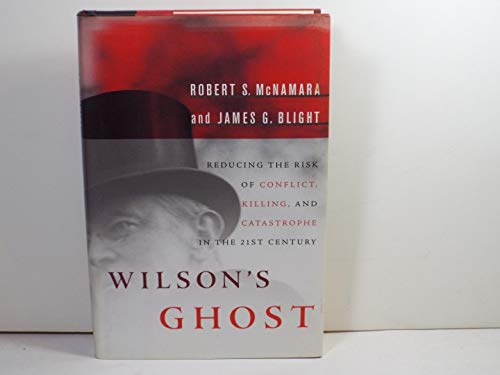
Wilson's Ghost: Reducing the Risk of Conflict, Killing, and Catastrophe in the 21st Century - Hardcover
Synopsis
A passionate manifesto on what exactly we can and must do to prevent devastating global conflicts in the century ahead.
Woodrow Wilson's vision of a collective international action to resist aggressive conflict after the carnage of World War I failed tragically. Over 160 million people died in war during the 20th century, and in Wilson's Ghost, Robert S. McNamara and James G. Blight put forth a decisive, multi-faceted action program for realizing Wilson's dream during this century. The plan begins with a moral imperative that establishes as a major goal of foreign policy across the globe the avoidance of war. To that end, enforcement entails only multilateral intervention on the part of the United States; full reconciliation with Russia and China to integrate those nations into relations with the other Great Powers; restructuring the United Nations to greater effectiveness; defining and deterring war crimes; creating UN enforcement; and finally, reducing nuclear danger by eliminating the huge arsenal held by the United States and Russia, and by signing into law the Comprehensive Test Ban Treaty. The authors support their plan with specific, achievable steps that can begin now to ensure a more peaceful 21st century.
"synopsis" may belong to another edition of this title.
About the Author
Robert S. McNamara was president of the Ford Motor Company, secretary of defense to Presidents Kennedy and Johnson, and president of the World Bank. He is the author of In Retrospect: The Tragedy and Lessons of Vietnam, and co-author of Argument Without End: In Search of Answers to the Vietnam Tragedy. James G. Blight is professor of international relations (research) at the Watson Institute for International Studies at Brown University, and the author or editor of a dozen books on the recent history of U.S. foreign policy, including Argument Without End.
Reviews
In the 20th century, 160 million people died in war and political violence, the bloodiest century on record. But, warn the authors, unless there is a radical change in the conduct of international affairs, the 21st century could see far more carnage. Drawing on the Wilsonian tradition in American foreign policy, former Secretary of Defense McNamara and Brown University international relations professor Blight (the two also coauthored Argument Without End: In Search of Answers to the Vietnam Tragedy) offer two imperatives the U.S. should follow: a "Moral Imperative," to make it a major goal of U.S. foreign policy to avoid the violence of the previous century, and a "Multilateral Imperative," to disavow the unilateral use of U.S. economic, political and military power when confronting foreign crises or challenges. A moral imperative does not mean violence will never occur, but with such an imperative in place leaders will be far more cautious than in the past in resorting to violence. For the U.S., the moral imperative must be tied to a multilateral imperative. The U.S. is indeed powerful and must lead, but it is not omnipotent, say the authors. Multilateral action can help ensure that the U.S. does not act precipitously, in an ignorant and arrogant fashion. The authors amplify on these imperatives in separate vignettes on the Cuban missile crisis of 1962, where they were applied, and on the Vietnam War, where they were not (McNamara was a participant in both). Finally, the authors address in detail three major problems confronting U.S. foreign policy bringing Russia and China fully into the world community, reducing communal or ethnic violence, eliminating nuclear weapons. Deftly written and cogently argued, this is one of the best recent books on foreign policy. (On-sale: June 5) Forecast: The day before this book hits the stores, McNamara will appear on the Today Show, kicking off a tour to New York, D.C., Boston, Philadelphia, Los Angeles and San Francisco. Given McNamara's position and background, this will generate media attention, but is unlikely to bolster sales much beyond foreign policy-wonk circles.
Copyright 2001 Cahners Business Information, Inc.
Former Secretary of Defense McNamara, perhaps as controversial today as in the 1960s, reunites with Blight, the Brown University international relations professor with whom he wrote Argument Without End (1999), to suggest what should be done to realize Woodrow Wilson's dream of an end to war. Reducing human carnage in the new century, they hold, "requires an unprecedented moral commitment to avoid killing, in addition to an equally unprecedented commitment to 'zero-tolerance multilateralism.'" To prevent Great Power conflict, McNamara and Blight suggest, it is essential to "bring Russia and China in from the Cold." To reduce "communal killing" as in Bosnia or Rwanda, they call for multilateral intervention in "dangerous, troubled, failed, murderous states." To avoid nuclear catastrophe, they insist, "nuclear weapons can and must now be eliminated . . . rather than trying . . . to construct a defensive 'shield.'" George W. Bush earned points in the 2000 election for calling for a more humble U.S. foreign policy. McNamara and Blight also stress humility, but empathy is an equally important part of their foreign policy prescription. Thoughtful, provocative analysis. Mary Carroll
Copyright © American Library Association. All rights reserved
Former Secretary of Defense McNamara is 85 and still atoning for his role in the Vietnam conflict (see In Retrospect: The Tragedy and Lessons of Vietnam, LJ 4/15/95). His new book, written with international relations expert Blight, takes the ideas and idealism of Woodrow Wilson and sets forth a moral and multilateral formula for achieving peace in the world. The authors advocate the importance of "democratic decision-making" in U.S. foreign policy and increased empathy toward Russia and China. They also warn that the plague of communal violence within nations poses a dilemma for the United States and international organizations, as intervention might not lead to a satisfactory solution of the conflict. McNamara and Blight are especially eloquent in their pleas to end the threat of nuclear catastrophe, and McNamara inserts his personal reflections on the Cuban missile crisis (as well as on the lost opportunities for an early resolution in Vietnam). The authors critique major foreign policy theories and develop a convincing "Wilsonian" framework for U.S. policy. This stimulating and challenging work will do much to redeem McNamara's legacy; recommended for academic and large public libraries. Thomas A. Karel, Franklin & Marshall Coll. Lib., Lancaster, PA
Copyright 2001 Reed Business Information, Inc.
"About this title" may belong to another edition of this title.
Search results for Wilson's Ghost: Reducing the Risk of Conflict,...

Stock Image
Wilson's Ghost: Reducing the Risk of Conflict, Killing and Catastrophe in the 21st Century
Seller: World of Books (was SecondSale), Montgomery, IL, U.S.A.
Seller rating 5 out of 5 stars

Hardback. Condition: Good. This is the authors' manifesto on what exactly we can and must do to prevent devastating global conflicts in the 21st century, based on Woodrow Wilson's vision of a collective international action to resist aggressive conflict. The authors support their plan with specific, achievable steps. Seller Inventory # CIN1891620894G
Stock Image
Wilson's Ghost: Reducing the Risk of Conflict, Killing and Catastrophe in the 21st Century
Seller: World of Books (was SecondSale), Montgomery, IL, U.S.A.
Seller rating 5 out of 5 stars
Hardback. Condition: Fair. This is the authors' manifesto on what exactly we can and must do to prevent devastating global conflicts in the 21st century, based on Woodrow Wilson's vision of a collective international action to resist aggressive conflict. The authors support their plan with specific, achievable steps. Seller Inventory # 00107915340
Seller Image
Wilson's Ghost: Reducing the Risk of Conflict, Killing, and Catastrophe in the 21st Century
Seller: Greenworld Books, Arlington, TX, U.S.A.
Seller rating 5 out of 5 stars
Condition: good. Fast Free Shipping â" Good condition. It may show normal signs of use, such as light writing, highlighting, or library markings, but all pages are intact and the book is fully readable. A solid, complete copy that's ready to enjoy. Seller Inventory # GWV.1891620894.G
Stock Image
Wilson's Ghost: Reducing the Risk of Conflict, Killing, and Catastrophe in the 21st Century
Seller: More Than Words, Waltham, MA, U.S.A.
Seller rating 5 out of 5 stars
Condition: Good. . . Before placing your order for please contact us for confirmation on the book's binding. Check out our other listings to add to your order for discounted shipping. All orders guaranteed and ship within 24 hours. Seller Inventory # BOS-S-10a-01513
Stock Image
Wilson's Ghost: Reducing the Risk of Conflict, Killing and Catastrophe in the 21st Century
Seller: World of Books Inc, Montgomery, IL, U.S.A.
Seller rating 4 out of 5 stars

Hardback. Condition: Good. This is the authors' manifesto on what exactly we can and must do to prevent devastating global conflicts in the 21st century, based on Woodrow Wilson's vision of a collective international action to resist aggressive conflict. The authors support their plan with specific, achievable steps. Seller Inventory # CIN1891620894G
Stock Image
Wilson's Ghost: Reducing the Risk of Conflict, Killing and Catastrophe in the 21st Century
Seller: World of Books Inc, Montgomery, IL, U.S.A.
Seller rating 4 out of 5 stars
Hardback. Condition: Fair. This is the authors' manifesto on what exactly we can and must do to prevent devastating global conflicts in the 21st century, based on Woodrow Wilson's vision of a collective international action to resist aggressive conflict. The authors support their plan with specific, achievable steps. Seller Inventory # CIN1891620894A
Stock Image
Wilson's Ghost: Reducing the Risk of Conflict, Killing, and Catastrophe in the 21st Century
Published by
PublicAffairs (edition First Edition (stated)), 2001
ISBN 10: 1891620894
ISBN 13: 9781891620898
Used
Hardcover
Seller: BooksRun, Philadelphia, PA, U.S.A.
Seller rating 5 out of 5 stars
Hardcover. Condition: Very Good. First Edition (stated). With dust jacket. It's a well-cared-for item that has seen limited use. The item may show minor signs of wear. All the text is legible, with all pages included. It may have slight markings and/or highlighting. Seller Inventory # 1891620894-11-1-29
Stock Image
Wilson's Ghost: Reducing the Risk of Conflict, Killing, and Catastrophe in the 21st Century
Seller: ThriftBooks-Reno, Reno, NV, U.S.A.
Seller rating 5 out of 5 stars
Hardcover. Condition: Very Good. No Jacket. Missing dust jacket; May have limited writing in cover pages. Pages are unmarked. ~ ThriftBooks: Read More, Spend Less. Seller Inventory # G1891620894I4N01
Stock Image
Wilson's Ghost: Reducing the Risk of Conflict, Killing, and Catastrophe in the 21st Century
Seller: ThriftBooks-Dallas, Dallas, TX, U.S.A.
Seller rating 5 out of 5 stars
Hardcover. Condition: Good. No Jacket. Pages can have notes/highlighting. Spine may show signs of wear. ~ ThriftBooks: Read More, Spend Less. Seller Inventory # G1891620894I3N00
Stock Image
Wilson's Ghost: Reducing the Risk of Conflict, Killing, and Catastrophe in the 21st Century
Seller: ThriftBooks-Atlanta, AUSTELL, GA, U.S.A.
Seller rating 5 out of 5 stars
Hardcover. Condition: Very Good. No Jacket. May have limited writing in cover pages. Pages are unmarked. ~ ThriftBooks: Read More, Spend Less. Seller Inventory # G1891620894I4N00