
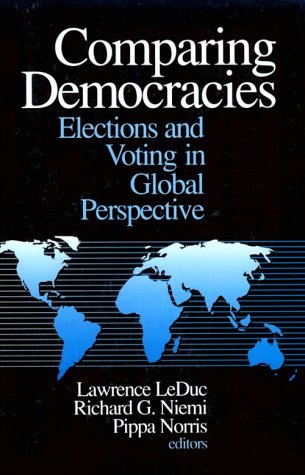
Comparing Democracies: Elections and Voting in Global Perspective
ISBN 10: 0803958366 ISBN 13: 9780803958364
Published by SAGE Publications, Inc, 1996
Used
Soft cover
From
World of Books (was SecondSale), Montgomery, IL, U.S.A.
Seller rating 5 out of 5 stars

AbeBooks Seller since December 20, 2007
This specific item is no longer available.
About this Item
Description:
Item in good condition. Textbooks may not include supplemental items i.e. CDs, access codes etc. Seller Inventory # 00042224429
Synopsis:
Elections have undergone radical changes in recent decades, not only in the United States but throughout the world. Electoral systems have experienced major reform in many countries including Italy, Israel, and Japan, and new parties have changed the face of competition in Germany, France, and Belgium. The emerging democracies of Eastern Europe and Latin America have also established new party systems with competitive elections. Integrating and synthesizing the most recent research in the field of elections, Comparing Democracies offers selections from a team of renowned international scholars writing on their areas of specialty. Contributors provide a cross-national study comparing elections in a number of democracies and discussing key topics associated with the study of elections including electoral laws, campaign finance regulations, media communications, and voter turnout.
This prestigious volume is an invaluable addition to the literature on elections and voting behavior, comparative democracy, and area studies. It will also serve as a standard reference for graduate students in comparative politics.
About the Authors:
Richard G. Niemi is Don Alonzo Watson Professor of Political Science at the University of Rochester, where he has taught for forty-five years and has served as department chair, associate dean for graduate studies, and interim dean. He earned his PhD from the University of Michigan in 1967. Professor Niemi has been a Guggenheim fellow and a fellow at the Center for Advanced Study in the Behavioral Sciences. He has been a visiting professor at the University of Lund (Sweden) and at the University of Iowa. In 2007–2009 he was president of the American Political Science Association’s Section on State Politics and Policy. He is a foreign member of the Finnish Academy of Science and Letters and a member of the American Academy of Arts and Sciences. He is the author, coauthor, or editor of numerous works on political socialization, civic education, voting behavior, and various aspects of state politics. He has an ongoing interest in the Native Americans of upstate New York and Wisconsin, from whom he can trace a portion of his ancestry.
Pippa Norris is Director of the Democratic Governance group in the United Nations Development Programme in New York and the Maguire Lecturer in Comparative Politics at Harvard University′s John F. Kennedy School of Government. Recent books include Sacred and Secular: Politics and Religion Worldwide (with Ronald Inglehart, 2004), Electoral Engineering: Voting Rules and Political Behavior (2004), and Driving Democratization: What Works (2006). Norris, who is a political scientist, has served as an expert consultant for many international bodies including the UN, UNESCO, the Council of Europe, International IDEA, the National Endowment for Democracy, and the UK Electoral Commission.
"About this title" may belong to another edition of this title.
Bibliographic Details
Title: Comparing Democracies: Elections and Voting ...
Publisher: SAGE Publications, Inc
Publication Date: 1996
Binding: Soft cover
Condition: Good
Top Search Results from the AbeBooks Marketplace

Stock Image
Comparing Democracies: Elections and Voting in Global Perspective
Seller: More Than Words, Waltham, MA, U.S.A.
Seller rating 5 out of 5 stars
Condition: Good. . . All orders guaranteed and ship within 24 hours. Before placing your order for please contact us for confirmation on the book's binding. Check out our other listings to add to your order for discounted shipping. Seller Inventory # WAL-C-4h-002445
Seller Image
Comparing Democracies: Elections and Voting in Global Perspective
Seller: Book Express (NZ), Shannon, New Zealand
Seller rating 4 out of 5 stars

Paperback. Condition: Good. 440 pages. Elections have undergone radical changes in recent decades. Television, opini on polls, and professional campaign consultants have become transforming factors . Electoral systems have been reformed in many countries including Italy, Israel. Seller Inventory # 1203c
Buy Used
US$ 5.41
US$ 31.00 shipping
Ships from New Zealand to U.S.A.
Ships from New Zealand to U.S.A.
Quantity: 1 available
Stock Image
Comparing Democracies: Elections and Voting in Global Perspective
Seller: ThriftBooks-Atlanta, AUSTELL, GA, U.S.A.
Seller rating 5 out of 5 stars
Paperback. Condition: Good. No Jacket. Former library book; Pages can have notes/highlighting. Spine may show signs of wear. ~ ThriftBooks: Read More, Spend Less. Seller Inventory # G0803958366I3N10
Stock Image
Comparing Democracies : Elections and Voting in Global Perspective
Published by
SAGE Publications, Incorporated, 1996
ISBN 10: 0803958366
ISBN 13: 9780803958364
Used
Softcover
First Edition
Seller: Better World Books: West, Reno, NV, U.S.A.
Seller rating 5 out of 5 stars
Condition: Very Good. 1st Edition. Former library copy. Pages intact with possible writing/highlighting. Binding strong with minor wear. Dust jackets/supplements may not be included. Includes library markings. Stock photo provided. Product includes identifying sticker. Better World Books: Buy Books. Do Good. Seller Inventory # GRP82683221
Stock Image
Comparing Democracies: Elections and Voting in Global Perspective
Seller: SHIMEDIA, Brooklyn, NY, U.S.A.
Seller rating 5 out of 5 stars
Condition: New. Satisfaction Guaranteed or your money back. Seller Inventory # 0803958366