About this Item
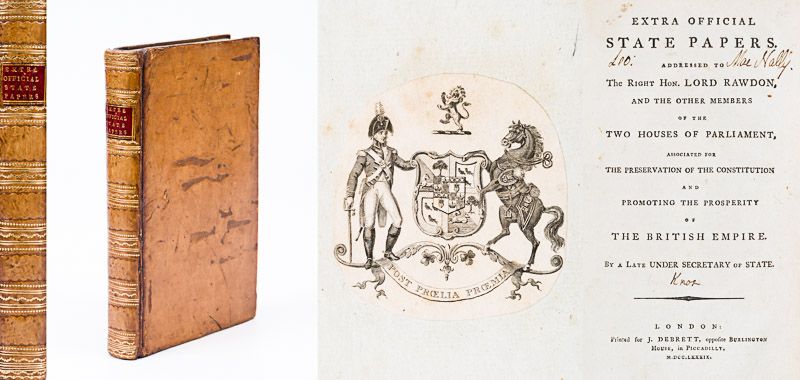
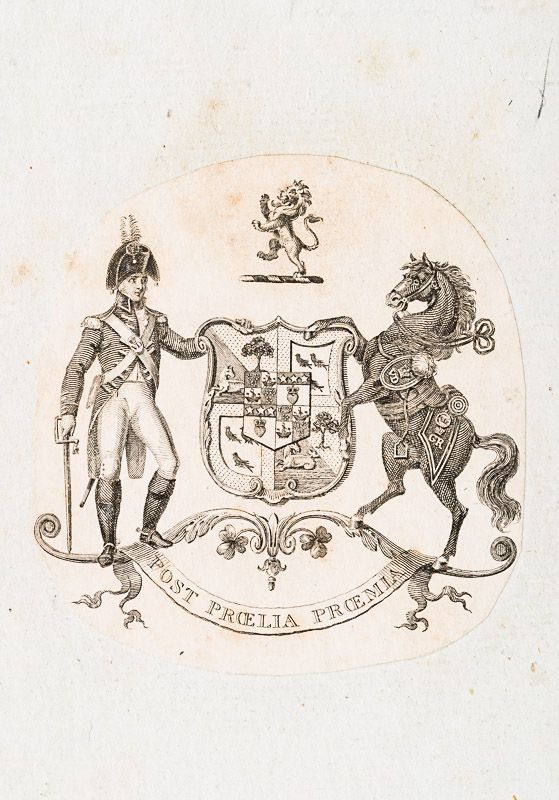
8°. 49, [1], 14, [2], 174 [2] pages plus Errata-leaf. Original Hardcover. Contemporary Irish calf with gilt lettering and ornament on spine / edges in light green. Neatly rebacked. Gilt ornaments on spine with beautiful original spinelabel. In overall excellent condition. This thoughtful work on Irish politics and history was written by an Irish-born government official, and subsequently owned by two significant figures in Irish history, both of whom have left their mark on it. The first was the spy and co-founder of the United Irishmen, Leonard Macnally who has signed and annotated the text, followed by Warner William Westenra second Baron Rossmore who has left his notes and jottings on the Act of Union. [SABIN 38181] The title page bears the ownership signature of Leonard Macnally who signs himself 'Leo: MacNally' with the name of the anonymous author '[William] Knox' written in his hand below. Macnally, a barrister and playwright, is now remembered as a notorious spy for the British government, exploiting his status as a co-founder of the United Irishmen to betray friends and republican clients such as Wolfe Tone even as he purported to defend them in the court cases that followed the rebellion of 1798. In addition to his ownership signature MacNally has lightly annotated Knox's Appendix which contains a 'Paper delivered to Lord Frederick Campbell, when appointed Secretary to Ireland, 1767' in which the author addresses the 'tyranny' of aristocratic government in Ireland, lamenting the 'wretched. ancient condition of Ireland. in respect to property' ownership. MacNally's interest seems to lie in Knox's reading of the history of Irish land tenure with five inked annotations setting out the legal justification for Knox's historical analysis, frequently by reference to Blackstone's Commentaries on the Laws of England. The bookplate of the Barons Rossmore appears on the front pastedown, almost certainly Warner William Westenra (1765-1842) the second Baron Rossmore, who was briefly a member of the Irish Parliament before losing his seat in the Act of Union, returning to spearhead a campaign to reform the representative peerage in Ireland, finally serving as Lord Lieutenant of Monaghan (Bookplate Motto "Post Proelia Praemia" [After battles, rewards]. On the penultimate blank endpaper, Westenra wrestles with the implications of Union with the UK, apparently writing before the act: 'The question now before the public is shall we have an Union? Shall the people of Ireland consent to an Union of Legislature. The voice of thousands cry out no - that is the voice of thousands exclaim - let material pride trample upon national interest.' Alluding to one of the perennial features of Irish history, Rossmore acknowledges: 'Literary men of genius will go to England', but resignedly continues, 'Is that not the case now - Sheridan &c' [Description: Christian White] KNOX, WILLIAM (1732 1810), official and controversialist, was born in Ireland in 1732. He received the rudiments of his political education from Sir Richard Cox [q. v.] Lord Halifax appointed him one of his majesty's council and provost-marshal of Georgia, when Henry Ellis [q. v.] was made governor of the colony. Ellis and Knox arrived at Savannah on 16 Feb. 1757, and Knox did not return to England until 1761. Lord Grosvenor was then his friend and patron; they were at Paris together in 1763, and it was probably through Grosvenor's influence that Knox obtained his introduction to George Grenville. He became agent in Great Britain for Georgia and East Florida, and in the interests of the colonies sent a memorial to Lord Bute, recommending the creation of a colonial aristocracy and the inclusion in parliament of representatives of the colonies; but his services as agent were dispensed with by resolution of the Georgia assembly on 15 Nov. 1765, for two pamphlets written in defence of the Stamp Act, which he considered to be the least objectionable mode of taxation. In the same year.
Seller Inventory # 27955AB
Contact seller
Report this item