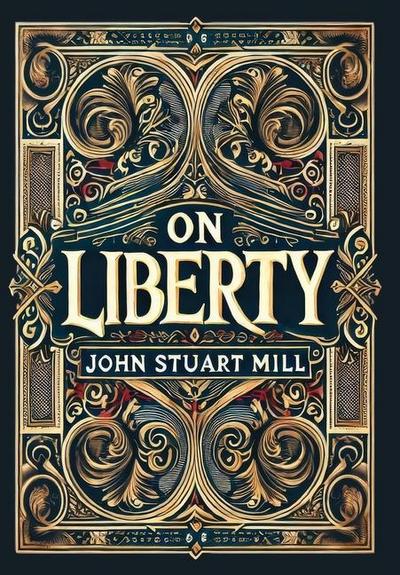
Collector's Edition Laminated Hardback with Jacket What happens when society decides it knows what's best for you? This powerful exploration of freedom and authority challenges the limits of government control and the dangers of a majority that silences dissent. With sharp reasoning and vivid examples, it defends individuality as the driving force of progress, warning against the suffocating grip of conformity. Arguing that the only valid restriction on personal liberty is to prevent harm to others, it makes a passionate case for free speech, independent thought, and the right to live as one chooses.
Few books have shaped modern democracy as profoundly as On Liberty with its timeless defense of individual freedom. Challenging oppressive traditions and unchecked government power, it laid the groundwork for civil liberties, free speech, and personal autonomy in the modern world. Its arguments against societal conformity and majority tyranny continue to influence debates on human rights, political thought, and personal expression. More than a century later, its call to protect individuality remains as urgent as ever in the face of growing ideological pressures.
Born on May 20, 1806, in Pentonville, England, John Stuart Mill was a philosopher, political economist, and civil servant. His father, James Mill, a historian and economist, provided him with an extensive education, fostering his early intellectual development. By his teenage years, Mill was already engaging deeply with classical literature, philosophy, and political economy.Throughout his career, Mill made significant contributions to social theory, political theory, and economics. He is best known for his works On Liberty and Utilitarianism, where he explored individual freedom and the principle of utility. As a proponent of utilitarianism, Mill expanded upon the ideas of his predecessor, Jeremy Bentham, emphasizing the greatest happiness principle.In addition to his philosophical pursuits, Mill was an active political figure. He served as a Member of Parliament for the City of Westminster from 1865 to 1868, advocating for social reforms such as women's suffrage and proportional representation. Mill's legacy endures as a foundational thinker in liberalism, influencing contemporary discussions on ethics, liberty, and governance.