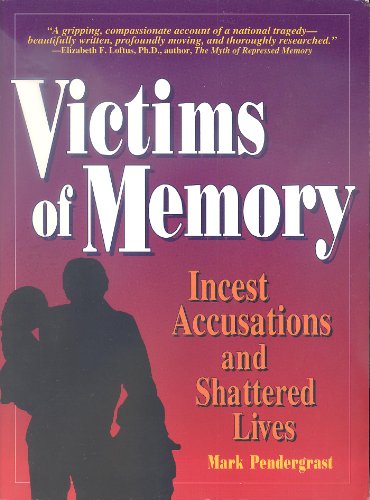
Taking on the issue of "repressed memories" in incest cases, the
author speaks from painful experience and questions whether therapists
are revealing actual happenings through hypnosis, guided imagery, dream
analysis, and suggestion--or shattering lives with false accusations.
Original. IP.
Pendergrast, an investigative journalist and author of the well-received For God, Country and Coca-Cola, here abandons any pretext of objectivity in an emotionally charged diatribe against the recovered memory movement. Accused of sexual abuse by one of his daughters on the basis of recovered memories, he describes his personal anguish and inability to find out any specifics of the allegations. Prime targets of his wrath are manipulative therapists who "facilitate" recovery of childhood memories of abuse, which they claim to be the cause for whatever mental illness their patients (usually, but not always, female) may suffer. Using hypnosis, psychotherapy, age regression, dream work, automatic writing, sodium Amytal, they guide troubled patients into remembering lurid scenes of sexual abuse (graphically described by Pendergrast), satanic rites and demonic possession. The unfortunate "incest survivors" usually cut off all contact with their families, becoming dependent on therapists for years. Pendergrast devotes four chapters to interviews he conducted, but without scientific control or scholarly basis, the narratives of therapists, survivors, the accused and retractors (those who have taken back their allegations) lack weight. Also detracting from his thesis are the repetitious accusations and titillating accounts of sexual abuse, which, after several hundred pages, seem obsessive and needlessly sensational. Pendergrast is a skilled journalist, but his book would have benefited greatly from substantive editing and a more scholarly approach to this controversial subject.
Copyright 1994 Reed Business Information, Inc.
They're staples on talk shows--adult incest survivors who have only recently recovered memories of being abused. Until lately, it was politically correct to believe the abused, never the accused. Then parents and others who felt themselves unjustly accused banded together to form the False Memory Syndrome Foundation. What is going on here? Pendergrast has written a well-researched and important book, and his findings should rightfully scare all of us. Pendergrast, it must be said, is not an objective reporter: his own daughters have accused him of abuse. His shock at their allegations sparked a personal crisis, leading to the writing of this book. Despite his conflict of interest, Pendergrast tries for evenhandedness, going so far as to offer in-their-own-words chapters by those with repressed memories and the therapists who treat them. But there is also a chapter from the "retractors," women who have realized that their memories of abuse were only products of their own imaginations.
Pendergrast's account of this controversial subject is wide ranging. He covers everything from the nature of memory and hypnosis to such related forms of sexual hysteria as the Salem witch trials to this country's growing cult of victimization. He also chronicles how abuse memories often lead to memories of ritual satanic abuse. His strongest and most effective assaults are reserved for the book The Courage to Heal, the bible of the repressed-memory movement, which informs readers that if you feel you've been abused, even if you don't remember the abuse, you probably have. Pendergrast takes readers into an Alice-in-Wonderland world in which innocent incidents, such as the back rubs he gave his daughters, become starting points for "remembered" abuse. He details how therapists, using The Courage to Heal, lead their patients into "memories" and encourage them to abandon their families without giving parents any chance to refute the accusations. (Patients often find new "families" in survivor support groups.) Pendergrast makes a strong case that what began as a way to empower women has now victimized them, isolating them from friends, families, and their true memories. This book is sure to spark a long-overdue debate, and it deserves to be on library shelves, right beside The Courage to Heal. Ilene Cooper
On the heels of On the Myth of Repressed Memory (LJ 8/94), Making Monsters (Scribner, 1994), and Return of the Furies (LJ 9/15/94), this latest entry on "false memory syndrome" is the most readable to date. The author is a professional journalist who has been accused of incest by his two adult daughters, adding an air of sensationalism to the book's promotion and content. But this is not just a personal story, Pendergrast (For God, Country & Coca Cola: The Unauthorized History of the Great American Soft Drink, LJ 3/15/93) interviews many subjects?the abused, the recanting formerly abused, alleged abusers, and their therapists?and relies on professionals in the field of clinical psychology for the scientific data. The author discusses why the "repressed memory" phenomenon is so prevalent today and also offers a short history of other psychological fads. Recommended for popular collections.?A. Arro Smith, San Marcos P.L., Tex.
Copyright 1995 Reed Business Information, Inc.