Order Total (1 Item Items):
Shipping Destination:

Edited Stagg (13 results)
Skip to main search results
Search filters
Product Type
- All Product Types
- Books (13)
- Magazines & Periodicals (No further results match this refinement)
- Comics (No further results match this refinement)
- Sheet Music (No further results match this refinement)
- Art, Prints & Posters (No further results match this refinement)
- Photographs (No further results match this refinement)
- Maps (No further results match this refinement)
- Manuscripts & Paper Collectibles (No further results match this refinement)
Condition Learn more
- New (1)
- As New, Fine or Near Fine (2)
- Very Good or Good (2)
- Fair or Poor (No further results match this refinement)
- As Described (8)
Binding
Collectible Attributes
- First Edition (9)
- Signed (No further results match this refinement)
- Dust Jacket (2)
- Seller-Supplied Images (9)
- Not Print on Demand (13)
Language (2)
Free Shipping
- Free Shipping to U.S.A. (No further results match this refinement)
Seller Location
Seller Rating
-

Christchurch court rolls in the time of Henry VIII
Language: English
Published by Red House Museum Archives' Fund, 1983
ISBN 10: 0950927805 ISBN 13: 9780950927800
Soft cover. Condition: Good. Stapled soft cover - Good. 67 pages including illustrations. Local history library label to inside front cover. Content Good. (123g) Photo on request. As Books that Benefit gives the proceeds from the sale of this book correct postage will be asked for when more than default price quoted.
-

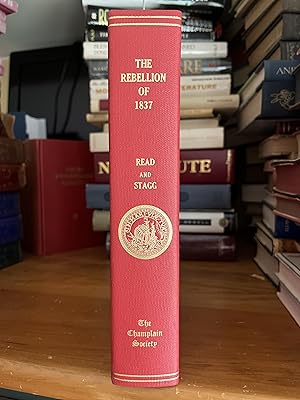
THE PUBLICATIONS OF THE CHAMPLAIN SOCIETY, ONTARIO SERIES - THE REBELLION OF 1837 IN UPPER CANADA, A COLLECTION OF DOCUMENTS
Published by The Champlain Society, Toronto, 1985
Seller: UHR Books, Hollis Center, ME, U.S.A.
Association Member: MABA
Seller rating 5 out of 5 stars

First Edition
Hardcover. Condition: Fine. No Jacket. First Edition. One of 1293 copies printed, of which this is copy number 873. One of the volumes of the diary of Simeon Perkins - the Nova Scotia military leader, merchant, diarist, and politician. 471 page history of "one of the central events of Ontario's history". Many pages are uncut. Book.
-

Calendar of New Forest Documents, 1244-1334 (Hampshire record Series Volume III / 3)
Published by Hampshire Record Office for Hampshire County Council., Hampshire., 1979
US$ 24.92
US$ 23.52 shipping
Ships from United Kingdom to U.S.A.Quantity: 1 available
Add to basketHard with Dust Jacket. Condition: Very good in near fine dust ja. Illustrated. (illustrator). Very good in near fine dust jacket. Ownership inscription neatly penned to free front endpaper.
-
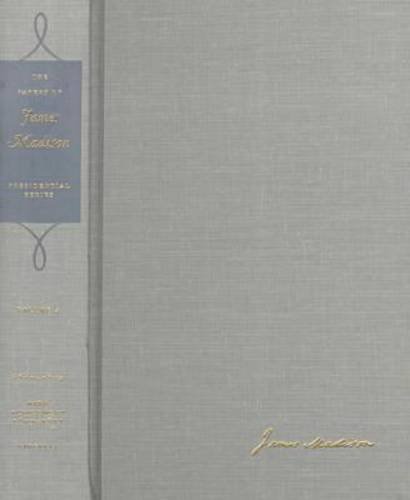
The Papers of James Madison: Presidential Series (Volume 4)
Language: English
Published by University Press of Virginia, Charlottesville, 1999
ISBN 10: 0813918596 ISBN 13: 9780813918594
Seller: Carpe Diem Fine Books, ABAA, Monterey, CA, U.S.A.
Association Member: ABAA ILAB TXBA
Seller rating 4 out of 5 stars

First Edition
Hardcover. 1st. First edition. 8vo. xli, 675pp, including index. Grey cloth covered boards; gilt titles to the spine. A fine copy. 5 November 1811-9 July 1812 with a Supplement 5 March 1809-19 October 1811.
-

Roses; A Celebration, Thirty-three Eminent Gardeners on their Favourite Rose
Published by Published by Frances Lincoln Ltd., 4 Torriano Mews, Torriano Avenue, London First Edition . London 2003., 2003
Seller: Little Stour Books PBFA Member, Canterbury, United Kingdom
Association Member: PBFA
Seller rating 5 out of 5 stars
First Edition
US$ 17.31
US$ 40.32 shipping
Ships from United Kingdom to U.S.A.Quantity: 1 available
Add to basketFirst edition hard back binding in publisher's original maroon paper covered boards, gilt title and author lettering to the maroon cloth spine, green end papers. Quarto 9½'' x 7½''. Contains 261 printed pages of text with beautiful full-page colour illustrations throughout. Fine condition book in Very Good condition dust wrapper with creases and rubs to the spine ends, not price clipped. Dust wrapper supplied in archive acetate film protection, this preserves and prolongs the life of the paper, it is not adhered to the book or to the dust wrapper. Member of the P.B.F.A. ISBN 0711223408 GARDEN & HORTICULTURE.
-
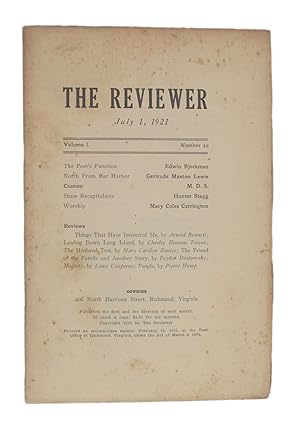
THE REVIEWER: July 1, 1921 (Volume 1, Number 10)
Published by The Reviewer, Richmond, 1921
Seller: Michael Pyron, Bookseller, ABAA, Conshohocken, PA, U.S.A.
Association Member: ABAA ILAB IOBA
Seller rating 5 out of 5 stars
First Edition
Stapled Pamphlet. Condition: Very Good binding. Octavo. 291-322 pp. First edition. As issued in self wrappers. This copy is fairly clean but for some light soiling and toning to the covers. The Reviewer began as a biweekly, shifted to a monthly and concluded its final years as a quarterly. A significant publication begun by Emily Clark, Hunter Stagg, Mary Dallas Street, and Margaret Freeman in Richmond in 1921. While its earliest issues are largely if not exclusively southern writers, over its 4 years it published work from some of the most talented writers of the period, southern and otherwise. In addition to publishing heavyweights like Gertrude Stein, Ellen Glasgow, H.L. Mencken, Carl Van Vechten, Amy Lowell, and others, it brought out new writers like Julia Peterkin who would go on to be the first southern novelist to win a Pulitzer Prize. In 1924 it was moved to Chapel Hill where Paul Green took over editing the magazine for its final year. In 1925, all unpublished manuscripts were used to begin The Southwest Review, still in publication today. In his article, "'An Experiment of Southern Letters': Reconsidering the Role of The Reviewer in the Southern Renaissance," Benjamin Wise writes, "The magazine was essential in the literary awakening of the region during this timeand is essential to our understanding of the periodnot just because it was published, but because of what it published, who published it, and when it was published." He goes on to write, "The Reviewer changed over time in its short career, and the writing in its pages reflected the contested cultural terrain of the South in these years. It provided a forum for writing from and about the South, and in doing so The Reviewer played a crucial role in the development of a new artistic sensibility that reshaped southern literature." For such a significant publication which had at its peak over a thousand subscribers, it is fairly uncommon to find individual issues. Smith, Leanne. "Reviewer, The" Encyclopedia Virginia. Virginia Humanities. Wise, Benjamin E. "'An Experiment in Southern Letters': Reconsidering the Role of The Reviewer in the Southern Renaissance." The Virginia Magazine of History and Biography 113. 2 (2005): 146178.
-
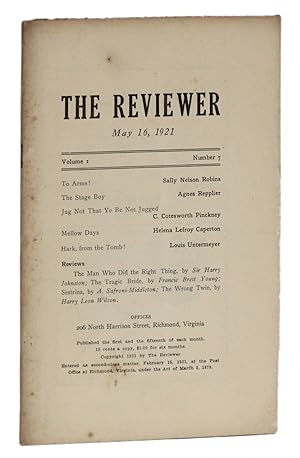
THE REVIEWER: May 16, 1921 (Volume 1, Number 7)
Published by The Reviewer, Richmond, 1921
Seller: Michael Pyron, Bookseller, ABAA, Conshohocken, PA, U.S.A.
Association Member: ABAA ILAB IOBA
Seller rating 5 out of 5 stars
First Edition
Stapled Pamphlet. Condition: Very Good binding. Octavo. [2] 197-226 pp. First edition. As issued in self wrappers. This copy has covers that are toned and a trifled soiled; contents clean. The Reviewer began as a biweekly, shifted to a monthly and concluded its final years as a quarterly. A significant publication begun by Emily Clark, Hunter Stagg, Mary Dallas Street, and Margaret Freeman in Richmond in 1921. While its earliest issues are largely if not exclusively southern writers, over its 4 years it published work from some of the most talented writers of the period, southern and otherwise. In addition to publishing heavyweights like Gertrude Stein, Ellen Glasgow, H.L. Mencken, Carl Van Vechten, Amy Lowell, and others, it brought out new writers like Julia Peterkin who would go on to be the first southern novelist to win a Pulitzer Prize. In 1924 it was moved to Chapel Hill where Paul Green took over editing the magazine for its final year. In 1925, all unpublished manuscripts were used to begin The Southwest Review, still in publication today. In his article, "'An Experiment of Southern Letters': Reconsidering the Role of The Reviewer in the Southern Renaissance," Benjamin Wise writes, "The magazine was essential in the literary awakening of the region during this timeand is essential to our understanding of the periodnot just because it was published, but because of what it published, who published it, and when it was published." He goes on to write, "The Reviewer changed over time in its short career, and the writing in its pages reflected the contested cultural terrain of the South in these years. It provided a forum for writing from and about the South, and in doing so The Reviewer played a crucial role in the development of a new artistic sensibility that reshaped southern literature." For such a significant publication which had at its peak over a thousand subscribers, it is fairly uncommon to find individual issues. Smith, Leanne. "Reviewer, The" Encyclopedia Virginia. Virginia Humanities. Wise, Benjamin E. "'An Experiment in Southern Letters': Reconsidering the Role of The Reviewer in the Southern Renaissance." The Virginia Magazine of History and Biography 113. 2 (2005): 146178.
-
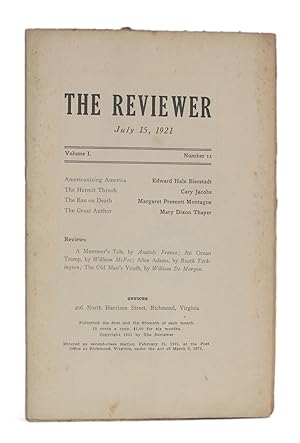
THE REVIEWER: July 15, 1921 (Volume 1, Number 11)
Published by The Reviewer, Richmond, 1921
Seller: Michael Pyron, Bookseller, ABAA, Conshohocken, PA, U.S.A.
Association Member: ABAA ILAB IOBA
Seller rating 5 out of 5 stars
First Edition
Stapled Pamphlet. Condition: near Very Good binding. Octavo. 291-322 pp. First edition. As issued in self wrappers. This copy has some closed tears to the margins of several leaves from being opened roughly, otherwise, it is fairly clean but for some light soiling and toning to the covers. The Reviewer began as a biweekly, shifted to a monthly and concluded its final years as a quarterly. A significant publication begun by Emily Clark, Hunter Stagg, Mary Dallas Street, and Margaret Freeman in Richmond in 1921. While its earliest issues are largely if not exclusively southern writers, over its 4 years it published work from some of the most talented writers of the period, southern and otherwise. In addition to publishing heavyweights like Gertrude Stein, Ellen Glasgow, H.L. Mencken, Carl Van Vechten, Amy Lowell, and others, it brought out new writers like Julia Peterkin who would go on to be the first southern novelist to win a Pulitzer Prize. In 1924 it was moved to Chapel Hill where Paul Green took over editing the magazine for its final year. In 1925, all unpublished manuscripts were used to begin The Southwest Review, still in publication today. In his article, "'An Experiment of Southern Letters': Reconsidering the Role of The Reviewer in the Southern Renaissance," Benjamin Wise writes, "The magazine was essential in the literary awakening of the region during this timeand is essential to our understanding of the periodnot just because it was published, but because of what it published, who published it, and when it was published." He goes on to write, "The Reviewer changed over time in its short career, and the writing in its pages reflected the contested cultural terrain of the South in these years. It provided a forum for writing from and about the South, and in doing so The Reviewer played a crucial role in the development of a new artistic sensibility that reshaped southern literature." For such a significant publication which had at its peak over a thousand subscribers, it is fairly uncommon to find individual issues. Smith, Leanne. "Reviewer, The" Encyclopedia Virginia. Virginia Humanities. Wise, Benjamin E. "'An Experiment in Southern Letters': Reconsidering the Role of The Reviewer in the Southern Renaissance." The Virginia Magazine of History and Biography 113. 2 (2005): 146178.
-
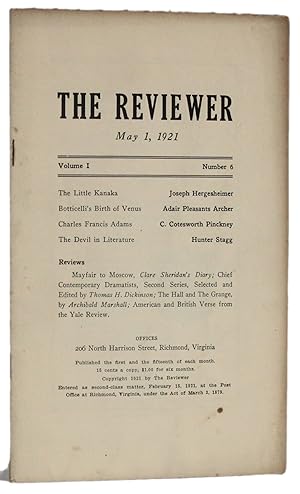
THE REVIEWER: May 1, 1921 (Volume 1, Number 6)
Published by The Reviewer, Richmond, 1921
Seller: Michael Pyron, Bookseller, ABAA, Conshohocken, PA, U.S.A.
Association Member: ABAA ILAB IOBA
Seller rating 5 out of 5 stars
First Edition
Stapled Pamphlet. Condition: Very Good binding. Octavo. 165-196 pp. First edition. As issued in self wrappers. This copy has covers that are toned and a trifled soiled; contents clean. The Reviewer began as a biweekly, shifted to a monthly and concluded its final years as a quarterly. A significant publication begun by Emily Clark, Hunter Stagg, Mary Dallas Street, and Margaret Freeman in Richmond in 1921. While its earliest issues are largely if not exclusively southern writers, over its 4 years it published work from some of the most talented writers of the period, southern and otherwise. In addition to publishing heavyweights like Gertrude Stein, Ellen Glasgow, H.L. Mencken, Carl Van Vechten, Amy Lowell, and others, it brought out new writers like Julia Peterkin who would go on to be the first southern novelist to win a Pulitzer Prize. In 1924 it was moved to Chapel Hill where Paul Green took over editing the magazine for its final year. In 1925, all unpublished manuscripts were used to begin The Southwest Review, still in publication today. In his article, "'An Experiment of Southern Letters': Reconsidering the Role of The Reviewer in the Southern Renaissance," Benjamin Wise writes, "The magazine was essential in the literary awakening of the region during this timeand is essential to our understanding of the periodnot just because it was published, but because of what it published, who published it, and when it was published." He goes on to write, "The Reviewer changed over time in its short career, and the writing in its pages reflected the contested cultural terrain of the South in these years. It provided a forum for writing from and about the South, and in doing so The Reviewer played a crucial role in the development of a new artistic sensibility that reshaped southern literature." For such a significant publication which had at its peak over a thousand subscribers, it is fairly uncommon to find individual issues. Smith, Leanne. "Reviewer, The" Encyclopedia Virginia. Virginia Humanities. Wise, Benjamin E. "'An Experiment in Southern Letters': Reconsidering the Role of The Reviewer in the Southern Renaissance." The Virginia Magazine of History and Biography 113. 2 (2005): 146178.
-

THE REVIEWER: March 1, 1921 (Volume 1, Number 2)
Published by The Reviewer, Richmond, 1921
Seller: Michael Pyron, Bookseller, ABAA, Conshohocken, PA, U.S.A.
Association Member: ABAA ILAB IOBA
Seller rating 5 out of 5 stars
First Edition
Stapled Pamphlet. Condition: Very Good binding. Octavo. 37-68 pp. First edition. As issued, in self wrappers. This copy has covers that are toned and a trifled soiled, a closed tear to the margin of two leaves; contents clean. The Reviewer began as a biweekly, shifted to a monthly and concluded its final years as a quarterly. A significant publication begun by Emily Clark, Hunter Stagg, Mary Dallas Street, and Margaret Freeman in Richmond in 1921. While its earliest issues are largely if not exclusively southern writers, over its 4 years it published work from some of the most talented writers of the period, southern and otherwise. In addition to publishing heavyweights like Gertrude Stein, Ellen Glasgow, H.L. Mencken, Carl Van Vechten, Amy Lowell, and others, it brought out new writers like Julia Peterkin who would go on to be the first southern novelist to win a Pulitzer Prize. In 1924 it was moved to Chapel Hill where Paul Green took over editing the magazine for its final year. In 1925, all unpublished manuscripts were used to begin The Southwest Review, still in publication today. In his article, "'An Experiment of Southern Letters': Reconsidering the Role of The Reviewer in the Southern Renaissance," Benjamin Wise writes, "The magazine was essential in the literary awakening of the region during this timeand is essential to our understanding of the periodnot just because it was published, but because of what it published, who published it, and when it was published." He goes on to write, "The Reviewer changed over time in its short career, and the writing in its pages reflected the contested cultural terrain of the South in these years. It provided a forum for writing from and about the South, and in doing so The Reviewer played a crucial role in the development of a new artistic sensibility that reshaped southern literature." For such a significant publication which had at its peak over a thousand subscribers, it is fairly uncommon to find individual issues. Smith, Leanne. "Reviewer, The" Encyclopedia Virginia. Virginia Humanities. Wise, Benjamin E. "'An Experiment in Southern Letters': Reconsidering the Role of The Reviewer in the Southern Renaissance." The Virginia Magazine of History and Biography 113. 2 (2005): 146178.
-
The Rebellion of 1837 in Upper Canada - A Collection of Documents.
Published by The Champlain Society, 1985
First Edition
US$ 110.00 25% offUS$ 82.50
US$ 18.90 shipping
Ships from Canada to U.S.A.Quantity: 1 available
Add to basketHardcover. Condition: New. No Jacket. 1st Edition. Hardcover. Limited edition, No 1030#. Excellent condition as a new book never read since pages uncut. Top edge gilt and untrimmed other edges. Illustrated. xcix, 471pp.
-

The Rebellion of 1837 in Upper Canada - A Collection of Documents.
Published by The Champlain Society c. 1985;, Toronto, 1985
Seller: Alexandre Antique Prints, Maps & Books, Toronto, ON, Canada
Seller rating 5 out of 5 stars
Edition : First and limited edition., Original red cloth hard cover; spine lettering and publisher?s emblem in gilt; front and lower edges uncut; , #367 of 1293 numbered limited edition copies printed for the Champlain Society. , Size : 4to. (240x165mm) text clean and crisp; lacks dust jacket otherwise a fine copy.
-
STAGG OF TARCOWIE - THE DIARIES OF A COLONIAL TEENAGER (1885 - 1887)
Published by Nadjuri Australia, 1977
Paperback. Condition: As New. A beautiful copy. Text in mint/unmarked condition. Cover has minor wear with bumped corners. Binding is tight.