

Order Total (1 Item Items):
Shipping Destination:

Martin Pascal Ludovic (14 results)
Skip to main search results
Search filters
Product Type
- All Product Types
- Books (14)
- Magazines & Periodicals (No further results match this refinement)
- Comics (No further results match this refinement)
- Sheet Music (No further results match this refinement)
- Art, Prints & Posters (No further results match this refinement)
- Photographs (No further results match this refinement)
- Maps (No further results match this refinement)
- Manuscripts & Paper Collectibles (No further results match this refinement)
Condition Learn more
- New (10)
- As New, Fine or Near Fine (1)
- Very Good or Good (3)
- Fair or Poor (No further results match this refinement)
- As Described (No further results match this refinement)
Binding
Collectible Attributes
- First Edition (1)
- Signed (No further results match this refinement)
- Dust Jacket (No further results match this refinement)
- Seller-Supplied Images (4)
- Not Print on Demand (14)
Language (3)
Free Shipping
Seller Location
Seller Rating
-

Paperback. Condition: New. Modal verbs in English communicate delicate shades of meaning, there being a large range of verbs both on the necessity side (must, have to, should, ought to, need, need to) and the possibility side (can, may, could, might, be able to). They therefore constitute excellent test ground to apply and compare different methodologies that can lay bare the factors that drive the speaker's choice of modal verb. This book is not merely concerned with a purely grammatical description of the use of modal verbs, but aims at advancing our understanding of lexical and grammatical units in general and of linguistic methodologies to explore these. It thus involves a genuine effort to compare, assess and combine a variety of approaches. It complements the leading descriptive qualitative work on modal verbs by testing a diverse range of quantitative methods, while not ignoring qualitative issues pertaining to the semantics-pragmatics interface. Starting from a critical assessment of what constitutes the meaning of modal verbs, different types of empirical studies (usage-based, data-driven and experimental), drawing considerably on the same data sets, shows how method triangulation can contribute to an enhanced understanding. Due attention is also given to individual variation as well as the degree to which modals can predict L2 proficiency level.
-

Condition: good. Befriedigend/Good: Durchschnittlich erhaltenes Buch bzw. Schutzumschlag mit Gebrauchsspuren, aber vollständigen Seiten. / Describes the average WORN book or dust jacket that has all the pages present.
-
Condition: very good. Gut/Very good: Buch bzw. Schutzumschlag mit wenigen Gebrauchsspuren an Einband, Schutzumschlag oder Seiten. / Describes a book or dust jacket that does show some signs of wear on either the binding, dust jacket or pages.
-
![Stock image for Models of Modals: From Pragmatics and Corpus Linguistics to Machine Learning (Topics in English Linguistics [TiEL], 110) for sale by Majestic Books](https://pictures.abebooks.com/isbn/9783111620725-us-300.jpg)
-
Condition: New. 1st edition NO-PA16APR2015-KAP.
-

Paperback. Condition: New. Modal verbs in English communicate delicate shades of meaning, there being a large range of verbs both on the necessity side (must, have to, should, ought to, need, need to) and the possibility side (can, may, could, might, be able to). They therefore constitute excellent test ground to apply and compare different methodologies that can lay bare the factors that drive the speaker's choice of modal verb. This book is not merely concerned with a purely grammatical description of the use of modal verbs, but aims at advancing our understanding of lexical and grammatical units in general and of linguistic methodologies to explore these. It thus involves a genuine effort to compare, assess and combine a variety of approaches. It complements the leading descriptive qualitative work on modal verbs by testing a diverse range of quantitative methods, while not ignoring qualitative issues pertaining to the semantics-pragmatics interface. Starting from a critical assessment of what constitutes the meaning of modal verbs, different types of empirical studies (usage-based, data-driven and experimental), drawing considerably on the same data sets, shows how method triangulation can contribute to an enhanced understanding. Due attention is also given to individual variation as well as the degree to which modals can predict L2 proficiency level.
-

Fare il compost
Language: Italian
ISBN 10: 8866815896 ISBN 13: 9788866815891
Seller: libreriauniversitaria.it, Occhiobello, RO, Italy
Seller rating 4 out of 5 stars

Condition: NEW.
-
Condition: Bon. Merci, votre achat aide à financer des programmes de lutte contre l'illettrisme.
-
Condition: Assez bon. Attention: Ancien support de bibliothèque, plastifié, étiquettes. Merci, votre achat aide à financer des programmes de lutte contre l'illettrisme.
-
![Stock image for Models of Modals: From Pragmatics and Corpus Linguistics to Machine Learning (Topics in English Linguistics [TiEL], 110) for sale by Ria Christie Collections](https://pictures.abebooks.com/isbn/9783110738612-us-300.jpg)
Models of Modals: From Pragmatics and Corpus Linguistics to Machine Learning (Topics in English Linguistics [TiEL], 110)
Seller: Ria Christie Collections, Uxbridge, United Kingdom
Seller rating 5 out of 5 stars

US$ 180.93
US$ 16.10 shipping
Ships from United Kingdom to U.S.A.Quantity: Over 20 available
Add to basketCondition: New. In.
-

Hardback. Condition: New. Modal verbs in English communicate delicate shades of meaning, there being a large range of verbs both on the necessity side (must, have to, should, ought to, need, need to) and the possibility side (can, may, could, might, be able to). They therefore constitute excellent test ground to apply and compare different methodologies that can lay bare the factors that drive the speaker's choice of modal verb. This book is not merely concerned with a purely grammatical description of the use of modal verbs, but aims at advancing our understanding of lexical and grammatical units in general and of linguistic methodologies to explore these. It thus involves a genuine effort to compare, assess and combine a variety of approaches. It complements the leading descriptive qualitative work on modal verbs by testing a diverse range of quantitative methods, while not ignoring qualitative issues pertaining to the semantics-pragmatics interface. Starting from a critical assessment of what constitutes the meaning of modal verbs, different types of empirical studies (usage-based, data-driven and experimental), drawing considerably on the same data sets, shows how method triangulation can contribute to an enhanced understanding. Due attention is also given to individual variation as well as the degree to which modals can predict L2 proficiency level.
-
US$ 217.20
US$ 8.74 shipping
Ships from United Kingdom to U.S.A.Quantity: 3 available
Add to basketCondition: New.
-
-
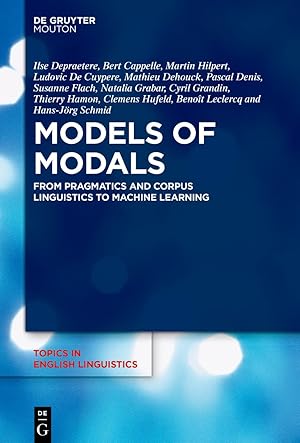
Models of Modals
First Edition
US$ 231.64
US$ 56.86 shipping
Ships from Germany to U.S.A.Quantity: Over 20 available
Add to basketHardcover. Condition: New. The new monograph [.] contributes to a better understanding of EMs [English modals] by appropriately combining linguistic theories and applying advanced rigorous quantitative methods. Consequently, this book is definitely a most cutting-edge one in st.

