
Synopsis
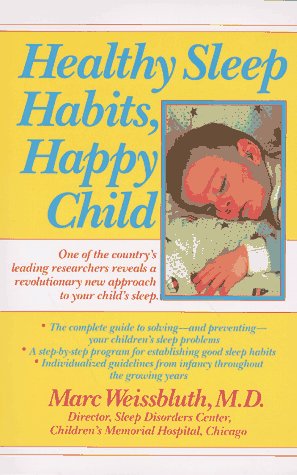
One of the country's leading researchers and pediatricians reveals a revolutionary new approach to your child's sleep in this complete guiding to solving -- and preventing -- sleep problems. Includes a step-by-step program for establishing good sleep habits and individualized guidelines from infancy throughout the growing years.
"synopsis" may belong to another edition of this title.
About the Author
A pediatrician with thirty-two years of experience, Marc Weissbluth, M.D., is also a leading researcher on sleep and children. He founded the original Sleep Disorders Center at Chicago’s Children’s Memorial Hospital and is a professor of clinical pediatrics at Northwestern University School of Medicine. Dr. Weissbluth discovered that sleep is linked to temperament and that sleeping problems are related to infant colic. His landmark seven-year study on the development and disappearance of naps highlighted the importance of daytime sleep. In addition to his own research, he has written about sleep problems in manuals of pediatrics, lectured extensively to parent groups, and appeared on Oprah. Dr. Weissbluth has four sons, two grandsons, and, thankfully, one granddaughter–and they are all good sleepers. Linda, his wife of more than forty years, has provided both inspiration and original ideas for this book.
From the Hardcover edition.
From the Inside Flap
One of the country's leading researchers and pediatricians reveals a revolutionary new approach to your child's sleep in this complete guiding to solving -- and preventing -- sleep problems. Includes a step-by-step program for establishing good sleep habits and individualized guidelines from infancy throughout the growing years.
Excerpt. © Reprinted by permission. All rights reserved.
Infants and children who are still of tender age [may be] attacked by . . . wakefulness at night. —Aulus Cornelius Celsus, a.d. 130
Sleeplessness in children and worrying about sleeplessness have been around for a long time.
Healthy sleep appears to come so easily and naturally to newborn babies. Effortlessly, they fall asleep and stay asleep. Their sleep patterns, however, shift and evolve as the brain matures during the first few weeks and months. Such changes may result in “day/night confusion”—long sleep periods during the day and long wakeful periods at night. This is bothersome, but it is only a problem of timing. The young infant still does not have any difficulty falling asleep or staying asleep. After several weeks of age, though, parents can shape natural sleep rhythms and patterns into sleep habits.
It comes as a surprise to many parents that healthy sleep habits do not develop automatically. In fact, parents can and do help or hinder the development of healthy sleep habits. Of course, children will spontaneously fall asleep when totally exhausted—“crashing” is a biological necessity! But this is unhealthy, because extreme fatigue (often identified by “wired” behavior immediately preceding the crash) interferes with normal social interactions and even learning. You should not assume that it is “natural” for all children to get peevish, irritable, or cranky at the end of the day. Well-rested children do not behave this way.
Before electricity, radio, television, computers, or commuting long distances to work, children went to sleep earlier than children do today. Our current popular late bedtimes may be no more “natural” than the outdated “natural” belief that fatter babies are healthier babies. Commonly held or popular beliefs about what is natural, normal, or healthy are not always true. In addition, when you think of child rearing, it may appear “natural” for you to consider parenting practices performed in traditional cultures. That is, breast-feed frequently day and night and sleep with your baby, wear your baby in a sling or soft carrier, always be close to your baby, and always respond to your baby. This is not always practical for some families, and even for those families who choose this “natural” style, their baby’s extreme fussiness/crying/not sleeping or “unnatural” factors can interfere.
Dr. Christian Guilleminault, who along with Dr. William C. Dement was the founding editor of the world’s leading journal of sleep research, taught me to consider five fundamental principles of understanding sleep:
1. The sleeping brain is not a resting brain.
2. The sleeping brain functions in a different manner than the waking brain.
3. The activity and work of the sleeping brain are purposeful.
4. The process of falling asleep is learned.
5. Providing the growing brain with sufficient sleep is necessary for developing the ability to concentrate and an easier temperament.
Sleep is the power source that keeps your mind alert and calm. Every night and at every nap, sleep recharges the brain’s battery. Sleeping well increases brainpower just as lifting weights builds stronger muscles, because sleeping well increases your attention span and allows you to be physically relaxed and mentally alert at the same time. Then you are at your personal best.
As you will discover as you read this book, when children
“NATURAL” VERSUS “UNNATURAL”
“Natural”
All babies have spells of fussing and crying.
These spells distress all parents.
All parents want to soothe their baby.
The more the baby fusses or cries, the less she sleeps.
The less the baby sleeps, the less the parents sleep.
The less the parents sleep, the harder it is for them to soothe their baby.
Relatives and friends want to help soothe the baby and are expected to assist parents.
Breast-feeding and sleeping with your baby are powerful ways to soothe your baby.
“Unnatural”
Urban stimulation (noises, voices, delivery trucks, shopping trips, errands) may interfere with baby’s sleeping.
Day care (not being able to put your child to sleep when just starting to become tired or too much stimulation) may interfere with baby’s sleeping.
Social isolation forcing only the mother to be wholly responsible to take care of soothing and sleeping may cause intense stress for the mother.
Busy modern lifestyles means that parents have many things to do and little time to do them; sometimes they have to take their baby with them even at sleep times.
Mothers have to work outside the house, miss playing with their baby, and keep their baby up too late at night.
Fathers or mothers have a long commute and return home from work late, want to play with their baby, and keep their baby up too late at night.
Grandparents interfere with sleep routines.
learn to sleep well, they also learn to maintain optimal wakefulness. The notion of optimal wakefulness, also called optimal alertness, is important, because we tend to think simplistically of being either awake or asleep. Just as our twenty-four-hour cycle consists of more than just the two states called daytime and nighttime, there are gradations—which we call dawn and dusk—in sleep and wakefulness.
In sleep, the levels vary from deep sleep to partial arousals; in wakefulness, the levels vary from being wide awake to being groggy.
The importance of optimal wakefulness cannot be overemphasized. If your child does not get all the sleep he needs, he may seem either drowsy or hyperalert. If either state lasts for a long time, the results are the same: a child with a difficult mood and hard-to-control behavior, certainly not one who is ready and able to enjoy himself or get the most out of the myriad of learning experiences placed before him.
With our busy lifestyles, how can we keep track of nap schedules and regular bedtime hours? Is it really true that I can harm my baby by giving him love at night when he cries out for me? How can I be sure that sleep is really that important? Am I a bad parent if my child cries? If he cries at night, isn’t he feeling insecure? These are questions many parents ask me. Parents will often mention that articles or books they have read seem to support different ideas, and so they conclude by saying that since this whole issue is “so controversial,” they would rather let matters stay as they are. If you think your child is not sleeping well and if you disagree with the suggestions in this book, then ask yourself how long you should wait for improvement to occur. Three months? Three years? If you are following the opinion of a professional who says you must spend more time with your child at night to make him feel more “secure,” ask that professional, “When will I know we are on the right track?” Don’t wait forever. Consider what Dr. Charles E. Sundell, the physician in charge of the Children’s Department in the Prince of Wales General Hospital in England, wrote in 1922: “Success in the treatment of sleeplessness in infants is a good standard by which to estimate the patience and skill of the practitioner.” He also wrote: “A sleepless baby is a reproach to his guardian, and convicts them of some failure in their guardianship.” So don’t think that worrying about sleeplessness is just a contemporary issue.
The truth is, modern research regarding sleep/wake states only confirms what careful practitioners such as Dr. Sundell observed over eighty years ago. He wrote:
The temptation to postpone the time for a baby’s sleep, so that he may be admired by some relative or friend who is late in arriving, or so that his nurse may finish some work on which she may be engaged, must be strongly resisted. A sleepy child who is kept awake exhausts his nervous energy very quickly in peevish restlessness, and when preparations are at last made for his sleep he may be too weary to settle down. . . .
Regularity of habits is one of the sheet-anchors by which the baroque of an infant’s health is secured. The reestablishment of a regular routine, after even a short break, frequently calls for patient perseverance on the part of the nurse, but though the child may protest vigorously for several nights, absolute firmness seldom fails to procure the desired result.
Each baby is unique. They’re like little snowflakes. Babies are born with individual traits that affect the amount of physical activity, the duration of sleep, and the length of periods of crying they will sustain. But babies also differ in more subtle ways. Some are easier to “read”; they seem to have predictable schedules for feeding and sleeping. These babies also tend to cry less and sleep more. Regular babies are more self-soothing; they fall asleep easier, and when they awaken at night they are more able to return to sleep unassisted. But don’t blame yourself if you have an irregular baby who cries a lot and is less self-soothing. It’s only luck, although social customs may affect how you feel about it.
In those societies where the mother holds the baby close all the time, and her breasts are always available for nursing and soothing, there are still great differences among babies in terms of fussiness and crying. The mother compensates by increasing the amount of rhythmic, rocking motions or nursing. She may not even expect the baby to sleep alone, away from her body. As she grows up, a child might share the bed with her parents for a long time. This is not necessarily good or bad; it’s just different from the expectations of most m...
"About this title" may belong to another edition of this title.
Search results for Healthy Sleep Habits, Happy Child

Stock Image
Healthy Sleep Habits, Happy Child
Seller: Orion Tech, Kingwood, TX, U.S.A.
Seller rating 5 out of 5 stars

paperback. Condition: Fair. Seller Inventory # 0449902242-4-27383102
Stock Image
Healthy Sleep Habits, Happy Child
Seller: World of Books (was SecondSale), Montgomery, IL, U.S.A.
Seller rating 5 out of 5 stars
Condition: Acceptable. Item in acceptable condition! Textbooks may not include supplemental items i.e. CDs, access codes etc. Seller Inventory # 00085157261
Stock Image
Healthy Sleep Habits, Happy Child
Seller: World of Books (was SecondSale), Montgomery, IL, U.S.A.
Seller rating 5 out of 5 stars
Condition: Good. Item in good condition. Textbooks may not include supplemental items i.e. CDs, access codes etc. Seller Inventory # 00103772018
Stock Image
Healthy Sleep Habits, Happy Child
Seller: Once Upon A Time Books, Siloam Springs, AR, U.S.A.
Seller rating 4 out of 5 stars

Paperback. Condition: Good. This is a used book in good condition and may show some signs of use or wear . This is a used book in good condition and may show some signs of use or wear . Seller Inventory # mon0001393116
Stock Image
Healthy Sleep Habits, Happy Child
Seller: Half Price Books Inc., Dallas, TX, U.S.A.
Seller rating 5 out of 5 stars
Paperback. Condition: Very Good. Connecting readers with great books since 1972! Used books may not include companion materials, and may have some shelf wear or limited writing. We ship orders daily and Customer Service is our top priority! Seller Inventory # S_460688192
Seller Image
Healthy Sleep Habits, Happy Child
Seller: 2nd Life Books, Burlington, NJ, U.S.A.
Seller rating 5 out of 5 stars
Condition: very_good. Used book in very good condition. May have some minor wear. May NOT include discs, or access code or other supplemental material. Ships directly from Amazon and is eligible for Prime or super saver FREE shipping. We ship Monday-Saturday and respond to inquiries within 24 hours. Seller Inventory # BXM.C7PS
Seller Image
Healthy Sleep Habits, Happy Child
Seller: ZBK Books, Carlstadt, NJ, U.S.A.
Seller rating 5 out of 5 stars
Condition: good. Fast & Free Shipping â" Good condition. It may show normal signs of use, such as light writing, highlighting, or library markings, but all pages are intact and the book is fully readable. A solid, complete copy that's ready to enjoy. Seller Inventory # ZWV.0449902242.G
Stock Image
Healthy Sleep Habits, Happy Child
Seller: HPB-Emerald, Dallas, TX, U.S.A.
Seller rating 5 out of 5 stars
Paperback. Condition: Very Good. Connecting readers with great books since 1972! Used books may not include companion materials, and may have some shelf wear or limited writing. We ship orders daily and Customer Service is our top priority! Seller Inventory # S_462453758
Stock Image
Healthy Sleep Habits, Happy Child
Seller: ThriftBooks-Dallas, Dallas, TX, U.S.A.
Seller rating 5 out of 5 stars
Paperback. Condition: Fair. No Jacket. Former library book; Readable copy. Pages may have considerable notes/highlighting. ~ ThriftBooks: Read More, Spend Less. Seller Inventory # G0449902242I5N10
Stock Image
Healthy Sleep Habits, Happy Child
Seller: ThriftBooks-Dallas, Dallas, TX, U.S.A.
Seller rating 5 out of 5 stars
Paperback. Condition: Very Good. No Jacket. Former library book; May have limited writing in cover pages. Pages are unmarked. ~ ThriftBooks: Read More, Spend Less. Seller Inventory # G0449902242I4N10