Items related to Follies: New Stories
Synopsis
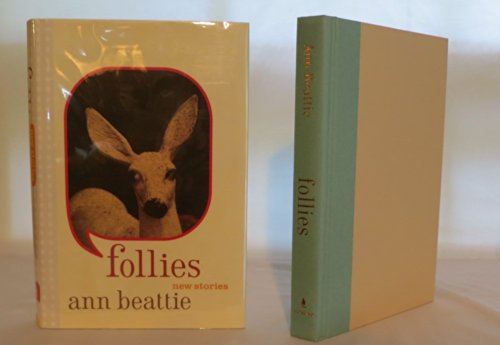
Ann Beattie's Follies is a superb novella and collection of stories about adult children, aging parents, and the chance encounters that irrevocably alter lives. Beattie, winner of four O. Henry prizes, has been called "one of our era's most vital masters of the short form" (The Washington Post Book World). She is a masterful observer of domestic relations and the idiosyncratic logic that governs human lives.
In Follies, her most resonant collection, she looks at baby boomers in their maturity, sorting out their own lives and struggling with parents who are eccentric, unpredictable, and increasingly dependent. In "Fléchette Follies," a man rear-ends a woman at a stoplight, and the ripple effect of that encounter is vast and catastrophic. In "Apology for a Journey Not Taken," a woman's road trip is perpetually postponed by the UPS deliveryman who wants to watch TV in her house, by the girl next door who has lost her dog, and by the death of her friend in a freak accident. Impatient in his old age, the protagonist of "That Last Odd Day in L.A." can hardly manage a pleasant word to his own daughter, but he finds a chance for redemption on the last day of a vacation he spends with his niece and nephew.
Ann Beattie is at the top of her form in this superb collection, writing with the vividness, compassion, and sometimes morbid wit that have made her one of the most influential writers of her generation.
"synopsis" may belong to another edition of this title.
About the Author
Ann Beattie has been included in four O. Henry Award Collections, in John Updike’s The Best American Short Stories of the Century, and in Jennifer Egan’s The Best American Short Stories 2014. In 2000, she received the PEN/Malamud Award for achievement in the short story. In 2005, she received the Rea Award for the Short Story. She was the Edgar Allan Poe Professor of Literature and Creative Writing at the University of Virginia. She is a member of The American Academy of Arts and Letters and of the American Academy of Arts and Sciences. She and her husband, Lincoln Perry, live in Maine and Key West, Florida.
Excerpt. © Reprinted by permission. All rights reserved.
Find and Replace
Linda turned left, into a housing development with a waterfall to one side, above which rose a sign: Beechwood Village. Underneath it, someone had spray-painted on the rocks: sucks shit. "We weren't able to have children because of treatments Rich had for an illness, long ago. We should adopt, you'd think. But I've never felt like doing that. If it's God's will that we can't have children, maybe we should honor that. Not that it wouldn't be a great idea and all that, but I just don't really...the thing is, I've sort of said to Sister Mary Matthew that we'd do it, one day, but I really think it's enough that Rich gets the children out. There are families waiting for them. I mean, lists of families. It's just not something Rich and I ever talked seriously about doing, even though Mary sort of thinks it is. You know what I mean?"
"You mean she assumes it's going to happen, and it isn't," Paula said.
"Exactly!" Linda said. She pulled into the driveway of a big house and touched a button on her visor. The garage door began to rise. "I mean, we let her think it, because she couldn't imagine not thinking it. You know what I mean?"
She knew, and had known since childhood: she meant that the course of least possible pain was to let somebody retain his view of how things were, even though you knew otherwise.
Father Ambrose raised a champagne flute. "In the thirteenth century," he began, "Saint Francis was blessed and privileged to live in times of compelling significance. Today, in times whose complexities we may dread, and in an age that may lack so many qualities we identify with Christian charity" -- he drank most of his champagne -- "with Christian charity," he repeated. "But, like Francis, there are always those individuals who stand apart and distinguish themselves from others not through any feeling of superiority, but because they understand that they have been called. The message received may be humble. It need not be the case, as it was with Francis, who saw around him the disorder of the state and the paucity of honorable examples and felt compelled to take a stand. One's being selected can come not as an epiphany, but begin as an enigmatic question, a thing confusing rather than enlightening." A man stepped forward and poured more champagne into the empty glass. "Thank you," Father Ambrose said. "As a longtime friend of the groom, I am here today to say that one must act according to one's conscience, which may mean..."
Paula wandered off. The next morning, the wedding couple would be gone and the three of them would finally set out for Charlottesville, the town where George had last lived, where he had met a woman who somehow persuaded him -- she must have persuaded him, though Paula described him repeatedly to her shrink as intractable -- to move outside his usual parameters. And what exactly were they? she thought, bringing herself up short. So much analyzing, when she had only limited information to go on. She supposed that if she thought like some of the people at the wedding, she would have to say that she had committed the sin of Pride. What a surprise to find out that he and Rich went to the aid of ailing honchos in places they shouldn't be, the U.S. government -- and even American Express, if she could believe what Linda had later told her -- entering into bribes and blackmail with foreign governments, and if that wasn't problematic enough, they got to be heroes by hauling back children, like remora, along with the sharks. What had she, with her brilliant novelistic imagination, thought he was doing? She had thought he was killing people, was the answer. She had not wanted to ask because she had been so sure. For years, she had assumed he was an assassin, and she had been relieved but also let down, as if his life were downright ordinary, when she began to piece the puzzle together from what Linda described and what bare-bones details Rich O'Malley assumed she knew.
Father Ambrose was reading from something called Canticle of the Sun. He was a little tipsy, which added to the strangeness of the day. She shuddered to think that she had almost married the wrong man. If only she could see George again, she might think seriously about proposing to him. What she'd thought all those years she didn't ask questions was that he was an assassin, and she had always assumed that because of his ability, he would be all right; now, even though she'd had it verified that he'd been involved in dangerous activity, she felt less sure that he was safe. There was her inimitable reasoning, as her shrink liked to call it: if he could kill people, he wouldn't be killed. If he was just some glorified body snatcher, somebody might be able to kill him.
She walked around inside the house, where it was darker and cooler, and the young bartender followed her with his eyes. What did he make of these people with their flushed faces and their purses stashed here and there, as if they were squirrels, burying nuts? Her own purse was upstairs, in the bedroom where she'd slept the last two nights, bizarrely papered in gingerbread wallpaper, with a mobile of gingerbread boys and girls suspended from the ceiling, as if the room awaited children. She had pulled the door closed when she went down to meet the bride and groom, so she was surprised to see it open when she walked upstairs to comb her hair. A teenage girl was sitting on the side of the bed, reading a magazine. She had stepped out of her high heels, and one foot was tucked under her, the other planted on the woven rug on the floor. The girl looked surprised. No -- just unhappy to be discovered. She had been reading a thick issue of Vanity Fair, Paula saw; the girl put her thumb inside and closed the magazine.
"Hi. I'm Paula."
"Shalissa Ray," the girl said. Her black hair was pulled back in an elastic band. "Am I in your room?"
Paula nodded.
"I don't like weddings," the girl said. "My sister was killed the night of her wedding."
"How awful," Paula said.
"I know," the girl said. Like many teenagers wearing their best clothes, she looked uncomfortable. "I'm not going to get married. Not because my sister died, just because you can just live with somebody."
"I used to think that way," Paula said. "Then my boyfriend disappeared, and suddenly I'm missing him so much I'm thinking about getting married to him."
The girl shrugged. "How come you've got a room that looks like a kid's room?" she asked.
"Well, I'm only staying here temporarily, so it isn't really my room. I came up because the ceremony didn't make a lot of sense to me."
"Yeah. The stuff about Saint Francis taming the wolf."
"He was talking about Saint Francis. I'm afraid I didn't quite understand the point, so I thought I'd take a breather."
"He practiced what he was going to say last night, at my parents' house. He's my uncle," the girl said. "And his boyfriend's my stepuncle, supposedly. I don't care if people are gay. I just don't understand why weddings are such a big deal. I mean, I guess if I'd been a nun, a wedding would be a surefire way to let everybody know I was having sex and all."
"T-t-true," Paula said.
"My sister used to stutter. You didn't even ask how she died. A tire came off a truck and turned their car over, and he lived, but she didn't. Anyway: she learned how not to stutter by using puppets. She'd put on these little finger puppets, and they'd say everything she was saying, but it came out perfect. She didn't do it in public, but she did it at home, so really all she had to learn was how to think her fingers were talking."
"Never heard of that," Paula said.
"Nobody's ever heard of it," the girl said.
"Want to go back down together?" Paula said, combing her hair.
"I guess so," the girl said. "Especially if my uncle's done with his speech. I never understand what he's talking about. He's obsessed with Saint Francis, though. He's got a blind bird named Francis, which makes sense, with Saint Francis having so much trouble with his eyes and hiding in that dark cave and all."
"I went to Assisi once," Paula said. "With the person I was telling you about. We went to a monastery because I wanted to see the garden."
"What was it like?"
"The person who showed us around was very nice. He spoke Italian very slowly and gestured, so I could pretty much understand him. There was a cat there that they took care of. Everywhere else, the cats were starving. Pretty scary cats, actually. The guy who showed us around was there because the brothers had helped him to give up drugs. He wasn't one of them. He was more or less just there to live a clean life."
"That's a lot more interesting than that myth about Saint Francis and the wolf," Shalissa said. "One really lucky cat shut up inside a monastery, being taken care of -- that's something you can understand if you believe in good luck and bad luck." She looked at Paula, to make sure that it went without saying that her sister was still part of the conversation; her sister who'd had bad luck.
"What's the luckiest thing that ever happened to you?" Paula said, dropping her brush in her purse.
"Being rescued from Vietnam. But long after the war," she added. "You might say I was lucky not to be born yet, during the war."
"You were rescued? Your sister, too?"
"Yep. We went to Massachusetts, but I don't remember it. It was really cold. I think that's something I do remember, not just something I was told. But nobody knew we were sisters, and we weren't reunited for a whole year. Then I went to live in Louisiana with Nora. They gave her an American name. I don't know what, exactly, the point of my name is supposed to be. Anyway, they found out we were sisters, and then Sister flew with me to New Orleans."
"My boyfriend might have been the one who got you," Paula said.
"Really? Did he fly with Rich?"
"Y-y-yes," Paula said.
"That would be way cool if I was meeting the girlfriend of one of the guys who saved me," she said. "Worms were eating my intestine. I had to have surgery once I got here. I don't remember anything about it, but Sister Mary Matthew kept me all that year, while m...
"About this title" may belong to another edition of this title.
- PublisherScribner
- Publication date2005
- ISBN 10 0743269616
- ISBN 13 9780743269612
- BindingHardcover
- LanguageEnglish
- Edition number1
- Number of pages320
- Rating

Search results for Follies: New Stories

Stock Image
Follies: New Stories
Published by
Scribner, Old Tappan, New Jersey, U.S.A., 2005
ISBN 10: 0743269616
ISBN 13: 9780743269612
Used
Hardcover
Seller: The Yard Sale Store, Narrowsburg, NY, U.S.A.
Seller rating 5 out of 5 stars

Hardcover. Condition: Good. Clean text! RELIABLE library withdrawal with a NICE dust jacket in the plastic, protective cover. Stamped at the page edge with a card pocket page on the inside.The card pocket has been removed by the library leaving a mark. Light scuff to the plastic cover. This edition is PRESENTABLE!. Seller Inventory # HCLibNov29VI106
Quantity: 1 available
Stock Image
Follies: New Stories
Seller: ThriftBooks-Dallas, Dallas, TX, U.S.A.
Seller rating 5 out of 5 stars
Hardcover. Condition: Good. No Jacket. Former library book; Pages can have notes/highlighting. Spine may show signs of wear. ~ ThriftBooks: Read More, Spend Less 1.25. Seller Inventory # G0743269616I3N10
Quantity: 1 available
Stock Image
Follies: New Stories
Seller: ThriftBooks-Dallas, Dallas, TX, U.S.A.
Seller rating 5 out of 5 stars
Hardcover. Condition: As New. No Jacket. Pages are clean and are not marred by notes or folds of any kind. ~ ThriftBooks: Read More, Spend Less 1.25. Seller Inventory # G0743269616I2N00
Quantity: 1 available
Stock Image
Follies : New Stories
Seller: Better World Books: West, Reno, NV, U.S.A.
Seller rating 5 out of 5 stars
Condition: Very Good. First Edition. Used book that is in excellent condition. May show signs of wear or have minor defects. Seller Inventory # 39211547-6
Quantity: 1 available
Stock Image
Follies: New Stories
Seller: HPB-Ruby, Dallas, TX, U.S.A.
Seller rating 5 out of 5 stars
hardcover. Condition: Very Good. Connecting readers with great books since 1972! Used books may not include companion materials, and may have some shelf wear or limited writing. We ship orders daily and Customer Service is our top priority!. Seller Inventory # S_419300389
Quantity: 1 available
Stock Image
Follies: New Stories
Seller: gigabooks, Spokane, WA, U.S.A.
Seller rating 5 out of 5 stars
Hard Cover. Condition: Very Good. Dust Jacket Condition: Very Good. First Edition. Hard Cover - VG/VG - Book and dust jacket are clean and tight with light wear - Ex-Library - 305 pages. Ex-Library. Seller Inventory # 239823
Quantity: 1 available
Stock Image
Follies: New Stories
Seller: WorldofBooks, Goring-By-Sea, WS, United Kingdom
Seller rating 4 out of 5 stars

Paperback. Condition: Very Good. The book has been read, but is in excellent condition. Pages are intact and not marred by notes or highlighting. The spine remains undamaged. Seller Inventory # GOR008522643
Quantity: 1 available
Stock Image
Follies: New Stories
Seller: Book Deals, Tucson, AZ, U.S.A.
Seller rating 5 out of 5 stars
Condition: Good. Good condition. This is the average used book, that has all pages or leaves present, but may include writing. Book may be ex-library with stamps and stickers. 1.05. Seller Inventory # 353-0743269616-gdd
Quantity: 1 available
Stock Image
Follies: New Stories
Seller: GF Books, Inc., Hawthorne, CA, U.S.A.
Seller rating 5 out of 5 stars
Condition: Very Good. Book is in Used-VeryGood condition. Pages and cover are clean and intact. Used items may not include supplementary materials such as CDs or access codes. May show signs of minor shelf wear and contain very limited notes and highlighting. 1.05. Seller Inventory # 0743269616-2-3
Quantity: 1 available
Stock Image
Follies, New Stories
Published by
Scriber, NY, 2005
ISBN 10: 0743269616
ISBN 13: 9780743269612
Used
Hardcover
First Edition
Seller: Bruce Davidson Books, Arlington, MA, U.S.A.
Seller rating 5 out of 5 stars
Hardcover. Condition: Fine. Dust Jacket Condition: Fine. 1st Edition. First printing. Fine in a fine dustjacket. (box 54). Book. Seller Inventory # 013094
Quantity: 1 available