Synopsis
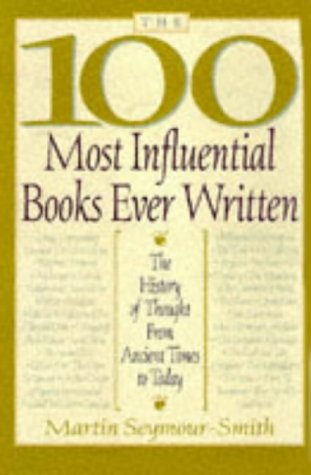
Presents the history of each book, little-known facts about its author and its creation, reasons for its inclusion, and an analysis of its influence today
Reviews
Grade 9 Up-Pulling together works from science, political science, philosophy, religion, and literature, Seymour-Smith provides a chronologically arranged history of thought and knowledge. Each four- to five-page essay includes background information on the time period, how and why the book was written, the author, and an examination of the influence of the work today. Although the publisher says this is for the "general reader," the author assumes some prior knowledge in the various fields. This title will be useful as a reference source because it includes many ancient works and many selections from Eastern cultures that are not fully discussed in other tools. It could also stimulate a discussion or writing assignment on the inclusions and omissions.
Claudia Moore, W. T. Woodson High School, Fairfax, VA
Copyright 1999 Reed Business Information, Inc.
British literary historian Seymour-Smith's survey of what he considers the 100 most influential books is a searching inquiry into major thinkers, writers and philosophers. Arranged in chronological order from the I Ching to B.F. Skinner's Beyond Freedom and Dignity, the selection is admirably inclusive, setting Confucius's Analects, India's Upanishads, the Koran and the Zoroastrian Avesta alongside the Old and New Testaments, Plato's Republic, and works by Dante, Shakespeare, Spinoza, Gibbon, Copernicus, Voltaire, Marx, Thoreau, Einstein, Freud, Jung. His compendium features concise, opinionated essays marked by intellectual depth and scope, and includes vivid biographical details of each book's author. Seymour-Smith finds most modernist techniques already present, or anticipated, in Cervantes's Don Quixote, and he views Rabelais as the first truly popular writer. His eclectic choice of influential moderns?de Beauvoir, Mao, Orwell, Keynes, Chomsky, cybernetician Norbert Winer, mystic G.I. Gurdjieff, Wittgenstein?is unpredictable, a roster he defends with alacrity. This is a mind-expanding one-volume humanities course. Illustrations.
Copyright 1998 Reed Business Information, Inc.
In this highly opinionated survey, Seymour-Smith, biographer of Hardy and Graves and world literature scholar, combines the appeal of lists (best-selling books and Letterman's nightly Top Ten) and controversy (from political sniping to Jerry Springer slugfests). For each entry, an essay discusses the author's background, the chosen work's context, and the nature of its influence on later generations. Up to the Middle Ages, Seymour-Smith's selection is fairly diverse--numbers 1^-35 include the I Ching, the Upanishads, Lao-tzu, the Avesta, the Dhammapada, and the Koran along with the Greek, Roman, Jewish, and Christian documents one might expect--but later, European (and a few American) writers dominate, with Tolstoy and Gurdjieff representing Russia and Mao China (but Gandhi, for example, omitted). This is precisely the kind of issue Seymour-Smith hoped to raise in compiling this "substantially annotated list of the one hundred books that have actually exercised, if sometimes in devious and very subterranean ways, the most decisive influence upon the course of human thought--and therefore, of course, upon various kinds of conduct, too." Mary Carroll
This book is part of the publisher's "100" series, which includes The 100: A Ranking of the Most Influential Persons in History (Carol Pub., 1992) and 13 similar compilations of the most influential women, films, gays, blacks, and so on. The current title describes the 100 books that have most changed human history, having formed the basis of the world's religions, advanced scientific knowledge, altered our understanding of ourselves, and created and reformed social and political traditions. The author, who has written many books on literary and biographical topics, e.g., Hardy (LJ 1/95), offers a four- or five-page essay on each title, giving historical background and setting, an argument for the book's right to be on the list, and a discussion of its influence today. Among the works included are Herodotus's History, The Gospels of Truth, Erasmus's In Praise of Folly, Shakespeare's First Folio, Pascal's Pens?es, Mary Wollstonecraft's Vindication of the Rights of Women, Martin Buber's I and Thou, Simone de Beauvoir's The Second Sex, and Mao's Quotations from Chairman Mao Tse-tung. Half the fun of any such list is seeing which books are included and hearing the author's reasoning. Unfortunately, though the content is good, the essays are uneven and the style digressive. Not an essential purchase.APaul A. D'Alessandro, Portland P.L., ME
Copyright 1998 Reed Business Information, Inc.
"About this title" may belong to another edition of this title.