About this Item
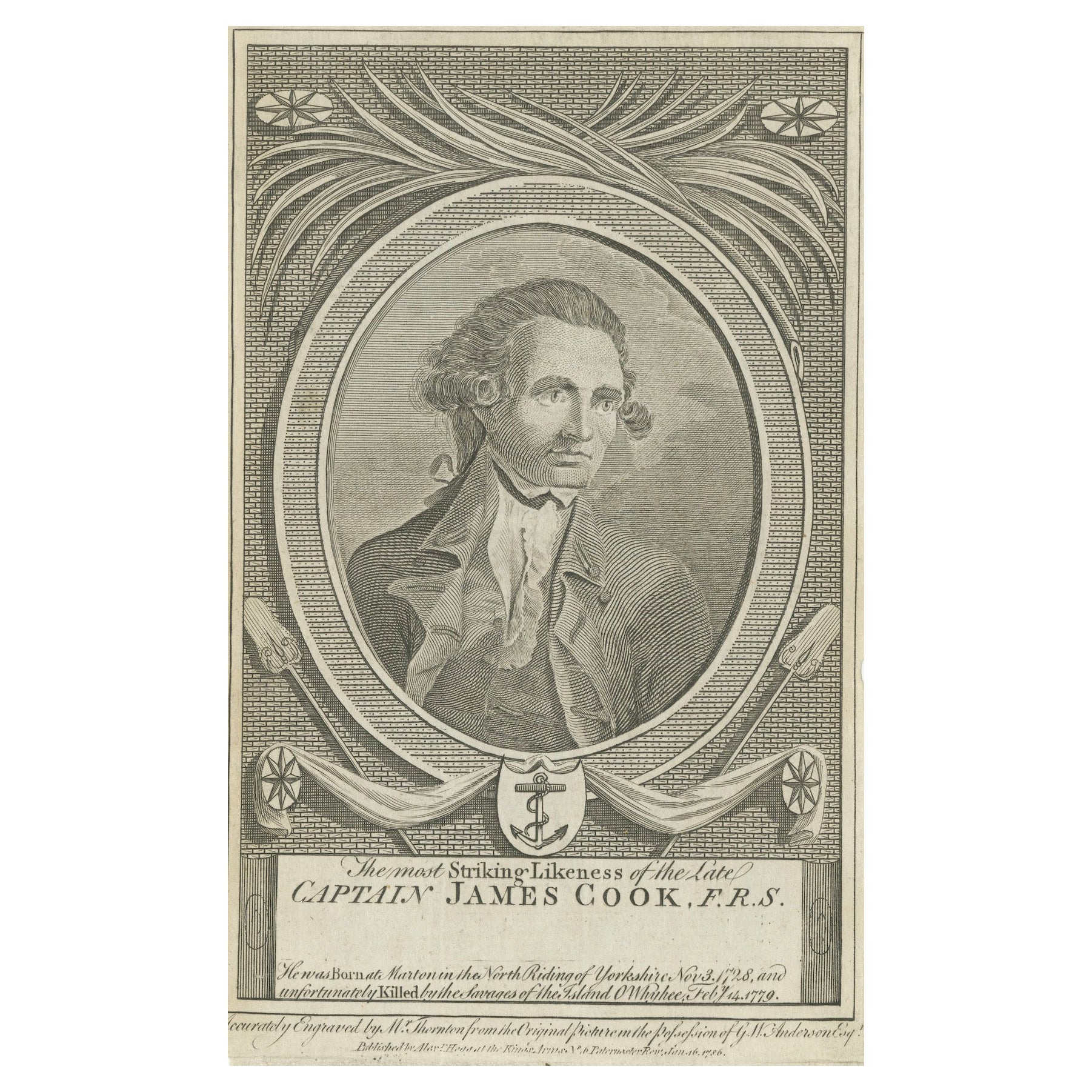
Captain James Cook, depicted in a period-style coat with a cravat. His hair is styled in a manner typical of the late 18th century, combed back and possibly powdered. The portrait is set within an oval frame, surrounded by decorative elements that include maritime motifs such as ropes and a compass at the top, suggesting his seafaring career. Below the portrait, there is an emblem featuring an anchor, which further emphasizes his naval connections. Below the portrait, there is a caption that reads: "The most Striking Likeness of the late CAPTAIN JAMES COOK, F.R.S." F.R.S. stands for Fellow of the Royal Society, indicating that Cook was a recognized member of this prestigious institution. Additional text states: "He was born at Marton in the North Riding of Yorkshire Novr. 3, 1728, and unfortunately Killed by the natives of O-Why-hee, Feby. 14, 1779." This text provides biographical details about Captain Cook, including his birthplace, birth date, and the date and location of his death (O-Why-hee, an old spelling for Hawaii). The engraver is identified as M. Thornton. This individual was responsible for creating this particular engraved image from the original picture. Engravers were highly skilled artisans, and their work was essential for the reproduction of images before the advent of modern printing technology. The original picture belonged to G.H. Anderson, Esq. The use of "Esq." or Esquire after his name implies that he was a person of status, potentially a property owner or a person with a standing in society that warranted a formal title. This detail also suggests that the original picture was of significant value and that Anderson was likely a collector or someone with an interest in the arts or maritime exploration. The print was published by Alex Hogg. Publishers like Hogg were involved in the production and distribution of books, prints, and periodicals. They played a crucial role in making images like this widely available to the public. The print was published in 1786, seven years after Captain James Cook's death. This date places the print squarely in the late 18th century and provides context for its style and the manner of its distribution. Given that the print was published in 1786, it is well over two centuries old. The condition, as previously noted, seems relatively good for its age, and the paper's discoloration aligns with the natural aging process of such materials. The print would be of significant historical interest, particularly for those studying the life of Captain James Cook or the history of exploration, maritime history, or the art of engraving. This print is a historical artifact, providing not just a visual representation of Captain James Cook, but also a connection to the cultural and artistic practices of the late 18th century. Such prints are valuable for both their artistic merit and for the historical insight they provide.
Seller Inventory # BG-13599-12
Contact seller
Report this item