
Items related to Complete Idiot's Guide to Saving the Environment
Synopsis
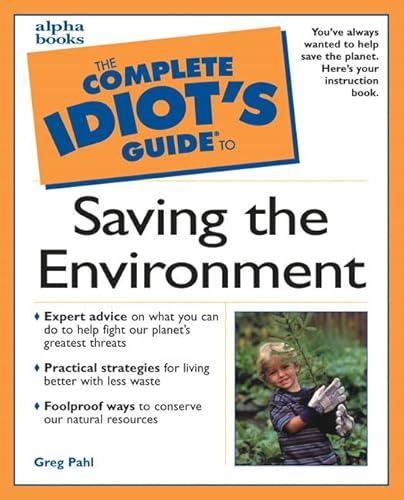
Discusses the three main global threats--decline in biodiversity, the thinning of the ozone layer, and global warming--and offers ways to reduce, reuse, and recycle.
"synopsis" may belong to another edition of this title.
About the Author
Greg Pahl is a journalist and author of numerous books who has been involved in environmental issues for more than 20 years. In the 1980s he lived "off the grid" in a wind-powered home. He has written about biodiesel, wind power, solar energy, wood heat, electric cars, sustainable forestry management, and "green" home building materials.
From the Back Cover
"The Complete Idiot's Guide to Saving the Environment" is a comprehensive guide to the ways an average citizen can make every day Earth Day. We learn how the environment got in this condition and how we can improve it by reducing, reusing, and recycling at home, at work, and everywhere else. The book suggests groups and organizations to join or to go to for information.
Excerpt. © Reprinted by permission. All rights reserved.
An excerpt from Chapter 1 to The Complete Idiot's Guide to Saving the Environment by Greg Pahl:
What a beautiful picture! Our lovely blue and green Earth with its swirling white cloud patterns set against the stark blackness of space. It's simply breathtaking. These now-familiar views of our home planet taken from the moon have caused a lot of people to change their thinking about our society--and their place in it. From space there are no visible political boundaries. There are just huge interconnected mountain ranges, forests, rivers, and oceans. And one big, interdependent global community.
But back down on Earth, things aren't so pretty. Radioactive emissions, oil spills, toxic chemical leaks; strip-mined landscapes; clear-cut rainforests; vanishing plants, birds, and animals; huge killer storms and mudslides; increasing competition for dwindling resources; famine, disease, and poverty--the unhappy list goes on and on. All of these events are connected to a variety of environmental issues, especially over-consumption of limited resources. What's more, these issues are all related to each other in one way or another. It can get confusing pretty quickly. While you might be tempted to stand there and scratch your head in bewilderment, you don't need to hold an advanced degree in environmental studies to grasp this stuff. Actually, if you understand a few simple lessons that you probably learned in kindergarten, most of this becomes pretty clear. We'll get to those lessons a bit later in this chapter.
First, we're going to pause briefly for a birthday party. Then, I'll introduce you to the basic issues we'll be seeing throughout the rest of the book. I'll also explain some environmental lingo and show you why all of this is so important.
Happy Birthday, Earth Day!
Earth Day 2000 was quite a bash. All over the planet millions of people celebrated the thirtieth anniversary of what started out as an environmental teach-in on college campuses in the U.S. back in 1970. Since then, Earth Day has expanded across the country and around the world. This year it was marked by events, both large and small, almost everywhere.
During the month of April 2000 there were speeches and parades, and demonstrations that featured alternative energy technology, and lots of other imaginative new products, programs, and ideas to help save the environment. Many participants looked fondly back over the past three decades at the many environmental success stories that have taken place. But participants also were faced with the sobering realization that while we've made progress in some areas, we're losing ground in many others.
In this country, the original Earth Day ultimately led to strengthened national Clean Air and Clean Water legislation, among many other positive things. We've cleaned up some of our worst toxic waste sites, improved the quality of the water in many of our rivers and lakes (the Cuyahoga River in Ohio doesn't catch fire anymore), banned the use of many dangerous chemicals and pesticides, increased environmental awareness, and much more. But we've still got a long way to go--especially in the realm of over-consumption because it relates to so many other environmental issues (more on that later). So, we can't pat ourselves on the back too quickly.
In Western Europe, Earth Day participants had quite a lot more to celebrate. A number of European countries have moved far ahead of us in environmental protection, alternative energy generation, and in establishing comprehensive environmental "green plans" (more on them in Chapter 26). On the other hand, in parts of Eastern Europe, and especially in Russia, the situation is grim, but not hopeless.
But the biggest challenges of all are probably in many parts of the Third World, where huge numbers of impoverished people are struggling to simply survive. And in many cases, they're stripping what few natural resources remain to try to do that. This, of course, makes survival even harder. So, on a global level it's a real mixed bag. Consequently, Earth Day was both a celebration and a call for redoubled efforts to tackle the many difficult environmental problems that remain.
The Environmental Century
At the very least, the Earth Day anniversary has helped to refocus our attention on the continuing damage we're causing to the very resources that provide us with our food, clothing, shelter, and fuel. And we're beginning to run out of time to make the fundamental changes needed to reverse these trends.
Although environmentalists have been warning about this situation for decades, many other people are finally beginning to realize that if we don't act soon it will be too late. The good news is that more and more businesses and governments are beginning to understand that without a healthy environment the global economy and everything that depends on it will be seriously endangered. And they are beginning to take positive action. We'll focus on the good news later on in the book.
One way or another, this is unquestionably going to be the Environmental Century. We'll either tackle these problems head on and begin to resolve them, or Mother Nature will do it for us. And, as you've probably heard, it's not a good idea to mess with Mother Nature. But that's exactly what we have been doing for a very long time. Now she's beginning to get really irritated....
"About this title" may belong to another edition of this title.
Search results for Complete Idiot's Guide to Saving the Environment

Seller Image
Complete Idiot's Guide to Saving the Environment
Seller: -OnTimeBooks-, Phoenix, AZ, U.S.A.
Seller rating 5 out of 5 stars

Condition: very_good. Gently read. May have name of previous ownership, or ex-library edition. Binding tight; spine straight and smooth, with no creasing; covers clean and crisp. Minimal signs of handling or shelving. 100% GUARANTEE! Shipped with delivery confirmation, if you're not satisfied with purchase please return item! Ships USPS Media Mail. Seller Inventory # OTV.0028639820.VG
Stock Image
Complete Idiot's Guide to Saving the Environment
Seller: Wonder Book, Frederick, MD, U.S.A.
Seller rating 5 out of 5 stars
Condition: Very Good. Very Good condition. A copy that may have a few cosmetic defects. May also contain light spine creasing or a few markings such as an owner's name, short gifter's inscription or light stamp. Seller Inventory # J07R-00498
Stock Image
Complete Idiot's Guide to Saving the Environment
Published by
Penguin Publishing Group, 2000
ISBN 10: 0028639820
ISBN 13: 9780028639826
Used
Softcover
First Edition
Seller: Better World Books, Mishawaka, IN, U.S.A.
Seller rating 5 out of 5 stars
Condition: Very Good. 1st Edition. Pages intact with possible writing/highlighting. Binding strong with minor wear. Dust jackets/supplements may not be included. Stock photo provided. Product includes identifying sticker. Better World Books: Buy Books. Do Good. Seller Inventory # 13973611-6
Seller Image
The Complete Idiots Guide to Saving the Environment
Seller: Manyhills Books, Traralgon, VIC, Australia
Seller rating 4 out of 5 stars

Softcover. Condition: As New. Softcover. 348 pages. *** PUBLISHING DETAILS: Alpha Books, USA, 2001. *** CONDITION: This book is in as new condition. Remainder mark. *** ABOUT THIS BOOK: You re no idiot, of course. You know that pollution does more than just clutter up the landscape and that our natural resources won t last without careful conservation. So you try to do your share-when you have the time. You recycle your soda cans-when you remember. And you d like to do more-but you re just so busy . Stop making excuses! The truth is, the earth needs you now-and The Complete Idiot s Guide to Saving the Environment shows you simple, easy ways you can make a difference. In this Complete Idiot s Guide , you get: An overview of the crisis facing Mother Earth. Simple facts about what global warming means for us-and for plants and animals. Practical ways you can be part of the solution, not the problem. Idiot-proof tips on making the three R s-Reduce, Reuse, and Recycle-part of your life. *** Quantity Available: 4. Category: Natural History & Resources; ISBN: 0028639820. ISBN/EAN: 9780028639826. Inventory No: 07120007. This item is in stock in our Australian warehouse. We are not dropshippers. Seller Inventory # 07120007
Buy Used
US$ 16.06
US$ 52.00 shipping
Ships from Australia to U.S.A.
Ships from Australia to U.S.A.
Quantity: 4 available