
Items related to The Chalice and the Blade
Synopsis
The legacy ofthe sacred feminine
The Chalice and the Blade tells a new story of our cultural origins. It showsthat warfare and the war of the sexes are neither divinely nor biologicallyordained. It provides verification that a better future is possible—and is in factfirmly rooted in the haunting dramas of what happened in our past.
"synopsis" may belong to another edition of this title.
About the Author
Riane Eisler is an internationally acclaimed scholar, futurist, and activist, and is codirector of the Center for Partnership Studies in Pacific Grove, California. She is the author of Sacred Pleasure and The Partnership Way.
From the Back Cover
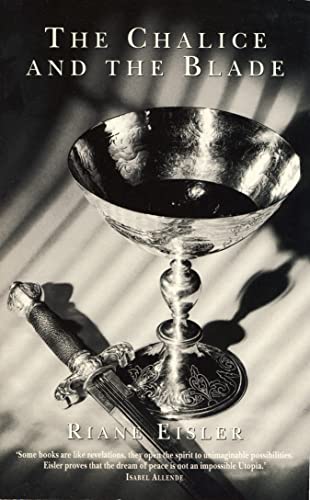
The Chalice and the Blade tells a new story of our cultural origins. It shows that war and the "war of the sexes" are neither divinely nor biologically ordained. And it provides verification that a better future is possible--and is in fact firmly rooted in the haunting drama of what actually happened in our past."
Some books are like revelations, they open the spirit to unimaginable possibilities. The Chalice and the Blade is one of those magnificent key books that can transform us and...initiate fundamental changes in the world. With the most passionate eloquence, Riane Eisler proves that the dream of peace is not an impossible utopia."--Isabel Allende, author of The House of Spirits
"The Chalice and the Blade may be the most significant work published in all our lifetimes."--LA Weekly
"Everyone...should have the opportunity to read it."-- The Chicago Tribune
"Eisler's highly readable synthesis...is an important contribution to social history."-- Publishers Weekly
"A gem....A rare combination of poetic expression and sober sustenance."--Jesse Bernard, author of The Future of Marriage and The Female World
"Validates a belief in humanity's capacity for benevolence and cooperation in the face of so much destruction."--San Francisco Chronicle Book Review
"As important, perhaps more important, than the unearthing of Troy or the deciphering of cuneiform."--Bruce Wilshire, professor of philosophy, Rutgers University FRONT COVER: Limestone Goddess figurine, Great Mother of Sernobi, near Cagliari, Sardinia, from between the second half of the fifth a the early fourth millenium B.C.E. Photograph by Scala/Art Resource.
Reviews
Women played leading roles in the first Christian communities; Jesus' teachings had a feminist bent; ancient Hebrews worshipped the prehistoric goddess-mother well into monarchic times; and Nazis, with their system of male dominance, were a direct throwback to the Indo-European or Aryan invaders whom they crudely imitated. These controversial ideas and findings suggest the thrust of Eisler's highly readable synthesis. She convincingly documents the global shift from egalitarian to patriarchal societies, interweaving new archeological evidence and feminist scholarship. In her scenario, as womenonce veneratedwere degraded to pawns controlled by men, social cooperation gave way to reliance on violence, hierarchy and authoritarianism. The book, despite its jargon, is an important contribution to social history. Eisler wrote The Equal Rights Handbook.
Copyright 1987 Reed Business Information, Inc.
In this first of a projected three-book series, Eisler covers terrain also described by Marilyn French in Beyond Power ( LJ 6/1/85) and Gerda Lerner in The Creation of Patriarchy ( LJ 7/86). In prehistorical times, Eisler argues, women and men lived together in egalitarian communities devoted to nurturance; with the imposition of male domination, female values gave way to creeds of hierarchy, aggression, power, obedience. Eisler, a futurist, posits a new society based on the recovery of more humane values. She gives us a broader reach of time than Lerner, and she does not swamp her outline in detail as French did. An imaginative and persuasive work, Eisler's effort is undermined by jargon; her view of the future is exceedingly optimistic. For a select audience. Cynthia Harrison, American Historical Assn., Washington, D.C.
Copyright 1987 Reed Business Information, Inc.
Excerpt. © Reprinted by permission. All rights reserved.
Chapter One
Journey into a Lost World:
The Beginnings of
Civilization
Preserved in a cave sanctuary for over twenty thousand years, a female figure speaks to us about the minds of our early Western ancestors. She is small and carved out of stone: one of the so-called Venus figurines found all over prehistoric Europe.
Unearthed in excavations over a wide geographical area--from the Balkans in eastern Europe to Lake Baikal in Siberia, all the way west to Willendorf near Vienna and the Grotte du Pappe in France--these figurines have been described by some scholars as expressions of male eroticism: that is, an ancient analogue for today's Playboy magazine. To other scholars they are only something used in primitive, and presumably obscene, fertility rites.
But what is the actual significance of these ancient sculptures? Can they really be dismissed as the "products of unregenerated male imagination"?1 Is the term Venus even appropriate to describe these broad-hipped, sometimes pregnant, highly stylized, and often faceless figures? Or do these prehistoric sculptures tell us something important about ourselves, about how both women and men once venerated the life-giving powers of the universe?
The Paleolithic
Along with their wall paintings, cave sanctuaries, and burial sites, the female figurines of the peoples of the Paleolithic are important psychic records. They attest to our forebears' awe at both the mystery of life and the mystery of. death. They indicate that very early in human history the human will to live found expression and reassurance through a variety of rituals and myths that seem to have been associated with the still widely held belief that the dead can return to life through rebirth.
"In a great cavern sanctuary like Les Trois Frères, Niaux, Font de Gaume or Lascaux," writes the religious historian E. O. James, "the ceremonies must have involved an organized attempt on the part of the community . . . to control natural forces and processes by supernatural means directed to the common good. The sacred tradition, be it in relation to the food supply, the mystery of birth and propagation, or of death, arose and functioned, it would appear, in response to the will to live here and hereafter."2
This sacred tradition found expression in the remarkable art of the Paleolithic. And an integral component of this sacred tradition was the association of the powers that govern life and death with woman.
We can see this association of the feminine with the power to give life in Paleolithic burials. For example, in the rock shelter known as Cro-Magnon in Les Eyzies, France (where in 1868 the first skeletal remains of our Upper Paleolithic ancestors were found), around and on the corpses were carefully arranged cowrie shells. These shells, shaped in the form of what James discreetly calls "the portal through which a child enters the world," seem to have been associated with some kind of early worship of a female deity. As he writes, the cowrie was a lifegiving agent. So also was red ocher, still in later traditions the surrogate of the life-giving or menstrual blood of woman.3
The main emphasis seems to have been on the association of woman with the giving and sustaining of life. But at the same time, death--or, more specifically, resurrection--also appears to have been a central religious theme. Both the ritualized placement of the vagina-shaped cowrie shells around and on the dead and the practice of coating these shells and/or the dead with red ocher pigment (symbolizing the vitalizing power of blood) appear to have been part of funerary rites intended to bring the deceased back through rebirth. Even more specifically, as James notes, they "point to mortuary rituals in the nature of a life-giving ritual closely connected with the female figurines and other symbols of the Goddess cult."4
In addition to this archaeological evidence of Paleolithic funerary rites, there is also evidence of rites seemingly designed to encourage the fecundity of the wild animals and plants that provided our forebears with life support. For example, in the gallery of the inaccessible cavern of Tuc d'Audoubert in Ariège, on the soft clay floor underneath the wall painting of two bisons (a female followed by a male), we find impressions of human feet believed by scholars to have been made in ritual dances. Similarly, in the Cogul rock shelter in Catalonia, we find a scene of women, possibly priestesses, dancing around a smaller naked male figure in what seems to be a religious ceremony.
These cave sanctuaries, figurines, burials, and rites all seem to have been related to a belief that the same source from which human life springs is also the source of all vegetable and animal life--the great Mother Goddess or Giver of All we still find in later periods of Western civilization. They also suggest that our early ancestors recognized that we and our natural environment are integrally linked parts of the great mystery of life and death and that all nature must therefore be treated with respect. This consciousness--later emphasized in Goddess figurines either surrounded by natural symbols such as animals, water, and trees or themselves partly animal--evidently was central to our lost psychic heritage. Also central to that lost heritage is the apparent awe and wonder at the great miracle of our human condition: the miracle of birth incarnated in woman's body. Judging from these early psychic records, this was a central theme of prehistoric Western systems of belief.
Now what we have been developing to this point is still not the view of many scholars. Nor is it the view still taught in most survey classes about the origins of civilization. For here, as in most popularized writings on the subject, there still prevail the preconceptions of earlier scholars who saw Paleolithic art in terms of the conventional stereotype of "primitive man": bloodthirsty, warlike hunters, in fact very unlike some of the most primitive gathering-hunting societies discovered in modern times.5
"About this title" may belong to another edition of this title.
Search results for The Chalice and the Blade

Seller Image
The Chalice and the Blade: Our History, Our Future (Mandala Books)
Seller: WeBuyBooks, Rossendale, LANCS, United Kingdom
Seller rating 5 out of 5 stars

paperback. Condition: Good. Most items will be dispatched the same or the next working day. A copy that has been read but remains in clean condition. All of the pages are intact and the cover is intact and the spine may show signs of wear. The book may have minor markings which are not specifically mentioned. Seller Inventory # rev2219766616
Buy Used
US$ 23.30
US$ 7.04 shipping
Ships from United Kingdom to U.S.A.
Ships from United Kingdom to U.S.A.
Quantity: 1 available
Stock Image
The Chalice and the Blade: Our History, Our Future (Mandala Books)
Seller: Greener Books, London, United Kingdom
Seller rating 4 out of 5 stars

Paperback. Condition: Used; Very Good. **SHIPPED FROM UK** We believe you will be completely satisfied with our quick and reliable service. All orders are dispatched as swiftly as possible! Buy with confidence! Greener Books. Seller Inventory # 4914066
Buy Used
US$ 9.23
US$ 26.81 shipping
Ships from United Kingdom to U.S.A.
Ships from United Kingdom to U.S.A.
Quantity: 1 available
Seller Image
The Chalice and the Blade: Our History, Our Future
Seller: M Godding Books Ltd, Devizes, WILTS, United Kingdom
Seller rating 5 out of 5 stars
paperback. Condition: Good. . Posted within 1 working day. Royal Mail Tracked 24 to UK. Tracked Airmail worldwide. Robust recyclable packaging. Picture is the actual item. Seller Inventory # 312466
Buy Used
US$ 22.57
US$ 16.73 shipping
Ships from United Kingdom to U.S.A.
Ships from United Kingdom to U.S.A.
Quantity: 1 available
Stock Image
The Chalice and the Blade: Our History, Our Future (Mandala Books)
Seller: Hay-on-Wye Booksellers, Hay-on-Wye, HEREF, United Kingdom
Seller rating 4 out of 5 stars
Condition: Good. Reading content is in clean and readable condition.Some tanning ot the edge of the pages and crease to the spine. Seller Inventory # 126587-03-09-2026-CB
Buy Used
US$ 27.61
US$ 33.51 shipping
Ships from United Kingdom to U.S.A.
Ships from United Kingdom to U.S.A.
Quantity: 1 available
Seller Image
The Chalice and the Blade: Our History, Our Future (Mandala Books)
Published by
Mandala (Unwin/Harper Collins imprint) 2/1/1996, 1996
ISBN 10: 0044406274
ISBN 13: 9780044406273
Used
Paperback
Seller: Oak Books, Ouyen, VIC, Australia
Seller rating 5 out of 5 stars
Paperback. This text proposes two models of human history: the blade represents the dominator model, a world of conflict and domination, threatened with environmental destruction; the chalice represents the partnership model, a society based on equality and co-operation. Eisler uncovers the existence, prehistory, of a goddess culture where the chalice held sway and there was peace for humankind. These are USED books. Please only purchase if you are happy with that. Images & Editions We use stock images and database descriptions based on the ISBN. The image shown may NOT be the actual book cover you will receive. Covers, editions, printings, and publishers may differ. If you need a specific cover, edition, or printing, please contact us before purchasing. What "Used" Means Because these books are pre-owned: Colouring books may be coloured in Textbooks may have answers filled in, highlighting, notes, or underlining Workbooks may have writing inside Access codes, download codes, CDs, DVDs, or online content are usually missing or already used Books that originally came with toys, inserts, maps, cards, or bonus items will usually NOT include them Pages may be folded, marked, or show normal signs of use If you are buying a book for anything other than reading (e.g. colouring, study use, collecting, gifts, specific covers, bonus items, or digital access), used books may not be suitable. Condition All books are listed as Used - Good Books are clean and readable but not new Some books may have: Writing, highlighting, or markings Folded pages or minor wear A small warehouse or inventory sticker on the spine Original retailer stickers (we do not remove them) Our Process We purchase books by the pallet and scan thousands at a time. For this reason, we cannot photograph or individually inspect every book. Acknowledgement By purchasing, you acknowledge that: You understand the book is used You accept the condition and limitations described above Stock images and descriptions may not exactly match the item received Thank you for supporting Oak Books and helping give books a second life. Seller Inventory # CS292_fo1
Buy Used
US$ 50.96
US$ 33.00 shipping
Ships from Australia to U.S.A.
Ships from Australia to U.S.A.
Quantity: 1 available