
Items related to Treasure Box
Synopsis
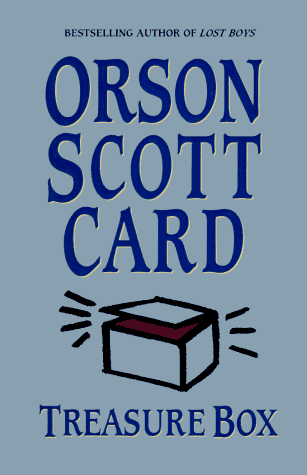
When Quentin Fears was ten, his sister left this world, the victim of a car accident. Her death made him withdraw from this world too - into books, away from people. By the time he reaches adulthood, Quentin has become a certifiable recluse, moving restlessly from town to town, investing the millions he's made as a software creator and avoiding companionship. It's odd but maybe inevitable that on a rare outing to a party he should meet his dream woman, Madeleine. She's witty and beautiful and as naive to the world's ways as he is, and they marry in a matter of weeks. Their relationship seems idyllic but for one thing - Madeleine's multigenerational, cantankerous, eccentric family who all live in a rambling riverside mansion in upstate New York. But poor family dynamics isn't all that's wrong with them. Beyond the squabbling, there's an ancient, dirty family secret to which Madeleine holds the key. Only Quentin can stop her from unleashing an ageless malevolence that will rule the world. But to do so, he must do what seems impossible - step outside himself into the world he has avoided. He must learn friendship, trust, forgiveness, and the courage to face down the ultimate evil. Joining Quentin in this epic confrontation is a splendidly quirky cast of heroes, villains, and witches - from a no-nonsense nurse with a dash of the romantic in her to a small-town sheriff whose affable exterior conceals a dangerous past to a ten-year-old girl named Roz whose malign powers are rivaled only by her smart mouth.
"synopsis" may belong to another edition of this title.
About the Author
Orson Scott Card has won several Hugo and Nebula Awards for his works of speculative fiction, among them the Ender series and The Tales of Alvin Maker. He lives in Greensboro, North Carolina, with his wife and four children.
Reviews
When naive computer-nerd and millionaire Quentin Fears meets the woman of his dreams at a posh Washington, D.C., party and then marries her, he thinks his life is complete. But in this low-key horror novel, appearances can't be trusted and people aren't always in control of their actions. Although Madeleine seems quite sophisticated, there are deficits in her memory and her background is vague. She claims a large, well-to-do family but invites no relatives to the wedding. When Quentin finally meets his in-laws at their palatial Upstate New York mansion, they strike him as eccentric, almost as cartoons of real people. The domineering grandmother, whom Madeleine hates, sits in a trance, eyes closed, refusing to speak. There are hints of past child abuse?and of the possibility that a young boy may have been murdered. Why do so many of Madeleine's relatives have names identical to those buried in the family cemetery? And why doesn't Madeleine leave any footprints in the snow? Although the story moves toward a powerful climax, its primary pleasures are more subtle: strong character development and complex motivations, a mystery to solve, the discovery of wheels within wheels. It's rare that Card, renowned for his science fiction (see the review of his Children of the Mind, below), switches genres. But when he does, here as in his Lost Boys (1992), there's little lost and a rare pleasure gained. $50,000 ad/promo; author tour; U.K., translation, first serial and dramatic rights: Barbara Bova.
Copyright 1996 Reed Business Information, Inc.
A contemporary tale of the supernatural: fantastic/science- fictioneer Card's second mainstream outing (after Lost Boys, 1992). When Quentin Fears was a young boy, his beloved elder sister Lizzy went joyriding and ended up dead--though Quentin continued to imagine himself talking to her. After making a fortune in computers, Quentin sells out and drifts. Innocent about women, he meets a soulmate, Madeleine Cryer, at a party; perhaps because she reminds him of Lizzy, he falls in love. They marry quickly, fumble their way toward sexual awareness (with Madeleine as innocent as he), then visit Madeleine's family at their rambling upstate New York mansion. Next morning, during an elaborate breakfast, Quentin meets Madeleine's grandmother and assorted weird cousins; then, oddly, Madeleine insists that Quentin open a box that supposedly contains her inheritance. Thoroughly uneasy, Quentin refuses. Madeleine storms off and disappears--leaving no footprints in the snow, Quentin discovers, though he does come upon the graveyard where the cousins he just met are buried! Madeleine, it emerges, never existed: She's a succubus conjured by a witch. The mansion's real owner, Anna Laurent Tyler--grandmother!--lives in a nearby nursing home. Her daughter Rowena is, Quentin suspects, the witch who has set all of this in motion. He talks things over with Lizzy- -a ghost, not his imagination--and decides to confront Rowena. Unfortunately, the witch is actually Roz, Rowena's 11-year-old horror of a daughter; and Roz, having trapped Lizzie's ghost, now has the means to compel Quentin to open the mysterious box. Inside lurks an evil and powerful dragon that Roz thinks she'll control- -once it has absorbed Quentin. Beautifully orchestrated, with above-average characters, but blandly unsurprising and lacking the gritty, discomfiting feel of reality underfoot. ($50,000 ad/promo; author tour) -- Copyright ©1996, Kirkus Associates, LP. All rights reserved.
Card's second departure from science fiction, the genre in which he's a perennial best-seller, is, like the very successful Lost Boys (1992), essentially a ghost story and a better one than its predecessor because Card doesn't weigh it down with Mormon family values preaching. Instead, he inserts a smidgen of his religion by making his protagonist, bachelor millionaire Quentin Fears, a 34-year-old virgin. Actually, Quentin's chastity, credible and sympathetically portrayed, is rather refreshing. Card also makes it the vehicle for subtle satire of the American obsession with sex as well as the Achilles' heel whereby Quentin is bowled over when he meets the mysterious blond stunner Madeleine Cryer at a Washington, D.C., society party. Not the least of Madeleine's attractions for Quentin is her resemblance to his sister, who died when Quentin was 11 and to whom he was devoted. It turns out that Madeleine is not what she seems, or rather, is only seeming, as Quentin discovers after he meets her family in a creepy old Hudson River mansion--a haunted house, perhaps? Yes, but not merely haunted. Many readers will hear echoes of Robert Marasco's superb haunted-house thriller, Burnt Offerings (1973), and of Hitchcock's classic film about romantic obsession, Vertigo, in Card's effort, which, although not as good as either, is enthrallingly entertaining, nevertheless. Ray Olson
At age 11, Quentin Fears is devastated by his older sister Lizzy's death. Subsequently, he grows up to be a lonely man, obsessed with memories of Lizzy. He becomes extremely wealthy, yet everything he does centers around Lizzy. He even picks a wife who reminds him of her. Madeleine, the woman with whom he falls in love and marries in a matter of weeks, turns out to be an apparition invented by an evil witch. Once the story turns to Quentin's wife and her family, the plot degenerates into the script of a B-movie, with wild explanations for the comings and goings of ghosts and the mysterious treasure box that Madeleine wants her new husband to open. Card, the author of many highly acclaimed works (e.g., Children of the Mind, Tor, 1996) is more handy with quick and witty dialog than story content. There is not enough humor here it to be funny and not enough horror or fantasy for it to be either. Recommended only for large collections.?Shirley Gibson Coleman, Ann Arbor Dist. Lib, Mich.
Copyright 1996 Reed Business Information, Inc.
"About this title" may belong to another edition of this title.
Search results for Treasure Box

Stock Image
Treasure Box
Published by
HarperCollins Publishers Inc, 1996
ISBN 10: 0060176547
ISBN 13: 9780060176549
Used
Hardcover
Seller: World of Books (was SecondSale), Montgomery, IL, U.S.A.
Seller rating 5 out of 5 stars

Hardback. Condition: Good. A shattering childhood tragedy leftQuentin Fears devastated and unable tocope with the world and its citizens. It didn't, however, prevent him from making millions throughbrilliant investments. And now the enigmatic recluse has experienced the extraordinarily unexpected: love at first sight.But a whirlwind courtship and marriage to Madeleine -- beautiful, witty, and equally ill-at-ease with reality -- is bringing Quentin something other than the bliss he anticipated, for now he must meet his new wife's family.A bizarre, dysfunctional collection of extreme characters, they are guarding a secret both shocking and terrifying -- as is Madeleine herself. And suddenly Quentin Fears must prevent his dream woman from unleashing an ageless malevolence intent on ruling the world. Seller Inventory # 00065841203
Seller Image
Treasure Box
Seller: Aspen Book Co., Denver, CO, U.S.A.
Seller rating 5 out of 5 stars
Condition: very_good. Excellent condition with just a hint of character. Minor signs of love, but the pages are still clean and ready for adventure. Seller Inventory # PKV.0060176547.VG
Stock Image
Treasure Box
Published by
HarperCollins Publishers, 1996
ISBN 10: 0060176547
ISBN 13: 9780060176549
Used
Hardcover
Seller: Better World Books, Mishawaka, IN, U.S.A.
Seller rating 5 out of 5 stars
Condition: Good. Former library copy. Pages intact with minimal writing/highlighting. The binding may be loose and creased. Dust jackets/supplements are not included. Includes library markings. Stock photo provided. Product includes identifying sticker. Better World Books: Buy Books. Do Good. Seller Inventory # 39688375-6
Stock Image
Treasure Box
Published by
HarperCollins Publishers Inc, 1996
ISBN 10: 0060176547
ISBN 13: 9780060176549
Used
Hardcover
Seller: World of Books Inc, Montgomery, IL, U.S.A.
Seller rating 4 out of 5 stars

Hardback. Condition: Good. A shattering childhood tragedy leftQuentin Fears devastated and unable tocope with the world and its citizens. It didn't, however, prevent him from making millions throughbrilliant investments. And now the enigmatic recluse has experienced the extraordinarily unexpected: love at first sight.But a whirlwind courtship and marriage to Madeleine -- beautiful, witty, and equally ill-at-ease with reality -- is bringing Quentin something other than the bliss he anticipated, for now he must meet his new wife's family.A bizarre, dysfunctional collection of extreme characters, they are guarding a secret both shocking and terrifying -- as is Madeleine herself. And suddenly Quentin Fears must prevent his dream woman from unleashing an ageless malevolence intent on ruling the world. Seller Inventory # CIN0060176547G
Stock Image
Treasure Box
Seller: Redux Books, Grand Rapids, MI, U.S.A.
Seller rating 5 out of 5 stars
Hardcover. Condition: Very Good. Hardcover with dust jacket. Pages are clean and unmarked. Covers show very minor shelf wear. Dust jacket shows light edge wear. Binding is tight, hinges strong.; 100% Satisfaction Guaranteed! Ships same or next business day! Seller Inventory # 142206210045
Stock Image
Treasure Box
Seller: Wonder Book, Frederick, MD, U.S.A.
Seller rating 5 out of 5 stars
Condition: Very Good. Very Good condition. Good dust jacket. A copy that may have a few cosmetic defects. May also contain light spine creasing or a few markings such as an owner's name, short gifter's inscription or light stamp. Seller Inventory # L01A-02811
Seller Image
Treasure Box
Seller: Goodwill Books, Hillsboro, OR, U.S.A.
Seller rating 5 out of 5 stars
Condition: good. Signs of wear and consistent use. Seller Inventory # GICWV.0060176547.G
Stock Image
Treasure Box
Published by
HarperCollins Publishers August 1996, 1996
ISBN 10: 0060176547
ISBN 13: 9780060176549
Used
Hardcover
Seller: Book People, Henrico, VA, U.S.A.
Seller rating 5 out of 5 stars
Hardcover. Condition: Used. Dust Jacket Condition: Fine. Some shelf wear with slightly bumped corners and light edgewear, but binding is tight and the pages are all clean with no markings. This IS a former library edition with all the usual stamps and labels. Seller Inventory # 66719
Stock Image
Treasure Box
Seller: HPB Inc., Dallas, TX, U.S.A.
Seller rating 5 out of 5 stars
hardcover. Condition: Very Good. Connecting readers with great books since 1972! Used books may not include companion materials, and may have some shelf wear or limited writing. We ship orders daily and Customer Service is our top priority! Seller Inventory # S_479529668
Stock Image
Treasure Box
Published by
HarperCollins, Scranton, Pennsylvania, U.S.A., 1996
ISBN 10: 0060176547
ISBN 13: 9780060176549
Used
Hardcover
Seller: Vashon Island Books, Vashon, WA, U.S.A.
Seller rating 5 out of 5 stars
Hardcover. Condition: Very Good+. Dust Jacket Condition: Very Good+. First Edition; First Printing. Size: 8vo - over 7¾" - 9¾" tall. Book. Seller Inventory # G39833