
Items related to What Do Women Want? Bread, Roses, Sex, Power
Synopsis
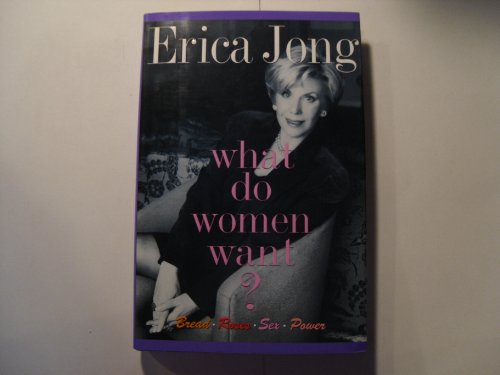
A renowned author attempts to answer an age-old question in this collection of witty meditations on everything from Hillary Clinton to writing love letters, ultimately revealing the secrets of what women are really after in life.
"synopsis" may belong to another edition of this title.
About the Author
Erica Jong, award-winning poet, novelist, and essayist, is best known for seven bestselling novels, including her most recent, Inventing Memory, and her midlife memoir, Fear of Fifty. She is a former president of the Authors Guild and frequent lecturer on women's rights, authors' rights, and free expression both here and abroad. She lives in New York City and Connecticut.
Reviews
Jong is sometimes a lot of fun to read. The "sometimes" is the problem with this random collection of essays, some of which bounce off the news headlines and some of which sound like presentations to eager undergraduates. Jong is snippy and funny on the subject of the impotence drug Viagra?would we have expected less from the author of the famously raunchy Fear of Flying? But she can't resist pointing out that she was ahead of her time in 1973 when her heroine Isadora Wing opined on the subject of male limpness. Jong is interesting and trenchant on why we have such mixed feelings toward Hillary Rodham Clinton. She is academic on the subject of Charlotte Bronte and less than discreet about Henry Miller and his seemingly unalloyed admiration of her. She likes Virginia Woolf and Vladimir Nabokov, but it is hard not to balk a little when she describes herself as a "celebrated writer" in such company. Judging by her frequent references to her own notorious frankness, the celebration may be more sexual than literary. Complain, complain as ruffled critics have done since Isadora made her noisy debut 25 years ago, but at the end of it all Erica Jong is an original. One may flinch at a writer who can't leave the subject of sex for more than a paragraph or two but at the same time be seduced by one who believes in the power of poetry and introduces her miscellany with the words "Poetry has saved my life. I think it can save yours."
Copyright 1998 Reed Business Information, Inc.
As she did in her best-selling memoir, Fear of Fifty (1994), Jong lays it on the line in these potent essays about women's lives, writing with acuity, gutsiness, and humor. She presents clarifying, empathic, yet not uncritical analyses of the tragedy of Princess Diana and the martyrdom of Hillary Rodham Clinton, arguing convincingly that the Clintons have "revolutionized" the institutions of American political marriages and First Ladyhood and helped the nation "grow up sexually." Jong muses on the question of why life for "brainy" women is so difficult and ponders the source of the ongoing castigation of working mothers. She also shows off her literary smarts and unwavering support of the freedom of expression in fresh and discerning discussions of the unexpurgated journals of Anais Nin and the cyclical censorship of Nabokov's Lolita, a novel no U.S. publisher would touch in the 1950s and now no movie conglomerate will distribute in its latest film incarnation. If a film depicted "an adolescent girl carved up by cannibals," Jong suggests, it would have been released with "remarkably little fuss," but hint at underage sexuality and pedophilia and look out. Whether she's writing about literature, mothers and daughters, or the "perfect man," Jong is vigorous, bright, and forthright. Donna Seaman
Jong (Inventing Memory, LJ 6/1/97) should stick to fiction writing. Her latest effort, essays on women, contemporary culture, and travel, is embarrassingly unsophisticated, full of the kind of gossip found in People magazine. To be fair, the travel essays are enjoyable, especially Jong's list of places to visit in Italy. But her focus is erratic, almost stream-of-consciousness?in writing about a sepulchre in Lucca and discussing the wife of a "15th-century boss," Jong writes, "I forgot how she died. I'm sure I deliberately blank out her story because I loathe stories about young women who die at tender ages." Jong continues to use the short choppy line, a style choice that can be hard to take. Though readers may devour Jong's personal stories about Hillary Clinton and the convicted nanny Louise Woodward, many will see them as yet another sensationalist attempt to sell books. Worst of all, Jong includes herself with many fine writers in the chapter "Writing for Love." If she is writing for love, one can only hope that she will do so privately.
-?Barbara O'Hara, Free Lib. of Philadelphia
Copyright 1998 Reed Business Information, Inc.
"About this title" may belong to another edition of this title.
Search results for What Do Women Want? Bread, Roses, Sex, Power

Stock Image
What Do Women Want?: Bread, Roses, Sex, Power
Published by
HarperCollins Publishers Inc, 1998
ISBN 10: 0060183764
ISBN 13: 9780060183769
Used
Hardcover
Seller: World of Books (was SecondSale), Montgomery, IL, U.S.A.
Seller rating 5 out of 5 stars

Hardback. Condition: Good. Seller Inventory # 00090042718
Stock Image
What Do Women Want? Bread, Roses, Sex, Power
Seller: More Than Words, Waltham, MA, U.S.A.
Seller rating 5 out of 5 stars
Condition: Good. A sound copy with only light wear. Overall a solid copy at a great price! Seller Inventory # BOS-M-08h-01672
Stock Image
What Do Women Want?: Bread, Roses, Sex, Power
Published by
HarperCollins Publishers Inc, 1998
ISBN 10: 0060183764
ISBN 13: 9780060183769
Used
Hardcover
Seller: World of Books Inc, Montgomery, IL, U.S.A.
Seller rating 4 out of 5 stars

Hardback. Condition: Good. Seller Inventory # CIN0060183764G
Stock Image
What Do Women Want? : Bread, Roses, Sex, Power
Published by
HarperCollins Publishers, 1998
ISBN 10: 0060183764
ISBN 13: 9780060183769
Used
Hardcover
Seller: Better World Books: West, Reno, NV, U.S.A.
Seller rating 5 out of 5 stars
Condition: Very Good. Former library copy. Pages intact with possible writing/highlighting. Binding strong with minor wear. Dust jackets/supplements may not be included. Includes library markings. Stock photo provided. Product includes identifying sticker. Better World Books: Buy Books. Do Good. Seller Inventory # 12131070-6
Stock Image
What Do Women Want? : Bread, Roses, Sex, Power
Published by
HarperCollins Publishers, 1998
ISBN 10: 0060183764
ISBN 13: 9780060183769
Used
Hardcover
Seller: Better World Books, Mishawaka, IN, U.S.A.
Seller rating 5 out of 5 stars
Condition: Good. Former library copy. Pages intact with minimal writing/highlighting. The binding may be loose and creased. Dust jackets/supplements are not included. Includes library markings. Stock photo provided. Product includes identifying sticker. Better World Books: Buy Books. Do Good. Seller Inventory # GRP89593621
Stock Image
What Do Women Want? Bread, Roses, Sex, Power
Seller: Wonder Book, Frederick, MD, U.S.A.
Seller rating 5 out of 5 stars
Condition: Good. Good condition. Very Good dust jacket. A copy that has been read but remains intact. May contain markings such as bookplates, stamps, limited notes and highlighting, or a few light stains. Seller Inventory # V07B-04543
Stock Image
What Do Women Want? Bread, Roses, Sex, Power
Seller: Wonder Book, Frederick, MD, U.S.A.
Seller rating 5 out of 5 stars
Condition: Very Good. Very Good condition. Very Good dust jacket. A copy that may have a few cosmetic defects. May also contain light spine creasing or a few markings such as an owner's name, short gifter's inscription or light stamp. Seller Inventory # G14Q-00768
Stock Image
What Do Women Want? Bread, Roses, Sex, Power
Seller: ThriftBooks-Atlanta, AUSTELL, GA, U.S.A.
Seller rating 5 out of 5 stars
Hardcover. Condition: Good. No Jacket. Missing dust jacket; Pages can have notes/highlighting. Spine may show signs of wear. ~ ThriftBooks: Read More, Spend Less. Seller Inventory # G0060183764I3N01
Stock Image
What Do Women Want? Bread, Roses, Sex, Power
Seller: ThriftBooks-Atlanta, AUSTELL, GA, U.S.A.
Seller rating 5 out of 5 stars
Hardcover. Condition: As New. No Jacket. Pages are clean and are not marred by notes or folds of any kind. ~ ThriftBooks: Read More, Spend Less. Seller Inventory # G0060183764I2N00
Stock Image
What Do Women Want? Bread, Roses, Sex, Power
Published by
HarperCollins Publishers September 1998, 1998
ISBN 10: 0060183764
ISBN 13: 9780060183769
Used
Hardcover
Seller: Dunaway Books, St. Louis, MO, U.S.A.
Seller rating 5 out of 5 stars
Hardcover. Condition: Very Good. Dust Jacket Condition: Very Good. Seller Inventory # 158151