
Items related to Fire In The East: The Rise of Asian Military Power...
Synopsis
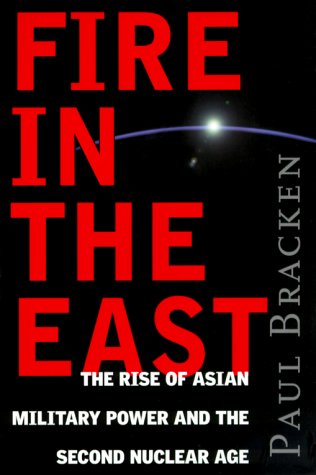
The world changed forever on May 11, 1998. That was the day India defied the rest of the world by testing nuclear weapons. The Indian test of five atomic bombs, and the Pakistani tests that answered a few weeks later, marked the end of an arms control system that has kept the world from nuclear was for half a century. But much more important, as Paul Bracken, professor of management and political science at Yale University, explains in this landmark study, they signal the re-emergence of something the world hasn't seen since the sixteenth century--modern, technologically adept military powers on the mainland of Asia. In an unbroken crescent stretching six thousand miles from Israel to North Korea, Asian countries are building missiles and topping them with atomic, biological, or chemical warheads. This is a development that cannot help but concern anyone who plans to live in the twenty-first century.
In this book, Professor Bracken:
- reveals new details about the Iraqi missile and biological warfare program, showing how close Israel actually came to a germ attack during the Gulf War.
- explodes the comforting Western belief that "globalization" will inevitably lead Asian nations into peaceful economic competition. In fact, he says, it works the other way: economic progress both spurs and makes possible the development of weapons of mass destruction.
- shows how American bases, allies, and interests are increasingly endangered by Asian nationalism.
- teaches us how to navigate not the post-cold war era, but what he names The Second Nuclear Age.
Generals, it said, are always preparing to fight the last war. Equally true, policy makers, academics, and journalists draw their metaphors from limited historical experience and use them to debate the future. Just as cold war thinking was dominated by fears of a nuclear Pearl Harbor or an atomic Munich, the United States is entering the twenty-first century with an outdated mind-set drawn from the Cuban Missile Crisis and the Gulf War. Professor Bracken provides a new intellectual framework for a world in which being the only superpower poses as many dangers as it does opportunities. Fire in the East is a template for thinking about the future in the new global order.
"synopsis" may belong to another edition of this title.
About the Author
Paul Bracken is a professor of management and political science at Yale University and a well-established expert in the field of international politics. He has served as a consultant to nearly all of the post-cold war government reassessments of national security, including those for the Department of Defense and the CIA. He is the author of Command and Control of Nuclear Forces.
Reviews
"A multipolar balance of terror stretches over a six-thousand-mile arc, comprising some of the most unstable countries on earth." Such ominous phrases abound in this alarming vision of the post-Cold War geopolitical landscape. Yale political scientist Bracken (Command and Control of Nuclear Forces) takes the 1998 nuclear tests by India and Pakistan as his cue to make an argument that the nuclear genie is out of the bottle. Increased cash reserves brought about by the global economy enable governments to buy nuclear technology; therefore, in the 21st century, Asian nations will be able to achieve a measure of military parity with the West not seen for half a millennium. Parts of the book get rather technical, as Bracken addresses military strategy and takes interesting digressions into Asian military history. However, whether he's writing about the oil-rich but politically unstable Central Asian countries of the former Soviet Union or more traditional Asian powers such as China and India, Bracken always returns to his theme that the days when the West was the dominant military power in Asia (a period that stretches from the beginning of European colonialism to today's American military hegemony) are numbered. While very clear and persuasive in making his case that the availability of nuclear weapons will change the Asian geopolitical landscape and the relationship between the West and Asia, Bracken is less clear about what the West should do to manage this inevitable shift. He does clearly outline the options (arms control, balance-of-power diplomacy among them), and his book stands as a sobering reminder that economic globalization is as likely to give rise to geopolitical tension as it is to peace and prosperity. (June)
Copyright 1999 Reed Business Information, Inc.
Bracken (political science, Yale) argues convincingly in this book-length essay that when Pakistan and India engaged in their 1998 series of nuclear tests, the power balance of the world radically changed. The Eurocentric model of the last 400 years has given way to one in which Asian countries with border problems or grandiose ideas and access to new generations of small nuclear, biological, or chemical weapons can attempt to upset the power balance in Asia, with disastrous consequences. At a time when our morning papers report on Iraq and anthrax, China and purloined American nuclear secrets, and North Korea and a ballistic missile program, this is thought-provoking reading. For general-interest and foreign-policy collections, this essay merits careful perusal along with the front pages of the news.AMel D. Lane, Sacramento, CA
Copyright 1999 Reed Business Information, Inc.
"About this title" may belong to another edition of this title.
Search results for Fire In The East: The Rise of Asian Military Power...

Stock Image
Fire In The East: The Rise of Asian Military Power and the Second Nuclear Age
Published by
Harper (edition First Edition), 1999
ISBN 10: 0060193441
ISBN 13: 9780060193447
Used
Hardcover
First Edition
Seller: BooksRun, Philadelphia, PA, U.S.A.
Seller rating 5 out of 5 stars

Hardcover. Condition: Fair. First Edition. With dust jacket. The item might be beaten up but readable. May contain markings or highlighting, as well as stains, bent corners, or any other major defect, but the text is not obscured in any way. Seller Inventory # 0060193441-7-1-29
Stock Image
Fire In The East: The Rise of Asian Military Power and the Second Nuclear Age
Seller: ThriftBooks-Atlanta, AUSTELL, GA, U.S.A.
Seller rating 5 out of 5 stars
Hardcover. Condition: Good. No Jacket. Pages can have notes/highlighting. Spine may show signs of wear. ~ ThriftBooks: Read More, Spend Less. Seller Inventory # G0060193441I3N00
Stock Image
Fire In The East: The Rise of Asian Military Power and the Second Nuclear Age
Seller: ThriftBooks-Atlanta, AUSTELL, GA, U.S.A.
Seller rating 5 out of 5 stars
Hardcover. Condition: Very Good. No Jacket. May have limited writing in cover pages. Pages are unmarked. ~ ThriftBooks: Read More, Spend Less. Seller Inventory # G0060193441I4N00
Stock Image
Fire In The East: The Rise of Asian Military Power and the Second
Seller: Hawking Books, Edgewood, TX, U.S.A.
Seller rating 4 out of 5 stars

Condition: Very Good. Very Good Condition. Clean, tight and Neat. Five star seller - Buy with confidence! Seller Inventory # X0060193441X2
Stock Image
Fire In The East: The Rise of Asian Military Power and the Second Nuclear Age
Seller: The Maryland Book Bank, Baltimore, MD, U.S.A.
Seller rating 5 out of 5 stars
hardcover. Condition: Very Good. First Edition. Used - Very Good. Seller Inventory # 10-A-4-0171
Stock Image
Fire In the East : The Rise of Asian Military Power and the Second Nuclear Age
Published by
HarperCollins Publishers, 1999
ISBN 10: 0060193441
ISBN 13: 9780060193447
Used
Hardcover
Seller: Better World Books, Mishawaka, IN, U.S.A.
Seller rating 5 out of 5 stars
Condition: Fine. Used book that is in almost brand-new condition. May contain a remainder mark. Better World Books: Buy Books. Do Good. Seller Inventory # 68031611-6
Stock Image
Fire In the East : The Rise of Asian Military Power and the Second Nuclear Age
Published by
HarperCollins Publishers, 1999
ISBN 10: 0060193441
ISBN 13: 9780060193447
Used
Hardcover
Seller: Better World Books, Mishawaka, IN, U.S.A.
Seller rating 5 out of 5 stars
Condition: Good. Pages intact with minimal writing/highlighting. The binding may be loose and creased. Dust jackets/supplements are not included. Stock photo provided. Product includes identifying sticker. Better World Books: Buy Books. Do Good. Seller Inventory # 219624-6
Stock Image
Fire In The East: The Rise of Asian Military Power and the Second Nuclear Age
Seller: HPB Inc., Dallas, TX, U.S.A.
Seller rating 5 out of 5 stars
Hardcover. Condition: Very Good. Connecting readers with great books since 1972! Used books may not include companion materials, and may have some shelf wear or limited writing. We ship orders daily and Customer Service is our top priority! Seller Inventory # S_432333175
Stock Image
Fire In The East: The Rise of Asian Military Power and the Second Nuclear Age
Seller: HPB-Emerald, Dallas, TX, U.S.A.
Seller rating 5 out of 5 stars
hardcover. Condition: Very Good. Connecting readers with great books since 1972! Used books may not include companion materials, and may have some shelf wear or limited writing. We ship orders daily and Customer Service is our top priority! Seller Inventory # S_479789617
Stock Image
Fire In The East: The Rise of Asian Military Power and the Second Nuclear Age
Seller: Wonder Book, Frederick, MD, U.S.A.
Seller rating 5 out of 5 stars
Condition: Very Good. Very Good condition. Like New dust jacket. A copy that may have a few cosmetic defects. May also contain light spine creasing or a few markings such as an owner's name, short gifter's inscription or light stamp. Seller Inventory # N03P-01118