
Items related to The Cloud Sketcher
Synopsis
As the liner Ile de France docks in New York harbor, passengers notice with surprise the policemen gathered below and speculate as to which criminal among them will soon be apprehended. Here and there a single word floats above the general din: murder. Now and then a sage head tips knowingly in the direction of a flamboyant bootlegger: a crime of passion. But when the crowd begins to make its way down the gangplank, the notorious gangster slips through unmolested. Instead it's a celebrated architect with bums from a childhood accident partly covered by the patch over one eye -- who submits to authorities and is taken away in handcuffs.
So begins The Cloud Sketcher, a passionate tale of love and war and art that ranges from the ice fields of the Arctic Circle at the dawn of the last century to the ruthless world of New York real estate speculation in the 1920s. In a tiny village in the northernmost reaches of Finland, a young boy named Esko Vaananen mourns the death of his mother, who died in the same fire that so horribly scarred his face. Miserably, impossibly in love with the beautiful daughter of a Russian aristocrat, Esko is at the brink of despair when, in the magical light of the aurora borealis, he has a vision of an impossibly tall building rising gracefully from the frozen lake and disappearing into the clouds above him.
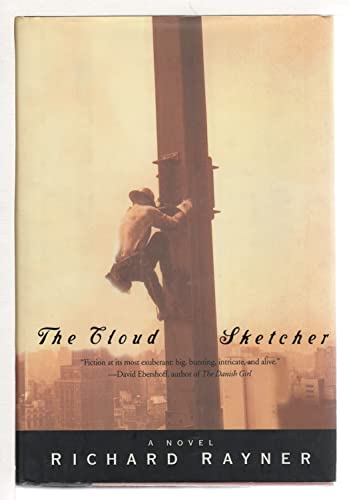
This pilvenpiirtaja--"cloud sketcher," or skyscraper sparks Esko's lifelong quest for beauty. He becomes an architect, believing that if he can create something of unparalleled loveliness, surely then he will be worthy of the love of Katerina Malysheva. This obsessive desire will cause Esko to risk everything time and again: as a reluctant hero in the bloody Battle of Tampere (the defining battle in the Finnish Civil War); as a laborer on the treacherous high steel of a riveting gang, hundreds of feet above Manhattan's city streets; as a player in the ruthless world of New York real estate speculation; and, finally, as a man accused of murdering the husband of the woman he loves.
The Cloud Sketcher is a transforming journey into the heart of beauty and the peril of love, a romantic, lyrical epic that resurrects history with such authenticity and drama as to place Richard Rayner in the company of our very best novelists.
"synopsis" may belong to another edition of this title.
About the Author
Born in England, Richard Rayner now lives in Los Angeles. His previous books include the memoir The Blue Suit and the novels The Cloud Sketcher, L.A. Without a Map, and Murder Book. His work has appeared in the New Yorker, the New York Times, and many other publications.
Reviews
Taking early skyscrapers' unlikely assault on the heavens as its central metaphor, this transatlantic Great Expectations of the jazz-age '20s spins a captivating, if somewhat improbable, tale of a disfigured Finnish boy's life quest for fame as an architect and his elusive true love. In 1901, three events shape 11-year-old Esko's future. He is burned and blinded in one eye in a fire. News reaches Esko's remote Finnish village of the country's first elevatorAan invention that immediately captures the boy's imagination. Then months later at the village fair, he meets and falls in love with a beautiful Russian girl, Katerina Malysheva, the unattainable daughter of the czar-appointed provincial governor. The years find Esko pursuing his dream as a draftsman in Helsinki, and Katerina engaged to Esko's best friend and colleague, Klaus. Surviving the Bolshevik revolution and Finland's own bloody civil war, Esko emigrates in 1922 to New York, where he works as a riveter on skyscrapers and saves the life of Paul Mantilini, who later becomes a powerful bootlegger. Esko gains an entr?e into New York's architectural world through a newspaper design contest and learns that Katerina is gaining fame in that city as a photographer. When he finally finds Katerina again, Esko has achieved a measure of professional success, but she is engaged to Manhattan blueblood Andrew MacCormick, who offers to finance the building of Esko's skyscraper. After he is arrested for MacCormick's murder, Esko seeks help from his gangster friend. Ultimately, Esko must put a price on his dreams, personal loyalties, honor and life. While the broad strokes of the story have often been seen before, Rayner (whose memoir, The Blue Suit, was widely praised) vividly captures details of Finnish culture, history and landscape and the developing architectural aesthetic of the age. This is an old-fashioned novel in the best sense: full of incident and passion, presenting a slice of history and relating a gripping story. (Feb. 11) Forecast: The generally unfamiliar territory of this novel should be an enticement to readers searching for a new fictional landscape. In addition, Rayner may flash on readers' radar screens as the author of Los Angeles Without a Map, which was made into a movie with Johnny Depp, and Murder Book, soon to be filmed by John Malkovich. Its confidence in this book's breakthrough potentialAbacked by a 6-city author tourAhas inspired HarperCollins to sign Rayner to write a sequel. Foreign rights have been sold in France, Germany and Finland.
Copyright 2000 Reed Business Information, Inc.
This novel has all the ingredients of good historical fiction, including a strongly told story; an expansive, fascinating setting; and richly drawn period details. The story opens with a bit of a cliff-hanger as Esko Vaananen, a well-known Finnish architect, arrives in New York in 1929 aboard an ocean liner and is immediately arrested for murder. We then move back to Esko's sad childhood in rural Finland, when the country was under the rule of the Russian czar, although the political unrest of the Bolshevik Revolution stamped his student days. Esko's childhood fascination with the invention of the elevator--a credible metaphor for escape--leads him to his adult passion for architecture and the creation of skyscrapers, or "cloud sketchers." His other adult passion, for Katerina, a well-off Russian girl he met in childhood, is perhaps a bit hackneyed in design if less so in execution. But there is plenty else to enjoy in this novel, not the least of which is Rayner's depiction of glittering, Jazz Age Manhattan and the Mephistophelian Paul Mantilini, a professional gangster. Rayner is an eclectic writer, last year publishing the successful neo-noir mystery Murder Book, and his latest doesn't fit snugly into any category. Perhaps because of that, it is sure to delight a broad spectrum of readers. Brian Kenney
Copyright © American Library Association. All rights reserved
Excerpt. © Reprinted by permission. All rights reserved.
The Cloud Sketcher
By Richard RaynerHarperCollins Publishers
Copyright © 2001 Richard RaynerAll right reserved.
ISBN: 0060196343
Chapter One
It began with news of an elevator, in 1901 an instrument unknown, unheard of, undreamed of in the tiny Finnish village where Esko grew up, as close to the Arctic Circle as to the capital Helsinki. At that time, at the beginning of the fresh century, the village was almost untouched by the modern world, by a future that would, in a few years, sweep aside a way of life unchanged for hundreds. In 1901, when Esko was eleven, the village boasted no railroad and one telephone, which resided, crownlike, atop a narrow throne of solid oak in the study of the vicarage, the only house with electricity for fifty miles. Armies of spruce and pine creaked with snow during the frozen, infinitely long winter, trees that towered above a narrow, deeply rutted track that led into and out of the tiny village of Pyhajarvi. The track ran past a small general store that smelled of leather and mildewed potatoes and burlap. It weaved its way among four graveyards lit at Christmas time with ice lanterns, thousands of ice lanterns, one beacon for each departed soul, flickering bravely in the northern dark. But the track did not run between the sparse scattering of farms set among forests so dense, wild, and uncharted that strangers required a guide to show them the way from one farm to another. There was a lake, twenty miles long, frozen eight months of the year, and you had to be a local to find it among the trees. There were bears, wolves, and mountainous warm smelling ant heaps where a booted foot might sink up to the thigh. It was a world of poverty, famine, frequent suicide, a world where most recalled how it was to have to eat bread made from pine bark. Despite this there was no complaint, indeed little dialogue at all, except when coaxed from gruff throats by vodka. The villagers had wary eyes and faces that aged quickly in this place where the ownership of land and winter were the most pressing realities: land that was miserable to work even if it belonged to you, and it almost certainly didn't. The villagers cared little for history or events in the world beyond. They were foxy, hard, and sly- fatalists who for the most part smiled and shook their heads at displays of hope or statements of ideals, these being considered the province of fools and very dangerous men. Esko's father, Timo Vaananen, was known to be one such dangerous man.
This severe place had its hothead- Timo- as well as a building of true magnificence. Viewed from afar, the old wooden church seemed to have two towers, both painted red ochre, one peeping over the shoulder of the other like a parent. Moving closer, you saw that the two towers belonged to two different buildings: there was the church itself, with a twenty-four-cornered ground plan in the shape of a crucifix and a steeply pitched roof giving rise to a dome like an onion; and there was the bell tower, strangely taller and more slender, elegant, with a steep shingle roof and a needlelike spire shooting out of the bell compartment. In years past Esko had climbed the stairs and the narrow ladder that led to the top of the tower with his friends, so they could play hide and seek among the ropes and bells, and with his mother, so they could stand together and admire the midnight sun as it dipped toward the lake and then, at once, miraculously, began to rise again. By the summer of 1901, however, his life had taken a different turn, and he didn't go to the bell tower anymore. When he did happen to notice it, it seemed ominous to him, a warning, saying don't stray, don't go too far.
When they finished supper on that June night Esko cleared and washed the dishes, anxiously hoping to be done and escape, to flee before his father was ready to begin. No such luck: Timo was brisk and determined, decisive as ever. He put a book with a pebbled brown cover on the table, then a glass, then a bottle of schnapps, which he uncorked with a pop and placed beside the glass. Then Timo nudged the glass. Then he poured the schnapps, knocked it back, slopped in another shot, and one more, and commanded Esko to sit. "Now we learn," he said.
Timo Vaananen's mission was to teach Esko everything. At the village school, where Timo was one of the two teachers, this wasn't so bad. In school, at least, learning did not involve slaps. There was safety in numbers, and surrounded by the other kids, his head always deep in a book, Esko had only to pretend to negotiate the laws of geometry, algebra, trigonometry, the triumphs and sadnesses of Finnish history, the subtleties of Swedish, Finnish, and, because it was now the law, Russian, and the dirgelike chanting rhythms of "Kalevala," the national epic poem. "Kalevala" had Vainamoinen, the poet, the sorcerer who creates the world and defeats his enemies through the power of song; it had Aino, a beautiful maiden who spurns him; it had Lemminkainen, a fellow who lies and kidnaps and plays tricks; it had the doomed and sad Kullervo. Esko looked at "Kalevala" and saw a world that was familiar to the one he knew. In 1901, a time of simmering rebellion and nationalistic fervor, there were those who preached that the poem was also the literally true account of Finland in times gone by, an idea that appealed to little Esko, and one that appalled Timo, who preferred his history tinged a different color.
At night, at home, now that school was out, there was no pretense of scientific or scholarly rigor. Timo came on full and furious. Sometimes he stared silently at Esko for minutes on end, daring him to give a wrong answer.
Continues...Continues...
Excerpted from The Cloud Sketcherby Richard Rayner Copyright © 2001 by Richard Rayner. Excerpted by permission.
All rights reserved. No part of this excerpt may be reproduced or reprinted without permission in writing from the publisher.
Excerpts are provided by Dial-A-Book Inc. solely for the personal use of visitors to this web site.
"About this title" may belong to another edition of this title.
Search results for The Cloud Sketcher

Stock Image
The Cloud Sketcher
Published by
HarperCollins Publishers Inc, 2001
ISBN 10: 0060196343
ISBN 13: 9780060196349
Used
Hardcover
Seller: World of Books (was SecondSale), Montgomery, IL, U.S.A.
Seller rating 5 out of 5 stars

Hardback. Condition: Good. As the liner Ile de France docks in New York harbor, passengers notice with surprise the policemen gathered below and speculate as to which criminal among them will soon be apprehended. Here and there a single word floats above the general din: murder. Now and then a sage head tips knowingly in the direction of a flamboyant bootlegger: a crime of passion. But when the crowd begins to make its way down the gangplank, the notorious gangster slips through unmolested. Instead it's a celebrated architect with bums from a childhood accident partly covered by the patch over one eye -- who submits to authorities and is taken away in handcuffs. So begins The Cloud Sketcher, a passionate tale of love and war and art that ranges from the ice fields of the Arctic Circle at the dawn of the last century to the ruthless world of New York real estate speculation in the 1920s. In a tiny village in the northernmost reaches of Finland, a young boy named Esko Vaananen mourns the death of his mother, who died in the same fire that so horribly scarred his face. Miserably, impossibly in love with the beautiful daughter of a Russian aristocrat, Esko is at the brink of despair when, in the magical light of the aurora borealis, he has a vision of an impossibly tall building rising gracefully from the frozen lake and disappearing into the clouds above him. This pilvenpiirtaja--"cloud sketcher," or skyscraper sparks Esko's lifelong quest for beauty. He becomes an architect, believing that if he can create something of unparalleled loveliness, surely then he will be worthy of the love of Katerina Malysheva. This obsessive desire will cause Esko to risk everything time and again: as a reluctant hero in the bloody Battle of Tampere (the defining battle in the Finnish Civil War); as a laborer on the treacherous high steel of a riveting gang, hundreds of feet above Manhattan's city streets; as a player in the ruthless world of New York real estate speculation; and, finally, as a man accused of murdering the husband of the woman he loves. The Cloud Sketcher is a transforming journey into the heart of beauty and the peril of love, a romantic, lyrical epic that resurrects history with such authenticity and drama as to place Richard Rayner in the company of our very best novelists. Seller Inventory # 00090784217
Stock Image
The Cloud Sketcher
Published by
Harper (edition First Edition), 2001
ISBN 10: 0060196343
ISBN 13: 9780060196349
Used
Hardcover
First Edition
Seller: BooksRun, Philadelphia, PA, U.S.A.
Seller rating 5 out of 5 stars
Hardcover. Condition: Very Good. First Edition. With dust jacket. It's a well-cared-for item that has seen limited use. The item may show minor signs of wear. All the text is legible, with all pages included. It may have slight markings and/or highlighting. Seller Inventory # 0060196343-11-1-29
Stock Image
The Cloud Sketcher
Seller: HPB-Movies, Dallas, TX, U.S.A.
Seller rating 4 out of 5 stars

hardcover. Condition: Very Good. Connecting readers with great books since 1972! Used books may not include companion materials, and may have some shelf wear or limited writing. We ship orders daily and Customer Service is our top priority! Seller Inventory # S_474218128
Stock Image
The Cloud Sketcher
Seller: HPB Inc., Dallas, TX, U.S.A.
Seller rating 5 out of 5 stars
hardcover. Condition: Very Good. Connecting readers with great books since 1972! Used books may not include companion materials, and may have some shelf wear or limited writing. We ship orders daily and Customer Service is our top priority! Seller Inventory # S_483048570
Stock Image
The Cloud Sketcher
Seller: HPB-Ruby, Dallas, TX, U.S.A.
Seller rating 5 out of 5 stars
hardcover. Condition: Very Good. Connecting readers with great books since 1972! Used books may not include companion materials, and may have some shelf wear or limited writing. We ship orders daily and Customer Service is our top priority! Seller Inventory # S_474693037
Stock Image
The Cloud Sketcher
Published by
HarperCollins Publishers, 2001
ISBN 10: 0060196343
ISBN 13: 9780060196349
Used
Hardcover
First Edition
Seller: Better World Books, Mishawaka, IN, U.S.A.
Seller rating 5 out of 5 stars
Condition: Good. 1st. Former library copy. Pages intact with minimal writing/highlighting. The binding may be loose and creased. Dust jackets/supplements are not included. Includes library markings. Stock photo provided. Product includes identifying sticker. Better World Books: Buy Books. Do Good. Seller Inventory # 7715752-6
Stock Image
The Cloud Sketcher
Published by
HarperCollins Publishers, 2001
ISBN 10: 0060196343
ISBN 13: 9780060196349
Used
Hardcover
First Edition
Seller: Better World Books, Mishawaka, IN, U.S.A.
Seller rating 5 out of 5 stars
Condition: Good. 1st. Pages intact with minimal writing/highlighting. The binding may be loose and creased. Dust jackets/supplements are not included. Stock photo provided. Product includes identifying sticker. Better World Books: Buy Books. Do Good. Seller Inventory # 3073848-20
Stock Image
The Cloud Sketcher
Seller: Wonder Book, Frederick, MD, U.S.A.
Seller rating 5 out of 5 stars
Condition: Good. Good condition. Very Good dust jacket. In protective mylar cover. A copy that has been read but remains intact. May contain markings such as bookplates, stamps, limited notes and highlighting, or a few light stains. Seller Inventory # J04I-00441
Stock Image
The Cloud Sketcher
Seller: Wonder Book, Frederick, MD, U.S.A.
Seller rating 5 out of 5 stars
Condition: Very Good. Very Good condition. Very Good dust jacket. With remainder mark. A copy that may have a few cosmetic defects. May also contain light spine creasing or a few markings such as an owner's name, short gifter's inscription or light stamp. Bundled media such as CDs, DVDs, floppy disks or access codes may not be included. Seller Inventory # I12I-01550
Stock Image
The Cloud Sketcher
Seller: ThriftBooks-Dallas, Dallas, TX, U.S.A.
Seller rating 5 out of 5 stars
Hardcover. Condition: Good. No Jacket. Pages can have notes/highlighting. Spine may show signs of wear. ~ ThriftBooks: Read More, Spend Less. Seller Inventory # G0060196343I3N00