
Items related to Who Killed Jesus?: Exposing the Roots of Anti-Semitism...
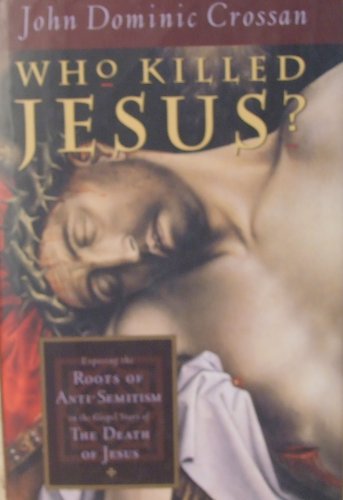
Who Killed Jesus?: Exposing the Roots of Anti-Semitism in the Gospel Story of the Death of Jesus - Hardcover
Synopsis
A wide-ranging study examines key theological issues and argues that the popular--and historically inaccurate--acceptance of the biblical version of Jesus's execution has resulted in dangerous anti-Semitic practices. 30,000 first printing. $40,000 ad/promo. Tour.
"synopsis" may belong to another edition of this title.
About the Author
John Dominic Crossan is professor of biblical studies at DePaul University in Chicago.
Reviews
In a book sure to generate both conversation and controversy, John Dominic Crossan, author of two well-regarded books on the historical Jesus, names the New Testament Gospels' insistence on Jewish responsibility for Jesus' death as Christianity's "longest lie." Crossan argues particularly against many of the theories posed in Raymond Brown's The Death of the Messiah. While Brown finds that many of the events in the stories of Jesus' last days are plausible historically, Crossan claims that almost none of the events are historical. According to Crossan, they are "prophesy historicized," accounts written by looking back at the Old Testament and other early materials and then projecting those prophecies on whatever historical events occurred. Because many of those early writers were persecuted by the Jewish authorities, they threw in a heavy dose of propaganda against the Jews. As Crossan aptly states, these gospels were relatively harmless when Christians were a small sect. When, however, Rome became Christian, those anti-Semitic narratives became, and continue to be, lethal. Well argued and highly readable, Who Killed Jesus? also includes an important epilogue stating Crossan's own faith perspectives on the divinity and resurrection of Christ. Scholars rarely go this far, yet such a confession provides another valuable entry into this fascinating material.
Copyright 1995 Reed Business Information, Inc.
Given the conjunction of concern with Jesus and public discourse in the ascendancy of the "Christian coalition" in our own historical moment, Crossan's decision to make this argument available to a popular audience is a timely one. Briefly, Crossan contends that the understanding of the passion narratives in the canonical Gospels as historical "fact" is not only wrong, but also dangerous. It is dangerous because of the particular way in which the confusion of "interpretation" and "fact" came in this case to be backed by power. Crossan notes that, for Christians, the Gospel accounts are divinely inspired, but that inspiration comes through human beings in human communities and can come as inspired propaganda. When Christianity was a relatively powerless sect within Judaism struggling like other sects for the hearts and minds of the Jewish community, its propaganda about "Jewish responsibility and Roman innocence" was relatively harmless. But as Christianity and the Roman Empire became inextricably linked, that propaganda became the lethal basis for transition from a theological controversy within a religious community to propaganda directed by one religious community against another to genocidal anti-Semitism. What may have been relatively harmless propaganda at its origins has become, Crossan argues, "the longest lie." The scholarly debate behind this discussion asks whether the passion narrative is derived from "history remembered" or from "prophecy historicized." Crossan has argued consistently for the second option, and he wrote this book largely in response to Raymond Brown's influential Death of the Messiah, which defends the first. The book is a lucid, accessible guide to the controversy, but, more important, it is one of the best accounts of how prejudice is transformed into racism in the conjunction of mythological and political power. Steve Schroeder
The two main theses of this extraordinary book are that the roots of anti-Semitism spring from gospel narratives of the death of Jesus and that the Romans, not the Jews, killed Jesus as a revolutionary agitator inimical to their continued governance of Judea. Crossan, a former Roman Catholic priest and now a noted expert on the life of Jesus, fascinatingly describes here two types of historical writing: 1) history remembered?history written as it actually happened?and 2) prophecy historicized, a tendentious interpretation of what really happened made to conform to or "fulfill" ancient prophecies?in this case, supposed prophecies about the life of Jesus uttered by Hebrew prophets. According to Crossan, the passion accounts blaming the Jews for Jesus' arrest and crucifixion are based on this second type of writing and are thus myths if not downright lies. He pleads for a reevaluation of the passion stories, which have caused such animus toward Jews for the past 2000 years. An excellent study for lay readers and specialists; recommended for larger religion collections.?Robert A. Silver, formerly with Shaker Heights P.L., Ohio
Copyright 1995 Reed Business Information, Inc.
"About this title" may belong to another edition of this title.
Search results for Who Killed Jesus?: Exposing the Roots of Anti-Semitism...

Stock Image
Who Killed Jesus?: Exposing the Roots of Anti-Semitism in the Gospel Story of the Death of Jesus
Seller: World of Books (was SecondSale), Montgomery, IL, U.S.A.
Seller rating 5 out of 5 stars

Condition: Good. Item in good condition. Textbooks may not include supplemental items i.e. CDs, access codes etc. Seller Inventory # 00086098169
Stock Image
Who Killed Jesus?: Exposing the Roots of Anti-Semitism in the Gospel Story of the Death of Jesus
Published by
HarperCollins Publishers Inc, 1995
ISBN 10: 006061479X
ISBN 13: 9780060614799
Used
Hardcover
Seller: World of Books (was SecondSale), Montgomery, IL, U.S.A.
Seller rating 5 out of 5 stars
Hardback. Condition: Very Good. The death of Jesus is one of the most hotly debated questions in Christianity today. In his massive and highly publicized The Death of the Messiah, Raymond Brown -- while clearly rejecting anti-Semitism -- never questions the essential historicity of the passion stories. Yet it is these stories, in which the Jews decide Jesus' execution, that have fueled centuries of Christian anti-Semitism. Now, in his most controversial book, John Dominic Crossan shows that this traditional understanding of the Gospels as historical fact is not only wrong but dangerous. Drawing on the best of biblical, anthropological, sociological and historical research, he demonstrates definitively that it was the Roman government that tried and executed Jesus as a social agitator. Crossan also candidly addresses such key theological questions as Did Jesus die for our sins? and Is our faith in vain if there was no bodily resurrection? Ultimately, however, Crossan's radical reexamination shows that the belief that the Jews killed Jesus is an early Christian myth (directed against rival Jewish groups) that must be eradicated from authentic Christian faith. Seller Inventory # 00106594103
Seller Image
Who Killed Jesus?: Exposing the Roots of Anti-Semitism in the Gospel Story of the Death of Jesus
Seller: 3Brothers Bookstore, Egg harbor township, NJ, U.S.A.
Seller rating 5 out of 5 stars
Condition: very_good. Cover may have light wear, pages in very good condition and binding is sturdy; may have other light shelf wear or creases. May have notes or highlighting. Seller Inventory # EVV.006061479X.VG
Seller Image
Who Killed Jesus?: Exposing the Roots of Anti-Semitism in the Gospel Story of the Death of Jesus
Seller: Greenworld Books, Arlington, TX, U.S.A.
Seller rating 5 out of 5 stars
Condition: very_good. Fast Free Shipping â" Very Good condition book with a firm cover and clean pages. Shows normal use and some light wear or limited notes markings. A solid, nice copy to enjoy. Seller Inventory # GWV.006061479X.VG
Stock Image
Who Killed Jesus?: Exposing the Roots of Anti-Semitism in the Gospel Story of the Death of Jesus
Published by
HarperCollins (edition 1), 1995
ISBN 10: 006061479X
ISBN 13: 9780060614799
Used
Hardcover
Seller: BooksRun, Philadelphia, PA, U.S.A.
Seller rating 5 out of 5 stars
Hardcover. Condition: Very Good. 1. With dust jacket. It's a well-cared-for item that has seen limited use. The item may show minor signs of wear. All the text is legible, with all pages included. It may have slight markings and/or highlighting. Seller Inventory # 006061479X-11-1-29
Stock Image
Who Killed Jesus?: Exposing the Roots of Anti-Semitism in the Gospel Story of the Death of Jesus
Published by
HarperCollins Publishers Inc, 1995
ISBN 10: 006061479X
ISBN 13: 9780060614799
Used
Hardcover
Seller: World of Books Inc, Montgomery, IL, U.S.A.
Seller rating 4 out of 5 stars

Hardback. Condition: Good. The death of Jesus is one of the most hotly debated questions in Christianity today. In his massive and highly publicized The Death of the Messiah, Raymond Brown -- while clearly rejecting anti-Semitism -- never questions the essential historicity of the passion stories. Yet it is these stories, in which the Jews decide Jesus' execution, that have fueled centuries of Christian anti-Semitism. Now, in his most controversial book, John Dominic Crossan shows that this traditional understanding of the Gospels as historical fact is not only wrong but dangerous. Drawing on the best of biblical, anthropological, sociological and historical research, he demonstrates definitively that it was the Roman government that tried and executed Jesus as a social agitator. Crossan also candidly addresses such key theological questions as Did Jesus die for our sins? and Is our faith in vain if there was no bodily resurrection? Ultimately, however, Crossan's radical reexamination shows that the belief that the Jews killed Jesus is an early Christian myth (directed against rival Jewish groups) that must be eradicated from authentic Christian faith. Seller Inventory # CIN006061479XG
Stock Image
Who Killed Jesus?: Exposing the Roots of Anti-Semitism in the Gospel Story of the Death of Jesus
Seller: ThriftBooks-Dallas, Dallas, TX, U.S.A.
Seller rating 5 out of 5 stars
Hardcover. Condition: Very Good. No Jacket. Missing dust jacket; May have limited writing in cover pages. Pages are unmarked. ~ ThriftBooks: Read More, Spend Less. Seller Inventory # G006061479XI4N01
Stock Image
Who Killed Jesus?: Exposing the Roots of Anti-Semitism in the Gospel Story of the Death of Jesus
Seller: ThriftBooks-Atlanta, AUSTELL, GA, U.S.A.
Seller rating 5 out of 5 stars
Hardcover. Condition: Very Good. No Jacket. May have limited writing in cover pages. Pages are unmarked. ~ ThriftBooks: Read More, Spend Less. Seller Inventory # G006061479XI4N00
Stock Image
Who Killed Jesus?: Exposing the Roots of Anti-Semitism in the Gospel Story of the Death of Jesus
Seller: Wonder Book, Frederick, MD, U.S.A.
Seller rating 5 out of 5 stars
Condition: Very Good. Very Good condition. Very Good dust jacket. A copy that may have a few cosmetic defects. May also contain light spine creasing or a few markings such as an owner's name, short gifter's inscription or light stamp. Seller Inventory # Q13A-02581
Stock Image
Who Killed Jesus?: Exposing the Roots of Anti-Semitism in the Gospel Story of the Death of Jesus
Published by
HarperCollins (edition 1), 1995
ISBN 10: 006061479X
ISBN 13: 9780060614799
Used
Hardcover
Seller: BooksRun, Philadelphia, PA, U.S.A.
Seller rating 5 out of 5 stars
Hardcover. Condition: Fair. 1. With dust jacket. The item might be beaten up but readable. May contain markings or highlighting, as well as stains, bent corners, or any other major defect, but the text is not obscured in any way. Seller Inventory # 006061479X-7-1-13_29