Items related to The River of God: A New History of Christian Origins
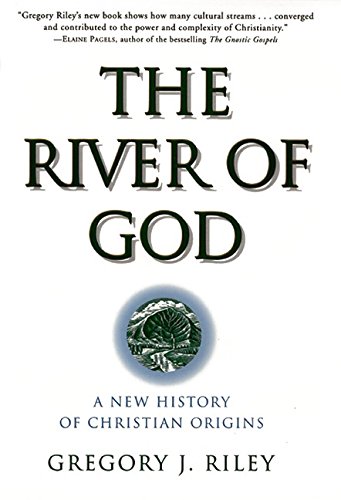

In this powerful and persuasive work trailblazing historian Gregory Riley traces the origins of Christianity beyond its familiar sources in Judaism and in the Hebrew Bible. journeying off the beaten path, Riley reveals other, lesser-known sources -- elements of Greek philosophy and science, Zoroastrianism, and the religions of ancient Mesopotamia and Egypt. "From the very beginning," writes Riley, "there were several varieties of Christians." The differences were greater, perhaps, than those seen in the Christianity of today. Dozens of sects arose in different cities of the first-century Greco-Roman world, all claiming to be the religion of the risen Christ. Ultimately, these early, doctrinally disparate Christianities led to the present-day diversity of the Church.
Moving from the origins of Christianity to understanding Christianity, this remarkable book guides the reader through five major areas at the core of Christian faith.
- The rise of monotheism.
- The subsequent development of Christian Trinitarianism.
- The evolution of the Devil and eschatology.
- The development and the consequences of the concept of body and soul for humans.
- The meaning of Jesus as savior.
In straightforward, accessible prose, Riley shows how an enriched understanding of Christianity can uncover new truths and new pathways to faith. Likening the history of Christianity to a great river, Riley illustrates the ebb and flow of the relationship between God and humanity over the centuries. There are contributions from each side, divine and human, in a relationship that stretches over thousands of years, from before the dawn of writing to the time of the early Christians, and beyond.
The River of God is an original and masterly exploration of how the beliefs and experience of early Christianity evolved among its early adherents. Weaving historical, theological, scientific, and social developments and insights, Gregory Riley distills the history of Christianity into a superbly readable volume that has profound implications for both its present and future.
"synopsis" may belong to another edition of this title.
Review:
Believing in Jesus means so many different things to so many people that it's difficult, if not impossible, to define the true essence of Christianity. The differences between a charismatic Baptist hymnal, for instance, and a high-church Anglican communion merely scratch the surface of the many varieties of Christian belief. The River of God reminds readers that Christian belief has always been wildly diverse, and that Christianity was preceded and informed by many ancient cultural traditions. This is the point made by author Gregory J. Riley, professor of New Testament and Early Christianity at the Claremont School of Theology in California and the author of One Jesus, Many Christs. Riley's prose is mostly uncomplicated, and his metaphorical argument is fairly clear: many cultural streams converged to form the river of God, and material from those streams built up the delta of Christianity. But this book is not, as its subtitle claims, "A New History of Christian Origins." It is primarily a reworking of a familiar and amply documented fact, made popular by the work of Elaine Pagels and Jack Miles, among others: Christianity did not spring into being independent from its cultural context. Like life, it evolved, and continues to evolve. Though not original, Riley's point does bear repeating. Its repetition cultivates Christian humility, by helping to remind us that everyone in history who has ever learned to live well--including, or perhaps especially, Jesus--has learned largely by paying attention to the world around him. --Michael Joseph Gross
About the Author:
Gregory Riley, Ph.D., educated at Harvard University, is professor of NewTestament and Early Christianity at the Claremont School of Theology in California and the author of the acclaimed One Jesus, Many Christs.
"About this title" may belong to another edition of this title.
- PublisherHarperOne
- Publication date2001
- ISBN 10 0060669799
- ISBN 13 9780060669799
- BindingHardcover
- Edition number1
- Number of pages256
- Rating
Buy New
Learn more about this copy
US$ 21.41
Shipping:
FREE
Within U.S.A.
Top Search Results from the AbeBooks Marketplace
Stock Image
The River of God: A New History of Christian Origins
Seller:
Rating

Book Description Condition: New. Book is in NEW condition. Seller Inventory # 0060669799-2-1
Buy New
US$ 21.41
Convert currency
Stock Image
The River of God: A New History of Christian Origins
Seller:
Rating
Book Description Condition: New. New! This book is in the same immaculate condition as when it was published. Seller Inventory # 353-0060669799-new
Buy New
US$ 21.42
Convert currency
Stock Image
The River of God: A New History of Christian Origins
Seller:
Rating
Book Description hardcover. Condition: New. Seller Inventory # 0060669799-11-31737150
Buy New
US$ 21.45
Convert currency
Stock Image
The River of God: A New History of Christian Origins
Published by
HarperOne July 2001
(2001)
ISBN 10: 0060669799
ISBN 13: 9780060669799
New
Hardcover
Quantity: 1
Seller:
Rating
Book Description Hardcover. Condition: New. Seller Inventory # 205788
Buy New
US$ 19.00
Convert currency
Stock Image
The River of God: A New History of Christian Origins
Seller:
Rating
Book Description Hardcover. Condition: new. New. Fast Shipping and good customer service. Seller Inventory # Holz_New_0060669799
Buy New
US$ 21.86
Convert currency
Stock Image
The River of God: A New History of Christian Origins
Seller:
Rating
Book Description Hardcover. Condition: new. New. Seller Inventory # Wizard0060669799
Buy New
US$ 26.79
Convert currency
Stock Image
The River of God: A New History of Christian Origins
Seller:
Rating
Book Description Hardcover. Condition: new. New Copy. Customer Service Guaranteed. Seller Inventory # think0060669799
Buy New
US$ 28.48
Convert currency
Stock Image
The River of God: A New History of Christian Origins
Seller:
Rating
Book Description Condition: new. Seller Inventory # FrontCover0060669799
Buy New
US$ 29.69
Convert currency
Stock Image
The River of God: A New History of Christian Origins
Seller:
Rating
Book Description Hardcover. Condition: New. Seller Inventory # Abebooks85200
Buy New
US$ 59.00
Convert currency
Stock Image
THE RIVER OF GOD: A NEW HISTORY
Seller:
Rating
Book Description Condition: New. New. In shrink wrap. Looks like an interesting title! 1.58. Seller Inventory # Q-0060669799
Buy New
US$ 59.07
Convert currency