
Items related to I Never Called It Rape: The Ms. Report on Recognizing,...
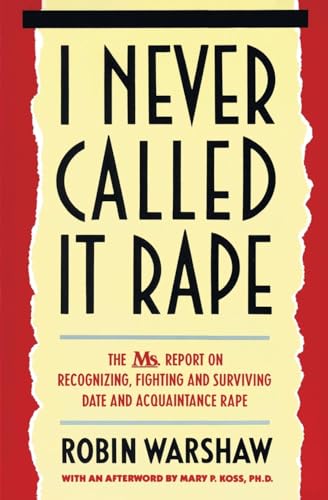
I Never Called It Rape: The Ms. Report on Recognizing, Fighting, and Surviving Date and Acquaintance Rape - Softcover
Synopsis
The classic book that broke new ground by thoroughly reporting on the widespread problem of date and acquaintance rape has now been completely updated to include recent studies, issues, current events, and controversies.
"synopsis" may belong to another edition of this title.
About the Authors
Robin Warshaw writes on social issues, medicine and health. In writing I Never Called It Rape, she used pseudonyms for the many women who shared their stories but wrote openly about her own acquaintance rape for the first time. She has never regretted that decision and is grateful to the women (and some men) who have reached out over the years to tell her how the book helped them. Warshaw is a contributing writer for Living Beyond Breast Cancer and writes for other nonprofits and publications. She is a member of the Authors Guild, American Society of Journalists and Authors, and the Association of Health Care Journalists. Her work has received several national awards.
Salamishah Tillet is a rape survivor, activist, and feminist writer. She is the cofounder of A Long Walk Home, a nonprofit that uses art to empower young people to end violence against girls and women, and the writer of the award-winning Story of a Rape Survivor, a performance that chronicles her pathway to healing after being sexually assaulted in college. She is the faculty director of the New Arts Jus- tice Initiative at Express Newark and the Henry Rutgers Professor of African American Studies and Creative Writing at Rutgers University.
Excerpt. © Reprinted by permission. All rights reserved.
The Reality of Acquaintance Rape
"I never heard of anybody having that happen to them."
-- Lori, raped at 19 by a date
Women raped by men they know--acquaintance rape--is not an aberrant quirk of male-female relations. if you are a woman, your risk of being raped by someone you know is four times greater than your risk of being raped by a stranger.
A recent scientific study of acquaintance rape on 32 college campuses conducted by Ms. magazine and psychologist Mary P. Koss showed that significant numbers of women are raped on dates or by acquaintances, although most victims never report their attacks.
Ms. Survey stats* 1 in 4 women surveyed were victims of rape or attempted rape.
* 84 percent of those raped knew their attacker.
* 57 percent of the rapes happened on dates.
Those figures make acquaintance rape and date rape more common than left-handedness or heart attacks or alcoholism. These rapes are no recent campus fad or the fantasy of a few jilted females. They are real. And they are happening all around us.
The Extent of "Hidden" Rape
Most states define rape as sexual assault in which a man uses his penis to commit vaginal penetration of a victim against her will, by force or threats of force or when she is physically or mentally unable to give her consent. Many states now also include unwanted anal and oral intercourse in that definition and some have removed gender-specific language to broaden the applicability of rape laws.
In acquaintance rape, the rapist and victim may know each other casually--having met through a common activity, mutual friend, at a party, as neighbors, as students in the same class, at work, on a blind date, or while traveling. Or they may have a closer relationship--as steady dates or former sexual partners. Although largely a hidden phenomenon because it's the least reported type of rape (and rape, in general, is the most underreported crime against a person), many organizations, counselors, and social researchers agree that acquaintance rape is the most prevalent rape crime today.
Only 90,434 rapes were reported to U.S. law enforcement agencies in 1986, a number that is conservatively believed to represent a minority of the actual rapes of all types taking place. Government estimates find that anywhere from three to ten rapes are committed for every one rape reported. And while rapes by strangers are still underreported, rapes by acquaintances are virtually nonreported. Yet, based on intake observations made by staff at various rapecounseling centers (where victims come for treatment, but do not have to file police reports), 70 to 80 percent of all rape crimes are acquaintance rapes.
Those rapes are happening in a social environment in which sexual aggression occurs regularly. Indeed, less than half the college women questioned in the Ms. survey reported that they had experienced no sexual victimization in their lives thus far (the average age of respondents was 21). Many had experienced more than one episode of unwanted sexual touching, coercion, attempted rape, or rape. Using the data collected in the study (see the Afterword on page 189 for an explanation of how the survey was conducted), the following profile can be drawn of what happens in just one year of "social life" on America's college campuses:
MS. Survey stats * In one year 3,187 women report* 328 rapes (as defined by law)
* 534 attempted rapes (as defined by law)
* 837 episodes of sexual coercion (sexual intercourse obtained through the aggressor's continual arguments or pressure)
* 2,024 experiences of unwanted sexual contact (fondling, kissing, or petting committed against the woman's will)
Over the years, other researchers have documented the phenomenon of acquaintance rape. In 1957, a study conducted by Eugene J. Kanin of Purdue University in West Lafayette, Indiana, showed that 30 percent of women surveyed had suffered attempted or completed forced sexual intercourse while on a high school date. Ten years later, in 1967, while young people donned flowers and beads and talked of love and peace, Kanin found that more than 25 percent of the male college students surveyed had attempted to force sexual intercourse on a woman to the point that she cried or fought back. In 1977, after the blossoming of the women's movement and countless pop-culture attempts to extol the virtues of becoming a "sensitive man," Kanin found that 26 percent of the men he surveyed had tried to force intercourse on a woman and that 25 percent of the women questioned had suffered attempted or completed rape. In other words, two decades had passed since Kanin's first study, yet women were being raped by men they knew as frequently as before.
In 1982, a doctoral student at Auburn University in Auburn, Alabama, found that 25 percent of the undergraduate women surveyed had at least one experience of forced intercourse and that 93 percent of those episodes involved acquaintances. That same year, Auburn psychology professor and acquaintance-rape expert Barry R. Burkhart conducted a study in which 61 percent of the men said they had sexually touched a woman against her will.
Further north, at St. Cloud State University in St. Cloud, Minnesota, research in 1982 showed 29 percent of women surveyed reported being physically or psychologically forced to have sexual intercourse.
In 1984, 20 percent of the female students questioned in a study at the University of South Dakota in Vermillion, South Dakota, said they had been physically forced to have intercourse while on a date. At Brown University in Providence, Rhode Island, 16 percent of the women surveyed reported they were raped by an acquaintance and 11 percent of the men said they had forced sexual intercourse on a woman. And another study coauthored by Auburn's Burkhart showed 15 percent of the male respondents reporting having raped a date.
"About this title" may belong to another edition of this title.
Search results for I Never Called It Rape: The Ms. Report on Recognizing,...

Stock Image
I Never Called It Rape: The Ms. Report on Recognizing, Fighting, and Surviving Date and Acquaintance Rape
Seller: Your Online Bookstore, Houston, TX, U.S.A.
Seller rating 5 out of 5 stars

Paperback. Condition: Very Good. Seller Inventory # 0060925728-2-19287389
Stock Image
I Never Called It Rape
Published by
HarperCollins Publishers (Australia) Pty Ltd, 1994
ISBN 10: 0060925728
ISBN 13: 9780060925727
Used
Paperback
Seller: World of Books (was SecondSale), Montgomery, IL, U.S.A.
Seller rating 5 out of 5 stars
Paperback. Condition: Good. Explores date rape, including what it is, why it happens, and its impact on victims, with information on resources and counseling and support programs. Seller Inventory # 00107771869
Stock Image
I Never Called It Rape
Published by
HarperCollins Publishers (Australia) Pty Ltd, 1994
ISBN 10: 0060925728
ISBN 13: 9780060925727
Used
Paperback
Seller: World of Books (was SecondSale), Montgomery, IL, U.S.A.
Seller rating 5 out of 5 stars
Paperback. Condition: Fair. Explores date rape, including what it is, why it happens, and its impact on victims, with information on resources and counseling and support programs. Seller Inventory # CIN0060925728A
Stock Image
I Never Called It Rape: The Ms. Report on Recognizing, Fighting, and Surviving Date and Acquaintance Rape
Published by
Harper Perennial (edition Reprint), 1994
ISBN 10: 0060925728
ISBN 13: 9780060925727
Used
Paperback
Seller: BooksRun, Philadelphia, PA, U.S.A.
Seller rating 5 out of 5 stars
Paperback. Condition: Fair. Reprint. The item might be beaten up but readable. May contain markings or highlighting, as well as stains, bent corners, or any other major defect, but the text is not obscured in any way. Seller Inventory # 0060925728-7-1
Seller Image
I Never Called It Rape: The Ms. Report on Recognizing, Fighting, and Surviving Date and Acquaintance Rape
Seller: Greenworld Books, Arlington, TX, U.S.A.
Seller rating 5 out of 5 stars
Condition: good. Fast Free Shipping â" Good condition. It may show normal signs of use, such as light writing, highlighting, or library markings, but all pages are intact and the book is fully readable. A solid, complete copy that's ready to enjoy. Seller Inventory # GWV.0060925728.G
Seller Image
I Never Called It Rape: The Ms. Report on Recognizing, Fighting, and Surviving Date and Acquaintance Rape
Seller: Greenworld Books, Arlington, TX, U.S.A.
Seller rating 5 out of 5 stars
Condition: very_good. Fast Free Shipping â" Very Good condition book with a firm cover and clean pages. Shows normal use and some light wear or limited notes markings. A solid, nice copy to enjoy. Seller Inventory # GWV.0060925728.VG
Stock Image
I Never Called It Rape
Published by
HarperCollins Publishers (Australia) Pty Ltd, 1994
ISBN 10: 0060925728
ISBN 13: 9780060925727
Used
Paperback
Seller: World of Books Inc, Montgomery, IL, U.S.A.
Seller rating 4 out of 5 stars

Paperback. Condition: Fair. Explores date rape, including what it is, why it happens, and its impact on victims, with information on resources and counseling and support programs. Seller Inventory # CIN0060925728A
Stock Image
I Never Called It Rape
Published by
HarperCollins Publishers (Australia) Pty Ltd, 1994
ISBN 10: 0060925728
ISBN 13: 9780060925727
Used
Paperback
Seller: World of Books Inc, Montgomery, IL, U.S.A.
Seller rating 4 out of 5 stars
Paperback. Condition: Good. Explores date rape, including what it is, why it happens, and its impact on victims, with information on resources and counseling and support programs. Seller Inventory # CIN0060925728G
Stock Image
I Never Called It Rape: The Ms. Report on Recognizing, Fighting, and Surviving Date and Acquaintance Rape
Seller: Wonder Book, Frederick, MD, U.S.A.
Seller rating 5 out of 5 stars
Condition: Good. Good condition. A copy that has been read but remains intact. May contain markings such as bookplates, stamps, limited notes and highlighting, or a few light stains. Seller Inventory # I04A-05764
Stock Image
I Never Called It Rape
Seller: ThriftBooks-Phoenix, Phoenix, AZ, U.S.A.
Seller rating 5 out of 5 stars
Paperback. Condition: Very Good. No Jacket. May have limited writing in cover pages. Pages are unmarked. ~ ThriftBooks: Read More, Spend Less. Seller Inventory # G0060925728I4N00