
Items related to How to Raise a Child with a High EQ: A Parents'...
Synopsis
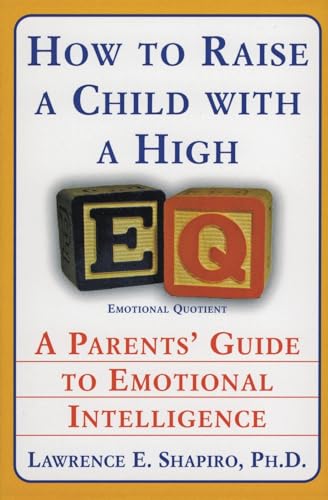
Studies show that emotional intelligence -- the social and emotional skills that make up what we call character -- is more important to your child's success than the cognitive intelligence measured by IQ. And unlike IQ, emotional intelligence can be developed in kids at all stages.
Filled with games, checklists and practical parenting techniques, How to Raise a Child with a High EQ will help your child to cope with -- and overcome -- the emotional stress of modern times and the normal problems of growing up.
"synopsis" may belong to another edition of this title.
About the Author
Lawrence E. Shapiro, Ph.D., the inventor pf more than two dozen theraputic games and a frequent lecturer, is the author of How to Raise a Child with a High E.Q.
From the Back Cover
Studies show that emotional intelligence -- the social and emotional skills that make up what we call character -- is more important to your child's success than the cognitive intelligence measured by IQ. And unlike IQ, emotional intelligence can be developed in kids at all stages.
Filled with games, checklists and practical parenting techniques, How to Raise a Child with a High EQ will help your child to cope with -- and overcome -- the emotional stress of modern times and the normal problems of growing up.
Excerpt. © Reprinted by permission. All rights reserved.
How to Raise a Child with a High Eq
A Parents' Guide to Emotional IntelligenceBy Shapiro, Lawrence E.Quill
Copyright © 2004 Lawrence ShapiroAll right reserved.
ISBN: 0060928913
Introduction
For the children in Miss Ansel's preschool class, it was a very special day. This is not to say that every day wasn't special in the room of brightly colored murals with the huge play locomotive that doubled as a reading area and the cubicles full of books and toys. But today, the class would have an important visitor, who would play a fun game with them in which everyone got a turn.
Barry, a four-year-old, was the first one selected to play this game, which was intentionally designed to be too difficult for the children. The visitor, a researcher in child development, showed Barry a shiny metal ball that sat on a platform attached to a tower. "It's like a little elevator," he said. "You have to raise the platform to the top of the tower without the little ball falling off."
On Barry's first try, the ball fell off almost immediately. The second time around, it fell off again and rolled off the table, onto the floor, and into the corner. On the third try, Barry was able to raise the ball about a quarter of the way up the tower before it fell off. His fourth try was no better than his first.
"Do you think that you're going to be able to do this?" the visitor asked in a neutral tone.
"Oh, yes!" Barry replied enthusiastically as he tried again.
Barry was typical of the rest of the children in his preschool class who participated in this experiment on self-motivation. Although each child tried repeatedly to raise the ball and failed, each child reported that he or she could eventually master the task.
Young children are naturally self-confident, even in the face of insurmountable odds and repeated failure. As the originator of the tower experiment, Deborah Stipek, notes, "Until the age of six or seven years, children maintain high expectations for success despite poor performance on past trials . . . they almost invariably expect to get the platform to the top, even though they barely got the platform off the base without the ball falling off on four previous trials."
The qualities that the children of Miss Ansel's preschool class demonstrated--persistence, optimism, self-motivation, and friendly enthusiasm--are part of what has come to be known as emotional intelligence. Emotional intelligence, or EQ, is not based on how smart a child might be, but rather on what we once called personality characteristics, or just "character." Studies are now finding that these social and emotional skills may be even more critical to life success than one's intellectual ability. In other words, having a high EQ may be more important to success in life than a high IQ as measured by a standardized test of verbal and nonverbal cognitive intelligence.
What is Emotional Intelligence?The term "emotional intelligence" was first used in 1990 by psychologists Peter Salovey of Harvard University and John Mayer of the University of New Hampshire. It was used to describe the emotional qualities that appear to be important to success. These can include:
- Empathy.
- Expressing and understanding feelings.
- Controlling one's temper.
- Independence.
- Adaptability.
- Being well-liked.
- Interpersonal problem solving.
- Persistence.
- Friendliness.
- Kindness.
- Respect.
It was Daniel Goleman's 1995 best-seller, Emotional Intelligence, that propelled this concept into public awareness, placing it on the cover of Time magazine and making it a topic of conversation from classrooms to boardrooms. The implications and significance of EQ even reached the White House. "I'll tell you what's a great book," President Clinton told reporters at the Tattered Cover Bookstore in Denver, Colorado, on an unscheduled campaign stop, "this Emotional Intelligence. It's a very interesting book. I love it. Hillary gave it to me."
The excitement over the concept of emotional intelligence begins with its implications for raising and educating children, but extends to its importance in the workplace and in virtually all human relationships and endeavors. Studies show that the same EQ skills that result in your child being perceived as an enthusiastic learner by his teacher, or being liked by his friends on the playground, will also help him twenty years from now on his job or in his marriage.
In many studies of corporate America, adults do not appear to be that different from the children they once were, and the social workings of the job are reminiscent of playground politics. This does not come as a surprise to human resource consultants who have been saying for years that "people skills" are important at every level of a company's operations, from the sales call to the boardroom. But the extent to which EQ skills can affect the workplace is still surprising. For example, Alan Farnham reported in an article in Fortune magazine about a study done at Bell Labs to find out why some scientists were performing poorly at their jobs in spite of intellectual prowess and academic credentials equal to their high-achieving colleagues. The researchers studied the E-mail patterns of all the scientists and found that the employees who were disliked because of poor emotional and social skills were being ostracized by their colleagues, much the way the nerd or the show-off is left out of games on the playground. At Bell Labs, however, the playground was the electronic chat rooms, which were used, in part, to gossip, but also as a place where people exchanged important professional information and sought advice when they were stuck on a project. The study concluded that it was the social isolation, presumably due to a low EQ, that led to diminished work performance.
Even though emotional intelligence has only recently become a part of the public vernacular, research in this area is hardly new. In the last fifty years, there have been thousands of studies exploring the development of EQ skills in children. Unfortunately, few of these findings have found their way into practical applications, largely due to a schism between the academic world of carefully planned statistical paradigms and the two-headache-a-day world of the frontline teacher and mental health professional. But we can no longer afford to raise and educate our children based merely on intuition or "political correctness." Just like medicine or other "hard" sciences, we must look to a body of knowledge to make the informed decisions that will affect our children's day-to-day well-being. Brown University professor William Damon forcefully explains this in the preface to his book The Moral Child:
Scientific research on children's morality has a great potential to aid us in our pressing desire to improve children's moral values. This is an untapped potential, however, because most of this research is either unknown to the public, ignored as irrelevant or debunked as ivory-tower nonsense. . . .[In part] the scholarly work on children's morality is obscure because it has remained embedded in academic journals and scattered throughout disparate professional writings.
We can also look to the schools for practical information about the effectiveness of teaching social and emotional intelligence. Although there is controversy among educators as to the merits of bringing mental health issues into public education, for the past two decades, hundreds of millions of dollars have been spent on teaching social and emotional skills. The legitimization of teaching these skills in schools can be traced back to a single act of Congress, Public Law 94-142, the Education for All Handicapped Children's Act. This groundbreaking legislation states that all children in the United States have the right to a public education regardless of any disability or handicap and any and all problems that impede a child's ability to learn must be addressed by the school system. The school psychologists and special education teachers who worked to implement this law were among the first professionals to link what we are now calling EQ with academic performance and school success. As a result of their efforts, you can now look to the wide variety of techniques and myriad programs that have been developed for children with special needs and apply them to your child at home.
EQ Vs. IQ
Social scientists are still arguing about exactly what makes up a person's IQ, but most professionals agree that it can be measured by standardized intelligence tests such as the Wechsler Intelligence Scales, which gauge both verbal and nonverbal abilities, including memory, vocabulary, comprehension, problem solving, abstract reasoning, perception, information processing, and visual-motor skills. The "general intelligence factor" derived from these scales--what we call IQ--is considered to be extremely stable after a child is six years old and usually correlates with other tests of aptitude such as college admission tests.Continues...
Excerpted from How to Raise a Child with a High Eqby Shapiro, Lawrence E. Copyright © 2004 by Lawrence Shapiro. Excerpted by permission.
All rights reserved. No part of this excerpt may be reproduced or reprinted without permission in writing from the publisher.
Excerpts are provided by Dial-A-Book Inc. solely for the personal use of visitors to this web site.
"About this title" may belong to another edition of this title.
Search results for How to Raise a Child with a High EQ: A Parents'...

Stock Image
How To Raise A Child With High: A Parents Guide to Emotional Intelligenc e
Published by
HarperCollins Publishers Inc, 1998
ISBN 10: 0060928913
ISBN 13: 9780060928919
Used
Paperback
Seller: World of Books (was SecondSale), Montgomery, IL, U.S.A.
Seller rating 5 out of 5 stars

Paperback. Condition: Good. Studies show that emotional intelligence -- the social and emotional skills that make up what we call character -- is more important to your child's success than the cognitive intelligence measured by IQ. And unlike IQ, emotional intelligence can be developed in kids at all stages. Filled with games, checklists and practical parenting techniques, How to Raise a Child with a High EQ will help your child to cope with -- and overcome -- the emotional stress of modern times and the normal problems of growing up. Seller Inventory # 00062750698
Stock Image
How To Raise A Child With High: A Parents Guide to Emotional Intelligenc e
Published by
HarperCollins Publishers Inc, 1998
ISBN 10: 0060928913
ISBN 13: 9780060928919
Used
Paperback
Seller: World of Books (was SecondSale), Montgomery, IL, U.S.A.
Seller rating 5 out of 5 stars
Paperback. Condition: Fair. Studies show that emotional intelligence -- the social and emotional skills that make up what we call character -- is more important to your child's success than the cognitive intelligence measured by IQ. And unlike IQ, emotional intelligence can be developed in kids at all stages. Filled with games, checklists and practical parenting techniques, How to Raise a Child with a High EQ will help your child to cope with -- and overcome -- the emotional stress of modern times and the normal problems of growing up. Seller Inventory # 00061230337
Seller Image
How to Raise a Child with a High EQ: A Parents' Guide to Emotional Intelligence
Seller: Zoom Books Company, Lynden, WA, U.S.A.
Seller rating 5 out of 5 stars
Condition: very_good. Book is in very good condition and may include minimal underlining highlighting. The book can also include "From the library of" labels. May not contain miscellaneous items toys, dvds, etc. . We offer 100% money back guarantee and 24 7 customer service. Seller Inventory # ZBV.0060928913.VG
Stock Image
How to Raise a Child with a High EQ: A Parents' Guide to Emotional Intelligence
Published by
Harper Perennial (edition ), 1998
ISBN 10: 0060928913
ISBN 13: 9780060928919
Used
Paperback
Seller: BooksRun, Philadelphia, PA, U.S.A.
Seller rating 5 out of 5 stars
Paperback. Condition: Very Good. It's a well-cared-for item that has seen limited use. The item may show minor signs of wear. All the text is legible, with all pages included. It may have slight markings and/or highlighting. Seller Inventory # 0060928913-8-1
Seller Image
How to Raise a Child with a High EQ: A Parents' Guide to Emotional Intelligence
Seller: Greenworld Books, Arlington, TX, U.S.A.
Seller rating 5 out of 5 stars
Condition: very_good. Fast Free Shipping â" Very Good condition book with a firm cover and clean pages. Shows normal use and some light wear or limited notes markings. A solid, nice copy to enjoy. Seller Inventory # GWV.0060928913.VG
Stock Image
How to Raise a Child with a High EQ: A Parents' Guide to Emotional Intelligence
Seller: Once Upon A Time Books, Siloam Springs, AR, U.S.A.
Seller rating 4 out of 5 stars

Paperback. Condition: Acceptable. This is a used book. It may contain highlighting/underlining and/or the book may show heavier signs of wear . It may also be ex-library or without dustjacket. This is a used book. It may contain highlighting/underlining and/or the book may show heavier signs of wear . It may also be ex-library or without dustjacket. Seller Inventory # mon0001385228
Stock Image
How To Raise A Child With High: A Parents Guide to Emotional Intelligenc e
Published by
HarperCollins Publishers Inc, 1998
ISBN 10: 0060928913
ISBN 13: 9780060928919
Used
Paperback
Seller: World of Books Inc, Montgomery, IL, U.S.A.
Seller rating 4 out of 5 stars
Paperback. Condition: Fair. Studies show that emotional intelligence -- the social and emotional skills that make up what we call character -- is more important to your child's success than the cognitive intelligence measured by IQ. And unlike IQ, emotional intelligence can be developed in kids at all stages. Filled with games, checklists and practical parenting techniques, How to Raise a Child with a High EQ will help your child to cope with -- and overcome -- the emotional stress of modern times and the normal problems of growing up. Seller Inventory # CIN0060928913A
Stock Image
How To Raise A Child With High: A Parents Guide to Emotional Intelligenc e
Published by
HarperCollins Publishers Inc, 1998
ISBN 10: 0060928913
ISBN 13: 9780060928919
Used
Paperback
Seller: World of Books Inc, Montgomery, IL, U.S.A.
Seller rating 4 out of 5 stars
Paperback. Condition: Good. Studies show that emotional intelligence -- the social and emotional skills that make up what we call character -- is more important to your child's success than the cognitive intelligence measured by IQ. And unlike IQ, emotional intelligence can be developed in kids at all stages. Filled with games, checklists and practical parenting techniques, How to Raise a Child with a High EQ will help your child to cope with -- and overcome -- the emotional stress of modern times and the normal problems of growing up. Seller Inventory # CIN0060928913G
Stock Image
How to Raise a Child with a High Eq: A Parents' Guide to Emotional Intelligence
Seller: ThriftBooks-Dallas, Dallas, TX, U.S.A.
Seller rating 5 out of 5 stars
Paperback. Condition: Very Good. No Jacket. May have limited writing in cover pages. Pages are unmarked. ~ ThriftBooks: Read More, Spend Less. Seller Inventory # G0060928913I4N00
Stock Image
How to Raise a Child with a High EQ: A Parents' Guide to Emotional Intelligence
Seller: HPB-Emerald, Dallas, TX, U.S.A.
Seller rating 5 out of 5 stars
paperback. Condition: Very Good. Connecting readers with great books since 1972! Used books may not include companion materials, and may have some shelf wear or limited writing. We ship orders daily and Customer Service is our top priority! Seller Inventory # S_452300700