
Items related to The Best American Science Writing 2000
Synopsis
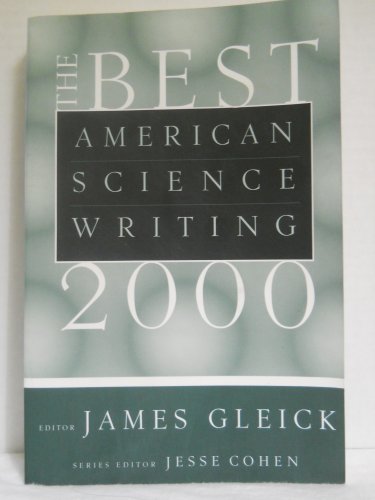
The first volume in this annual series of the best writing by Americans, meticulously selected by bestselling author James Gleick, one of the foremost chronicles of scientific social history, debuts with a stellar collection of writers and thinkers. Many of these cutting-edge essays offer glimpses of new realms of discovery and thought, exploring territory that is unfamiliar to most of us, or finding the unexpected in the midst of the familiar. Nobel Laureate physicist Steven Weinberg challenges the idea of whether the universe has a designer; Pulitzer Prize winner Natalie Angier reassesses caveman (and-woman) couture; bestselling author and Darwinian theorist Stephen Jay Gould makes a claim for the man whose ideas Darwin discredited; Timothy Ferris proposes a realistic alternative to wrap-speed interseller travel; neurologist and bestselling author Oliver Sacks reminisces about his first loves-chemistry and math. This diverse, stimulating and accessible collection is required reading for anyone who wants to travel to the frontier of knowledge.
"synopsis" may belong to another edition of this title.
About the Author
James Gleick's three books, Chaos, Genuis,and Faster,have been translated into nearly thirty languages. Gleick, a former reporter and editor of the New York Times,lives in New York.
>From the Back Cover
The first volume in this annual series of the best writing by Americans, meticulously selected by bestselling author James Gleick, one of the foremost chronicles of scientific social history, debuts with a stellar collection of writers and thinkers. Many of these cutting-edge essays offer glimpses of new realms of discovery and thought, exploring territory that is unfamiliar to most of us, or finding the unexpected in the midst of the familiar. Nobel Laureate physicist Steven Weinberg challenges the idea of whether the universe has a designer; Pulitzer Prize winner Natalie Angier reassesses caveman (and-woman) couture; bestselling author and Darwinian theorist Stephen Jay Gould makes a claim for the man whose ideas Darwin discredited; Timothy Ferris proposes a realistic alternative to wrap-speed interseller travel; neurologist and bestselling author Oliver Sacks reminisces about his first loves-chemistry and math. This diverse, stimulating and accessible collection is required reading for anyone who wants to travel to the frontier of knowledge.
Reviews
Edited by Pulitzer Prize nominee Gleick (Genius), this first volume of a new annual series is a delight to read, in part because it effectively counters the widely held belief that science writing is uniformly bad or dryly boring. These fascinating essays by scientists and science journalists (including Timothy Ferris, Steven Jay Gould, Steven Weinberg, and Natalie Angier) are, in turn, mesmerizing, exciting, and dramatic. The articles come mostly from sources like The New Yorker, the New York Times, and Natural History, but some are from nontraditional venues like the humor journal the Onion and the online magazine Salon. Since these publications are aimed at an intelligent but not scientifically trained readership, the essays are free of the technical terms that make many scientific research articles inaccessible to the nonspecialist. Douglas Hofstadter's piece on the role of analogy in cognition is probably the most ambitious entry, and Francis Halzen's account of his search for neutrinos beneath the Antarctic ice provides a wonderful description of the vagaries, difficulties, and delights of scientific research and discovery. One of the most affecting pieces is Floyd Skoot's description of how a viral infection of his brain has damaged his mind and concept of self. Highly recommended for all libraries.DLloyd Davidson, Seeley G. Mudd Lib. for Science & Engineering, Northwestern Univ., Evanston, IL
Copyright 2000 Reed Business Information, Inc.
Excerpt. © Reprinted by permission. All rights reserved.
Atul Gawande
When Doctors Make Mistakes
From The New Yorker
A study released by the National Academy of Sciences in November 1999 reported that medical errors caused between 44,000 and 98,000 deaths a year. Congress held hearings to investigate its findings and President Clinton ordered hospitals to monitor errors and report them to a federal agency. Months before, readers of The New Yorker were introduced to the subject through the courageous reporting of a young surgical resident. Atul Gawande's bracing first -person account of life-and-death decision-making in the emergency room puts a human face on this complex and urgent issue.I--Crash Victim
At 2 A.M. on a crisp Friday in winter, I was in sterile gloves and gown, pulling a teenage knifing victim's abdomen open, when my pager ded "Code Trauma, three minutes," the operating-room nurse sounded. said, reading aloud from my pager display. This meant that an ambulance would be bringing another trauma patient to the hospital momentarily, and, as the surgical resident on duty for emergencies, I would have to be present for the patient's arrival. I stepped back from the table and took off my gown. Two other surgeons were working on the knifing victim: Michael Ball, the attending (the staff surgeon in charge of the case), and David Hernandez, the chief resident (a general surgeon in his last of five years of training). Ordinarily, these two would have come later to help with the trauma, but they were stuck here. Ball, a dry, imperturbable forty-two-year-old Texan, looked over to me as I headed for the door. "If you run into any trouble, you call, and one of us will peel away," he said.
I did run into trouble. In telling this story, I have had to change significant details about what happened (including the names of the participants and aspects of my role), but I have tried to stay as close to the actual events as I could while protecting the patient, myself, and the rest of the staff. The way that things go wrong in medicine is normally unseen and, consequently, often misunderstood. Mistakes do happen. We think of them as aberrant; they are anything but.
The emergency room was one floor up, and, taking the stairs two at a time, I arrived just as the emergency medical technicians wheeled in a woman who appeared to be in her thirties and to weigh more than two hundred pounds. She lay motionless on a hard orange plastic spinal board-eyes closed, skin pale, blood running out of her nose. A nurse directed the crew into Trauma Bay 1 an examination room outfitted like an O.R., with green tiles on the wall, monitoring devices, and space for portable X-ray equipment. We lifted her onto the bed and then went to work. One nurse began cutting off the woman's clothes. Another took vital signs. A third inserted a large-bore intravenous line into her right arm. A surgical intern put a Foley catheter into her bladder. The emergency-medicine attending was Samuel Johns, a gaunt, Ichabod Crane-like man in his fifties. He was standing to one side with his arms crossed, observing, which was a sign that I could go ahead and take charge.
If you're in a hospital, most of the "moment to moment" doctoring you get is from residents--physicians receiving specialty training and a small income in exchange for their labor. Our responsibilities depend on our level of training, but we're never entirely on our own: there's always an attending, who oversees our decisions. That night, since Johns was the attending and was responsible for the patient's immediate management, I took my lead from him. But he wasn't a surgeon, and so he relied on me for surgical expertise.
"What's the story?" I asked.
An E.M.T. rattled off the details: "Unidentified white female unrestrained driver in high-speed rollover. Ejected from the car. Found unresponsive to pain. Pulse a hundred, B.P. a hundred over sixty, breathing at thirty on her own.
As he spoke, I began examining her. The first step in caring for a trauma patient is always the same. It doesn't matter if a person has been shot eleven times or crushed by a truck or burned in a kitchen fire. The first thing you do is make sure that the patient can breathe without difficulty. This woman's breaths were shallow and rapid. An oximeter, by means of a sensor placed on her finger, measured the oxygen saturation of her blood. The "O2 sat" is normally more than ninety-five percent for a patient breathing room air. The woman was wearing a face mask with oxygen turned up full blast, and her sat was only ninety percent.
"She's not oxygenating well I announced in the flattened-out, wake-meup-when-something-interesting-happens tone that all surgeons have acquired by about three months into residency. With my fingers, I verified that there wasn't any object in her mouth that would obstruct her airway; with a stethoscope, I confirmed that neither lung had collapsed. I got hold of a bag mask, pressed its clear facepiece over her nose and mouth, and squeezed the bellows, a kind of balloon with a one-way valve, shooting a litre of air into her with each compression. After a minute or so, her oxygen came up to a comfortable ninety-eight percent. She obviously needed our help with breathing. "Let's tube her," I said. That meant putting a tube down through her vocal cords and into her trachea, which would insure a clear airway and allow for mechanical ventilation.
Johns, the attending, wanted to do the intubation. He picked up a Mac 3 laryngoscope, a standard but fairly primitive-looking L-shaped metal instrument for prying open the mouth and throat, and slipped the shoehornlike blade deep into her mouth and down to her larynx. Then he yanked the handle up toward the ceiling to pull her tongue out of the way, open her mouth and throat, and reveal the vocal cords, which sit like fleshy tent flaps at the entrance to the trachea. The patient didn't wince or gag: she was still out cold.
"About this title" may belong to another edition of this title.
Search results for The Best American Science Writing 2000

Stock Image
The Best American Science Writing: null: 2000
Published by
HarperCollins Publishers Inc, 2000
ISBN 10: 0060957360
ISBN 13: 9780060957360
Used
Hardcover
Seller: World of Books (was SecondSale), Montgomery, IL, U.S.A.
Seller rating 5 out of 5 stars

Hardback. Condition: Very Good. The first volume in this annual series of the best writing by Americans, meticulously selected by bestselling author James Gleick, one of the foremost chronicles of scientific social history, debuts with a stellar collection of writers and thinkers. Many of these cutting-edge essays offer glimpses of new realms of discovery and thought, exploring territory that is unfamiliar to most of us, or finding the unexpected in the midst of the familiar. Nobel Laureate physicist Steven Weinberg challenges the idea of whether the universe has a designer; Pulitzer Prize winner Natalie Angier reassesses caveman (and-woman) couture; bestselling author and Darwinian theorist Stephen Jay Gould makes a claim for the man whose ideas Darwin discredited; Timothy Ferris proposes a realistic alternative to wrap-speed interseller travel; neurologist and bestselling author Oliver Sacks reminisces about his first loves-chemistry and math. This diverse, stimulating and accessible collection is required reading for anyone who wants to travel to the frontier of knowledge. Seller Inventory # 00091586702
Stock Image
The Best American Science Writing: null: 2000
Published by
HarperCollins Publishers Inc, 2000
ISBN 10: 0060957360
ISBN 13: 9780060957360
Used
Hardcover
Seller: World of Books (was SecondSale), Montgomery, IL, U.S.A.
Seller rating 5 out of 5 stars
Hardback. Condition: Good. The first volume in this annual series of the best writing by Americans, meticulously selected by bestselling author James Gleick, one of the foremost chronicles of scientific social history, debuts with a stellar collection of writers and thinkers. Many of these cutting-edge essays offer glimpses of new realms of discovery and thought, exploring territory that is unfamiliar to most of us, or finding the unexpected in the midst of the familiar. Nobel Laureate physicist Steven Weinberg challenges the idea of whether the universe has a designer; Pulitzer Prize winner Natalie Angier reassesses caveman (and-woman) couture; bestselling author and Darwinian theorist Stephen Jay Gould makes a claim for the man whose ideas Darwin discredited; Timothy Ferris proposes a realistic alternative to wrap-speed interseller travel; neurologist and bestselling author Oliver Sacks reminisces about his first loves-chemistry and math. This diverse, stimulating and accessible collection is required reading for anyone who wants to travel to the frontier of knowledge. Seller Inventory # 00092424413
Seller Image
The Best American Science Writing 2000
Seller: Greenworld Books, Arlington, TX, U.S.A.
Seller rating 5 out of 5 stars
Condition: very_good. Fast Free Shipping â" Very Good condition book with a firm cover and clean pages. Shows normal use and some light wear or limited notes markings. A solid, nice copy to enjoy. Seller Inventory # GWV.0060957360.VG
Stock Image
The Best American Science Writing 2000
Seller: The Maryland Book Bank, Baltimore, MD, U.S.A.
Seller rating 5 out of 5 stars
paperback. Condition: Very Good. First Edition. Used - Very Good. Seller Inventory # 4-EE-5-0157
Stock Image
The Best American Science Writing 2000
Seller: ThriftBooks-Dallas, Dallas, TX, U.S.A.
Seller rating 5 out of 5 stars
Paperback. Condition: As New. No Jacket. Pages are clean and are not marred by notes or folds of any kind. ~ ThriftBooks: Read More, Spend Less. Seller Inventory # G0060957360I2N00
Stock Image
The Best American Science Writing 2000
Seller: ThriftBooks-Atlanta, AUSTELL, GA, U.S.A.
Seller rating 5 out of 5 stars
Paperback. Condition: Good. No Jacket. Pages can have notes/highlighting. Spine may show signs of wear. ~ ThriftBooks: Read More, Spend Less. Seller Inventory # G0060957360I3N00
Stock Image
The Best American Science Writing: null: 2000
Published by
HarperCollins Publishers Inc, 2000
ISBN 10: 0060957360
ISBN 13: 9780060957360
Used
Hardcover
Seller: World of Books Inc, Montgomery, IL, U.S.A.
Seller rating 4 out of 5 stars

Hardback. Condition: Very Good. The first volume in this annual series of the best writing by Americans, meticulously selected by bestselling author James Gleick, one of the foremost chronicles of scientific social history, debuts with a stellar collection of writers and thinkers. Many of these cutting-edge essays offer glimpses of new realms of discovery and thought, exploring territory that is unfamiliar to most of us, or finding the unexpected in the midst of the familiar. Nobel Laureate physicist Steven Weinberg challenges the idea of whether the universe has a designer; Pulitzer Prize winner Natalie Angier reassesses caveman (and-woman) couture; bestselling author and Darwinian theorist Stephen Jay Gould makes a claim for the man whose ideas Darwin discredited; Timothy Ferris proposes a realistic alternative to wrap-speed interseller travel; neurologist and bestselling author Oliver Sacks reminisces about his first loves-chemistry and math. This diverse, stimulating and accessible collection is required reading for anyone who wants to travel to the frontier of knowledge. Seller Inventory # CIN0060957360VG
Stock Image
The Best American Science Writing: null: 2000
Published by
HarperCollins Publishers Inc, 2000
ISBN 10: 0060957360
ISBN 13: 9780060957360
Used
Hardcover
Seller: World of Books Inc, Montgomery, IL, U.S.A.
Seller rating 4 out of 5 stars
Hardback. Condition: Good. The first volume in this annual series of the best writing by Americans, meticulously selected by bestselling author James Gleick, one of the foremost chronicles of scientific social history, debuts with a stellar collection of writers and thinkers. Many of these cutting-edge essays offer glimpses of new realms of discovery and thought, exploring territory that is unfamiliar to most of us, or finding the unexpected in the midst of the familiar. Nobel Laureate physicist Steven Weinberg challenges the idea of whether the universe has a designer; Pulitzer Prize winner Natalie Angier reassesses caveman (and-woman) couture; bestselling author and Darwinian theorist Stephen Jay Gould makes a claim for the man whose ideas Darwin discredited; Timothy Ferris proposes a realistic alternative to wrap-speed interseller travel; neurologist and bestselling author Oliver Sacks reminisces about his first loves-chemistry and math. This diverse, stimulating and accessible collection is required reading for anyone who wants to travel to the frontier of knowledge. Seller Inventory # CIN0060957360G
Stock Image
The Best American Science Writing 2000
Seller: HPB-Movies, Dallas, TX, U.S.A.
Seller rating 4 out of 5 stars
paperback. Condition: Very Good. Connecting readers with great books since 1972! Used books may not include companion materials, and may have some shelf wear or limited writing. We ship orders daily and Customer Service is our top priority! Seller Inventory # S_444999339
Stock Image
The Best American Science Writing 2000
Seller: HPB-Ruby, Dallas, TX, U.S.A.
Seller rating 5 out of 5 stars
paperback. Condition: Very Good. Connecting readers with great books since 1972! Used books may not include companion materials, and may have some shelf wear or limited writing. We ship orders daily and Customer Service is our top priority! Seller Inventory # S_438724240