
Items related to Freakonomics
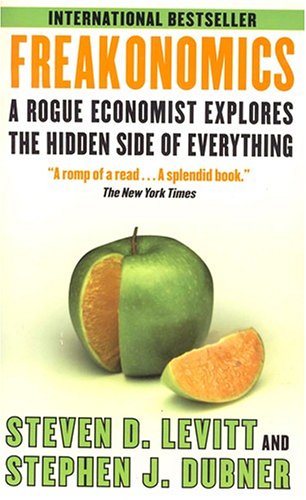
Synopsis
Which is more dangerous, a gun or a swimming pool? What do schoolteachers and sumo wrestlers have in common? Why do drug dealers still live with their moms? How much do parents really matter? What kind of impact did Roe v. Wade have on violent crime?
These may not sound like typical questions for an economist to ask. But Steven D. Levitt is not a typical economist. He is a much-heralded scholar who studies the riddles of everyday life -- from cheating and crime to sports and child rearing -- and whose conclusions regularly turn the conventional wisdom on its head. Thus the new field of study contained in this book: Freakonomics.
Levitt and co-author Stephen J. Dubner show that economics is, at root, the study of incentives -- how people get what they want or need especially when other people want or need the same thing. In Freakonomics, they set out to explore the hidden side of ... well, everything. The inner workings of a crack gang. The truth about real-estate agents. The secrets of the Ku Klux Klan.
What unites all these stories is a belief that the modern world is even more intriguing than we think. All it takes is a new way of looking. Steven Levitt, through devilishly clever and clear-eyed thinking, shows how to see through all the clutter.
Read by Stephen J. Dubner
"synopsis" may belong to another edition of this title.
About the Author
Steven D. Levitt, a professor of economics at the University of Chicago, was awarded the John Bates Clark medal, given to the most influential American economist under the age of forty. He is also a founder of The Greatest Good, which applies Freakonomics-style thinking to business and philanthropy.
Stephen J. Dubner is an award-winning author, journalist, and radio and TV personality. He quit his first career—as an almost-rock-star—to become a writer. He has worked for The New York Times and published three non-Freakonomics books. He lives with his family in New York City.
Reviews
"Rogue" economist might be an overstatement. As a professor of economics at the University of Chicago and the recipient of the John Bates Clark medal (presented by the American Economics Association to the nation’s most outstanding economist under 40) Steven Levitt is hardly an outsider. Yet when journalist Stephen Dubner published a profile of Levitt in The New York Times Magazine, the economist’s theories struck many as, well, freaky. Levitt’s field of behavior economics tries to combine classical economics with the emotional rules of human behavior. Some critics complain that Freakonomics reads too much like an extended collection of articles without a theme; wasn’t this the same complaint we heard most often about Malcolm Gladwell’s Blink (**1/2 Mar/Apr 2005)? Sometimes we don’t mind learning about a variety of things, you know. Levitt and Dubner’s continued partnership uncovers entertaining tales of the many quirks of human behavior.
Copyright © 2004 Phillips & Nelson Media, Inc.
Though the idea of listening to an economics text may bring to mind nightmarish visions of incomprehensible facts, figures and graphs, this audiobook is refreshingly accessible and engrossing. Journalist Dubner reads with just the right mix of enthusiasm and awe, revealing juicy morsels of wisdom on everything from what sumo wrestlers and teachers have in common (a propensity to cheat) to whether parents can really push their kids to greatness by buying them Baby Einstein toys and enlisting them in numerous before- and after-school activities (not really). The only section that doesn't translate well to the format is the final one on naming conventions. The lists of "White Girl Names" and "Black Girl Names," and "Low-End" names and "High-End" names can be mind-numbing, though the text that breaks up these lists will intrigue. Overall, however, these unusual investigations by Levitt, the "rogue" of the subtitle, make for meaty—and entertaining—listening.
Copyright © Reed Business Information, a division of Reed Elsevier Inc. All rights reserved.
According to economist Levitt and writer Dubner, everything--including the cheating habits of Sumo wrestlers, the choice of baby names, the finances of crack dealers, or the likelihood of bagel theft--can be decoded if we study the numbers. Using a freewheeling narrative style that jumps from one cultural phenomenon to another, FREAKONOMICS takes on conventional wisdom. (No, apparently it doesn't help much if you read to your child, and, yes, even Harvard graduates from good families can become serial killers.) There's no unified field theory here, but there is a message behind the medium: Don't trust the experts. Co-author Dubner reads in a friendly, instructive style that captures the enthusiasm of the authors. This is especially recommended for those who liked the books of Malcolm Gladwell or James Surowiecki's THE WISDOM OF CROWDS. R.W.S. © AudioFile 2005, Portland, Maine-- Copyright © AudioFile, Portland, Maine
Award-winning economist Levitt and journalist Dubner join forces to strip a layer or two from the surface of modern life and see what is happening underneath. The authors' worldview as they explore the hidden side of many issues is based on a few fundamentals--among them, incentives are the cornerstone of modern life, and conventional wisdom is often wrong. They look at many different scenarios in a treasure-hunt approach, employing the best economic analytical tools but also following any freakish curiosities that they encounter--hence the study of Freakonomics. They evaluate intriguing questions such as "What do Schoolteachers and Sumo Wrestlers Have in Common?" "How is the Ku Klux Klan Like a Group of Real Estate Agents?" "Where Have All the Criminals Gone?" and "What Makes a Perfect Parent?" We are counseled to think sensibly about how people behave in the real world and to ask a lot of questions. This excellent, readable book will enlighten many library patrons. Mary Whaley
Copyright © American Library Association. All rights reserved
Freakonomics sounds like a text on the business structure of rap music. The subtitle is similarly puzzling. What's a "rogue" economist -- one who has stopped taking calls from his CIA handler? Who wears disguises when he sneaks into the library to crunch numbers? Turns out Freakonomics is about the field of behavioral economics, which attempts to combine the pure-logic tools of classical economics with understanding the emotional impulses of human behavior. And the book's principal figure, Steven D. Levitt, is anything but an outsider. Levitt is a chaired professor of economics at the University of Chicago, meaning he sits at the very pinnacle of his profession's establishment. Nothing "rogue" about that.
Levitt is regarded as among the most creative thinkers in contemporary economics, gifted at drawing connections among seemingly unrelated forces. He believes, for example, that there is a relationship between legalization of abortion and the decline in crime -- more on that in a moment. Levitt is the latest winner of the American Economics Association's John Bates Clark Medal, granted biennially to the top economist under the age of 40. Clark medalists often become influential figures: Paul Krugman, an economist at Princeton and a closely read columnist for the New York Times, was a Clark winner, for instance. In typically dry economics-speak, the Clark judges declared, "Steven Levitt is the most innovative empirical researcher in his cohort." American Economics Association, just come out and say it: The guy is interesting!
Freakonomics presents Levitt's findings in accessible, non-academic terms. It is an engaging and always interesting work, rich in insights, full of surprises. Readers, though, may find themselves in a perpetual state of confusion regarding just what it is they are reading. The book is by Levitt and Stephen J. Dubner, a writer whose previous books include Turbulent Souls and Confessions of a Hero-Worshipper. You're never sure who is speaking. Sometimes Levitt or his work is spoken of in the third person, as if Dubner were writing of them in a detached way; sometimes the text sounds like Levitt addressing the reader; sometimes the book spends pages discussing work done by people other than Levitt, yet the impression given is that it's all Levitt's thinking. Often the reader must flip to the source notes to try to figure out what's going on.
The mishmash quality of Freakonomics seems to trace to its origin. In 2003, Dubner wrote a New York Times Magazine article on Levitt's quirky theories. The piece was a great read, and Levitt and Dubner began to collaborate on articles. According to Freakonomics, Levitt then agreed to write a book, but only if Dubner actually did the writing. (Writing is work, as any economist will tell you!) Yet it seems the two never resolved the question of whether Dubner would ghostwrite for Levitt or write about Levitt. The result feels too much like a magazine article padded to book length. Each chapter of Freakonomics even begins with quotations from the Times piece, as if it merited study by future historians.
Confusing structure aside, Freakonomics is packed with fascinating ideas. Consider Levitt's notion of a relationship between abortion access and the crime drop. First, Freakonomics shows that although commonly cited factors such as improved policing tactics, more felons kept in prison and the declining popularity of crack account for some of the national reduction in crime that began in about the year 1990, none of these completes the explanation. (New York City and San Diego have enjoyed about the same percentage decrease in crime, for instance, though the former adopted new policing tactics and the latter did not.) What was the significance of the year 1990, Levitt asks? That was about 16 years after Roe v. Wade. Studies consistently show that a disproportionate number of crimes are committed by those raised in broken homes or who were unwanted as children. When abortion became legal nationally, Levitt theorizes, births of unwanted children declined; 16 years later crime began to decline, as around age 16 is the point at which many once-innocent boys start their descent into the criminal life. Leavitt's clincher point is that the crime drop commenced approximately five years sooner in Alaska, California, Hawaii, New York and Washington state than it did in the nation as a whole. What do these states have in common? All legalized abortion about five years before Roe.
Other Levitt theories span the landscape. Along with sociologist Sudhir Venkatesh of Columbia University, Levitt has found that drug gangs are structured essentially like street versions of Fortune 500 corporations. Levitt studied high-tech car alarm devices and found they benefited the people who did not buy them almost as much as those who did, by discouraging all auto theft. Levitt has shown that campaign money has almost nothing to do with who wins elections. He has even looked at how parent name children. Parents who expect their children to go far in life give them classy-sounding names such as Katherine; parents who do not expect their children to go far give them names such as Brittney. (That Levitt can cite statistics for all this -- you'll have to read the book -- is impressive.) For amusement value, Levitt makes a case that academic cheating differs little from cheating in sumo wrestling.
Not all of Levitt's ideas meet the test of originality. He proffers that real estate agents serve themselves rather than their clients when they push sellers to take the first bona-fide offer, even if holding out might bring a better price. The agent wants the seller to take the first solid deal because then the agent gets the commission right away; holding out might mean weeks or months of extra work for the agent, while increasing his or her commission only slightly. Freakonomics presents the notion that homeowners and real-estate agents may have conflicting monetary incentives as big news. Memo to the University of Chicago Economics Department: Everyone who has ever sold a house already knows this.
Freakonomics proposes four basic notions: that incentives govern life, that conventional wisdom is often wrong, that "dramatic effects often have distant, even subtle causes" and that experts sometimes use their "informational advantage" to pursue private agendas. Valid points -- but is there anyone who disagrees with any of them? There is no requirement that an economist's work have any larger theme: To be a good professor and produce interesting papers is more than most accomplish. But Freakonomics leaves the reader with the sense of encountering an assortment of clever ideas that have been crowbarred together into something that doesn't really work as a book. Academic careers may not need unifying themes; books do.
Reviewed by Gregg Easterbrook
Copyright 2005, The Washington Post Co. All Rights Reserved.
"About this title" may belong to another edition of this title.
Search results for Freakonomics

Stock Image
Freakonomics
Published by
HarperCollins (edition ), 2005
ISBN 10: 0061143308
ISBN 13: 9780061143304
Used
Perfect Paperback
Seller: BooksRun, Philadelphia, PA, U.S.A.
Seller rating 5 out of 5 stars

Perfect Paperback. Condition: Fair. The item might be beaten up but readable. May contain markings or highlighting, as well as stains, bent corners, or any other major defect, but the text is not obscured in any way. Seller Inventory # 0061143308-7-18
Stock Image
Freakonomics
Seller: World of Books (was SecondSale), Montgomery, IL, U.S.A.
Seller rating 5 out of 5 stars
Paperback. Condition: Very Good. Seller Inventory # 00096516833
Stock Image
Freakonomics
Seller: Half Price Books Inc., Dallas, TX, U.S.A.
Seller rating 5 out of 5 stars
perfect. Condition: Very Good. Connecting readers with great books since 1972! Used books may not include companion materials, and may have some shelf wear or limited writing. We ship orders daily and Customer Service is our top priority! Seller Inventory # S_464548829
Stock Image
Freakonomics
Seller: World of Books Inc, Montgomery, IL, U.S.A.
Seller rating 4 out of 5 stars

Paperback. Condition: Very Good. Seller Inventory # CIN0061143308VG
Stock Image
Freakonomics
Seller: More Than Words, Waltham, MA, U.S.A.
Seller rating 5 out of 5 stars
Condition: Good. A sound copy with only light wear. Overall a solid copy at a great price! Seller Inventory # BOS-V-15e-01412
Stock Image
Freakonomics: A Rogue Economist Explores the Hidden Side of Everything
Seller: ThriftBooks-Atlanta, AUSTELL, GA, U.S.A.
Seller rating 5 out of 5 stars
Paperback. Condition: Fair. No Jacket. Readable copy. Pages may have considerable notes/highlighting. ~ ThriftBooks: Read More, Spend Less. Seller Inventory # G0061143308I5N00
Stock Image
Freakonomics
Seller: Better World Books, Mishawaka, IN, U.S.A.
Seller rating 5 out of 5 stars
Condition: Good. Pages intact with minimal writing/highlighting. The binding may be loose and creased. Dust jackets/supplements are not included. Stock photo provided. Product includes identifying sticker. Better World Books: Buy Books. Do Good. Seller Inventory # 5008075-6
Stock Image
Freakonomics
Seller: Hawking Books, Edgewood, TX, U.S.A.
Seller rating 4 out of 5 stars
Condition: Very Good. Very Good Condition. Clean, tight and Neat. Five star seller - Buy with confidence! Seller Inventory # X0061143308X2
Seller Image
SOS TITLE UNKNOWN
Seller: WeBuyBooks, Rossendale, LANCS, United Kingdom
Seller rating 5 out of 5 stars
Paperback. Condition: Good. Most items will be dispatched the same or the next working day. A copy that has been read but remains in clean condition. All of the pages are intact and the cover is intact and the spine may show signs of wear. The book may have minor markings which are not specifically mentioned. Seller Inventory # rev3211877938
Buy Used
US$ 2.09
US$ 6.11 shipping
Ships from United Kingdom to U.S.A.
Ships from United Kingdom to U.S.A.
Quantity: 1 available
Stock Image
SOS TITLE UNKNOWN
ISBN 10: 0061143308
ISBN 13: 9780061143304
Used
Paperback
Seller: WorldofBooks, Goring-By-Sea, WS, United Kingdom
Seller rating 5 out of 5 stars
Paperback. Condition: Very Good. The book has been read, but is in excellent condition. Pages are intact and not marred by notes or highlighting. The spine remains undamaged. Seller Inventory # GOR001959771
Buy Used
US$ 5.02
US$ 7.45 shipping
Ships from United Kingdom to U.S.A.
Ships from United Kingdom to U.S.A.
Quantity: 2 available