
Items related to A Matter of Justice: An Inspector Ian Rutledge Mystery
A Matter of Justice: An Inspector Ian Rutledge Mystery - Hardcover
Book 11 of 25: Inspector Ian Rutledge Mysteries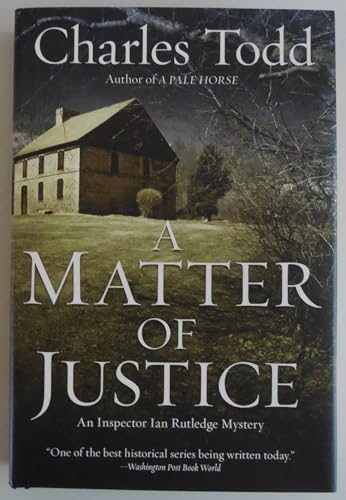
Synopsis
“Charles Todd hasn’t made a misstep yet in his elegant series featuring Scotland Yard detective Ian Rutledge, and A Matter of Justice keeps the streak going.”
—Cleveland Plain Dealer
The Washington Post calls the Ian Rutledge novels by Charles Todd, “one of the best historical series being written today.” A Matter of Justice—the eleventh in the New York Times Notable, Edgar® Award-nominated, and Barry Award-winning series—brings back the haunted British police inspector and still shell-shocked World War One veteran in a tale of unspeakable murder in a small English village filled to bursting with dark secrets and worthy suspects. A New York Times bestseller as spellbinding and evocative as the best of Ruth Rendell, Anne Perry, Martha Grimes, and P.D. James, A Matter of Justice represents a new high for this exceptional storyteller.
"synopsis" may belong to another edition of this title.
About the Author
Charles Todd is the New York Times bestselling author of the Inspector Ian Rutledge mysteries, the Bess Crawford mysteries, and two stand-alone novels. A mother-and-son writing team, Caroline passed away in August 2021 and Charles lives in Florida.
From the Back Cover
The superb new entry in the historical series the New York Times Book Review hails as "outstanding" and the Cleveland Plain Dealer calls "superb"
At the turn of the century, in a war taking place far from England, two soldiers chance upon an opportunity that will change their lives forever. To take advantage of it, they will be required to do the unthinkable, and then to put the past behind them. But not all memories are so short.
Twenty years later, a successful London busi-nessman is found savagely and bizarrely murdered in a medieval tithe barn on his estate in Somerset. Called upon to investigate, Scotland Yard inspector Ian Rutledge soon discovers that the victim was universally despised. Even the man's wife—who appears to be his wife in name only—and the town's police inspector are suspect. But who, among the many, hated him enough to kill?
Rutledge tenaciously follows a well-concealed trail reaching back to an act so barbarous and with consequences so devastating that even the innocent are enveloped by the murderous tide of events. As he summons all his skills to break through a wall of silence in time to stem this tide, others are eager to twist the truth for their own ends. When justice takes a malevolent turn, can Rutledge's own career survive?
Reviews
Any good historical novel steeps its reader in the details of a period. But Charles Todd does it with a passion—and through a narrator uniquely qualified to understand human nature—that brings fresh possibilities to the genre. Todd writes with atmospheric charm and a dark psychological edge that makes Rutledge one of crime writing's most compelling recurring characters. Especially intriguing is Rutledge's own coming to terms with his guilt over actions committed in World War I. "Finding a way back had somehow seemed to be a final betrayal," he thinks in A Matter of Justice, as he again questions his own survival. The success of the series hinges on both clever plotting and the nuance with which the authors continue to develop their character.
Copyright 2009 Bookmarks Publishing LLC
Starred Review. In the stellar 11th Insp. Ian Rutledge mystery (after 2007's A Pale Horse), Todd (the pseudonym of a mother-son writing team) seamlessly combines a fair-play whodunit with a nuanced look into the heart of darkness in the human soul. During the Boer War, Pvt. Harold Quarles takes advantage of a Boer attack on a British military train to enrich himself. When two decades later his battered corpse is found grotesquely displayed at his country residence in Somerset, Scotland Yard's Ian Rutledge must sift through the plethora of lies, omissions and motives surrounding Quarles, who had become a successful investment adviser in London. Because the victim was almost universally despised in Somerset, Rutledge has no shortage of suspects. The inspector's own inner struggles, stemming from his guilt over his morally questionable actions during WWI, make him a more human and complicated protagonist than most other series sleuths. (Jan.)
Copyright © Reed Business Information, a division of Reed Elsevier Inc. All rights reserved.
Still plagued by memories of the Great War, angst-ridden Scotland Yard inspector Ian Rutledge (along with his conscience and sounding board, the ghost Hamish), returns in a new historical mystery that finds him traveling to a country estate in Somerset. His task: investigate the murder of a man well known and respected by the London business community, but universally disliked by the country townsfolk who know him. Pressured by his superior to solve the brutal crime, Rutledge wastes no time digging into the victim’s character. He finds abundant reasons why people want the man dead, as well as a few people who are surprisingly eager to take the blame. The problem is that Rutledge wants more than strong emotion. He wants facts, and those don’t come on a timetable. Memories of Rutledge’s traumatic wartime experiences add texture to this character-driven novel, which pivots on greed, shame, anger, and the quest for vengeance. Readers need not be familiar with Rutledge’s previous adventures to appreciate this one, another smoothly constructed, literary endeavor put together by a mother-and-son writing team. --Stephanie Zvirin
Excerpt. © Reprinted by permission. All rights reserved.
A Matter of Justice
An Inspector Ian Rutledge MysteryBy Charles ToddWilliam Morrow
Copyright © 2009 Charles ToddAll right reserved.
ISBN: 978-0-06-123359-3
Chapter One
The Scilly IslesMay 1920
Ronald Evering was in his study, watching a mechanical toy bank go through its motions, when the idea first came to him.
The bank had been a gift from a friend who knew he collected such things. It had been sent over from America, and with it in a small pouch were American pennies with which to feed the new acquisition, because they fit the coin slot better than the English penny.
A painted cast-iron figure of a fat man sat in a chair, his belly spreading his brown coat so that his yellow waistcoat showed, and one hand was stretched out to receive his bribe from political figures and ordinary citizens seeking his favor. His name was "Boss" Tweed, and he had controlled political patronage in New York City in the aftermath of the American Civil War. Through an alliance between Tammany Hall and the Democratic Party, graft had been his stock-in-trade. Now his image was encouraging children to be thrifty. A penny saved ...
The note accompanying the gift had ended, "Look on this as a swindler of sorts for the swindled, my dear Ronald, and take your revenge by filling his belly full of pennies, in time to recoup your pounds...."
He hadn't particularly cared for the tone of the note, and had burned it.
Still, the bank was a clever addition to his collection.
It had been a mistake to confide in anyone, and the only reason he'd done it was to vent his rage at his own impotence. Even then he hadn't told his friend the whole truth: that he'd invested those pounds in order to look murderers in the face, to see, if such a thing existed, what it was that made a man a killer. In the end all he'd achieved was to make himself known to two -people who had no qualms about deliberately cheating him. The explanation was simple-they wanted no part of him, and losing his money was the simplest way to get rid of him without any fuss. He hadn't foreseen it, and it had become a personal affront.
He had sensed the subtle change in the air when he'd first given his name, and cursed himself for not using his mother's maiden name instead. But the damage was done, and he'd been afraid to let them see what he suspected.
Yet it had shown him-even though he couldn't prove it-that he'd been right about them. What he didn't know was what to do with that knowledge.
Vengeance is mine, saith the Lord ... But the Lord had been remarkably slow exacting it. If anything, these two men had prospered.
And he had had no experience of vengeance.
There was only his mother, crying in his father's arms, this quiet, unassuming woman fiercely demanding that whoever had killed her dear boy be punished. A ten-year-old, listening from the shadows of the stairs, shocked and heartbroken, had endured nightmares about that moment for years afterward. And it was his mother's prodding after his father's death that had sent him to Cape Town in 1911, to bring her dear boy home from his South African grave.
"Your father couldn't do it. But you must," she'd urged him time and again. "It's your duty to Timothy, to me, to the family. Bring him home, let him lie beside your father in the churchyard, where he belongs. Find a way, if you love me, and let me see him resting there before I die!"
Trying to shake off the memory, Evering took another penny from the pouch and placed it in Boss Tweed's outstretched hand.
Almost quicker than the eye could follow, the hand slid the penny into the waistcoat pocket as Boss Tweed's head moved to nod his thanks.
The man smiled. It was no wonder he preferred these toys to -people. He had come home from Cape Town with his brother's body, after two years of forms and long hours in hot, dusty offices in search of the proper signatures. What he hadn't bargained for was the information he'd collected along the way. Information he had never told his mother, but which had been a burden on his soul ever since. Almost ten years now. Because, like Hamlet, he couldn't make up his mind what to do about what he knew.
Well, to be fair, not ten years of single-minded effort.
The Great War had begun the year after his return from South Africa, while he was still trying to discover what had become of those two men after they left the army. It wasn't his fault that he'd been stationed in India, far from home. But that had turned out to be a lucky break, for he discovered quite by accident where they were and what they were doing. In early 1918 he'd been shipped back to London suffering from the bloody flux, almost grateful for that because he was able at last to look into the information he'd come by in Poona.
Only he'd misjudged his quarries and made a fool of himself.
It wouldn't do to brood on events again. That way lay madness.
On the shelves behind him was an array of mechanical and clockwork toys, many of them for adults, like the golden bird that rose from an enameled snuffbox to sing like a nightingale.
Banks were a particularly fine subject for such mechanical marvels. A penny tip to the owner sent a performing dog through a hoop. In another example, a grinning bear disappeared down a tree stump as the hunter lifted his rifle to fire. Humor and clever design had gone into the creation of each toy. The shifting weight of the penny set the device concealed in the base into motion, making the action appear to be magical.
He had always found such devices fascinating, even after he'd worked out the mechanism that propelled them. His mind grasped the designer's plan very quickly, and sometimes he had bettered it in devices of his own. Skill calling to skill. He took quiet pride in that.
(Continues...)
Excerpted from A Matter of Justiceby Charles Todd Copyright © 2009 by Charles Todd . Excerpted by permission.
All rights reserved. No part of this excerpt may be reproduced or reprinted without permission in writing from the publisher.
Excerpts are provided by Dial-A-Book Inc. solely for the personal use of visitors to this web site.
"About this title" may belong to another edition of this title.
Search results for A Matter of Justice: An Inspector Ian Rutledge Mystery

Stock Image
A Matter of Justice: An Inspector Ian Rutledge Mystery
Published by
HarperCollins Publishers Inc, 2008
ISBN 10: 0061233595
ISBN 13: 9780061233593
Used
Hardcover
Seller: World of Books (was SecondSale), Montgomery, IL, U.S.A.
Seller rating 5 out of 5 stars

Hardback. Condition: Fair. "Charles Todd hasn't made a misstep yet in his elegant series featuring Scotland Yard detective Ian Rutledge, andA Matter of Justice keeps the streak going." --Cleveland Plain Dealer TheWashington Post calls the Ian Rutledge novels by Charles Todd, "one of the best historical series being written today." A Matter of Justice--the eleventh in the New York Times Notable, Edgar® Award-nominated, and Barry Award-winning series--brings back the haunted British police inspector and still shell-shocked World War One veteran in a tale of unspeakable murder in a small English village filled to bursting with dark secrets and worthy suspects. A New York Times bestseller as spellbinding and evocative as the best of Ruth Rendell, Anne Perry, Martha Grimes, and P.D. James, A Matter of Justice represents a new high for this exceptional storyteller. Seller Inventory # 00094072732
Stock Image
A Matter of Justice: An Inspector Ian Rutledge Mystery
Published by
HarperCollins Publishers Inc, 2008
ISBN 10: 0061233595
ISBN 13: 9780061233593
Used
Hardcover
Seller: World of Books (was SecondSale), Montgomery, IL, U.S.A.
Seller rating 5 out of 5 stars
Hardback. Condition: Good. "Charles Todd hasn't made a misstep yet in his elegant series featuring Scotland Yard detective Ian Rutledge, andA Matter of Justice keeps the streak going." --Cleveland Plain Dealer TheWashington Post calls the Ian Rutledge novels by Charles Todd, "one of the best historical series being written today." A Matter of Justice--the eleventh in the New York Times Notable, Edgar® Award-nominated, and Barry Award-winning series--brings back the haunted British police inspector and still shell-shocked World War One veteran in a tale of unspeakable murder in a small English village filled to bursting with dark secrets and worthy suspects. A New York Times bestseller as spellbinding and evocative as the best of Ruth Rendell, Anne Perry, Martha Grimes, and P.D. James, A Matter of Justice represents a new high for this exceptional storyteller. Seller Inventory # 00101912361
Stock Image
A Matter of Justice: An Inspector Ian Rutledge Mystery
Seller: Gulf Coast Books, Cypress, TX, U.S.A.
Seller rating 5 out of 5 stars
hardcover. Condition: Very Good. Seller Inventory # 0061233595-2-36779021
Stock Image
A Matter of Justice: An Inspector Ian Rutledge Mystery (Inspector Ian Rutledge Mysteries, 11)
Seller: Orion Tech, Kingwood, TX, U.S.A.
Seller rating 5 out of 5 stars
Hardcover. Condition: Good. Seller Inventory # 0061233595-3-26921796
Stock Image
A Matter of Justice: An Inspector Ian Rutledge Mystery
Seller: Your Online Bookstore, Houston, TX, U.S.A.
Seller rating 5 out of 5 stars
hardcover. Condition: Very Good. Seller Inventory # 0061233595-2-36734485
Seller Image
A Matter of Justice: An Inspector Ian Rutledge Mystery
Seller: Zoom Books Company, Lynden, WA, U.S.A.
Seller rating 5 out of 5 stars
Condition: very_good. Book is in very good condition and may include minimal underlining highlighting. The book can also include "From the library of" labels. May not contain miscellaneous items toys, dvds, etc. . We offer 100% money back guarantee and 24 7 customer service. Seller Inventory # ZBV.0061233595.VG
Stock Image
A Matter of Justice: An Inspector Ian Rutledge Mystery
Published by
William Morrow (edition 1), 2008
ISBN 10: 0061233595
ISBN 13: 9780061233593
Used
Hardcover
Seller: BooksRun, Philadelphia, PA, U.S.A.
Seller rating 5 out of 5 stars
Hardcover. Condition: Fair. 1. With dust jacket. The item might be beaten up but readable. May contain markings or highlighting, as well as stains, bent corners, or any other major defect, but the text is not obscured in any way. Seller Inventory # 0061233595-7-1-13_29
Stock Image
A Matter of Justice: An Inspector Ian Rutledge Mystery (Inspector Ian Rutledge Mysteries)
Seller: More Than Words, Waltham, MA, U.S.A.
Seller rating 5 out of 5 stars
Condition: Good. A sound copy with only light wear. Overall a solid copy at a great price! Seller Inventory # BOS-M-09f-01682
Stock Image
A Matter of Justice: An Inspector Ian Rutledge Mystery
Published by
William Morrow (edition 1), 2008
ISBN 10: 0061233595
ISBN 13: 9780061233593
Used
Hardcover
Seller: BooksRun, Philadelphia, PA, U.S.A.
Seller rating 5 out of 5 stars
Hardcover. Condition: Very Good. 1. With dust jacket. It's a well-cared-for item that has seen limited use. The item may show minor signs of wear. All the text is legible, with all pages included. It may have slight markings and/or highlighting. Seller Inventory # 0061233595-8-6-29
Stock Image
A Matter of Justice: An Inspector Ian Rutledge Mystery
Published by
HarperCollins Publishers Inc, 2008
ISBN 10: 0061233595
ISBN 13: 9780061233593
Used
Hardcover
Seller: World of Books Inc, Montgomery, IL, U.S.A.
Seller rating 4 out of 5 stars

Hardback. Condition: Fair. "Charles Todd hasn't made a misstep yet in his elegant series featuring Scotland Yard detective Ian Rutledge, andA Matter of Justice keeps the streak going." --Cleveland Plain Dealer TheWashington Post calls the Ian Rutledge novels by Charles Todd, "one of the best historical series being written today." A Matter of Justice--the eleventh in the New York Times Notable, Edgar® Award-nominated, and Barry Award-winning series--brings back the haunted British police inspector and still shell-shocked World War One veteran in a tale of unspeakable murder in a small English village filled to bursting with dark secrets and worthy suspects. A New York Times bestseller as spellbinding and evocative as the best of Ruth Rendell, Anne Perry, Martha Grimes, and P.D. James, A Matter of Justice represents a new high for this exceptional storyteller. Seller Inventory # CIN0061233595A