
Items related to Surprised by Hope: Rethinking Heaven, the Resurrection,...
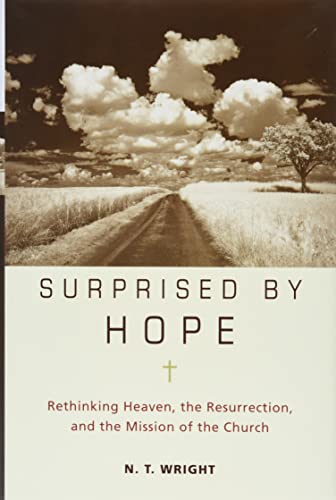
Synopsis
For years Christians have been asking, "If you died tonight, do you know where you would go?" It turns out that many believers have been giving the wrong answer. It is not heaven. Award-winning author N. T. Wright outlines the present confusion about a Christian's future hope and shows how it is deeply intertwined with how we live today. Wright, who is one of today's premier Bible scholars, asserts that Christianity's most distinctive idea is bodily resurrection. He provides a magisterial defense for a literal resurrection of Jesus and shows how this became the cornerstone for the Christian community's hope in the bodily resurrection of all people at the end of the age. Wright then explores our expectation of "new heavens and a new earth," revealing what happens to the dead until then and what will happen with the "second coming" of Jesus. For many, including many Christians, all this will come as a great surprise. Wright convincingly argues that what we believe about life after death directly affects what we believe about life before death. For if God intends to renew the whole creation—and if this has already begun in Jesus's resurrection—the church cannot stop at "saving souls" but must anticipate the eventual renewal by working for God's kingdom in the wider world, bringing healing and hope in the present life. Lively and accessible, this book will surprise and excite all who are interested in the meaning of life, not only after death but before it.
"synopsis" may belong to another edition of this title.
About the Author
N. T. Wright is the former bishop of Durham and senior research fellow at Wycliffe Hall, Oxford University. He is one of the world's leading New Testament scholars and the award-winning author of many books, including After You Believe, Surprised by Hope, Simply Christian, Interpreting Paul, and The New Testament in Its World, as well as the Christian Origins and the Question of God series.
From the Back Cover
For years Christians have been asking, "If you died tonight, do you know where you would go?" It turns out that many believers have been giving the wrong answer. It is not heaven.
Award-winning author N. T. Wright outlines the present confusion about a Christian's future hope and shows how it is deeply intertwined with how we live today. Wright, who is one of today's premier Bible scholars, asserts that Christianity's most distinctive idea is bodily resurrection. He provides a magisterial defense for a literal resurrection of Jesus and shows how this became the cornerstone for the Christian community's hope in the bodily resurrection of all people at the end of the age. Wright then explores our expectation of "new heavens and a new earth," revealing what happens to the dead until then and what will happen with the "second coming" of Jesus. For many, including many Christians, all this will come as a great surprise.
Wright convincingly argues that what we believe about life after death directly affects what we believe about life before death. For if God intends to renew the whole creation—and if this has already begun in Jesus's resurrection—the church cannot stop at "saving souls" but must anticipate the eventual renewal by working for God's kingdom in the wider world, bringing healing and hope in the present life.
Lively and accessible, this book will surprise and excite all who are interested in the meaning of life, not only after death but before it.
Reviews
Wright, one of the greatest, and certainly most prolific, Bible scholars in the world, will touch a nerve with this book. What happens when we die? How should we think about heaven, hell, purgatory and eternal life? Wright critiques the views of heaven that have become regnant in Western culture, especially the assumption of the continuance of the soul after death in a sort of blissful non-bodily existence. This is simply not Christian teaching, Wright insists. The New Testament's clear witness is to the resurrection of the body, not the migration of the soul. And not right away, but only when Jesus returns in judgment and glory. The "paradise," the experience of being "with Christ" spoken of occasionally in the scriptures, is a period of waiting for this return. But Christian teaching of life after death should really be an emphasis on "life after life after death"-the resurrection of the body, which is also the ground for all faithful political action, as the last part of this book argues. Wright's prose is as accessible as it is learned-an increasingly rare combination. No one can doubt his erudition or the greatness of the churchmanship of the Anglican Bishop of Durham. One wonders, however, at the regular citation of his own previous work. And no other scholar can get away so cleanly with continuing to propagate the "hellenization thesis," by which the early church is eventually polluted by contaminating Greek philosophical influence.
Copyright © Reed Business Information, a division of Reed Elsevier Inc. All rights reserved.
*Starred Review* Wright, the Anglican bishop of Durham, shares the strong current interest in Christian beginnings evidenced by the historical Jesus quest but points to faith, more than practice, more than dogma, as what most differentiates early from later Christians. Early Christians had faith in the Resurrection, that is, not only that Jesus rose from the dead in a new body but that they (indeed, everyone) would also rise from death in new bodies and into a new creation, not different but fulfilled, in which all would live fully and never die. That is what Christian hope consists in, and not in an afterlife in a distant heaven or hell, both of which domains are largely medieval fabrications popularized by a Florentine satirist, Dante. After explaining why we ought to believe objectively in Jesus’ literal resurrection, Wright argues that in his ministry resurrection is called the first fruits of the new creation because it demonstrated that the conditions of the new creation could be realized, however imperfectly, in the old, and by human agency. In the long run, Christian hope empowers and enjoins Christians to heal humanity and nature now, not to participate in general degradation through war, greed, and pollution. --Ray Olson
Excerpt. © Reprinted by permission. All rights reserved.
Surprised by Hope
Rethinking Heaven, the Resurrection, and the Mission of the ChurchBy N.T. WrightHarperCollins Publishers, Inc.
Copyright ©2008 N.T. WrightAll right reserved.
ISBN: 9780061551826
Chapter One
All Dressed Up and No Place to Go?
Introduction
Five snapshots set the scene for the two questions this book addresses.
In autumn 1997 much of the world was plunged into a week of national mourning for Princess Diana, reaching its climax in the extraordinary funeral service in Westminster Abbey. People brought flowers, teddy bears, and other objects to churches, cathedrals, and town halls and stood in line for hours to write touching if sometimes tacky messages in books of condolence. Similar if somewhat smaller occasions of public grief took place following such incidents as the Oklahoma City bombing in 1995. They showed a rich confusion of belief, half belief, sentiment, and superstition about the fate of the dead. The reaction of the churches showed how far we had come from what might once have been traditional Christian teaching on the subject.
The second scene was farce, with a serious undertone. Early in 1999 I awoke one morning to hear on the radio that a public figure had been sacked for heretical statements about the afterlife. I listened eagerly. Was this perhaps a radical bishop or theologian, exposed at last? Back came the answer, incredible but true: no, it was a soccer coach. Glen Hoddle, the manager of the England team, declared his belief in a particular version of reincarnation, according to which sins committed in one life are punished by disabilities in the next. Groups representing disabled people objected strongly, and Hoddle was dismissed. It was commented at the time, however, that reincarnation had become remarkably popular in our society and that it would be very odd if Hindus (many of whom hold similar beliefs) were automatically banned from coaching a national sports team.
The third scene is not a single moment, but the snapshot will be familiar. Twenty or thirty people arrive in slow-moving cars at a shabby building on the edge of town. A tinny electronic organ plays supermarket music. A few words, the press of a button, a solemn look from the undertaker, and they file out again, go home for a cup of tea, and wonder what it was all about. Cremation, almost unknown in the Western world a hundred years ago, is now the preference, actual or assumed, of the great majority. It both reflects and causes subtle but far-reaching shifts in attitudes to death and to whatever hope lies beyond.
I initially wrote those opening descriptions in early 2001. By the end of that year, of course, we had witnessed a fourth moment, too well known but also too horrible to describe or discuss in much detail. The events of September 11 of that year are etched in global memory; the thousands who died and the tens of thousands who were bereaved evoke our love and prayers. I shall not say much more about that day, but for many people it raised once more, very sharply, the questions this book seeks to discuss—as did, in their different ways, the three massive so-called natural disasters of 2004 and 2005: the Asian tsunami of Boxing Day 2004; the hurricanes on the Gulf Coast of North America of August 2005, bringing long-lasting devastation to New Orleans in particular; and the horrifying earthquake in Pakistan and Kashmir in October of that same year.
The fifth scene is a graveyard of a different sort. If you go to the historic village of Easington in County Durham, England, and walk down the hill toward the sea, you come to the town called Easington Colliery. The town still bears that name, but there is no colliery there anymore. Where the pit head once stood, with thousands of people working to produce more coal faster and more efficiently than at most other pits, there is smooth and level grass. Empty to the eye, but pregnant with bereavement. All around, despite the heroic efforts of local leaders, there are the signs of postindustrial blight, with all the human fallout of other people's power games. And that sight stands in my mind as a symbol, or rather a symbolic question, every bit as relevant to similar communities in America and elsewhere in the world as they are to my home territory. What hope is there for communities that have lost their way, their way of life, their coherence, their hope?1
This book addresses two questions that have often been dealt with entirely separately but that, I passionately believe, belong tightly together. First, what is the ultimate Christian hope? Second, what hope is there for change, rescue, transformation, new possibilities within the world in the present? And the main answer can be put like this. As long as we see Christian hope in terms of "going to heaven," of a salvation that is essentially away from this world, the two questions are bound to appear as unrelated. Indeed, some insist angrily that to ask the second one at all is to ignore the first one, which is the really important one. This in turn makes some others get angry when people talk of resurrection, as if this might draw attention away from the really important and pressing matters of contemporary social concern. But if the Christian hope is for God's new creation, for "new heavens and new earth," and if that hope has already come to life in Jesus of Nazareth, then there is every reason to join the two questions together. And if that is so, we find that answering the one is also answering the other. I find that to many—not least, many Christians —all this comes as a surprise: both that the Christian hope is surprisingly different from what they had assumed and that this same hope offers a coherent and energizing basis for work in today's world.
In this first chapter I want to set the scene and open up the questions by looking at the contemporary confusion in our world—the wider world, beyond the churches—about life after death. Then, in the second chapter, I shall look at the churches themselves, where there seems to me a worryingly similar uncertainty. This will highlight the key questions that have to be asked and suggest a framework for how we go about answering them.
Continues...
Excerpted from Surprised by Hopeby N.T. Wright Copyright ©2008 by N.T. Wright. Excerpted by permission.
All rights reserved. No part of this excerpt may be reproduced or reprinted without permission in writing from the publisher.
Excerpts are provided by Dial-A-Book Inc. solely for the personal use of visitors to this web site.
"About this title" may belong to another edition of this title.
Search results for Surprised by Hope: Rethinking Heaven, the Resurrection,...

Stock Image
Surprised by Hope: Rethinking Heaven, the Resurrection, and the Mission of the Church
Published by
HarperCollins Publishers Inc, 2008
ISBN 10: 0061551821
ISBN 13: 9780061551826
Used
Hardcover
Seller: World of Books (was SecondSale), Montgomery, IL, U.S.A.
Seller rating 5 out of 5 stars

Hardback. Condition: Good. For years Christians have been asking, "If you died tonight, do you know where you would go?" It turns out that many believers have been giving the wrong answer. It is not heaven. Award-winning author N. T. Wright outlines the present confusion about a Christian's future hope and shows how it is deeply intertwined with how we live today. Wright, who is one of today's premier Bible scholars, asserts that Christianity's most distinctive idea is bodily resurrection. He provides a magisterial defense for a literal resurrection of Jesus and shows how this became the cornerstone for the Christian community's hope in the bodily resurrection of all people at the end of the age. Wright then explores our expectation of "new heavens and a new earth," revealing what happens to the dead until then and what will happen with the "second coming" of Jesus. For many, including many Christians, all this will come as a great surprise. Wright convincingly argues that what we believe about life after death directly affects what we believe about life before death. For if God intends to renew the whole creation--and if this has already begun in Jesus's resurrection--the church cannot stop at "saving souls" but must anticipate the eventual renewal by working for God's kingdom in the wider world, bringing healing and hope in the present life. Lively and accessible, this book will surprise and excite all who are interested in the meaning of life, not only after death but before it. Seller Inventory # 00107037663
Stock Image
Surprised by Hope: Rethinking Heaven, the Resurrection, and the Mission of the Church
Published by
HarperCollins Publishers Inc, 2008
ISBN 10: 0061551821
ISBN 13: 9780061551826
Used
Hardcover
Seller: World of Books (was SecondSale), Montgomery, IL, U.S.A.
Seller rating 5 out of 5 stars
Hardback. Condition: Fair. For years Christians have been asking, "If you died tonight, do you know where you would go?" It turns out that many believers have been giving the wrong answer. It is not heaven. Award-winning author N. T. Wright outlines the present confusion about a Christian's future hope and shows how it is deeply intertwined with how we live today. Wright, who is one of today's premier Bible scholars, asserts that Christianity's most distinctive idea is bodily resurrection. He provides a magisterial defense for a literal resurrection of Jesus and shows how this became the cornerstone for the Christian community's hope in the bodily resurrection of all people at the end of the age. Wright then explores our expectation of "new heavens and a new earth," revealing what happens to the dead until then and what will happen with the "second coming" of Jesus. For many, including many Christians, all this will come as a great surprise. Wright convincingly argues that what we believe about life after death directly affects what we believe about life before death. For if God intends to renew the whole creation--and if this has already begun in Jesus's resurrection--the church cannot stop at "saving souls" but must anticipate the eventual renewal by working for God's kingdom in the wider world, bringing healing and hope in the present life. Lively and accessible, this book will surprise and excite all who are interested in the meaning of life, not only after death but before it. Seller Inventory # 00105956692
Stock Image
Surprised by Hope: Rethinking Heaven, the Resurrection, and the Mission of the Church
Published by
HarperCollins Publishers Inc, 2008
ISBN 10: 0061551821
ISBN 13: 9780061551826
Used
Hardcover
Seller: World of Books (was SecondSale), Montgomery, IL, U.S.A.
Seller rating 5 out of 5 stars
Hardback. Condition: Very Good. For years Christians have been asking, "If you died tonight, do you know where you would go?" It turns out that many believers have been giving the wrong answer. It is not heaven. Award-winning author N. T. Wright outlines the present confusion about a Christian's future hope and shows how it is deeply intertwined with how we live today. Wright, who is one of today's premier Bible scholars, asserts that Christianity's most distinctive idea is bodily resurrection. He provides a magisterial defense for a literal resurrection of Jesus and shows how this became the cornerstone for the Christian community's hope in the bodily resurrection of all people at the end of the age. Wright then explores our expectation of "new heavens and a new earth," revealing what happens to the dead until then and what will happen with the "second coming" of Jesus. For many, including many Christians, all this will come as a great surprise. Wright convincingly argues that what we believe about life after death directly affects what we believe about life before death. For if God intends to renew the whole creation--and if this has already begun in Jesus's resurrection--the church cannot stop at "saving souls" but must anticipate the eventual renewal by working for God's kingdom in the wider world, bringing healing and hope in the present life. Lively and accessible, this book will surprise and excite all who are interested in the meaning of life, not only after death but before it. Seller Inventory # 00110631938
Stock Image
Surprised by Hope: Rethinking Heaven, the Resurrection, and the Mission of the Church
Seller: BooksRun, Philadelphia, PA, U.S.A.
Seller rating 5 out of 5 stars
Hardcover. Condition: Very Good. With dust jacket. It's a well-cared-for item that has seen limited use. The item may show minor signs of wear. All the text is legible, with all pages included. It may have slight markings and/or highlighting. Seller Inventory # 0061551821-11-1-29
Seller Image
Surprised by Hope: Rethinking Heaven, the Resurrection, and the Mission of the Church
Seller: Zoom Books East, Glendale Heights, IL, U.S.A.
Seller rating 5 out of 5 stars
Condition: good. Book is in good condition and may include underlining highlighting and minimal wear. The book can also include "From the library of" labels. May not contain miscellaneous items toys, dvds, etc. . We offer 100% money back guarantee and 24 7 customer service. Seller Inventory # ZEV.0061551821.G
Stock Image
Surprised by Hope: Rethinking Heaven, the Resurrection, and the Mission of the Church
Seller: BooksRun, Philadelphia, PA, U.S.A.
Seller rating 5 out of 5 stars
Hardcover. Condition: Fair. With dust jacket. The item might be beaten up but readable. May contain markings or highlighting, as well as stains, bent corners, or any other major defect, but the text is not obscured in any way. Markings in workbook. Seller Inventory # 0061551821-7-1-29_117
Seller Image
Surprised by Hope: Rethinking Heaven, the Resurrection, and the Mission of the Church
Seller: Dream Books Co., Denver, CO, U.S.A.
Seller rating 5 out of 5 stars
Condition: acceptable. This copy has clearly been enjoyedâ"expect noticeable shelf wear and some minor creases to the cover. Binding is strong, and all pages are legible. May contain previous library markings or stamps. Seller Inventory # 4EKGRJ006G0V_ns
Stock Image
Surprised by Hope: Rethinking Heaven, the Resurrection, and the Mission of the Church
Seller: Wonder Book, Frederick, MD, U.S.A.
Seller rating 5 out of 5 stars
Condition: Good. Good condition. Good dust jacket. A copy that has been read but remains intact. May contain markings such as bookplates, stamps, limited notes and highlighting, or a few light stains. Seller Inventory # O13P-01277
Seller Image
Surprised by Hope: Rethinking Heaven, the Resurrection, and the Mission of the Church
Seller: Austin Goodwill 1101, Austin, TX, U.S.A.
Seller rating 5 out of 5 stars
Condition: good. Book shows general signs of use and handling. May have light wear on the cover or edges and minimal writing or highlighting. Binding remains tight, and pages are clean and readable. Seller Inventory # CTXV.0061551821.G
Stock Image
Surprised by Hope: Rethinking Heaven, the Resurrection, and the Mission of the Church
Seller: Indiana Book Company, Marion, IN, U.S.A.
Seller rating 5 out of 5 stars
Condition: Acceptable. Book has minor liquid or water damage on pages. Ships same or next business day with delivery confirmation. Acceptable condition. Contains highlighting. Expedited shipping available. Seller Inventory # 1000007710788-1100