
Items related to The Last Lone Inventor: A Tale of Genius, Deceit, and...
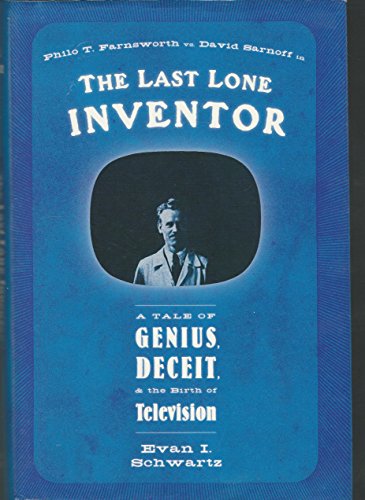
Synopsis
Selected for "100 Biographies & Memoirs to Read in a Lifetime" - Amazon includes The Last Lone Inventor on its all-time best list.
In a story that is both of its time and timeless, Evan I. Schwartz tells a tale of genius and greed, innocence and deceit, and corporate arrogance versus independent brilliance. In other words, the very qualities that have made this country -- for better or for worse -- what it is.
Many men have laid claim to the title "The Father of Television" but Philo T. Farnsworth is the true genius behind what may be the most influential invention of our time. Farnsworth may have ended up a footnote in history, yet he was the first to demonstrate an electronic process for scanning, transmitting and receiving moving images, a discovery that changed the way we live.
Growing up on a small farm in Idaho, Farnsworth was fascinated by anything scientific, especially the newest thing on the market -- radio. Wouldn't it be even more miraculous to project images along with the sound? Driven by his obsession, Farnsworth found a local philanthropist willing to fund his dream. By the age of twenty, in 1926, Farnsworth was operating his own laboratory above a garage in San Francisco and filing his first patent applications. The resulting publicity brought him to the attention of David Sarnoff, the celebrated founder of the NBC radio network, whose own RCA laboratories soon began investigating -- without much success -- a way to transmit a moving image. Determined to control television the way he monopolized radio -- by owning all the royalty producing patents--Sarnoff, from the lofty heights of his office in a New York skyscraper, devised a plan to steal credit for Farnsworth's designs.
Vividly written, and based on original research, including interviews with surviving members of the Farnsworth family The Last Lone Inventor is the story of the epic struggle between two equally passionate adversaries and how their clash symbolized a turning point in the culture of creativity.
"synopsis" may belong to another edition of this title.
About the Author
To write THE LAST LONE INVENTOR, Evan I. Schwartz spent two years researching the life stories of Philo T. Farnsworth and David Sarnoff. He interviewed surviving Farnsworth family members, including Farnsworth's 93-year-old widow, and he visited document archives in six states.
As a journalist, Evan has been covering information technology for 15 years. He is a former editor at BusinessWeek, where he covered software and digital media and was part of teams that produced 12 cover stories and won a National Magazine Award and a Computer Press Award. In recent years, he has written for The New York Times, WIRED, and MIT's Technology Review.
Evan's first book, titled WEBONOMICS, published by Broadway Books, a division of Random House, has ranked as Amazon.com's #1 bestselling business book and was chosen as a finalist for two major awards: The Global Business Book Award as well as the Computer Press Award. International editions have been published in eight countries.
Evan's second book, DIGITAL DARWINISM, from the same publisher, also hit #1 on Amazon's business list shortly after its release, in June 1999. Now in its twelfth hardcover and first paperback printing in the U.S., it is available in the U.K., from Penguin, and has been translated into eight other languages. It too was named a finalist for the Computer Press Award for Non-Fiction Book of the Year.
Evan holds a B.S. in computer science from Union College in Schenectady, New York, and lives with his family in Brookline, Mass.
From the Back Cover
In a story that is both of its time and timeless, Evan I. Schwartz tells a tale of genius and greed, innocence and deceit, and corporate arrogance versus independent brilliance. In other words, the very qualities that have made this country -- for better or for worse -- what it is.
Many men have laid claim to the title "The Father of Television" but Philo T. Farnsworth is the true genius behind what may be the most influential invention of our time. Farnsworth may have ended up a footnote in history, yet he was the first to demonstrate an electronic process for scanning, transmitting and receiving moving images, a discovery that changed the way we live.
Growing up on a small farm in Idaho, Farnsworth was fascinated by anything scientific, especially the newest thing on the market -- radio. Wouldn't it be even more miraculous to project images along with the sound? Driven by his obsession, Farnsworth found a local philanthropist willing to fund his dream. By the age of twenty, in 1926, Farnsworth was operating his own laboratory above a garage in San Francisco and filing his first patent applications. The resulting publicity brought him to the attention of David Sarnoff, the celebrated founder of the NBC radio network, whose own RCA laboratories soon began investigating -- without much success -- a way to transmit a moving image. Determined to control television the way he monopolized radio -- by owning all the royalty producing patents--Sarnoff, from the lofty heights of his office in a New York skyscraper, devised a plan to steal credit for Farnsworth's designs.
Vividly written, and based on original research, including interviews with surviving members of the Farnsworth family The Last Lone Inventor is the story of the epic struggle between two equally passionate adversaries and how their clash symbolized a turning point in the culture of creativity.
Reviews
This story of the invention of television is essentially the biography of two men. Philo T. Farnsworth was a genius who envisioned the concept of television at the age of 15 while plowing the family potato field and patented the device only five years later in 1927, creating the technology that is still used today. David Sarnoff was a poor Russian-Jewish immigrant who rose to fame in the radio broadcasting industry and as head of RCA became obsessed with stealing Farnsworth's invention so that he could go down in history as the man who brought television to the world. In this age of burgeoning corporations, the lone inventor was a dying breed, as big companies began to be the only ones with the resources needed to research, develop, and market new inventions. The teams hired by corporations would give up all patent rights to the organization, however, with very little compensation. Farnsworth, determined to control his patent rights, ultimately faced a showdown with Sarnoff and powerful RCA in this suspenseful account of the unknown man who influenced the world. David Siegfried
Copyright © American Library Association. All rights reserved
This is a lively and engaging account of the conception and invention of both television and the system of network broadcasting in the United States. Schwartz (Digital Darwinism, Webonomics) tells the stories of Philo T. Farnsworth, who essentially invented television before he was 30, and David Sarnoff, the founder of NBC, who essentially invented the business of broadcasting before he was 30. These two men were at tremendous odds with each other for decades, and the nature of their conflict helped determine the shape of the U.S. broadcasting industry. While many other works document the beginnings of broadcast media, they tend to be overviews, offering less of a personal story. This book complements D. Godfrey and C. Sterling's Philo T. Farnsworth: The Father of Television, which takes a drier, more academic approach to the inventor's life and work and should be of interest to academic libraries, particularly those with a technology or engineering department. Schwartz's well-researched biography is sure to appeal to anyone who has ever dreamed of coming up with "the next big thing." Recommended for public libraries and academic or special libraries with a media or technology focus. Andrea Slonosky, Long Island Univ., Brooklyn
Copyright 2002 Cahners Business Information, Inc.
"About this title" may belong to another edition of this title.
Search results for The Last Lone Inventor: A Tale of Genius, Deceit, and...

Stock Image
The Last Lone Inventor: A Tale of Genius, Deceit, and the Birth of Television
Published by
HarperCollins Publishers Inc, 2002
ISBN 10: 0066210690
ISBN 13: 9780066210698
Used
Hardcover
Seller: World of Books (was SecondSale), Montgomery, IL, U.S.A.
Seller rating 5 out of 5 stars

Hardback. Condition: Good. In a story that is both of its time and timeless, Evan I. Schwartz tells a tale of genius and greed, innocence and deceit, and corporate arrogance versus independent brilliance. In other words, the very qualities that have made this country -- for better or for worse -- what it is. Many men have laid claim to the title "The Father of Television" but Philo T. Farnsworth is the true genius behind what may be the most influential invention of our time. Farnsworth may have ended up a footnote in history, yet he was the first to demonstrate an electronic process for scanning, transmitting and receiving moving images, a discovery that changed the way we live. Growing up on a small farm in Idaho, Farnsworth was fascinated by anything scientific, especially the newest thing on the market -- radio. Wouldn't it be even more miraculous to project images along with the sound? Driven by his obsession, Farnsworth found a local philanthropist willing to fund his dream. By the age of twenty, in 1926, Farnsworth was operating his own laboratory above a garage in San Francisco and filing his first patent applications. The resulting publicity brought him to the attention of David Sarnoff, the celebrated founder of the NBC radio network, whose own RCA laboratories soon began investigating -- without much success -- a way to transmit a moving image. Determined to control television the way he monopolized radio -- by owning all the royalty producing patents--Sarnoff, from the lofty heights of his office in a New York skyscraper, devised a plan to steal credit for Farnsworth's designs. Vividly written, and based on original research, including interviews with surviving members of the Farnsworth family The Last Lone Inventor is the story of the epic struggle between two equally passionate adversaries and how their clash symbolized a turning point in the culture of creativity. Seller Inventory # CIN0066210690G
Stock Image
The Last Lone Inventor : A Tale of Genius, Deceit, and the Birth of Television
Published by
HarperCollins Publishers, 2002
ISBN 10: 0066210690
ISBN 13: 9780066210698
Used
Hardcover
First Edition
Seller: Better World Books, Mishawaka, IN, U.S.A.
Seller rating 5 out of 5 stars
Condition: Good. 1st. Pages intact with minimal writing/highlighting. The binding may be loose and creased. Dust jackets/supplements are not included. Stock photo provided. Product includes identifying sticker. Better World Books: Buy Books. Do Good. Seller Inventory # 4275103-6
Stock Image
The Last Lone Inventor : A Tale of Genius, Deceit, and the Birth of Television
Published by
HarperCollins Publishers, 2002
ISBN 10: 0066210690
ISBN 13: 9780066210698
Used
Hardcover
First Edition
Seller: Better World Books, Mishawaka, IN, U.S.A.
Seller rating 5 out of 5 stars
Condition: Very Good. 1st. Pages intact with possible writing/highlighting. Binding strong with minor wear. Dust jackets/supplements may not be included. Stock photo provided. Product includes identifying sticker. Better World Books: Buy Books. Do Good. Seller Inventory # 4906276-6
Stock Image
The Last Lone Inventor : A Tale of Genius, Deceit, and the Birth of Television
Published by
HarperCollins Publishers, 2002
ISBN 10: 0066210690
ISBN 13: 9780066210698
Used
Hardcover
First Edition
Seller: Better World Books, Mishawaka, IN, U.S.A.
Seller rating 5 out of 5 stars
Condition: Good. 1st. Former library copy. Pages intact with minimal writing/highlighting. The binding may be loose and creased. Dust jackets/supplements are not included. Includes library markings. Stock photo provided. Product includes identifying sticker. Better World Books: Buy Books. Do Good. Seller Inventory # 4393252-75
Stock Image
The Last Lone Inventor: A Tale of Genius, Deceit, and the Birth of Television
Seller: HPB Inc., Dallas, TX, U.S.A.
Seller rating 5 out of 5 stars
hardcover. Condition: Very Good. Connecting readers with great books since 1972! Used books may not include companion materials, and may have some shelf wear or limited writing. We ship orders daily and Customer Service is our top priority! Seller Inventory # S_464202159
Stock Image
The Last Lone Inventor: A Tale of Genius, Deceit, and the Birth of Television
Seller: HPB-Ruby, Dallas, TX, U.S.A.
Seller rating 5 out of 5 stars
hardcover. Condition: Very Good. Connecting readers with great books since 1972! Used books may not include companion materials, and may have some shelf wear or limited writing. We ship orders daily and Customer Service is our top priority! Seller Inventory # S_476039090
Stock Image
The Last Lone Inventor: A Tale of Genius, Deceit, and the Birth of Television
Seller: ThriftBooks-Atlanta, AUSTELL, GA, U.S.A.
Seller rating 5 out of 5 stars
Hardcover. Condition: Very Good. No Jacket. Former library book; May have limited writing in cover pages. Pages are unmarked. ~ ThriftBooks: Read More, Spend Less. Seller Inventory # G0066210690I4N10
Stock Image
The Last Lone Inventor: A Tale of Genius, Deceit, and the Birth of Television
Published by
HarperCollins Publishers Inc, 2002
ISBN 10: 0066210690
ISBN 13: 9780066210698
Used
Hardcover
Seller: World of Books Inc, Montgomery, IL, U.S.A.
Seller rating 4 out of 5 stars

Hardback. Condition: Good. In a story that is both of its time and timeless, Evan I. Schwartz tells a tale of genius and greed, innocence and deceit, and corporate arrogance versus independent brilliance. In other words, the very qualities that have made this country -- for better or for worse -- what it is. Many men have laid claim to the title "The Father of Television" but Philo T. Farnsworth is the true genius behind what may be the most influential invention of our time. Farnsworth may have ended up a footnote in history, yet he was the first to demonstrate an electronic process for scanning, transmitting and receiving moving images, a discovery that changed the way we live. Growing up on a small farm in Idaho, Farnsworth was fascinated by anything scientific, especially the newest thing on the market -- radio. Wouldn't it be even more miraculous to project images along with the sound? Driven by his obsession, Farnsworth found a local philanthropist willing to fund his dream. By the age of twenty, in 1926, Farnsworth was operating his own laboratory above a garage in San Francisco and filing his first patent applications. The resulting publicity brought him to the attention of David Sarnoff, the celebrated founder of the NBC radio network, whose own RCA laboratories soon began investigating -- without much success -- a way to transmit a moving image. Determined to control television the way he monopolized radio -- by owning all the royalty producing patents--Sarnoff, from the lofty heights of his office in a New York skyscraper, devised a plan to steal credit for Farnsworth's designs. Vividly written, and based on original research, including interviews with surviving members of the Farnsworth family The Last Lone Inventor is the story of the epic struggle between two equally passionate adversaries and how their clash symbolized a turning point in the culture of creativity. Seller Inventory # CIN0066210690G
Stock Image
The Last Lone Inventor: A Tale of Genius, Deceit, and the Birth of Television
Seller: St Vincent de Paul of Lane County, Eugene, OR, U.S.A.
Seller rating 5 out of 5 stars
Condition: Good. hardcover 100% of proceeds go to charity! Good condition with all pages in tact. Item shows signs of use and may have cosmetic defects. Seller Inventory # L-02-4432
Stock Image
The Last Lone Inventor: A Tale of Genius, Deceit, and the Birth of Television
Seller: Midtown Scholar Bookstore, Harrisburg, PA, U.S.A.
Seller rating 5 out of 5 stars
Hardcover. Condition: Good. With very good dust jacket. Very Good hardcover with light shelfwear - NICE! Standard-sized. Seller Inventory # mon0000077960