
Items related to When Generations Collide: Who They Are. Why They Clash....
When Generations Collide: Who They Are. Why They Clash. How to Solve the Generational Puzzle at Work. - Hardcover
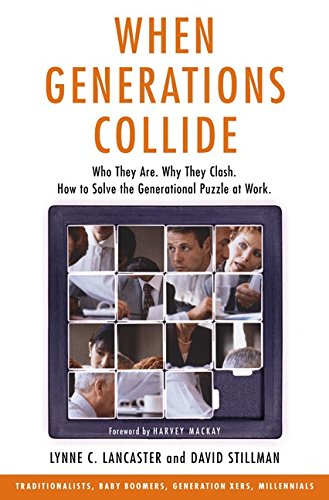
Synopsis
BICKERING. BACK BITING. CLASHING. COLLIDING.
JUST ANOTHER DAY AT THE OFFICE...
If your workplace sometimes feels like a battlefield and your colleagues sometimes seem like aliens, you are not alone. Today there are four distinct generations of employees glaring at one another from across the conference table, and the potential for conflict and confusion has never been greater.
In this insightful, captivating book, generational experts Lynne C. Lancaster and David Stillman shed much-needed light on how to bridge generational gaps at work by understanding the differences that drive generations apart.
Traditionalist employees with their "heads down, onward and upward" attitude live out a work ethic that was shaped during the dark days of the Great Depression. Meanwhile, the eighty million Baby Boomers are at a crossroads, trying to balance their overwhelming need to succeed with their desire to slow down and enjoy the fruits of their labor. They alternate between admiration and abhorrence for the chutzpah demonstrated by Generation Xers, who, in addition to feeling as if they have to prove themselves constantly, are chafing under the image of being overly ambitious, disrespectful, and irreverent. Nipping at everyone's heels are the new kids on the block, the Millennials -- with their unique mix of savvy and social conscience, they promise to change yet again the landscape of the workplace.
Whether you're a manager, an employee, an entrepreneur, or a skilled professional, you'll derive hands-on, take-home business benefits from understanding this vital form of diversity affecting today's high-performance workplace.
Using a wry and practical approach to bottom-line business issues and drawing upon interviews, experiences, and the findings from their national survey, Lancaster and Stillman give you in-depth insights into each generation. With their help, you'll have the tools you need to recruit, retain, motivate, and manage each generation more effectively. And you'll recognize that while -collisions are inevitable, ultimately it's how we manage them that counts.
"synopsis" may belong to another edition of this title.
About the Authors
Lynne C. Lancaster and David Stillman are nationally recognized public speakers, generational experts, and cultural translators as well as coauthors of When Generations Collide. They are cofounders of BridgeWorks, a highly successful twelve-year-old research, speaking, and training company focused exclusively on the generations at work. Their clients include high-profile companies such as 3M, American Express, Best Buy, Coca-Cola, Deloitte, Disney, Ford Motor Company, General Mills, and Procter & Gamble, as well as stellar organizations such as AARP, the American Bankers Association, the Conference Board, the Internal Revenue Service, the National Security Agency, and the United Way. Lancaster lives in Sonoma, California, and Stillman lives in Minneapolis, Minnesota.
David Stillman is the co-author of best-selling books When Generations Collide and The M-Factor: How the Millennials are Rocking the Workplace. He has contributed to Time, The Washington Post, the New York Times, and USA Today and has been featured as a generational expert on CNN, CNBC, and the “Today Show”. Stillman has been named one of the “Forty Under 40” movers and shakers and one of 200 to Watch by The Business Journal.
From the Back Cover
BICKERING. BACK BITING. CLASHING. COLLIDING.
JUST ANOTHER DAY AT THE OFFICE...
If your workplace sometimes feels like a battlefield and your colleagues sometimes seem like aliens, you are not alone. Today there are four distinct generations of employees glaring at one another from across the conference table, and the potential for conflict and confusion has never been greater.
In this insightful, captivating book, generational experts Lynne C. Lancaster and David Stillman shed much-needed light on how to bridge generational gaps at work by understanding the differences that drive generations apart.
Traditionalist employees with their "heads down, onward and upward" attitude live out a work ethic that was shaped during the dark days of the Great Depression. Meanwhile, the eighty million Baby Boomers are at a crossroads, trying to balance their overwhelming need to succeed with their desire to slow down and enjoy the fruits of their labor. They alternate between admiration and abhorrence for the chutzpah demonstrated by Generation Xers, who, in addition to feeling as if they have to prove themselves constantly, are chafing under the image of being overly ambitious, disrespectful, and irreverent. Nipping at everyone's heels are the new kids on the block, the Millennials -- with their unique mix of savvy and social conscience, they promise to change yet again the landscape of the workplace.
Whether you're a manager, an employee, an entrepreneur, or a skilled professional, you'll derive hands-on, take-home business benefits from understanding this vital form of diversity affecting today's high-performance workplace.
Using a wry and practical approach to bottom-line business issues and drawing upon interviews, experiences, and the findings from their national survey, Lancaster and Stillman give you in-depth insights into each generation. With their help, you'll have the tools you need to recruit, retain, motivate, and manage each generation more effectively. And you'll recognize that while -collisions are inevitable, ultimately it's how we manage them that counts.
Reviews
Lancaster and Stillman, partners in a consulting firm, tackle a potential conflict in the workplace: disparities in age may lead people to see situations differently. The authors divide the workforce into four categories: Traditionalists, born between 1900 and 1945; Baby Boomers, born 1946 to 1964; Gen-Xers, 1965-1980; and Millennials, born after 1980; these temporal and social demarcations show where conflicts may lie. This book, like the consultants' mission statement, "bridge[s] the gap between generations by helping people look beyond their own perspectives." No matter how well intentioned, this approach ensures a few inherent problems. Stereotyping is a danger when characterizing groups this large, and the authors don't always avoid the trap. Is it really accurate, for example, to say that Millennials are unique in wanting their work to have value? But the bigger problem is that an initial premise is questionable. The authors say, "Finding common ground with members of our own generation at work is relativity easy," but if it were, there wouldn't be a need for diversity training. And as any manager can attest, people can be difficult no matter what their age. Acknowledging that people of various ages see things differently is worthwhile. However, Lancaster and Stillman disappoint in failing to supply specifics for what to do about those differences. Agent, Sandy Dijkstra.
Copyright 2001 Cahners Business Information, Inc.
The concept of workplace diversity has come to embrace ethnicity, disability, sexual orientation, and more. Lancaster and Stillman, founding partners of BridgeWorks consulting firm, ask us to consider yet another category: generational differences. The generations they allude to are "Traditionalists" (1900-45), "Baby Boomers" (1946-64), "Generation Xers" (1965-80), and "Millennials" (1981-99), and they are interested in how members of each group interact in contemporary work settings. According to the authors, employee productivity is the key to success in the new economy, and given the difficulties employers have in recruiting, training, motivating, and managing their workforce, understanding multigenerational differences in the workplace could result in success or failure. The authors fully describe each generation and explore the problems each might encounter in work settings. Combining practical, how-to exercises with examples of companies that have used generational differences to their advantage, this is a book every corporate human resources department would want on the bookshelf. Unfortunately, given how the economy has changed recently, it may be something that is largely expendable at this time. Recommended for management collections. Richard Drezen, Washington Post, New York City Bureau
Copyright 2001 Reed Business Information, Inc.
*Starred Review* Diversity is a significant but sensitive issue in today's workplace. Here two experts in the field focus on generational diversity. Specifically, their book addresses the necessary but often difficult ways of attracting and retaining individuals from the four generations that make up the American workforce: traditionalists, baby boomers, generation Xers, and millenials (persons born between 1981 and 1999, who are just beginning to participate in the labor force). If you want the best and brightest working for your company, the authors aver, you need to hire people from all four of these generational groups and ensure that they work together successfully. But clashes are inevitable, admit Lancaster and Stillman, since each generation approaches the concept of balance and cooperation in the workplace from a different direction. Nevertheless, the authors show that "bridging the generation gaps at work can provide huge payoffs when it comes to recruiting, retaining, managing, and motivating others." Their book is a guide for employers and employees on how to take advantage of generational differences rather than allowing those differences to drain productivity. As with all outstanding business books, this wise and personable one will appeal to a wide range of readers by informing and educating them not only about corporate life but also about life in general. Brad Hooper
Copyright © American Library Association. All rights reserved
Excerpt. © Reprinted by permission. All rights reserved.
Chapter One
Generational Turbulence
The Widening Generation Gap at Work
"You two do that for a living?" asked David's seatmate with a disapproving raise of the eyebrow.
Lynne observed David's reaction from across the aisle and hoped he wouldn't say something flippant. However, recognizing that this was a 3 1/2-hour flight and we had just leveled off, David settled down and took a deep, cleansing breath.
The man's name was Paul. He was a craggy, sixty-five-year-old Traditionalist and the CEO of a national warehousing and distribution company. He liked the aisle seat, a vodka and tonic with no ice, and an extra pillow. He was probably wondering what two upstarts like us were doing in first class, but he was too polite to let on. Instead, he kept probing.
"So tell me, what exactly does a 'generational expert' do?" he asked with a patronizing but unmistakably curious tone.
Lynne jumped in: "We help employers and employees understand the differences among the generations, and we coach them in how to recruit, motivate, manage, and retain the generations more effectively."
As Paul pondered this information, we wondered if he, like so many successful leaders, had ever thought about "generational differences" as one of the fundamental reasons American companies are experiencing hiring challenges, skyrocketing turnover rates, increasing communication conundrums, and plummeting morale. Had he ever recognized that clashes among Traditionalists, Baby Boomers, Generation Xers, and Millennials at work could take a direct toll on his bottom line?
Paul fixed David with a thoughtful gaze. "When I was young, I didn't see eye to eye with my dad. Now my son's in the business and we butt heads all the time. Haven't there always been generational conflicts in the workplace?"
"Sure," David responded. "The generations have always clashed. But the generation gaps in the workplace today are wider than ever and of greater strategic importance. Think about it. Americans are living and working longer. The average life expectancy at birth in the year 1900 was forty-seven. Today it's closing in on eighty. Suddenly, four generations are facing off across the conference table instead of just one or two."
"Okay," Paul replied, "but what's the problem? As I see it, more generations mean more available workers."
"That's a good point," David responded. "But what most people overlook is that each generation brings its own set of values, beliefs, life experiences, and attitudes to the workplace, and that can be the problem. Take your generation, the Traditionalists. You grew up under the shadow of the Great Depression and felt lucky to have jobs. If we have learned one thing in our research, it is just how strong Traditionalists' beliefs are when it comes to patriotism, hard work, and respect for leaders, among other values they bring to the workplace."
Paul nodded.
"Now, compare that to my generation," David continued.
Paul eyed David's T-shirt and parachute pants "travel ensemble." "Hmm, and exactly what generation would that be?" he queried with a raised eyebrow.
"Generation X," David responded proudly. "We grew up seeing too many businesses downsize or merge, and we learned that the last thing we could trust was the permanence of the workplace. Let's face it, by the time we hit the job market, the employer-employee contract was already out the window and Social Security was headed down the toilet. And it sure didn't help that we've always been told we would never do as well as our parents had. As a result, we need to be recruited, rewarded, and managed differently from your generation if you hope to make us a contributing, loyal part of your workforce."
Paul turned back to Lynne. "I assume you're an Xer, too?"
"I must admit to actually being a Baby Boomer," she responded, blushing. David rolled his eyes and wanted to grab an airsickness bag.
"So, Boomer, what's your story?" Paul demanded.
"Well," answered Lynne, "My generation is different from yours and David's. When you've had to vie with eighty million peers every step of your career, you're bound to be competitive. We were raised by parents who convinced us we could make the world a better place; as a result, we tend to be idealists. We came to the workplace with a strong desire to put our own stamp on things.
"Yeah, I've definitely locked horns with a few of you in my workplace," Paul confirmed with a nod of his head.
Lynne continued: "You have to put the generations in an economic context. The long economic expansion of the 1990s created a situation of almost full employment in the United States. David's generation was promoted rapidly and was offered more financial and job growth opportunities than ever in history. Rather than paying their dues for a number of years, they've been able to demand that companies adapt to their ways of doing things. This has created both a culture clash and a resentment backlash as the generations collided around issues of fairness and opportunity.
"At the same time, low unemployment levels created major staffing problems. For example, one of our clients who owns a box factory in Catawba City, North Carolina, complained to us in 2000 that his town's unemployment rate had dropped to .8 percent! Imagine trying to recruit a workforce to operate a noisy plant that smells like diesel fumes and rotten eggs when the same workers can find jobs at an air-conditioned mall for the same money -- and enjoy the scent of Mrs. Fields cookies!"
"Now hold on there," Paul interrupted. "Let's face it, as soon as our economy takes a nosedive, the younger generations are going to have to come begging for jobs."
"But that's only part of the picture," David countered....
There's a talent war out there. Because Generation X is just a little over half the size of . . .
Copyright (c) 2002 Lynne C. Lancaster and David Stillman
"About this title" may belong to another edition of this title.
Search results for When Generations Collide: Who They Are. Why They Clash....

Stock Image
When Generations Collide: Who They Are. Why They Clash. How to Solve the Generational Puzzle at Work.
Seller: World of Books (was SecondSale), Montgomery, IL, U.S.A.
Seller rating 5 out of 5 stars

Condition: Very Good. Item in very good condition! Textbooks may not include supplemental items i.e. CDs, access codes etc. Seller Inventory # 00104136132
Stock Image
When Generations Collide: Who They Are. Why They Clash. How to Solve the Generational Puzzle at Work.
Seller: World of Books (was SecondSale), Montgomery, IL, U.S.A.
Seller rating 5 out of 5 stars
Condition: Good. Good condition ex-library book with usual library markings and stickers. Seller Inventory # 00103573181
Stock Image
When Generations Collide: Who They Are. Why They Clash. How to Solve the Generational Puzzle at Work.
Published by
Harper Business (edition First Edition), 2002
ISBN 10: 0066621062
ISBN 13: 9780066621067
Used
Hardcover
First Edition
Seller: BooksRun, Philadelphia, PA, U.S.A.
Seller rating 5 out of 5 stars
Hardcover. Condition: Fair. First Edition. With dust jacket. The item might be beaten up but readable. May contain markings or highlighting, as well as stains, bent corners, or any other major defect, but the text is not obscured in any way. Seller Inventory # 0066621062-7-1-29
Seller Image
When Generations Collide: Who They Are. Why They Clash. How to Solve the Generational Puzzle at Work.
Seller: ZBK Books, Carlstadt, NJ, U.S.A.
Seller rating 5 out of 5 stars
Condition: very_good. Fast & Free Shipping â" Very Good condition book with a firm cover and clean pages. Shows normal use and some light wear or limited notes markings. A solid, nice copy to enjoy. Seller Inventory # ZWV.0066621062.VG
Stock Image
When Generations Collide: Who They Are. Why They Clash. How to Solve the Generational Puzzle at Work.
Seller: ThriftBooks-Atlanta, AUSTELL, GA, U.S.A.
Seller rating 5 out of 5 stars
Hardcover. Condition: Very Good. No Jacket. May have limited writing in cover pages. Pages are unmarked. ~ ThriftBooks: Read More, Spend Less. Seller Inventory # G0066621062I4N00
Seller Image
When Generations Collide: Who They Are. Why They Clash. How to Solve the Generational Puzzle at Work.
Seller: Goodwill Books, Hillsboro, OR, U.S.A.
Seller rating 5 out of 5 stars
Condition: acceptable. Fairly worn, but readable and intact. If applicable: Dust jacket, disc or access code may not be included. Seller Inventory # GICWV.0066621062.A
Seller Image
When Generations Collide: Who They Are. Why They Clash. How to Solve the Generational Puzzle at Work.
Seller: Greenworld Books, Arlington, TX, U.S.A.
Seller rating 5 out of 5 stars
Condition: good. Fast Free Shipping â" Good condition. It may show normal signs of use, such as light writing, highlighting, or library markings, but all pages are intact and the book is fully readable. A solid, complete copy that's ready to enjoy. Seller Inventory # GWV.0066621062.G
Stock Image
When Generations Collide: Who They Are. Why They Clash. How to Solve the Generational Puzzle at Work.
Seller: BookHolders, Towson, MD, U.S.A.
Seller rating 5 out of 5 stars
Condition: Good. [ No Hassle 30 Day Returns ][ Ships Daily ] [ Underlining/Highlighting: NONE ] [ Writing: NONE ] [ Edition: first ] Publisher: HarperBusiness Pub Date: 2/5/2002 Binding: Hardcover Pages: 384 first edition. Seller Inventory # 6866647
Stock Image
When Generations Collide: Who They Are. Why They Clash. How to Solve the Generational Puzzle at Work.
Seller: Wonder Book, Frederick, MD, U.S.A.
Seller rating 5 out of 5 stars
Condition: Good. Good condition. Good dust jacket. A copy that has been read but remains intact. May contain markings such as bookplates, stamps, limited notes and highlighting, or a few light stains. Seller Inventory # E08A-04333
Stock Image
When Generations Collide : Who They Are. Why They Clash. How to Solve the Generational Puzzle at Work
Published by
HarperCollins Publishers, 2002
ISBN 10: 0066621062
ISBN 13: 9780066621067
Used
Hardcover
First Edition
Seller: Better World Books, Mishawaka, IN, U.S.A.
Seller rating 5 out of 5 stars
Condition: Very Good. 1st. Former library copy. Pages intact with possible writing/highlighting. Binding strong with minor wear. Dust jackets/supplements may not be included. Includes library markings. Stock photo provided. Product includes identifying sticker. Better World Books: Buy Books. Do Good. Seller Inventory # 12359753-20