
Items related to The Advanced Backpacker: A Handbook of Year Round,...
Synopsis
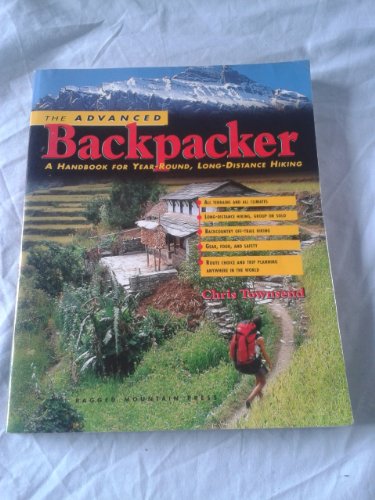
With thousands of all-weather miles to his credit, from North America, Europe, and Asia, Chris Townsend is the ultimate guide for backpackers of all levels. The Advanced Backpacker is an invaluable fusion of expert information and unlimited inspiration, featuring detailed discussions of everything from finding routes and choosing locations to planning, financing, equipping, and supplying oneself for the long haul. Offering readers unprecedented insight into the extensive preparations required to develop the body and psyche of a long-distance hiker, Townsend addresses the specifics of hiking in all climates, from deserts and mountains to the arctic tundra and the tropics. The Advanced Backpacker offers top-level navigation techniques as well as specific safety and health precautions for extreme heat and cold.
"synopsis" may belong to another edition of this title.
About the Author
Chris Townsend is an internationally recognized hiking expert who has trekked the world over. His books include The Backpacker's Handbook, which won the prestigious Outdoor Writers' Guild Award for Excellence in the United Kingdom. His solo treks include a 1,600-mile hike over the entire Candian Rockies, a 1,000-mile walk across the Yukon, and a monumental 3,000-mile hike from Canada to Mexico along the Continental Divide Trail. He lives in Scotland.
From the Back Cover
You already know the basics of backpacking. Now your goal is to hike the entire Appalachian Trail, make a solo trip through Denali, or see the far corners of the globe on your own two feet--you're ready to wander right off the map.
No matter where in the world you aim for--the Sierra Nevadas, Scandinavia, or beyond--there's a good chance that Chris Townsend has been there before you. With over 20,000 long- and short-distance hiking miles to his credit, Townsend shares with you the secrets he's learned while backpacking the world's most challenging and rewarding terrains: Nepal, the desert Southwest, the Scottish Highlands, the Yukon, the Pyrenees, and much more. The Advanced Backpacker explains everything there is to know about hiking on terrains from the desert to the arctic and in all kinds of weather. It gives you the tools you need for group or solo hiking on the long trail, the trackless wilderness, or the most remote and exotic corners of the planet.
Praise for The Backpacker's Handbook:
"Townsend's time-honored recommendations draw extensively from his often intense field experiences. . . . Every imaginable topic is covered thoroughly and engagingly."--Backpacker
"An clear and comprehensive primer."--Sierra
"Belongs in every bookcase dealing with outdoor topics. . . . Chockablock full of useful, practical, common-sense info. . . . If you tramp the outdoors, get this book."--Maine Sportsman
Excerpt. © Reprinted by permission. All rights reserved.
Introduction
This instinct for a free life in the open is as natural and wholesome as the gratification of hunger and thirst and love. It is Nature's recall to the simple mode of existence she intended us for.
--Horace Kephart, Camping and Woodcraft
Hiking is my passion, especially walking long-distance in wilderness areas, and has been all my adult life. In the many years since my first long walk, a 17-day journey along the 270-mile Pennine Way, a footpath along the moorland spine of England, I've endeavored to spend as much time as possible in wild country. During that time I've walked the 2,600-mile Pacific Crest Trail, the 3,000-mile Continental Divide Trail, 1,600 miles end to end along the Canadian Rockies, 1,000 miles south to north through Yukon Territory, 1,300 miles south to north through the mountains of Norway and Sweden, 1,250 miles from Land's End to John O'Groats in Great Britain, and 1,600 miles over the 517 summits over 3,000 feet in theScottish Highlands. There have been as well many other walks not quite so long in many different places and countries ranging from the Grand Canyon to the Alps, Iceland to Nepal.
These walks have given me great pleasure and satisfaction and wonderful feelings of joy and excitement. I've learned a little about the natural world and, I think, something about myself. I've also at times been soaked, sunburned, frozen, thirsty, hungry, footsore, and exhausted. Tents have blown down, trails have been lost, and rivers and snow banks have been fallen into.
All this experience means I have learned enough about long-distance hiking in wild places, and made enough mistakes, for my knowledge to perhaps be of use to others. There is much more for me to learn, of course. Indeed, I learn something new every time I go for a walk. But if the idea of spending weeks, perhaps months, walking and living in the wilderness attracts you, then my thoughts may well be of value.
Although novice backpackers may find much of interest here, this book isn't really designed for them. They would do better to look at my Backpacker's Handbook (Ragged Mountain Press), which covers all aspects of backpacking. Inevitably there may be some overlap between the two books, but in this book I've assumed a basic knowledge of camping and hiking techniques and equipment and a little backpacking experience. This book is for those who want to go beyond the weekend away or the week spent camping not far from a road and who want to venture further into the wilderness, walking longer distances and staying out for more nights. I've also looked at how to plan and undertake hikes in far-off distant places. Because the book is based on my own experience of long-distance hiking, some of the stories have appeared elsewhere in books about my hikes. If you hear an echo here and there, I apologize.
The question may be asked whether there is a need for a book like this. My reply is that although there are people who successfully complete long hikes without much preparation, they are rare. The dropout rate on popular long walks such as the Appalachian and Pacific Crest Trails is very high. Many hikers give up in the first hundred miles. Clearly there is a need for advice. There are many books on backpacking but few on long-distance backpacking. I fervently hope that this addition to the literature will help some to achieve their goals.
This book may encourage people who would otherwise not have thought to try long-distance hiking and to experience what it is like to live in the wilds for long periods. If so, I am pleased. That is part of my intention. Concern is sometimes expressed that there are too many people in the wilderness, that we are "loving it to death." I disagree. Although some places are very popular and can get crowded, most wilderness areas are not. And even where there are many people, the landscape is usually no more than a little ragged, a little tarnished looking. There is no comparison between an overwide trail or a flattened well-used camping site and a clear-cut forest or a strip-mined mountainside. The real threats to the wilderness come from logging, mining, overgrazing, dams, downhill ski resorts, mass tourism developments, and other large-scale projects. Who opposes these schemes? Often it is people who have learned to love wild places by walking and camping in them, by treating them softly and leaving little trace of their passing. Long-distance hikers frequently feel they must give something back to the wilderness that has given them so much joy, and they become involved in environmental work and campaigning. In the words of one of the greatest long-distance wilderness walkers, John Muir, they want to "do something for wilderness and make the mountains glad." If no one understands the value of remote, wild places, who will speak out when they are threatened? If long-distance walking leads to an understanding of the need for wilderness, then that is enough to justify encouraging it.
Although the real threats to the wilderness come from industry--not hikers--those of us who walk the wild places should do so as lightly as possible, leaving little trace of our passing. There are techniques for doing so, and I've described them in this book. Long-distance hikers in particular should take care of the land through which they pass. We are privileged to experience the most beautiful and spectacular places on the planet. In return, we should help to maintain and preserve those places for the sake of those who come after us and the creatures and plants whose homes they are.
"About this title" may belong to another edition of this title.
Search results for The Advanced Backpacker: A Handbook of Year Round,...

Stock Image
The Advanced Backpacker: A Handbook of Year Round, Long-Distance Hiking
Published by
McGraw-Hill Education - Europe, 2000
ISBN 10: 0071357564
ISBN 13: 9780071357562
Used
Paperback
Seller: World of Books (was SecondSale), Montgomery, IL, U.S.A.
Seller rating 5 out of 5 stars

Paperback. Condition: Very Good. Explains almost everything there is to know about hiking on terrains from the desert to the arctic and in all kinds of weather. This book aims to give you the tools you need for group or solo hiking on the long trail, the trackless wilderness, or the most remote and exotic corners of the planet. Seller Inventory # 00093797079
Stock Image
The Advanced Backpacker: A Handbook of Year Round, Long-Distance Hiking
Published by
McGraw-Hill Education - Europe, 2000
ISBN 10: 0071357564
ISBN 13: 9780071357562
Used
Paperback
Seller: World of Books (was SecondSale), Montgomery, IL, U.S.A.
Seller rating 5 out of 5 stars
Paperback. Condition: Good. Explains almost everything there is to know about hiking on terrains from the desert to the arctic and in all kinds of weather. This book aims to give you the tools you need for group or solo hiking on the long trail, the trackless wilderness, or the most remote and exotic corners of the planet. Seller Inventory # 00095666117
Stock Image
The Advanced Backpacker: A Handbook of Year Round, Long-Distance Hiking
Published by
International Marine/Ragged Mountain Press, 2000
ISBN 10: 0071357564
ISBN 13: 9780071357562
Used
Paperback
Seller: ThriftBooks-Dallas, Dallas, TX, U.S.A.
Seller rating 5 out of 5 stars
Paperback. Condition: Good. No Jacket. Former library book; Pages can have notes/highlighting. Spine may show signs of wear. ~ ThriftBooks: Read More, Spend Less. Seller Inventory # G0071357564I3N10
Stock Image
The Advanced Backpacker: A Handbook of Year Round, Long-Distance Hiking
Published by
International Marine/Ragged Mountain Press, 2000
ISBN 10: 0071357564
ISBN 13: 9780071357562
Used
Paperback
Seller: ThriftBooks-Dallas, Dallas, TX, U.S.A.
Seller rating 5 out of 5 stars
Paperback. Condition: Very Good. No Jacket. May have limited writing in cover pages. Pages are unmarked. ~ ThriftBooks: Read More, Spend Less. Seller Inventory # G0071357564I4N00
Stock Image
The Advanced Backpacker: A Handbook of Year Round, Long-Distance Hiking
Published by
International Marine/Ragged Mountain Press (edition 1), 2000
ISBN 10: 0071357564
ISBN 13: 9780071357562
Used
Paperback
Seller: BooksRun, Philadelphia, PA, U.S.A.
Seller rating 5 out of 5 stars
Paperback. Condition: Very Good. 1. It's a well-cared-for item that has seen limited use. The item may show minor signs of wear. All the text is legible, with all pages included. It may have slight markings and/or highlighting. Seller Inventory # 0071357564-8-1
Stock Image
The Advanced Backpacker: A Handbook of Year Round, Long-Distance Hiking
Published by
International Marine/Ragged Moun, 2000
ISBN 10: 0071357564
ISBN 13: 9780071357562
Used
Paperback
Seller: Half Price Books Inc., Dallas, TX, U.S.A.
Seller rating 5 out of 5 stars
Paperback. Condition: Very Good. Connecting readers with great books since 1972! Used books may not include companion materials, and may have some shelf wear or limited writing. We ship orders daily and Customer Service is our top priority! Seller Inventory # S_355055913
Stock Image
The Advanced Backpacker: A Handbook of Year Round, Long-Distance Hiking
Published by
International Marine/Ragged Moun, 2000
ISBN 10: 0071357564
ISBN 13: 9780071357562
Used
paperback
Seller: HPB-Diamond, Dallas, TX, U.S.A.
Seller rating 5 out of 5 stars
paperback. Condition: Very Good. Connecting readers with great books since 1972! Used books may not include companion materials, and may have some shelf wear or limited writing. We ship orders daily and Customer Service is our top priority! Seller Inventory # S_477508023
Stock Image
The Advanced Backpacker: A Handbook of Year Round, Long-Distance Hiking
Published by
McGraw-Hill Education - Europe, 2000
ISBN 10: 0071357564
ISBN 13: 9780071357562
Used
Paperback
Seller: World of Books Inc, Montgomery, IL, U.S.A.
Seller rating 4 out of 5 stars

Paperback. Condition: Very Good. Explains almost everything there is to know about hiking on terrains from the desert to the arctic and in all kinds of weather. This book aims to give you the tools you need for group or solo hiking on the long trail, the trackless wilderness, or the most remote and exotic corners of the planet. Seller Inventory # CIN0071357564VG
Stock Image
The Advanced Backpacker: A Handbook of Year Round, Long-Distance Hiking
Published by
McGraw-Hill Education - Europe, 2000
ISBN 10: 0071357564
ISBN 13: 9780071357562
Used
Paperback
Seller: World of Books Inc, Montgomery, IL, U.S.A.
Seller rating 4 out of 5 stars
Paperback. Condition: Good. Explains almost everything there is to know about hiking on terrains from the desert to the arctic and in all kinds of weather. This book aims to give you the tools you need for group or solo hiking on the long trail, the trackless wilderness, or the most remote and exotic corners of the planet. Seller Inventory # CIN0071357564G
Stock Image
The Advanced Backpacker : A Handbook of Year Round, Long-Distance Hiking
Published by
McGraw-Hill Professional Publishing, 2000
ISBN 10: 0071357564
ISBN 13: 9780071357562
Used
Softcover
First Edition
Seller: Better World Books: West, Reno, NV, U.S.A.
Seller rating 5 out of 5 stars
Condition: Good. 1st Edition. Former library copy. Pages intact with minimal writing/highlighting. The binding may be loose and creased. Dust jackets/supplements are not included. Includes library markings. Stock photo provided. Product includes identifying sticker. Better World Books: Buy Books. Do Good. Seller Inventory # GRP70845751