
Items related to Lessons from the Living Cell: The Limits of Reductionism
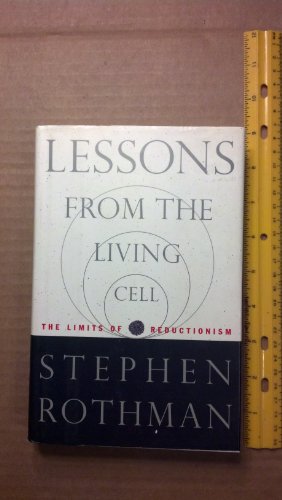
Synopsis
An elegant call to a new biology that goes beyond reductionism The Human Genome Project is the culmination of a two-centuries-old scientific tradition that takes as its central tenet the principle of reductionism, or the belief that a system can be thoroughly understood when it is reduced to its most fundamental constituent parts. Experimental biologist Stephen Rothman explains that reductionism also has serious, even dangerous, limitations.With the help of fascinating case studies, he takes a clear-eyed look at the social climate in which science is practiced and explores the collective psychology that he fears is leading scientists down a blind alley. Rothman explains why, despite all the hype surrounding the Genome Project, science is still no closer to building a bridge between molecules and reactions at the genetic level and large-scale biological processes. And, ultimately, he makes an eloquent and impassioned argument for a Darwinian-inspired approach to biological research that goes beyond reductionism to embrace living systems in their entirety.
"synopsis" may belong to another edition of this title.
About the Author
Stephen Rothman, Ph.D., has been an experimental biologist for 40 years. He was a research professor at Harvard Medical School until 1971 when he joined the faculty at the University of California, San Francisco. Best known for his landmark studies of the transport of protein molecules across cell membranes, he has made notable contributions in everything from molecular biology to physiology. Dr. Rothman has published nearly 200 articles in Nature, Science, and other prestigious scientific journals.
From the Back Cover
A philosophical call for a new biology from one of its veterans.
Reductionism has been an extraordinarily fruitful scientific tradition that has been with us since the Greeks when Democritus first proposed that all matter is made of unseen atoms. It takes as its central tenet the belief that a system can be understood when it is reduced to its most fundamental elements--its constituent parts. In an extreme form, however, this way of looking at nature loses a sense of the whole while arduously squinting at its smallest pieces.
As we enter the Genomic Age, many molecular biologists are optimistic that one day we will be able to know "a protozoan or a peacock" through its DNA alone. In this book, experimental biologist Stephen Rothman asserts that such a way of understanding will never be possible and hope that it will is misplaced. He maintains that to oversubscribe to reductionism is to misuse this venerable tradition, to heighten the danger of stifling new ideas and to impede progress.
In an elegant and unprecedented examination, Rothman challenges the double-edged sword of reductionism that threatens the scientific method itself. While reductionism remains essential to the scientific process, in its most extreme form, which he dubs strong microreductionism, it can never hope to answer the question "What makes a system a living?" With the help of fascinating case studies, Rothman takes a clear-eyed look at the social climate in which science is practiced and explores the collective psychology that he fears is leading scientists down a blind alley, toward a misshapen microscopic view of life and away from its method. Ultimately, he makes an eloquent argument for a Darwinian-inspired approach to biological research that goes beyond reductionism to the whole organism. Rothman sounds an impassioned, philosophical call for a new biologyone that embraces living systems in their transcendent entirety.
"In spite of science's noble goals, its remarkable tools, and its access to powerful means of reasoning, humans practice science much like they practice carpentry or politicsas the flawed creatures they are. It is from this perspective that Lessons from the Living Cell takes a critical look at one of the central beliefs of modern science, especially of modern biology, reductionism. As meant here reductionism is a method of inquiry whereby a system is broken down into its constituent parts and studied at as fundamental a level as possible. As we shall see, reductionism has been science's driving force since its emergence, and has been of inestimable, even transcendent, value. It has been far more than a powerful tool. But as with many a good thing, it has been a double-edged sword, with a back edge that is dangerously ragged."
Stephen Rothman
In the new Genomic Age, the centuries-old scientific tradition of reductionism has arrived at its "end game." Genomists hope to know "a protozoan or a peacock" by prying solely into its DNA sequence. Impossible, says experimental biologist Stephen Rothman. In this elegant and unprecedented examination of standard scientific practice, Rothman sounds an impassioned and philosophical call for a new biologyone that follows in Darwin's footsteps to go beyond the ragged sword of reductionism, toward a method of research that embraces living systems in their entirety.
"About this title" may belong to another edition of this title.
Search results for Lessons from the Living Cell: The Limits of Reductionism

Stock Image
Lessons from the Living Cell: The Limits of Reductionism
Seller: St Vincent de Paul of Lane County, Eugene, OR, U.S.A.
Seller rating 5 out of 5 stars

Condition: Good. THIS IS AN EX-LIBRARY BOOK THAT REMAINS INGOOD, COMPLETE, AND READABLE CONDITION. Former Library book. hardcover 100% of proceeds go to charity! Good condition with all pages in tact. Item shows signs of use and may have cosmetic defects. Seller Inventory # G-04-4811
Seller Image
Lessons from the Living Cell: The Limits of Reductionism
Seller: Greenworld Books, Arlington, TX, U.S.A.
Seller rating 5 out of 5 stars
Condition: very_good. Fast Free Shipping â" Very Good condition book with a firm cover and clean pages. Shows normal use and some light wear or limited notes markings. A solid, nice copy to enjoy. Seller Inventory # GWV.0071378200.VG
Stock Image
Lessons from the Living Cell: The Limits of Reductionism
Seller: ThriftBooks-Atlanta, AUSTELL, GA, U.S.A.
Seller rating 5 out of 5 stars
Hardcover. Condition: Very Good. No Jacket. May have limited writing in cover pages. Pages are unmarked. ~ ThriftBooks: Read More, Spend Less. Seller Inventory # G0071378200I4N00
Stock Image
Lessons from the Living Cell: The Limits of Reductionism
Seller: ThriftBooks-Dallas, Dallas, TX, U.S.A.
Seller rating 5 out of 5 stars
Hardcover. Condition: Very Good. No Jacket. May have limited writing in cover pages. Pages are unmarked. ~ ThriftBooks: Read More, Spend Less. Seller Inventory # G0071378200I4N00
Stock Image
Lessons from the Living Cell: The Limits of Reductionism
Seller: ThriftBooks-Reno, Reno, NV, U.S.A.
Seller rating 5 out of 5 stars
Hardcover. Condition: Very Good. No Jacket. May have limited writing in cover pages. Pages are unmarked. ~ ThriftBooks: Read More, Spend Less. Seller Inventory # G0071378200I4N00
Seller Image
Lessons from the Living Cell: The Limits of Reductionism
Seller: Early Republic Books, Hopatcong, NJ, U.S.A.
Seller rating 4 out of 5 stars

HARDCOVER. Condition: G+ / G+. GOOD-PLUS HARDBACK-WITH-DUSTJACKET HARDBACK-WITH-DUSTJACKET. Seller Inventory # 87883
Stock Image
Lessons from the Living Cell: The Limits of Reductionism
Published by
McGraw-Hill Companies, 2001
ISBN 10: 0071378200
ISBN 13: 9780071378208
Used
Hardcover
First Edition
Seller: Books End Bookshop, Syracuse, NY, U.S.A.
Seller rating 4 out of 5 stars
Hardcover. Condition: Very Good. Dust Jacket Condition: Very Good. First Edition. fmc2%262D. Seller Inventory # 1053724
Stock Image
Lessons from the Living Cell: The Limits of Reductionism
Seller: Book House in Dinkytown, IOBA, Minneapolis, MN, U.S.A.
Seller rating 5 out of 5 stars
Hardcover. Condition: Very Good. Dust Jacket Condition: Very Good. Very good hardcover in very good dust jacket. Binding is tight, sturdy, and square; boards and text also very good. Some very light shelfwear to dustjacket. Ships from Dinkytown in Minneapolis, Minnesota. Seller Inventory # 219750
Seller Image
Lessons from the Living Cell: The Limits of Reductionism
Published by
McGraw-Hill Companies, New York, 2001
ISBN 10: 0071378200
ISBN 13: 9780071378208
Used
Hardcover
First Edition
Seller: Monroe Street Books, Middlebury, VT, U.S.A.
Seller rating 4 out of 5 stars
Condition: Very Good. Dust Jacket Condition: Very Good. 300 pages. Hardcover. Gilt titles on spine. Light shelf wear to dust jacket, otherwise clean, tight copy. Record # 468148. Seller Inventory # 468148
Stock Image
Lessons from the Living Cell: The Limits of Reductionism
Seller: Your Online Bookstore, Houston, TX, U.S.A.
Seller rating 5 out of 5 stars
Hardcover. Condition: New. Seller Inventory # 0071378200-11-24704296