
Items related to 101 Best Ways to Land a Job in Troubled Times
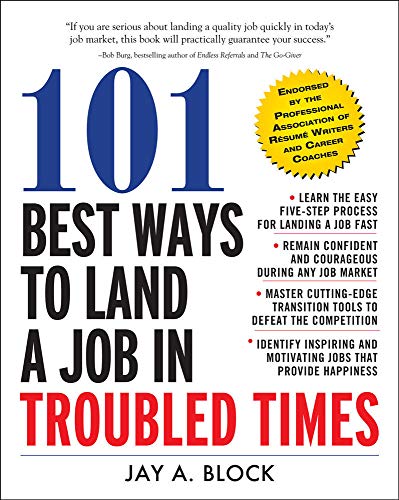
Synopsis
THE PROVEN FIVE-STEP STRATEGY FORFINDING THE JOB OF YOUR DREAMS!
“If you are serious about landing a quality job quickly in today’sjob market, this book will practically guarantee your success.”
–Bob Burg, bestselling author of Endless Referrals and The Go-Giver
“Jay Block has taken his place as one of the career coaching industry’smost innovative thinkers and contributors.”
―Frank X. Fox, Executive Director, Professional Association of Résumé Writers & Career Coaches
“A must-read for all job seekers in today’s highly competitive job market.”
―Sherry Zylka, Associate Dean of Continuing Educationand Workforce Development, Schoolcraft College (Michigan)
“Jay has written a unique and highly effective book combiningmotivational techniques with job search innovation.”
―Susan Leventhal, Manager, Professional Placement Network, Workforce One, Florida
About the Book:
In 101 Best Ways to Land a Job in Troubled Times, Jay Block helps you approach yourjob transition strategically―not as a one-time search, but as a campaign of discovery throughwhich you’ll achieve your career objectives. Follow his easy five-step process to:
- Manage fear and negative emotions that impede success
- Carefully define clear job and career goals
- Create effective and high-impact self- marketing tools that make job seekers STAND OUT professionally
- Develop strategic, structured action plans that will become the job seeker’s GPS to their next job
- Take action and “enjoy the process” of landing a job in troubled times quickly and effectively
Block’s proven method is the only way to truly seize control of your future, land the job you want,and earn the pay you deserve.
"synopsis" may belong to another edition of this title.
About the Author
Jay A. Block is an industry pioneer and one of the nation’s leading executive career andempowerment coaches. He is the author of 15 career and motivational titles, including the classic101 Best Résumés.
Excerpt. © Reprinted by permission. All rights reserved.
101 BEST WAYS TO LAND A JOB IN TROUBLED TIMES
By JAY A. BLOCKThe McGraw-Hill Companies, Inc.
Copyright © 2010 Jay A. Block
All rights reserved.
ISBN: 978-0-07-166328-1All rights reserved.
Contents
| Foreword | |
| Preface | |
| Acknowledgments | |
| Definition of a Job Seeker | |
| Introduction: What You Need to Know Before We Start | |
| Chapter 1: Learning How to Ride the Emotional Roller-Coaster | |
| Chapter 2: Defining Your Goal | |
| Chapter 3: Using Value-Based Résumés and Self-Marketing Tools | |
| Chapter 4: Creating a Meticulous Action Plan | |
| Chapter 5: Taking Action | |
| Author's Final Comment | |
| Index |
Excerpt
CHAPTER 1
LEARNING HOW TO RIDE THE EMOTIONAL ROLLER-COASTER
HOW TO MANAGE FEAR AND EMOTIONS WHEN ADVERSITY AFFECTS YOUR WORLD
Arguably, two of the most painful occurrences in life are the loss of a lovedone and the loss of a job. That being said and given your own situation, whatemotions are you feeling at this moment? Are you stunned, terrified, infuriated?Are you experiencing high anxiety or even bouts of depression? Are you in aplace called "I can't believe this is happening to me" or "this must be a baddream"? These are just some of the emotions experienced by people whose livesare turned upside down when they lose their jobs and find themselves seeking newopportunities in troubled economies and highly competitive job markets.
Regardless of what you are facing, in most cases, worry takes over and emotionsgo uncontrollably berserk. Initial questions will pervade your thoughts: "Will Isurvive this?" "Why did this happen to me?" "What did I do to deserve this?""Will I be able to endure the pain?" "How long will this last?" "Where will themoney come from?" "Will I be able to keep my home?" "How will this affect myquality of life?" "Will I be a burden to my family?" The worst-case scenariotakes center stage in the theater of your mind, and fear plays the starringrole.
Landing a new job in a troubled economy begins when you constructively andproactively manage and control your fears and emotions. Success is born froma fearless constitution. There are two primary components for effectivelymanaging job loss and securing a new job. The first is to assume personalresponsibility and maintain a confident and positive attitude. The second is touse your peak performing state of mind to plan and execute a flawless jobtransition campaign. You must become an educated, determined, and optimisticcampaigner to effectively recover from job loss and land a new job in acompetitive job market. The information contained in this chapter goes farbeyond the idea of positive thinking. You will be introduced to specifictechniques and strategies to inspire you to remain positive and to manage yourfears and emotions no matter what challenges you face. By doing so, you becomean empowered, proactive participant in securing a new opportunity quickly andeffectively.
FIRST, A FEW WORDS ABOUT FEAR
Fear is normal—it can't be eliminated, nor should it be ignored. Fearmust be conquered. It's been shown that experiencing success and landing anew, more rewarding job begins as soon as you learn how to conquer your fear. Infact, if you don't acknowledge your fear, you'll become more at riskpsychologically. Disarming and conquering your fear begins with recognizing itspresence, accepting it, and taking action to manage it. And fear grips not justthose who have lost their jobs, but all those who are part of their circle ofinfluence—spouses, children, parents, and friends.
This chapter contains authoritative information and strategies to motivate andempower everyone involved in the job transition process to effectively deal withfear and its attendant crippling emotions such as guilt, resentment,helplessness, and feelings of being overwhelmed. In the wake of some of life'smost difficult moments, courage and confidence become the conquering heroes.Courage and confidence help you become courageous in the wake of fear,negativity, pessimism, and stress in your efforts to get a new job in troubledeconomies.
John Costello was a sales professional working in his family's business. He wasunable to meet his financial obligations for himself and his son, Francesco, andhe sought a new job. He said: "My emotions were on a constant roller-coasterride. One day I was hopeful that my contacts would help me find a new position.Then anger, fear, and despair took over. I realized I was going to need helpworking through my emotions. And when I learned how to take control of myemotions, I immediately took control of my future in a positive and successfulmanner. I landed the job I wanted in less than two months."
A positive attitude and confident approach to job loss not only makes theassociated traumas and dramas bearable, but will also result in securing a newjob quickly and enjoyably. International job coach Martin Buck-land, JCTC andprincipal of Elite Executive Career Management Services headquartered inOntario, Canada, says, "Controlling negative emotions in a positive way iscritical to any job search campaign. The more out of control you are, the longerthe campaign will take, and you probably won't land the kind of job you reallydeserve. I work as hard with clients on their emotions as I do on theirrésumés."
So as you begin your journey to secure a new opportunity, you must embrace twocritical components:
1. Adopt a healthy and positive outlook about how best to cope with and workthrough your job loss, as well as any of life's other unexpected bumps in theroad.
2. Master the 10 principles of success and the four emotional channelingtechniques I will introduce later in this chapter to help you maintain apositive, healthy state of mind.
YOUR QUALITY OF LIFE IS THE QUALITY OF YOUR EMOTIONS
Your quality of life—and that includes how you feel—is the qualityof your emotions. It's not what you drive, where you live, or what you'reexperiencing that matters; it's how you feel about what you drive, where youlive, or what you're experiencing that makes all the difference. Managing youremotions and moods is about not allowing anyone or anything to determine how youfeel regardless of the challenges you face. You have the ultimate power todetermine how you feel at any given time and in any situation.
There are so many variables that influence how you feel. The irony is that ifyou're like most people, you allow everything and everyone, except you, todetermine what you are feeling. Said differently, you allow externalinfluences to dictate your emotions. Advertisers, television programs, andthe media are external influences. Parents, family members, and friends areexternal influences. Teachers, professors, and spiritual leaders are externalinfluences. Even employment professionals—including job coaches, authors,HR managers, and executive recruiters—are external influences. Most of thetime, you allow other people and other people's expectations to dictate how youfeel. But seldom do you allow yourself to determine how you feel based on yourown conscious thoughts and expectations of yourself. Your reactions and emotionsare a result of subconscious or conditioned beliefs rather than reason andcommon sense. In others words, you simply react in a fear-based, negative mannerto situations, rather than rationally and constructively address and managethem.
Destructive, negative, or fear-based emotions are emotions that hurt you andothers. They are emotions that damage the job transition process and impedeprospects of landing a job! Nothing good can come from something bad ifnegativity and fear drive the emotional process.
If you face your adversities in a courageous and positive manner, you can makethe best of any circumstance. The bottom line is that you have the power tocontrol how you feel at any moment, no matter what the situation. As anexample, two women experience the ultimate pain, the death of a child by a drunkdriver. Both women experience unbearable grief. One woman commits suicide anddestroys her life and the lives of those she leaves behind. The other, CandyLightner, forms MADD (Mothers Against Drunk Driving). What was the difference?The difference was mindset!
"HOW"—THE MISSING LINK
Like a world-class athlete, mindset determines outcome; emotions determinesuccess, or a lack thereof. You can have superior skills, but if you don'tshow up to play emotionally, you'll lose! In most cases, underdogs win notby having superior skills, but by having a bigger heart, a stronger character,and a positive, unstoppable mindset. So when job loss and career issues createsituations and events that require you to be at your emotional best, how do youdo it? In other words, when well-meaning people tell you to "think positive" inthe midst of crisis and chaos, how do you do this? Or better yet, how do youalter your emotions so that you actually benefit from the predicament you face?You're challenged to take the "high road" when you lose a job. You're advised toturn adversity into opportunity and to make the best of a bad situation. Butonce again, the question is, how do you accomplish this? The material in thischapter will teach you how. But before we delve into the how, you must know "TheFive Musts" for changing your state of mind to quickly and successfully land thejob you want at the pay you deserve in a troubled economy with highunemployment.
1. You must want to change. You must make the decision to change andhave a deep-rooted desire to be in total command of your emotional state at alltimes.
2. You must be committed to change. Commitment means you'll pay anyprice to attain your goals. Commitment means that quitting is not an option andthat you'll be relentless in pursuit of your objectives.
3. You must employ massive discipline in order to change. Disciplinemeans doing what you don't want to do in pursuit of what you want to achieve.Discipline means being aware of how you feel—and knowing your emotions arenot productive. Discipline means mastering just a few of the techniques thatwill be introduced in this chapter so you remain cool and calm and in emotionalcontrol to achieve your job goals.
4. You must embrace discomfort to ensure change. Here's one of the moreprofound statements I'll make in this chapter: discomfort cures"disease." Physical therapy might be uncomfortable, but it will cure thedisease of a possible relapse or prolonged recovery. And networking andinvesting more time and energy in attaining a new job might be discomforting atfirst, but it will cure the dis-ease of continued unemployment. Discomfort is agift. It's complacency and procrastination that induce poverty of the mind andatrophy of the spirit and rob you of any chance of landing a job, especially ina troubled economy. Complacency impairs any chance of success, whereasdiscomfort opens many new doors of opportunity.
5. You must condition yourself to learn new techniques to achieve lastingchange. Once you've learned the disciplines of managing your emotions andapproach your job and career challenges with a fearless constitution, you mustcondition yourself to master the techniques so they become second nature.Consistent repetition of new concepts and ideas is a success strategy. If youstart to walk an hour a day to improve your health and increase your energy soyou can work harder and smarter at landing a new job, you must condition thisactivity so it becomes routine. If you send out 15 résumés, contact five peoplein your network, and spend three hours online every day to secure a new job,this activity must become habitual so you give yourself a clear advantage overother qualified candidates in securing the best opportunities that await you.
THE 10 PRINCIPLES FOR SUCCESS
Before I introduce you to four powerful emotional channeling techniques,techniques that will enable you to remain upbeat, positive, and optimisticduring difficult times, I want to first teach you the 10 principles forsuccessfully obtaining a new job in troubled economies. These principles are notnew; in fact they're old. I believe that the list of 10 principles that I haveassembled represents the critical philosophies and strategies for winning a newjob. Once you have a clear understanding of these 10 principles and embracethem, the emotional channeling techniques presented later in this chapter willwork more effectively and at lightning speed to produce a courageousconstitution that will result in a new and rewarding job!
And I need to point out here that you can't simply pick and choose which of the10 principles you like and which you'd like to ignore. All 10 must bemastered with equal passion. Landing a job in a competitive job marketrequires that you become proficient with all 10 principles.
Principle #1: Personal Responsibility: If It's Going to Be, It's Up toMe
The two major causes of underachievement are blame and excuses. Sadly, fewpeople seem willing to take personal responsibility these days. Takingresponsibility means accepting any type of wind that might blow, knowing thatit's not the wind, but rather the set of the sail that makes the differencebetween unemployment and gainful employment, between remaining in a stressfuljob and securing the perfect job. Taking responsibility means that if it'sgoing to be, it's up to me and no one else! Responsibility means going theextra mile with a smile, knowing that going the extra mile is the bestinvestment you can make in yourself and your future. Taking personalresponsibility means not taking the path of least resistance even thoughit's a seductive option, but paying any price needed to succeed.
Responsibility means being a proactive and supportive resource in your own jobtransition campaign. You have a choice. You can spend 95 percent of your timeand energy on the problem, blaming, finding excuses, and griping that the worldis unfair. Or you can take personal responsibility and invest 95 percent of yourtime and energy on the solution, pursuing your career objectives with passionand confidence, knowing only you can stand in the way of your own success.
Principle #2: Desire: Nothing Happens without First a Dream
Purpose is everything. Being "on purpose" means you're willing to commit to yourdreams, desires, job, and career goals. Commitment means that you'll never giveup on your quest for a better life, no matter what obstacles stand in your way,because you're driven to succeed. As long as the flame of desire burns deepwithin you, you'll achieve whatever it is you want to achieve, because allnew job opportunities are born from a burning desire. A burning desirecreates inner drive, and when you're driven to land a new and exciting job, allsorts of opportunities will present themselves. It's true that whatever yourmind can conceive and believe, you can achieve. Believe in yourself and yourgoals. When the purpose is clear and when you're driven to pursue and secure abetter job, you will.
Principle #3: Faith: Where There's a Will, There's a Way
Faith is that ethereal power of knowing that miracles are born from obscuritywhen you believe. Faith is a belief, or a feeling of certainty, that somethinggood can be created even though it has yet to be determined when or how it willoccur. The expression "I'll believe it when I see it" is actually not thesuccess formula for landing a new position. The formula that will help you get ajob in a troubled job market is the opposite: "I'll see it when I first believeit." You first have to believe you can secure your next job; then you will.
Faith can be the belief that a higher power will help be a catalyst for themanifestation of your career goals. Or faith can be the unconditional beliefthat you have the power to achieve your mission. In any case, faith is thatintangible, positive energy needed to land a job in a troubled job market. Thehow hasn't arrived in your mind yet, but you have faith that it will. Faithmeans that you are certain that you will secure a new job because you know thatanything is possible if you truly believe it is.
Principle #4: A "Healthy" Character: Success Achievement Is NotAttracted by an Unhealthy Constitution
A healthy character means developing a positive outlook on life no matter whatserious situation you're facing. Well-respected basketball coach John Woodensaid, "Be more concerned about your character than your reputation. Yourreputation is how others perceive you; your character is who you really are."Character means having a healthy, positive attitude in the wake of job loss orany life challenge. Clement Stone said, "There is little difference in people,but that little difference makes a big difference. The little difference isattitude. The big difference is whether it is positive or negative." ThomasJefferson said, "Nothing can stop a person with the right mental attitude fromachieving his goal; but nothing on earth can help the person with the wrongmental attitude."
A healthy character means having the ability to use the right, honest,constructive thought, action, or reaction with any person, situation, or set ofcircumstances. It allows you to build on hope to overcome the feeling of despairand discouragement. A healthy character gives you the mental power, a feeling ofconfidence and positive expectation, to achieve anything at any time no matterwhat obstacles you face. Anyone can maintain a good attitude when things aregoing well. It's when the going gets tough that a healthy character inspires thetough to get going. One of the best methods for developing a healthycharacter is to appreciate all that you presently have. Most people tend tofocus on what they don't have rather than on the many gifts they actuallypossess. A healthy character comes from a sincere appreciation for all that youhave today in pursuit of all that you want tomorrow.
Principle #5: Discipline: Without Discipline, Nothing IsPossible
Discipline is the bridge between employment and unemployment, betweenunderemployment and meaningful employment. Discipline means doing thosethings that others aren't willing to do and hanging in there long after everyoneelse has let go. Discipline is the foundation upon which all success isattained. An abundance of discipline leads to an abundance of job offers! Inreality, you have one of two life-changing choices to make: to employ disciplinetoday to achieve your job objectives or neglect to employ discipline at theexpense of your goals.
Discipline leads to reward. Neglect leads to regret. The great Vince Lombardisaid, "Discipline and mental toughness are many things and rather difficult toexplain. Its qualities are sacrifice and self-denial, and most importantly, it'scombined with a perfectly disciplined will that refuses to give in."
The key is to choose discipline over "easy." You don't get to the World Seriesor the Olympics by easy, and you don't become a successful sales professional,nurse, administrative assistant, or CEO by easy. There is no "easy button" forlanding a job in a troubled economy with high rates of unemployment. You getthere through discipline.
(Continues...)
(Continues...)
Excerpted from 101 BEST WAYS TO LAND A JOB IN TROUBLED TIMES by JAY A. BLOCK. Copyright © 2010 by Jay A. Block. Excerpted by permission of The McGraw-Hill Companies, Inc..
All rights reserved. No part of this excerpt may be reproduced or reprinted without permission in writing from the publisher.
Excerpts are provided by Dial-A-Book Inc. solely for the personal use of visitors to this web site.
"About this title" may belong to another edition of this title.
Search results for 101 Best Ways to Land a Job in Troubled Times

Stock Image
101 Best Ways to Land a Job in Troubled Times
Seller: Wonder Book, Frederick, MD, U.S.A.
Seller rating 5 out of 5 stars

Condition: Very Good. Very Good condition. A copy that may have a few cosmetic defects. May also contain light spine creasing or a few markings such as an owner's name, short gifter's inscription or light stamp. Seller Inventory # U13B-05336
Stock Image
101 Best Ways to Land a Job in Troubled Times
Published by
McGraw-Hill Education - Europe, 2010
ISBN 10: 0071663282
ISBN 13: 9780071663281
Used
Paperback
Seller: World of Books (was SecondSale), Montgomery, IL, U.S.A.
Seller rating 5 out of 5 stars
Paperback. Condition: Fair. The bestselling career guru offers sure-fire tactics for any job market. Seller Inventory # 00099855073
Stock Image
101 Best Ways to Land a Job in Troubled Times
Published by
McGraw-Hill Education - Europe, 2010
ISBN 10: 0071663282
ISBN 13: 9780071663281
Used
Paperback
Seller: World of Books (was SecondSale), Montgomery, IL, U.S.A.
Seller rating 5 out of 5 stars
Paperback. Condition: Good. The bestselling career guru offers sure-fire tactics for any job market. Seller Inventory # 00101839041
Stock Image
101 Best Ways to Land a Job in Troubled Times
Published by
McGraw-Hill Education, 2009
ISBN 10: 0071663282
ISBN 13: 9780071663281
Used
Softcover
First Edition
Seller: Better World Books, Mishawaka, IN, U.S.A.
Seller rating 5 out of 5 stars
Condition: Very Good. 1st Edition. Pages intact with possible writing/highlighting. Binding strong with minor wear. Dust jackets/supplements may not be included. Stock photo provided. Product includes identifying sticker. Better World Books: Buy Books. Do Good. Seller Inventory # 38430970-6
Stock Image
101 Best Ways to Land a Job in Troubled Times
Published by
McGraw-Hill Education - Europe, 2010
ISBN 10: 0071663282
ISBN 13: 9780071663281
Used
Paperback
Seller: World of Books Inc, Montgomery, IL, U.S.A.
Seller rating 4 out of 5 stars

Paperback. Condition: Fair. The bestselling career guru offers sure-fire tactics for any job market. Seller Inventory # CIN0071663282A
Stock Image
101 Best Ways to Land a Job in Troubled Times
Published by
McGraw-Hill Education - Europe, 2010
ISBN 10: 0071663282
ISBN 13: 9780071663281
Used
Paperback
Seller: World of Books Inc, Montgomery, IL, U.S.A.
Seller rating 4 out of 5 stars
Paperback. Condition: Good. The bestselling career guru offers sure-fire tactics for any job market. Seller Inventory # CIN0071663282G
Stock Image
101 Best Ways to Land a Job in Troubled Times
Seller: ThriftBooks-Atlanta, AUSTELL, GA, U.S.A.
Seller rating 5 out of 5 stars
Paperback. Condition: Very Good. No Jacket. May have limited writing in cover pages. Pages are unmarked. ~ ThriftBooks: Read More, Spend Less. Seller Inventory # G0071663282I4N00
Stock Image
101 Best Ways to Land a Job in Troubled Times
Seller: suffolkbooks, Center moriches, NY, U.S.A.
Seller rating 5 out of 5 stars
paperback. Condition: Very Good. Fast Shipping - Safe and Secure 7 days a week! Seller Inventory # 3TWDDA004T32
Stock Image
101 Best Ways to Land a Job in Troubled Times
Seller: Revaluation Books, Exeter, United Kingdom
Seller rating 5 out of 5 stars
Paperback. Condition: Brand New. 1st edition. 208 pages. 9.30x7.40x0.53 inches. In Stock. Seller Inventory # zk0071663282
Buy New
US$ 29.73
US$ 13.24 shipping
Ships from United Kingdom to U.S.A.
Ships from United Kingdom to U.S.A.
Quantity: 1 available
Stock Image
101 Best Ways to Land a Job in Troubled Times
Seller: BennettBooksLtd, Los Angeles, CA, U.S.A.
Seller rating 5 out of 5 stars
paperback. Condition: New. In shrink wrap. Looks like an interesting title! Seller Inventory # Q-0071663282