
Items related to The Complete New Manager
Synopsis
Tackle every management challengewith skill and confidence!
Managers are faced with a variety of challenges every day. There are decisionsto make, conflicts to resolve, and strategies to implement, among many otherresponsibilities. As a new manager you need to build the skills necessary fortackling problems head-on.
The Complete New Manager is a valuable toolkit that helps you meet day-to-day challenges quickly and effectively. Filled with tips, techniques, andproven advice from renowned experts, The Complete New Manager teachesyou how to:
- Become a dynamic leader who instills confidencein both employees and upper management
- Hire the right people and cultivate an environmentthat makes them want to stay
- Develop and encourage free-flowing, two-waycommunication with your staff
- Use proven techniques to deal withdifficult people and problem employees
- Successfully plan and implement businessstrategies large and small
- Produce sustained, positive results thatimpress your bosses
The key to successful management is the ability to meet challenges as theyarise. Here, in one volume, is everything you need to bolster your on-the-jobskills and reach the highest levels of success.
"synopsis" may belong to another edition of this title.
About the Author
John H. Zenger, D.B.A., is the CEO and cofounder of Zenger/Folkman, a firm that employs evidence-based, positive methods to strengthen organizations and those who lead them. In 1994 he was inducted into the Human Resource Development Hall of Fame. He is the author or co-author of seven books on leadership and teams.
Excerpt. © Reprinted by permission. All rights reserved.
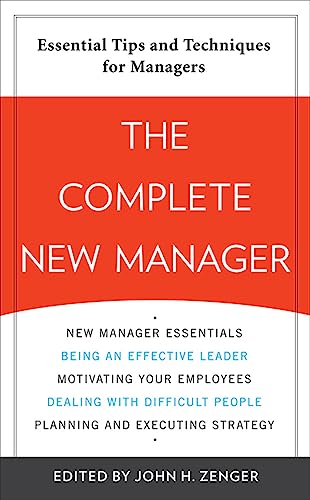
THE COMPLETE NEW MANAGER
Essential Tips and Techniques for Managers
By JOHN H. ZENGERThe McGraw-Hill Companies, Inc.
Copyright © 2007 The McGraw-Hill Companies, Inc.
All rights reserved.
ISBN: 978-0-07-174447-8All rights reserved.
Contents
| PART 1 NEW MANAGER ESSENTIALS | |
| 1 Give Feedback | |
| 2 Make the Best of Bad News | |
| 3 Delegate | |
| 4 Pick the Brains of Departing Workers | |
| 5 Review Performance Regularly | |
| 6 Decide and Deliver | |
| 7 Use "Praise Motivation" | |
| 8 Plan Your Meetings | |
| 9 Think Strategically | |
| 10 Build Alliances | |
| 11 Give Great Instructions | |
| 12 Get Feedback | |
| 13 Speak with Power | |
| 14 Win Over Cynics | |
| 15 Prepare for Change | |
| 16 Muzzle Your Mouth | |
| 17 Pose Penetrating Questions | |
| 18 Lift Poor and Mediocre Performers | |
| 19 Criticize Without Criticism | |
| 20 Beat the Clock | |
| 21 Impress Your Boss | |
| 22 Mix and Mingle | |
| PART 2 BEING AN EFFECTIVE LEADER | |
| 23 Leaders Can Be Made | |
| 24 Raise the Leadership "Tent" | |
| 25 Character Is the Essence of Leadership | |
| 26 Develop Personal Capability | |
| 27 Focus on Results | |
| 28 Cultivate Interpersonal Skills | |
| 29 Lead Organizational Change | |
| 30 Find Your Leadership "Sweet Spot" | |
| 31 Focus on Building Strengths | |
| 32 Concentrate on Developing Three to Five Strengths | |
| 33 Let the Halo Effect Work for You | |
| 34 Fix Fatal Flaws | |
| 35 Look for Powerful Combinations of Competencies | |
| 36 Learn from Mistakes | |
| 37 Build Positive Relationships | |
| 38 Be Open to New Ideas | |
| 39 Be Accountable | |
| 40 Take Initiative | |
| 41 Learn from Feedback | |
| 42 Take a Nonlinear Approach | |
| 43 Take Steps to Improve Leadership Skills | |
| 44 Develop Your People | |
| PART 3 MOTIVATING YOUR EMPLOYEES | |
| 45 Build a Motivated Workforce | |
| 46 Know What Drives People | |
| 47 Make Employees Feel Like Partners | |
| 48 Show Employees How the Business Operates | |
| 49 Know the Competition | |
| 50 Encourage Intelligent Risk-Taking | |
| 51 Inspire Creative and Innovative Thinking | |
| 52 Affirm the Link Between Motivation and Performance | |
| 53 Help Employees Achieve Greater Performance | |
| 54 Get Employees to Buy Into Your Ideas—and Theirs | |
| 55 Be Clear—and Consistent—About Rewards and Recognition | |
| 56 Always Expect the Best from Employees | |
| 57 Fire Up Successful Performance | |
| 58 Offer Incentives and Morale Boosters | |
| 59 Give Your Power Away | |
| 60 Encourage Accountability at All Times | |
| 61 Build Trust for a Better Tomorrow | |
| 62 Boost Morale | |
| 63 Make It Fun to Make It Motivating | |
| 64 Attack De-Motivators Head-On | |
| 65 Put Heart and Soul into Your Team | |
| 66 Unleash the Power of Human Potential | |
| 67 Retain Your Employees | |
| PART 4 DEALING WITH DIFFICULT PEOPLE | |
| 68 Recognize the 10 Most Unwanted Behaviors | |
| 69 Choose Your Approach | |
| 70 Understand the Four Intents | |
| 71 Understand the First Intent: Get It Done | |
| 72 Understand the Second Intent: Get It Right | |
| 73 Understand the Third Intent: Get Along | |
| 74 Understand the Fourth Intent: Get Appreciated | |
| 75 Recognize the Results of Threatened Intents | |
| 76 Reduce Differences | |
| 77 Listen to Understand | |
| 78 Reach a Deeper Understanding | |
| 79 Speak to Be Understood | |
| 80 Project and Expect the Best | |
| 81 Bring Out the Best in the Tank | |
| 82 Bring Out the Best in the Sniper | |
| 83 Bring Out the Best in the Know-It-All | |
| 84 Bring Out the Best in the Think-They-Know-It-All | |
| 85 Bring Out the Best in the Grenade | |
| 86 Bring Out the Best in the Yes Person | |
| 87 Bring Out the Best in the Maybe Person | |
| 88 Bring Out the Best in the Nothing Person | |
| 89 Bring Out the Best in the No Person | |
| 90 Bring Out the Best in the Whiner | |
| 91 Take Action Steps | |
| PART 5 PLANNING AND EXECUTING STRATEGY | |
| 92 Manage Strategically | |
| 93 Follow the Logic | |
| 94 Assess Your Company's Readiness | |
| 95 Plan to Plan | |
| 96 Define Your Businesses | |
| 97 Understand Your Model | |
| 98 Know Your Market | |
| 99 Assess the Terrain | |
| 100 Understand Opportunities and Threats | |
| 101 Set Feasible Goals | |
| 102 Strategize | |
| 103 Set Priorities | |
| 104 Pursue Your Purpose | |
| 105 Follow Your Mission | |
| 106 Write the Annual Plan | |
| 107 Obtain Commitment | |
| 108 Align with Strategy | |
| 109 Work Across Functions | |
| 110 Execute with Discipline | |
| 111 Monitor and Improve | |
| 112 Learn, Change, and Institutionalize | |
| Index |
Excerpt
CHAPTER 1
Give Feedback
Part of your job as a new manager is to give helpful feedback to employees. Butit doesn't stop there.
The feedback process isn't over when you reel off what you think the employeeshould do to improve performance. It ends when the worker understands your inputand applies it successfully.
Most managers dislike giving negative feedback. They may fear that workers willperceive their well-intentioned comments as personal criticism. And because it'scommon for rookie managers to want to be liked by their troops, they may shyaway from pointing out work-related defects or concerns about an individual'seffort or attitude.
Get over it!
Effective managers must give feedback every day. It can range from glowingpraise to neutral observation to serious alarm. Ideally, positive input shouldfar outweigh everything else. Employees crave compliments from theirsupervisor—they remember them, treasure them, and share them with friendsand family.
Look for opportunities to point out what workers are doing right. Don't feel youmust ration praise only for rare flashes of brilliance or exceptional results.Letting people know that you admire how they handle a customer, organize theirworkspace, or analyze a problem is in itself a form of feedback that strengthensyour relationship with your team.
When your goal is to provide constructive feedback that helps employees improve,set the stage. Get a two-way conversation going. Discuss the high standards youset for yourself and your crew—and find out what the worker thinks ofthese standards. That's better than coming right out and saying, "Here'ssomething you're doing wrong that you need to work on ..."
Remember that almost all workers thirst for input. One of the employees' biggestcomplaints is "I don't get enough feedback from my boss." Remove the mystery.Freely share your ideas, suggestions, and reservations. Make individuals awareof their performance and guide them to improve.
Use this three-step method to deliver feedback that sinks in:
Invite employees to evaluate their performance: Let them rate aspecific aspect of their work based on, say, a 1-to-10 scale or an A-to-F lettergrade. Many people judge themselves more harshly than you would. Even if theyinflate their rating, it gives you a baseline to respond with your input.
Ask follow-up questions: Dig for more information. Get employeesto share details or examples that justify their self-rating. Notice whatcriteria they use to evaluate themselves and how they track their performance.
Align your analysis with their comments: Now that you've givenemployees a chance to chime in, it's your turn. Begin by thanking them forexplaining how they view their performance. Then add, "I'd like to piggyback onwhat you've said." Start by giving feedback that they missed. Then endorsepositive input that you heard earlier (as long as you agree) and add some freshpraise so you end on a high note.
"The good ones among managers ... do not talk to their subordinates abouttheir problems, but they know how to make the subordinates talk about theirs."
—Peter Drucker
CHAPTER 2
Make the Best of Bad News
The way you express bad news will make or break your credibility as a manager.If you level with employees, you show that you're a no-nonsense leader whoprizes clear communication. But if you talk around the issue, others may followyour example and avoid addressing problems that need attention.
Prepare to deliver bad news. Decide in advance what you want to accomplish byspeaking up. Do you want to spur your employees to take action or simply raisetheir awareness? Is there an upside to the situation and, if so, should youemphasize it? Do you want to discuss the evolution of the problem or limit yourcomments to the here and now?
Maintain your perspective. New managers sometimes blow bad news out ofproportion by "awfulizing" it to the point where it takes on a life all its own.Realize that setbacks come with the territory; take them in stride and conveybad news to others so they, too, see the situation accurately rather than asArmageddon.
Watch your tone and mannerisms. Speak in succinct, straightforward terms. Givethe facts without editorializing. For example, skip phrases such as "I hate totell you this" or "This is the part of my job I dread most" and jump right tothe point.
Don't sigh, shrug, and repeatedly shake your head in dismay. Imagine you'reWalter Cronkite reporting the news with an undercurrent of strength andperseverance in your voice. If you start flinching or feeling too overwroughtabout it, your employees may focus more on your pained demeanor than the newsitself.
End on an upbeat note. Set a goal for future improvement or present a strategythat addresses the source of the problem. Left to fester, bad news can hurtmorale. Dangle hope or offer solutions to boost employees' attitudes.
Here are three techniques to make bad news more palatable:
Display "ego strength": Show that your ego isn't threatened bythe bad news. Use nondefensive language such as, "I take responsibility forcontributing to this state of affairs, and I take responsibility for leading usout of this." As a new manager, you can say, "I'm learning every day, so I wantyou to know what I've learned."
Set the context: Tie a specific piece of bad news to largerorganizational goals. Say, "This adds to our challenge, but we can overcome it."
Get to the point: Stay on track and don't waste words. State themost important news up front. Then add facts, evidence, or other supportinginformation.
"Communicate everything you possibly can to your partners. The more theyunderstand, the more they'll care. Once they care, there's no stopping them."
—Sam Walton
CHAPTER 3
Delegate
Effective managers must have faith—in their people. Your success dependson your willingness to rely on employees to take initiative, solve problems, andproduce results.
You've surely heard the advice: delegate when possible. But it's not thatsimple. If you do it the wrong way, delegation can backfire.
Andrew Carnegie said, "The secret of success is not in doing your own work butin recognizing the right man to do it." Delegation thus takes fore-thought.Match the right employee with a challenging assignment.
Consider an individual's interests, strengths, andexpertise—and hand off tasks to employees who rate highly in atleast two of those three categories. If you want someone to research and respondto customer complaints, for instance, delegate the project to an employee whoenjoys serving customers, possesses excellent people skills, and knows how toinvestigate problems and dig for answers.
By delegating, you improve your efficiency. You can focus on high-priorityissues and not get bogged down in work that depletes your time and energy. Atthe same time, you can develop your employees and make them more valuablecontributors.
Don't confuse delegation with assigning routine work to employees that fallswithin their normal job duties. True delegation involves giving someone theresponsibility and authority to do something that's normally part ofyour job.
Delegation is not "dumping." If employees think you're tossing the leastdesirable assignments on their lap, they'll resent it.
Set up controls and checkpoints to monitor your employees' progress. Discuss howyou can both evaluate progress and measure a project's success.
Define clear goals and expectations for the assignment. But don't explain how todo it. Let others discover for themselves how to follow through.
New managers often assume that once they delegate, they're no longer accountablefor the results. But handing over responsibility and authority to employees hasits limits. Ultimate accountability remains with you—whether you realizeit or not.
Rookie managers sometimes fall into the trap of taking an assignment backunwittingly. They might say, "Here, let me show you," and they wind up doing thewhole project. Avoid this by letting employees problem-solve for themselves.
Follow these pointers to delegate well:
Step back: Select tasks that employees can control and implementon their own. Make sure the individual can exercise judgment and autonomy. Ifyou micromanage, delegating does more harm than good.
Clarify the assignment: Confirm that employees understand thepurpose, the goal, and the performance measures you'll use to judge success.Remove ambiguities and set a clear deadline.
Run an "I'm not here" test: Identify key aspects of yourjob—and decide who could handle those responsibilities in your absence. Byanticipating what you want employees to do when you're not there, you candelegate pieces of your managerial duties to them now so they're ready to stepin later.
"Strange as it sounds, great leaders gain authority by giving it away."
—James B. Stockdale
CHAPTER 4
Pick the Brains of Departing Workers
When an employee quits, you have a golden opportunity to learn how to do yourjob better. How? On or just before the worker's last day, schedule an exitinterview.
People on the way out the door often speak freely about how they—and theircoworkers—view management. All you have to do is ask smart questions andlisten.
Invite departing employees to give their opinions about what you and yourorganization do right and wrong. Take notes. Show interest in their observationsand follow up.
Most employees, even embittered ones, will remain civil while sharinginformation and insights that make you a stronger, wiser manager. Once they seeyou're eager to pick their brains, they'll usually open up.
Don't assume departing employees will use the exit interview to settle scoreswith colleagues, unleash their pent-up anger at company policies, or lecture youabout misguided change campaigns or management screwups. Asking neutralquestions helps. "Can you describe the level of teamwork you've experienced?" isbetter than "Are you disappointed in our teamwork?"
Assure employees of confidentiality. Explain that you value their input and youwant them to raise honest concerns.
Exit interviews can help you identify reasons for high turnover or poor morale,expose poor working conditions, and gain ideas that sharpen how you manage.Longtime workers can reflect on their years at your organization, pointing outpros and cons of various policies, procedures, or personnel. They may know whatworks and what doesn't—and who are the unsung heroes in your unit. An exitinterview is one of the only ways for new managers to gather such valuableinsight.
Better yet, your genuine interest in the departing employee's views can leave alasting positive impression. The individual may come away feeling better aboutyou, and this can work in your favor later. Cultivating allies outside yourorganization helps you build a valuable network.
To squeeze the most knowledge from departing workers:
Lay the groundwork: Let employees know in advance what you'regoing to ask. Emphasize that you treat their opinions seriously and you hopethey'll give considerable thought to the issues before the interview.
Separate tangibles from intangibles: Ask two sets of questions.First, focus on fact-finding (example: "Did you have the tools and resources youneeded to do the job?"). Then shift to less concrete, hard-to-measure areas suchas morale and camaraderie (example: "How would you rate the work ethic of yourteam?").
Request names: Collect referrals for new hires, vendors, andconsultants. Probe to find the names of the individuals your departing employeesrespect most both inside and outside your organization. Discuss yourhiring needs and invite the employee to stay in touch and refer top candidatesto you in the weeks and months ahead.
"Most of the successful people I've known are the ones who do more listeningthan talking."
—Bernard Baruch
CHAPTER 5
Review Performance Regularly
Most employees hunger for information on how they're doing. They want a boss whoadministers regular performance reviews—and provides a thorough,thoughtful evaluation that's constructive and well supported.
Many new managers dread performance appraisals, especially when meeting withemployees with poor or inconsistent performance. What's worse, the reviewprocess in many organizations is a burdensome administrative task that requiresreams of paperwork.
Formal performance reviews become easier if you informally update employeesabout the quality of their work throughout the year. If they know on any givenday what they do well and what they need to improve, then there will be fewsurprises during your regularly scheduled appraisals.
Balance strengths and weaknesses when reviewing someone's performance. Don't gooverboard in either direction. If you dwell on employees' defects, you mayoverlook what they do well and deaden their spirit. But nonstop gushing can leadworkers to conclude they can do no wrong in your eyes. Aim for at least a 3-to-1ratio of pointing out what's right and what's wrong about an individual'sperformance.
Stick to the facts. Describe performance based on what you've seen firsthand orsolid evidence you've collected. Give dates and times to substantiate yourobservations. Avoid labels like "careless" or "sloppy." Instead, cite concretereasons why you perceive someone this way. One of the hardest lessonsfor new managers to learn when reviewing employees' performance is to allow theworkers to judge for themselves how they're doing—after citing specificexamples of their actions.
Strive for accuracy. Unseasoned managers tend to gloss over employees'performance problems by rating individuals as "fine" or "above average" in allcategories without much thought. That's risky. If a worker's performancedeclines to the point where termination becomes an issue, you may lack thedocumentation you need to prove that person's performance was already shaky atthe last performance appraisal.
Here's how to capitalize on performance reviews:
Stick to a schedule: Employees are counting the days until theirnext review, so honor your commitments. Whether you promise appraisalsquarterly, semiannually, or annually, follow through. If you postpone reviews orforce employees to nag you because you forgot, you'll kill morale.
Use the DISC formula: DISC stands for "describe impact, specifyconsequences." When you assess performance, describe the specific behavior,discuss its impact, specify what you want to happen, and explain theconsequences—both good and bad—based on the employee's response.
Suggest, don't threaten: Make sure your goal in reviewingsomeone's performance is to impart knowledge that allows the person to improve.Rather than insist that a receptionist's curt demeanor must stop, focus on howmuch there is to gain by adopting a more genial manner.
"It's only as we develop others that we permanently succeed."
—Harvey S. Firestone
(Continues...)
(Continues...)
Excerpted from THE COMPLETE NEW MANAGER by JOHN H. ZENGER. Copyright © 2007 by The McGraw-Hill Companies, Inc.. Excerpted by permission of The McGraw-Hill Companies, Inc..
All rights reserved. No part of this excerpt may be reproduced or reprinted without permission in writing from the publisher.
Excerpts are provided by Dial-A-Book Inc. solely for the personal use of visitors to this web site.
"About this title" may belong to another edition of this title.
Search results for The Complete New Manager

Stock Image
The Complete New Manager
Seller: World of Books (was SecondSale), Montgomery, IL, U.S.A.
Seller rating 5 out of 5 stars

Condition: Very Good. Item in very good condition! Textbooks may not include supplemental items i.e. CDs, access codes etc. Seller Inventory # 00103326110
Seller Image
The Complete New Manager
Seller: Zoom Books East, Glendale Heights, IL, U.S.A.
Seller rating 5 out of 5 stars
Condition: very_good. Book is in very good condition and may include minimal underlining highlighting. The book can also include "From the library of" labels. May not contain miscellaneous items toys, dvds, etc. . We offer 100% money back guarantee and 24 7 customer service. Seller Inventory # ZEV.0071744479.VG
Stock Image
The Complete New Manager
Published by
McGraw-Hill Education, 2010
ISBN 10: 0071744479
ISBN 13: 9780071744478
Used
Softcover
First Edition
Seller: Better World Books, Mishawaka, IN, U.S.A.
Seller rating 5 out of 5 stars
Condition: Very Good. 1st Edition. Former library copy. Pages intact with possible writing/highlighting. Binding strong with minor wear. Dust jackets/supplements may not be included. Includes library markings. Stock photo provided. Product includes identifying sticker. Better World Books: Buy Books. Do Good. Seller Inventory # 5043584-6
Stock Image
The Complete New Manager
Published by
McGraw-Hill Education, 2010
ISBN 10: 0071744479
ISBN 13: 9780071744478
Used
Softcover
First Edition
Seller: Better World Books: West, Reno, NV, U.S.A.
Seller rating 5 out of 5 stars
Condition: Good. 1st Edition. Pages intact with minimal writing/highlighting. The binding may be loose and creased. Dust jackets/supplements are not included. Stock photo provided. Product includes identifying sticker. Better World Books: Buy Books. Do Good. Seller Inventory # 9057845-6
Stock Image
The Complete New Manager
Published by
McGraw-Hill Education - Europe, 2010
ISBN 10: 0071744479
ISBN 13: 9780071744478
Used
Paperback
Seller: World of Books Inc, Montgomery, IL, U.S.A.
Seller rating 4 out of 5 stars

Paperback. Condition: Very Good. Available for the first time in one complete toolkit--the five most important topics for new managers from the popular Mighty Manager series. This book is the ultimate resource for new managers and the newly promoted alike. Seller Inventory # CIN0071744479VG
Stock Image
The Complete New Manager
Seller: ThriftBooks-Atlanta, AUSTELL, GA, U.S.A.
Seller rating 5 out of 5 stars
Paperback. Condition: Very Good. No Jacket. May have limited writing in cover pages. Pages are unmarked. ~ ThriftBooks: Read More, Spend Less. Seller Inventory # G0071744479I4N00
Seller Image
The Complete New Manager: Essential Tips and Techniques for Managers (BUSINESS SKILLS AND DEVELOPMENT)
Seller: WeBuyBooks, Rossendale, LANCS, United Kingdom
Seller rating 5 out of 5 stars
paperback. Condition: Good. Most items will be dispatched the same or the next working day. A copy that has been read but remains in clean condition. All of the pages are intact and the cover is intact and the spine may show signs of wear. The book may have minor markings which are not specifically mentioned. Ex library copy with usual stamps & stickers. Seller Inventory # rev3405249385
Buy Used
US$ 5.57
US$ 8.77 shipping
Ships from United Kingdom to U.S.A.
Ships from United Kingdom to U.S.A.
Quantity: 1 available
Stock Image
The Complete New Manager: Essential Tips and Techniques for Managers
Seller: Anybook.com, Lincoln, United Kingdom
Seller rating 5 out of 5 stars
Condition: Fair. This is an ex-library book and may have the usual library/used-book markings inside.This book has soft covers. In fair condition, suitable as a study copy. Please note the Image in this listing is a stock photo and may not match the covers of the actual item,600grams, ISBN:9780071744478. Seller Inventory # 9034208
Buy Used
US$ 3.41
US$ 17.26 shipping
Ships from United Kingdom to U.S.A.
Ships from United Kingdom to U.S.A.
Quantity: 1 available
Stock Image
The Complete New Manager (BUSINESS SKILLS AND DEVELOPMENT)
Seller: Devils in the Detail Ltd, Oxford, United Kingdom
Seller rating 5 out of 5 stars
Condition: New. Picture Shown is For Illustration Purposes Only, Please See Below For Further DetailsCONDITION ? NEW. Seller Inventory # 342/PP/485P 478
Buy New
US$ 3.41
US$ 21.16 shipping
Ships from United Kingdom to U.S.A.
Ships from United Kingdom to U.S.A.
Quantity: 2 available
Stock Image
The Complete New Manager: Essential Tips and Techniques for Managers
Seller: Revaluation Books, Exeter, United Kingdom
Seller rating 5 out of 5 stars
Paperback. Condition: Brand New. 1st edition. 480 pages. 8.00x5.00x1.12 inches. In Stock. Seller Inventory # zk0071744479
Buy New
US$ 36.32
US$ 13.23 shipping
Ships from United Kingdom to U.S.A.
Ships from United Kingdom to U.S.A.
Quantity: 1 available