
Items related to Building Team Power: How to Unleash the Collaborative...
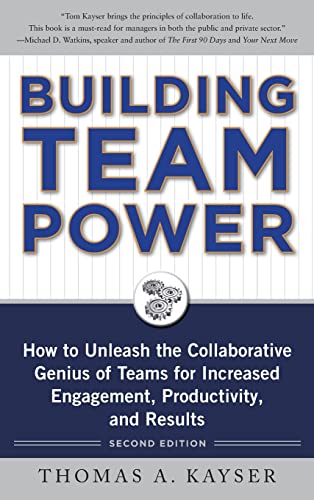
Building Team Power: How to Unleash the Collaborative Genius of Teams for Increased Engagement, Productivity, and Results - Hardcover
Synopsis
Building Team Power is a hands-on, how-to book. It is a roll-up-your-sleeves-and-get-your-hands-dirty book. It is applications oriented all the way. Don't look for complex psychological, sociological or academic group theory models here. You won't find any. Building Team Power extends and expands the reach of my well-received Mining Group Gold book. This one digs into the crucial behaviors you need to understand and practice to be a collaborative leader. It takes you into the "how-tos" for building collaborative partnerships and facilitating teamwork within your own work group, across work groups, or in task forces, committees, problem-solving teams, executive councils, and the like. It is one thing to say, "We need more and better collaboration around here;" it is another thing to do it. This book fills a void because it shows you how to do it in terms you can understand, with skills you can actually put into practice! Skill improvement in building and facilitating collaborative partnerships and teamwork is what this book teaches.
After reading Building Team Power, you will, I hope, pick out a few collaborative leadership actions and get started by saying: "Hey, I can give these a try because I understand what I am supposed to do. Kayser's book taught me something."
"synopsis" may belong to another edition of this title.
About the Author
Author Profile
Tom Kayser is the President of Kayser Associates, Inc, a Human-Resources consulting firm. He retired from the Xerox Corporation after 30 years of service creating and pioneering numerous organization effectiveness interventions from the executive v.p. level down to first-level managers. He is an expert in organizational behavior and change, group facilitation, team-building design & facilitation, and executive coaching.
Besides authoring the books Building Team Power and Mining Group Gold, he coauthored Changing Organizational Behavior. Tom is a speaker and the author of articles that have appeared in The California Management Review, Michigan Business Review, Community Banker, LeadershipExcellence, and Leader to Leader.
From the Inside Flap
During his 30 years at Xerox, pioneering numerous organization effectiveness techniques, processes, and methods, plus his current consulting work, Tom Kayser has discovered a major shift in how people work. The old school of rigid "command-and-control" management no longer gets satisfactory marketplace results. To stay productive and competitive in today's fierce global marketplace, the key word is "collaboration".
By studying and isolating what makes teams succeed in the marketplace, Kayser has developed a system of proven leadership team-building techniques that anyone can apply to his or her own group situation. He has broken his findings into three sections that flow and integrate into a true learning experience for the reader.
The Pressure for Collaborative Leadership and Partnerships in Organization
- The Call for Collaborative Leadership: Whitewater Global Markets and the Need to Transform Organizational Structures
- The Six Core Elements of Collaborative Partnerships: Six Ingredients for Success
- An Integrative Framework Linking the Book's Chapters: Your Pathway to Unleashing the Collaborative Genuis of Work Teams
- Mutual Trust: The Heart of Collaborative Leadership
- Decision Making: The Range of Options and the Forces Impacting Your Decision Choice
- Consensus Building: Facilitating Whole Group Support
- Conflict Management: Facilitating Seven Steps to Collaborative Conflict Resolution
- Delegation Effectiveness: Increasing the Capacity of Others to Act
- Team Problem Solving I: A Systematic, Collaborative Model for All Occassions
- Team Problem Solving II: Structured Methods for Creating, Displaying, and Analyzing Problem Solving Data
- "The Budget Cut": A Case Study Integrating What has Been Learned
Excerpt. © Reprinted by permission. All rights reserved.
BUILDING TEAM POWER
How to Unleash the Collaborative Genius of Teams for Increased Engagement, Productivity, and Results
By THOMAS A. KAYSERThe McGraw-Hill Companies, Inc.
Copyright © 2011 Thomas A. Kayser
All rights reserved.
ISBN: 978-0-07-174674-8All rights reserved.
Contents
| Acknowledgments | |
| Foreword | |
| Preface | |
| PART I. The Pressure for Collaborative Leadership and Partnerships in Organizations | |
| Chapter One. The Call for Collaborative Leadership | |
| Chapter Two. The Core elements of Collaborative Partnerships | |
| Chapter Three. An Integrative Framework Linking the Book's Chapters | |
| PART II. Seven "How to" Collaborative Leadership Behaviors for Building Team Power | |
| Chapter Four. Mutual trust | |
| Chapter Five. Decision Making | |
| Chapter Six. Consensus Building | |
| Chapter Seven. Conflict Management | |
| Chapter Eight. Delegation Effectiveness | |
| Chapter Nine. Team Problem solving I | |
| Chapter Ten. Team Problem solving II | |
| PART III. A Collaborative Leader in Action Building a Collaborative Partnership | |
| Chapter Eleven. The Budget Cut | |
| Index |
Excerpt
CHAPTER 1
THE CALL FOR COLLABORATIVE LEADERSHIP
Whitewater Global Markets and the Transformation OrganizationalStructures
CHAPTER OBJECTIVES
* To characterize global marketplace conditions of today
* To describe the characteristics of the traditional organizational model
* To contrast the traditional model with a transformed organizational model
* To detail five elements of the transformed model that are key to marketplacesuccess
* To demonstrate that collaboration is what makes the transformed model "tick"
INTRODUCTION
The symphony orchestra is routinely held up as the classic example ofcollaboration in action. Ninety individuals playing their instruments in perfectharmony to produce music that sends a chill down your spine. Sitting in thetheater, you have the opportunity to enjoy, firsthand, the results of thatcollaboration. However, collaboration rarely just emerges from an orchestra, orany work group for that matter. It requires someone to orchestrate it and othersto pull together and follow that lead to make collaboration a reality.Initiating, nurturing, refining, and extending collaboration throughout a workteam or between departments takes time, understanding, and patience on the partof everyone involved. Yet it can be fouled up in a heartbeat by anyone withmisguided intentions. The following consultant's report on actions to improvethe technical efficiency and productivity of a symphony orchestra vividlyillustrates this point.
All 12 violins are playing identical notes; this is unnecessary and wastefulduplication. The violin section can be cut drastically, saving considerablelabor costs. The oboe players have absolutely nothing to do for long periods oftime. They just sit in their chairs. Their number should be reduced.Compositions involving the oboe must be rewritten so that the work is spread outmore evenly, thus eliminating costly "peaks" and "valleys" of oboe productivity.
I noted a recurring repetition of certain musical passages. What useful purposeis served by repeating on horns what has already been produced by the strings?Were all such redundant passages eliminated, the concert time (2 hours) couldeasily be reduced to 40 minutes. This would also eliminate the need for a time-wastingintermission. Something should be done about the shocking obsolescenceof equipment. The program notes informed me that the first violinist'sinstrument was several hundred years old. If normal depreciation schedules hadbeen applied, the instrument's value would have been reduced to zero, and a moremodern and efficient violin could have been purchased.
An apocryphal story? Certainly. But, like many leaders in the workaday world,our change consultant had no understanding of, or appreciation for, the power ofcollaboration. In an attempt to make the members' work ever more simple andefficient in order to drive improvement in the orchestra's performancecapability, this person was about to destroy the diversity and synergisticgenius—the collaborative soul—of this team.
Any organization's success depends, first and foremost, on how well it is ableto tap the creative and innovative potential of all its members, regardless oftheir level. While a massive amount of lip service is paid to the idea that "ourpeople are our greatest resource," many approaches to management, costaccounting, productivity measurement, and technology actually view employees asvariable costs to be controlled. Failing to recognize the collaborative value oftheir people, too many organizations encourage adherence to lock-step proceduresand maintenance of the status quo. As you will soon see, given the fast-breaking,decentralized global marketplace, this is a death sentence.
THE BUSINESS ENVIRONMENT NOW AND AHEAD: CLASS V WHITEWATER TURBULENCE
Every kayaker, canoeist, or rafter knows well the classification system thatdescribes the rivers and rapids they paddle ("Class I," easy, to "Class VI,"unrunnable). "Class V" waters, the most turbulent of the runnable rivers andrapids, are long and contain more continuous features that cannot be avoided.Features include such things as: strong rapids, large waves, big holes,unpredictable currents, and dangerous obstructions requiring multiple maneuversto get around or through; in addition, there is serious risk to those goingoverboard because others may not be able to help.
Class V whitewater rapids are a perfect metaphor for the turbulent businessenvironment facing the vast majority of organizations today. Powerfultechnological, economic, and political forces are converging to create a neworder in which nations all belong to a single global marketplace. Huge globalmarkets for video-gaming systems come and go every few years. The Internet,satellites, and PDAs have integrated the world's financial markets to react on asplit-second basis; when the financial earthquake hit Wall Street in the fall of2008, London and Tokyo felt the tremendous aftershocks. More and moremanufacturers are producing goods in Third World countries, in cities whosenames we can't even pronounce. On the political front, an increasing number ofnations are dismantling trade barriers and deregulating state-runindustries—policies that pave the way for even more multinationalinterdependence in business.
So, as companies large and small, profit and nonprofit, manufacturing andservice oriented, all journey farther down their rivers, navigating the waves,currents, rapids, and obstacles of their churning business environments, allthey will find is more uncertainty, complexity, and interdependence as thedecades roll by. To be able to keep paddling and maneuvering, the successfulorganizations have to rely less on centralized grand strategies—designedand dictated by senior management to the rest of the organization—and moreon the collaborative abilities of managerial and employee work teams operatingin nimble networks to decipher trends and react swiftly with appropriateresponses in terms of decisions and actions.
In summary, the marketplace dynamics just discussed might best be characterizedby the adage: the world is moving so fast these days, the person who says itcan't be done is generally interrupted by someone doing it.
TRADITIONAL BUREAUCRACY: TOO RIGID AND SLOW FOR TODAY'S NEEDS
The business and economic success America enjoyed post-WWII came about becausewe took the structures and processes designed during the first decades of thetwentieth century and ran them harder. In effect, we performed organizationalsurgery and injected organizational "steroids." Whenever economic conditions gottough, we restructured, delayered, downsized, cranked out costs, and madeefforts to pump up perceived quality.
In essence, we took the same old organization and culture and just squeezed it,but in the overwhelming majority of instances we didn't really transformanything. We talked a good game conceptually about collaboration,synergy, and teamwork. Yet when push came to shove, over and over again wesubscribed to the "birdcage approach to change."
The birdcage approach to change operates like this: The canaries are all sittingon their perches in the birdcage. You reach in and remove two canaries. Theremaining canaries all flutter around the cage and come down on differentperches. Voilà! You have downsized and reorganized your birdcage. But nothingwas actually transformed. You simply have the same canaries—albeit fewerin number—sitting on different perches in the same birdcage, singing thesame songs, and producing the same droppings as before.
The birdcage theory of change was used often during the 1980s, 1990s, and thefirst decade of this century. Thousands of managers' heads rolled, and thosethat remained sat on different perches. Thousands of industrial workforcemembers were laid off to show the world that American business was breaking awayfrom its bloated, fat cat past. Slicing workers—and in most instancestalking about the need to empower workers, to be more flexible, to bemore risk taking, to be more innovative—has for too long been the changeagenda for too many firms. However, the traditional bureaucracy, with the seniorbosses as all-seeing, all-knowing, order givers, has remained largely intact.But this approach is no longer viable.
More and more organizations in the public and private sectors are coming torealize that the traditional bureaucracy has been pushed beyond its limits ofeffectiveness. It is an inadequate response to the new economic and marketdemands presented earlier.
Steven Dichter, former senior partner in the New York office of McKinsey andCompany, foresaw in the 1990s exactly what is being taken seriously today on abroad scale.
[Organizational] strategies are increasingly shifting from cost-and-volume-basedsources of competitive advantage to focusing on increased value to the customer.... The command-and-control organization is under strain. Indeed, manybusinesses are finding that command-and-control principles now result incompetitive disadvantage.
* Cost. Layers of management and unnecessary staff functions tocommunicate and control top management directives can no longer be afforded.
* Slow Response. Standardized procedures, together with inflexible rolesand responsibilities, create an organization that does not readily sense andreact to changes in customer needs or technologies.
* Lack of Creativity and Initiative. Narrowly defined tasks do not fullytap the potential of today's better educated employee.
The first principle of Organization Theory 101 makes clear that optimalstructures are situational. That is, they are influenced by each organization'slocation, market, environment, and history. The kind of structure that makessense for a pet food manufacturer may not make sense for a software developer ora Broadway theater.
For organizations fortunate to navigate in calmer, "Class I or Class II" waters,traditional approaches work fine. The bureaucracy can function well in arelatively stable market environment, where problems can be identified by dailyor weekly reports, analyzed by staff, presented to top management for theirdecision, and delegated to middle managers who transmit the decisions andcoordinate the implementation of the workers. If you are in a stable, slow-growthmass market, using single-purpose machinery, semiskilled workers, andproducing standardized, high-volume products (like chemicals, paper, lumber,electric power), the command-and-control bureaucracy can work for you. These andsimilar industries are less affected by the turbulent global market conditionsdescribed earlier. Still, competitive forces, even in stable industries, requirethose enterprises to be vigilant and to eliminate or rework overly restrictivepolicies, procedures, and control systems; to move final decision making downthe hierarchy; and to search for ways to eliminate waste from their workprocesses.
Conversely, if you operate in industries facing the "Class V" whitewaterbusiness conditions—such as IT services, banking/financial services,software development, green energy, health care/pharma, mass media, autos, andthe like—then you must make certain your bureaucracy is refined, loosened,and reshaped to be a world-class competitor. The reason is simple. A dynamic,uncertain, interdependent, and complex market environment overloads thebureaucracy's ability to be nimble, collaborative, and fast acting.
THE TRANSFORMED ENTERPRISE: NIMBLE AND FAST ACTING TO MEET TODAY'S NEEDS
In creating the transformed enterprise, today's organizations are not trying todestroy and eliminate the traditional model, but rather to shape and develop itdifferently so it can excel as a structure in coping with the chaotic conditionsfacing most businesses today.
As Table 1-1 shows, the elements of the traditional model still willexist even as the transformed enterprise evolves and takes root. The degrees ofvariation among organizations as they modify and refine the bureaucratictemplate to meet their business needs will be great. But the message is clear:while the basic elements underlying the traditional template will remain, theywill be thoroughly reworked and transformed. Although it is still possible tooperate in the traditional manner today, the intricacies and complexities of themarketplace are relegating this type of operation to the margins.
INTERNAL OPERATIONS OF THE TRANSFORMED ENTERPRISE
If we pull together what is described on the right-hand side of Table 1-1,we can describe the transformed enterprise as being one that is:flatter, more flexible, fast acting, team oriented, and customer driven.Figure 1-1 graphically emphasizes these elements as five interconnectedpieces.
Let's look briefly at each element to bring the whole operational picture intofocus.
Flatter
Becoming flatter means stripping out unnecessary layers of themanagerial hierarchy. Unnecessary refers to any person or function whosesole purpose is to act as a "mind guard"—sifting, sorting, interpreting,and censoring the information that flows between the hands-on people doing thework and the decision makers. The old hierarchical, pyramid-shaped managementstructure with its concurrent "mind guarding" is adept at grinding most decisionmaking to a snail's pace. Companies today must be able to launch new productsquickly and alter existing ones for big customers. The only solution is flattercompanies, in which information flows quickly from top to bottom and back upagain, compelling decisions to come fast.
However, the compression between the top and bottom that results from removinghierarchical levels has its dangers. Managers are thrust down closer to wherethe action is—closer to activities they do not readily know how to do orunderstand. The workers, on the other hand, who are used to carrying outdirectives, are now being asked to plan, schedule, solve problems, and makedecisions. This restructuring places a premium on something that may have beenin short supply under the old system: teamwork and collaboration up,down, and across all functions and levels of the hierarchy.
More Flexible
Increased flexibility means eliminating or redefining any procedures,rules, regulations, or approvals that are snarling decision making andinformation flow or perpetuating rigid work processes. In short, it meansripping out and burning your red tape! Organizational agility is essential forsuccess in a fast-changing, highly competitive global economy.
Companies are encouraging and rewarding people to learn different knowledge andskills. This makes people a multifaceted resource and provides the organizationwith the ability to reconfigure itself more easily. This also builds learninginto the job, which in itself is a source of motivation and reward forindividuals. In the flexible organization, teams variously composed offirst-line workers, managers, technical experts, suppliers, and customerscollaborate to do a job and then disband, with everyone going off to thenext assignment. Projects are being headed by collaborative leadersfacilitating the activities of interdisciplinary talent. This feature aims forone thing: fluidity.
Fast Acting
Fast acting means speed. Having ideas is not enough without the abilityto commercialize them before the competition does. Reducing time-to-market iscritical because, as the saying goes: the early bird gets the worm.
In the global economy today, with fierce, world-class competitors lurking inevery marketplace, the innovator has the edge. Early introduction of a productinto the market gives the innovator several outstanding advantages: longer saleslife, higher market share, higher margins because of premium pricing for beingthere first, and cost advantages from the manufacturing learning curve. Everyorganization must consider lost time as an irreplaceable resource. Either youput your own products out of business or your competitors will!
Creating teams aligned with the company's strategy, empowered with total projectresponsibility, and staffed with the smallest number of people having thenecessary complementary skills to meet the project's defined goals, requirescollaboration of the highest form. An emphasis on "chimneybusting"—eliminating the communication barriers and endless reviewsbetween functional departments so people can collaborate on a common project'ssuccess also drives speed.
Team Oriented
Team oriented means altering the classic hierarchical structure so it isno longer the sole or dominant determinant of organizational relationships. Adiverse group of people—using their own creativity, innovation, judgment,intuition, and brain power—can do a better job in today's world ofconstant change than any set of formal procedures, methods, or controlsadministered by a remote, centralized management. And social science research isreplete with studies on the power of synergy demonstrating that the groupsocial mind is far more than the sum of the individuals.
When intra- and interteam collaborative relationships are supported andfacilitated through words, actions, structures, and processes, the entireorganization benefits through: an improved sharing of know-how; a more effectivecoordination of the flow of products and services from one unit to another; agreater willingness for resource sharing; enhanced negotiating power bycombining purchases; greater opportunities for superior product and servicecreations via interdisciplinary teams, all leading to business regeneration andgrowth. These advantages, derived from the collaborative power of teams,can be an enormous differentiator in making your organization a recognizedleader in your industry or service sector, as opposed to being a mediocrealso-ran.
Customer Driven
Customer driven means demonstrating a superior ability to understand,attract, and keep valuable customers. It also means having the business agilityto change and evolve along with your customers, responding to shifting needs,market changes, and new opportunities as they arise.
(Continues...)
(Continues...)
Excerpted from BUILDING TEAM POWER by THOMAS A. KAYSER. Copyright © 2011 by Thomas A. Kayser. Excerpted by permission of The McGraw-Hill Companies, Inc..
All rights reserved. No part of this excerpt may be reproduced or reprinted without permission in writing from the publisher.
Excerpts are provided by Dial-A-Book Inc. solely for the personal use of visitors to this web site.
"About this title" may belong to another edition of this title.
Search results for Building Team Power: How to Unleash the Collaborative...

Stock Image
Building Team Power: How to Unleash the Collaborative Genius of Teams for Increased Engagement, Productivity, and Results
Published by
McGraw-Hill Education - Europe, 2011
ISBN 10: 0071746749
ISBN 13: 9780071746748
Used
Hardcover
Seller: World of Books (was SecondSale), Montgomery, IL, U.S.A.
Seller rating 5 out of 5 stars

Hardback. Condition: Good. The "sequel" to the classic Mining Group Gold offers ideas, tools, and techniques for increasing team productivity in any environmentpublic or private sector; profit or nonprofit; service or manufacturing-based. Seller Inventory # 00109307831
Stock Image
Building Team Power: How to Unleash the Collaborative Genius of Teams for Increased Engagement, Productivity, and Results
Seller: Your Online Bookstore, Houston, TX, U.S.A.
Seller rating 5 out of 5 stars
hardcover. Condition: Very Good. Seller Inventory # 0071746749-2-36739868
Stock Image
Building Team Power: How to Unleash the Collaborative Genius of Teams for Increased Engagement, Productivity, and Results
Seller: ThriftBooks-Dallas, Dallas, TX, U.S.A.
Seller rating 5 out of 5 stars
Hardcover. Condition: Very Good. No Jacket. May have limited writing in cover pages. Pages are unmarked. ~ ThriftBooks: Read More, Spend Less. Seller Inventory # G0071746749I4N00
Stock Image
Building Team Power: How to Unleash the Collaborative Genius of Teams for Increased Engagement, Productivity, and Results
Seller: ThriftBooks-Atlanta, AUSTELL, GA, U.S.A.
Seller rating 5 out of 5 stars
Hardcover. Condition: Very Good. No Jacket. May have limited writing in cover pages. Pages are unmarked. ~ ThriftBooks: Read More, Spend Less. Seller Inventory # G0071746749I4N00
Seller Image
Building Team Power: How to Unleash the Collaborative Genius of Teams for Increased Engagement, Productivity, and Results
Seller: -OnTimeBooks-, Phoenix, AZ, U.S.A.
Seller rating 5 out of 5 stars
Condition: very_good. Gently read. May have name of previous ownership, or ex-library edition. Binding tight; spine straight and smooth, with no creasing; covers clean and crisp. Minimal signs of handling or shelving. 100% GUARANTEE! Shipped with delivery confirmation, if you're not satisfied with purchase please return item! Ships USPS Media Mail. Seller Inventory # OTV.0071746749.VG
Stock Image
Building Team Power: How to Unleash the Collaborative Genius of T
Seller: Hawking Books, Edgewood, TX, U.S.A.
Seller rating 4 out of 5 stars

Condition: Very Good. Very Good Condition. Five star seller - Buy with confidence! Seller Inventory # X0071746749X2
Stock Image
Building Team Power: How to Unleash the Collaborative Genius of Teams for Increased Engagement, Productivity, and Results
Seller: Better World Books, Mishawaka, IN, U.S.A.
Seller rating 5 out of 5 stars
Condition: Good. Pages intact with minimal writing/highlighting. The binding may be loose and creased. Dust jackets/supplements are not included. Stock photo provided. Product includes identifying sticker. Better World Books: Buy Books. Do Good. Seller Inventory # 39340670-6
Stock Image
Building Team Power: How to Unleash the Collaborative Genius of Teams for Increased Engagement, Productivity, and Results
Seller: Better World Books, Mishawaka, IN, U.S.A.
Seller rating 5 out of 5 stars
Condition: Very Good. Pages intact with possible writing/highlighting. Binding strong with minor wear. Dust jackets/supplements may not be included. Stock photo provided. Product includes identifying sticker. Better World Books: Buy Books. Do Good. Seller Inventory # 5417597-6
Stock Image
Building Team Power: How to Unleash the Collaborative Genius of Teams for Increased Engagement, Productivity, and Results
Seller: Better World Books, Mishawaka, IN, U.S.A.
Seller rating 5 out of 5 stars
Condition: Good. Former library copy. Pages intact with minimal writing/highlighting. The binding may be loose and creased. Dust jackets/supplements are not included. Includes library markings. Stock photo provided. Product includes identifying sticker. Better World Books: Buy Books. Do Good. Seller Inventory # 5925390-6
Stock Image
Building Team Power: How to Unleash the Collaborative Genius of Teams for Increased Engagement, Productivity, and Results
Published by
McGraw-Hill Education - Europe, 2011
ISBN 10: 0071746749
ISBN 13: 9780071746748
Used
Hardcover
Seller: World of Books Inc, Montgomery, IL, U.S.A.
Seller rating 4 out of 5 stars
Hardback. Condition: Good. The "sequel" to the classic Mining Group Gold offers ideas, tools, and techniques for increasing team productivity in any environmentpublic or private sector; profit or nonprofit; service or manufacturing-based. Seller Inventory # CIN0071746749G