
Items related to Practice Makes Perfect English Problem Solver: With...
Practice Makes Perfect English Problem Solver: With 110 Exercises - Softcover
Book 34 of 67: Practice Makes Perfect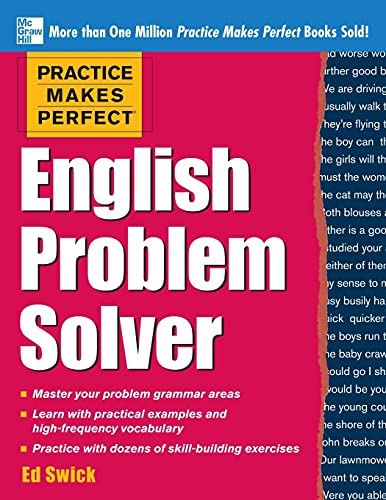
Synopsis
Tackle head-on all the hurdles that you find hard about learning English as an ESL student
Practice Makes Perfect: English Problem Solver doesn't pretend that learning English is easy. Instead of covering the entirety of the language, it hones in on those areas where you might have difficulty--areas such as definite vs. indefinite articles, little vs. few, using get, and restrictive and non-restrictive relative clauses.
Features:
- A variety of extensive exercises for practice
- Practical and high-frequency vocabulary
- Answer key provided for reference and quick feedback
Don't sweat those troublesome grammar areas any more! Practice Makes Perfect: English Problem Solver is your perfect learning tool for ironing out your troubles.
"synopsis" may belong to another edition of this title.
About the Author
Ed Swick has written several ESL titles, including Practice Makes Perfect: English Grammar for ESL Learners, and Practice Makes Perfect: English Pronouns and Prepositions, and Writing Better English.
Excerpt. © Reprinted by permission. All rights reserved.
Practice Makes Perfect English Problem Solver
By Ed SwickMcGraw-Hill Companies, Inc.
Copyright © 2013 The McGraw-Hill Companies, Inc.All right reserved.
ISBN: 978-0-07-179124-3
Contents
Chapter One
Definite versus indefinite articles
Some native languages other than English do not use definite and indefinite articles. Therefore, speakers of these languages often have difficulty learning and using the English definite and indefinite articles accurately. This chapter will help to alleviate this problem.
Definite articles
The definite article in English is the. It is pronounced as the (e = schwa) when it precedes words that begin with a consonant.
the book the funny story the long book the silly clown the suggested material
But when the precedes a word that begins with a vowel, the is pronounced more like thee.
thee apple thee eleven parts of the book thee interesting articles thee obvious results thee understanding
Remember that for some English words beginning with h, that letter is pronounced with an aspiration. In other English words, the h is silent. This difference will determine the pronunciation of the definite article. For example:
the hat thee heir
EXERCISE 1.1
Circle the correct pronunciation of the definite article the with each of the words or phrases provided.
1. little children the thee 2. amazing feats of strength the thee 3. evil empire the thee 4. local newspapers the thee 5. hours we work the thee 6. president the thee 7. residents of the hotel the thee 8. habits of whales the thee 9. newest automobiles the thee 10. advantage the thee 11. islands of Hawaii the thee 12. tall chimney the thee 13. honorary degree the thee 14. opinion of our readers the thee 15. liquidation sale the thee 16. heavy burden the thee 17. latest news the thee 18. unbelievable story the thee 19. yellow bird the thee 20. eventual outcome the thee
The definite article is used to modify a noun that is the specific subject of a speaker or writer. It is a person or thing that is known and being discussed. For example:
The man on the corner is my friend.
In this sentence, the man is the specific subject of the speaker. He is also known to the speaker, because he is a friend. Let's look at another example.
I know the answer to this question.
In this sentence, the answer is the specific subject of the speaker. It is the thing that is known and being discussed by the speaker. Let's look at one more example.
We keep our car in the garage.
Here, the garage is the specific location where our car is kept. It is a known place and is our subject.
EXERCISE 1.2
In the blank provided, write the phrase that is the specific and known subject of the writer of the sentence. If there is more than one, write all of them. For example:
John didn't like the blue suit and returned it. the blue suit
1. Our family needs a vacation and will travel to the state of Florida for some sunshine. ________________________________________________________________
2. The problem in a business is always the lack of customers. ________________________________________________________________
3. I want to take the children to the park. ________________________________________________________________
4. Did the tour guide find a beach for the tourists? ________________________________________________________________
5. The boys refused to play with the girls. ________________________________________________________________
6. She needs a lamp for the guest room. ________________________________________________________________
7. The newspaper was lying on the porch in the pouring rain. ________________________________________________________________
8. Let me know whether you find an article about the war. ________________________________________________________________
9. The scholarship winner wants to attend a university in the East. ________________________________________________________________
10. Who made a hole in the wall? ________________________________________________________________ ________________________________________________________________
Indefinite articles
The English indefinite articles are a and an. Use a before a word that begins with a consonant and an before a word that begins with a vowel.
a long story a pleasant surprise a stranger an anteater an exciting movie an orchestral piece
A word of caution regarding vowels: The vowel u is sometimes pronounced as yoo. In such cases, it is preceded by a.
a university
EXERCISE 1.3
Write the correct indefinite article, a or an, in the blank provided.
1. ___________ apple 2. ___________ angry man 3. ___________ crazy tale 4. ___________ laughing boy 5. ___________ unique story 6. ___________ history lesson 7. ___________ casual remark 8. ___________ zookeeper 9. ___________ yawning baby 10. ___________ understandable mistake 11. ___________ insult 12. ___________ opening to the play 13. ___________ tragic end 14. ___________ universal remote 15. ___________ cell phone 16. ___________ Internet connection 17. ___________ entertaining program 18. ___________ ugly duckling 19. ___________ honorable peace 20. ___________ ordinary day
Indefinite articles modify nouns that are not the specific subject of a speaker or writer. Such nouns are considered generalities. The word any can often replace the indefinite article and make sense. This is usually the signal that the indefinite article is the preferred choice over the definite article. For example:
Do you have a book? (Do you have any book? Do you have any books in general?)
The person asking this question is not looking for a specific book but rather any book that might be available.
There is a strange man on the corner.
The man in this sentence is not known to the speaker. Thus, he is not the known subject of conversation. The speaker is probably wondering who the stranger is.
When a nonspecific noun is introduced, it is most often modified by a or an. But once it has been introduced, it becomes specific and can be modified by the. It is the known subject of the conversation. Consider the following dialogue:
Tom: There is a strange man on the corner. Do you know him?
Mary: I have never seen the man before.
Tom: I think the man might be lost.
Mary: Perhaps we should help the man.
Consider another example:
Tom: I want to buy a bike for my son. What kind should I get?
Mary: I like the red bike over there.
Tom: The red bike is really nice but a little big for my son.
Mary: The blue bike is a bit smaller. How about that one?
Notice that the addition of adjectives (red and blue) makes the bike more specific.
The choice of a or an and the is often a matter of intent. Does the speaker wish to suggest that a noun is being discussed generally (any person or object)? Or does the speaker wish to imply that a specific noun is the subject of the conversation (the known person or object)? For example:
I like a cold beer. (I like any glass of beer that is cold. Generally, I enjoy a cold beer.)
I like the cold beer. (I just tasted three beers. I only enjoyed one—specifically, the cold beer.)
EXERCISE 1.4
In the blanks provided, write the correct definite or indefinite article—the, a, or an.
1. ___________ story that ___________ children are reading was written by ___________ woman in England. But I don't remember her name.
2. Do you have ___________ pencil I can borrow? I left my schoolbag on ___________ kitchen table.
3. Did you enjoy ___________ opera this evening? / Not really. I thought ___________ baritone was weak and ___________ orchestra too loud.
4. We just bought ___________ cottage in the woods. / What good news. I'd love to see ___________ cottage some day.
5. I need ___________ vacation. I've worked for ___________ company for six years, and now I want a couple weeks by ___________ lake or pond where I can fish.
6. Sometime next year, I want to spend ___________ week hunting in Colorado. They say that ___________ mountains are beautiful in ___________ autumn. Perhaps I should go then.
7. My husband needs ___________new suitcase. Let's go to ___________ mall on Main Street. There's supposed to be___________great leather goods store there.
8. Do you have ___________ extra pen? I lost ___________ one my brother gave me last year. I want to write him ___________ letter and get it to ___________ mailbox on ___________ corner before 4 p.m.
9. There's ___________ little boy alone in ___________ park. He seems lost. / I think I know ___________ boy. He lives in ___________ large, white house on ___________ hill outside of town.
10. John bought me ___________ bracelet yesterday. / What does ___________ bracelet look like? / I'm not sure. I haven't seen ___________ bracelet yet. John hid it somewhere in ___________ basement.
Plural articles
Definite and indefinite articles function not only in the singular but also in the plural. The plural indefinite article, however, is no article at all. The plural noun stands alone and implies a generality. If the word any can be used with the plural noun, it is indefinite. For example:
books (books in general, any books) nations (nations in general, any nations) children (children in general, any children)
Compare the use of definite and indefinite articles in the singular and plural. Keep in mind what the difference of meaning is.
DEFINITE ARTICLE
SINGULAR PLURAL
the house the houses the huge ship the huge ships the man the men the nervous horse the nervous horses
INDEFINITE ARTICLE
SINGULAR PLURAL
an angry mob angry mobs an astronaut astronauts a mountain mountains a television program television programs
Certain singular nouns that express something of a nonspecific nature or collectiveness can be written without an article. This structure implies a generality. For example:
Beauty is only skin-deep. Time can be your enemy or your friend. Money is the root of all evil. Hard work can be a character builder.
EXERCISE 1.5
Rewrite each sentence by changing the underlined singular nouns to the plural. Make any other necessary changes to the sentences.
1. The boy played in the field with a dog. ________________________________________________________________
2. We have a new gardener for the new nursery. ________________________________________________________________
3. When on a vacation in Hawaii, I often visit a young surfer at the beach. ________________________________________________________________
4. If you can find a racket, we can go to the tennis court and try to find a partner for you. ________________________________________________________________
5. The child never watches a movie of which the nanny does not approve. ________________________________________________________________
6. If I had a puppy, I would give the puppy to a lonely man or woman. ________________________________________________________________
7. The reason for my tardiness is simple: there was an accident on the snowy road, and the police officer halted all traffic. ________________________________________________________________
8. Put a candle on the table and a bottle of white wine in the cooler, so we can celebrate. ________________________________________________________________
9. Did you send the lawyer a telegram or an e-mail? ________________________________________________________________
10. A pretty woman approached the car and held up a sign asking for help. ________________________________________________________________ ________________________________________________________________
EXERCISE 1.6
Rewrite each sentence by changing the underlined plural nouns to the singular.
1. The boys ran across the gardens and ruined rows of vegetables. ________________________________________________________________
2. Rainstorms and windy days made the sightseeing trips miserable. ________________________________________________________________
3. The new students had to carry trays of milk cartons into classrooms. ________________________________________________________________
4. Are tourists from European countries better tippers than tourists from Asia? ________________________________________________________________
5. The reindeer bolted into the fields and startled the resting geese. ________________________________________________________________ ________________________________________________________________
EXERCISE 1.7
Circle the letter of the word or phrase that best completes each sentence.
1. Ellen wanted ___________ but didn't know where to buy one.
a. the green blouse
b. a new sweater
c. purchases
d. money
2. Who was ___________ unusual-looking man I saw in town yesterday?
a. a
b. an
c. the
d. any
3. John accepted ___________ she made but was a bit skeptical.
a. reasons
b. logic
c. the anger
d. the excuses
4. I'm looking for ___________ interesting book to read on the plane.
a. these
b. a
c. an
d. the
5. They were in ___________ hour-long discussion about the new project.
a. any
b. several
c. an
d. a frequently
Chapter Two
Capitalization and punctuation
Capitalization
European languages all use capitalization as a way of highlighting certain kinds of vocabulary. English is no different. There was a time when capitalization in English was a bit easier, because the general rule was to capitalize all nouns. Look at the following excerpt from the US Constitution and notice that all the nouns are capitalized.
Article I—The Legislative Branch
Section 1—The Legislature
All legislative Powers herein granted shall be vested in a Congress of the United States, which shall consist of a Senate and House of Representatives.
Section 2—The House
The House of Representatives shall be composed of Members chosen every second Year by the People of the several States, and the Electors in each State shall have the Qualifications requisite for Electors of the most numerous Branch of the State Legislature.
No Person shall be a Representative who shall not have attained to the Age of twenty five Years, and been seven Years a Citizen of the United States, and who shall not, when elected, be an Inhabitant of that State in which he shall be chosen.
This simple approach to capitalization is, unfortunately, no longer in vogue. However, standard rules exist to guide accurate capitalization of English.
There is only one pronoun that is always capitalized: I. However, this occurs only in the subjective case. The objective cases of me, my, mine, and myself are not capitalized unless they occur at the beginning of a sentence.
Names
The simplest and perhaps most obvious rule of capitalization is that all names—first names, middle names, or surnames—are capitalized.
George Washington Franklin Delano Roosevelt Helen Keller Martin Luther King Jr.
Titles
The titles that accompany names are also capitalized.
Dr. Jonas Salk Mr. Brad Pitt Ms. Gloria Steinem President Barak Obama Professor Maria Ibbotson Queen Elizabeth II Senator Dianne Feinstein
First word of a sentence
Always capitalize the first word of a sentence, whether the sentence is a statement, a question, or an exclamation.
My brother has a new job in New York City. Have you ever visited Disneyland? Watch out for that car!
EXERCISE 2.1
Rewrite each word that requires a capital letter.
1. during the late afternoon, i like to stroll down to the river and visit mr. smith. ________________________________________________________________
2. are frank and ellen coming to your party tomorrow? ________________________________________________________________
3. i bought a puppy yesterday and decided to call her spotty. ________________________________________________________________
4. why does professor keller continue to call me edward? my name is john.
5. dr. parsons said that this was the worst novel he ever read.
6. don't just stand there! help me!
7. the newly elected president will take the oath of office tomorrow.
8. we wanted to meet vice president biden, but he was much too busy.
9. last night, little mary began to cry, and when i went to her room, i realized she had had a nightmare.
10. could you spend some time with mrs. martin? she's been rather lonely. ________________________________________________________________ ________________________________________________________________
(Continues...)
Excerpted from Practice Makes Perfect English Problem Solverby Ed Swick Copyright © 2013 by The McGraw-Hill Companies, Inc.. Excerpted by permission of McGraw-Hill Companies, Inc.. All rights reserved. No part of this excerpt may be reproduced or reprinted without permission in writing from the publisher.
Excerpts are provided by Dial-A-Book Inc. solely for the personal use of visitors to this web site.
"About this title" may belong to another edition of this title.
Search results for Practice Makes Perfect English Problem Solver: With...

Stock Image
Practice Makes Perfect English Problem Solver
Published by
McGraw-Hill Education - Europe, 2013
ISBN 10: 0071791248
ISBN 13: 9780071791243
Used
Paperback
Seller: World of Books (was SecondSale), Montgomery, IL, U.S.A.
Seller rating 5 out of 5 stars

Paperback. Condition: Good. Helps you tackle head-on all the hurdles that you find hard about learning English as an ESL student. This title covers those areas where you might have difficulty - areas such as definite vs indefinite articles, little vs few, using get, and restrictive and non-restrictive relative clauses. Seller Inventory # 00098743620
Seller Image
Practice Makes Perfect English Problem Solver: With 110 Exercises
Seller: Greenworld Books, Arlington, TX, U.S.A.
Seller rating 5 out of 5 stars
Condition: very_good. Fast Free Shipping â" Very Good condition book with a firm cover and clean pages. Shows normal use and some light wear or limited notes markings. A solid, nice copy to enjoy. Seller Inventory # GWV.0071791248.VG
Seller Image
Practice Makes Perfect English Problem Solver: With 110 Exercises
Seller: ZBK Books, Carlstadt, NJ, U.S.A.
Seller rating 5 out of 5 stars
Condition: very_good. Fast & Free Shipping â" Very Good condition book with a firm cover and clean pages. Shows normal use and some light wear or limited notes markings. A solid, nice copy to enjoy. Seller Inventory # ZWV.0071791248.VG
Seller Image
Practice Makes Perfect English Problem Solver: With 110 Exercises
Seller: Zoom Books East, Glendale Heights, IL, U.S.A.
Seller rating 5 out of 5 stars
Condition: very_good. Book is in very good condition and may include minimal underlining highlighting. The book can also include "From the library of" labels. May not contain miscellaneous items toys, dvds, etc. . We offer 100% money back guarantee and 24 7 customer service. Seller Inventory # ZEV.0071791248.VG
Stock Image
Practice Makes Perfect English Problem Solver : With 110 Exercises
Published by
McGraw-Hill Education, 2013
ISBN 10: 0071791248
ISBN 13: 9780071791243
Used
Softcover
First Edition
Seller: Better World Books, Mishawaka, IN, U.S.A.
Seller rating 5 out of 5 stars
Condition: Good. 1st Edition. Pages intact with minimal writing/highlighting. The binding may be loose and creased. Dust jackets/supplements are not included. Stock photo provided. Product includes identifying sticker. Better World Books: Buy Books. Do Good. Seller Inventory # 4772396-6
Stock Image
Practice Makes Perfect English Problem Solver : With 110 Exercises
Published by
McGraw-Hill Education, 2013
ISBN 10: 0071791248
ISBN 13: 9780071791243
Used
Softcover
First Edition
Seller: Better World Books: West, Reno, NV, U.S.A.
Seller rating 5 out of 5 stars
Condition: Good. 1st Edition. Former library copy. Pages intact with minimal writing/highlighting. The binding may be loose and creased. Dust jackets/supplements are not included. Includes library markings. Stock photo provided. Product includes identifying sticker. Better World Books: Buy Books. Do Good. Seller Inventory # 5914422-6
Stock Image
Practice Makes Perfect English Problem Solver : With 110 Exercises
Published by
McGraw-Hill Education, 2013
ISBN 10: 0071791248
ISBN 13: 9780071791243
Used
Softcover
First Edition
Seller: Better World Books, Mishawaka, IN, U.S.A.
Seller rating 5 out of 5 stars
Condition: Good. 1st Edition. Former library copy. Pages intact with minimal writing/highlighting. The binding may be loose and creased. Dust jackets/supplements are not included. Includes library markings. Stock photo provided. Product includes identifying sticker. Better World Books: Buy Books. Do Good. Seller Inventory # 5914422-6
Stock Image
Practice Makes Perfect English Problem Solver
Published by
McGraw-Hill Education - Europe, 2013
ISBN 10: 0071791248
ISBN 13: 9780071791243
Used
Paperback
Seller: World of Books Inc, Montgomery, IL, U.S.A.
Seller rating 4 out of 5 stars

Paperback. Condition: Good. Helps you tackle head-on all the hurdles that you find hard about learning English as an ESL student. This title covers those areas where you might have difficulty - areas such as definite vs indefinite articles, little vs few, using get, and restrictive and non-restrictive relative clauses. Seller Inventory # CIN0071791248G
Stock Image
Practice Makes Perfect English Problem Solver: With 110 Exercises
Published by
McGraw Hill (edition 1), 2013
ISBN 10: 0071791248
ISBN 13: 9780071791243
Used
Paperback
Seller: BooksRun, Philadelphia, PA, U.S.A.
Seller rating 5 out of 5 stars
Paperback. Condition: Very Good. 1. It's a well-cared-for item that has seen limited use. The item may show minor signs of wear. All the text is legible, with all pages included. It may have slight markings and/or highlighting. Seller Inventory # 0071791248-11-18
Stock Image
Practice Makes Perfect English Problem Solver: With 110 Exercises
Published by
McGraw Hill (edition 1), 2013
ISBN 10: 0071791248
ISBN 13: 9780071791243
Used
Paperback
Seller: BooksRun, Philadelphia, PA, U.S.A.
Seller rating 5 out of 5 stars
Paperback. Condition: Very Good. 1. It's a well-cared-for item that has seen limited use. The item may show minor signs of wear. All the text is legible, with all pages included. It may have slight markings and/or highlighting. Seller Inventory # 0071791248-11-1