
Items related to Not In The Flesh
Synopsis
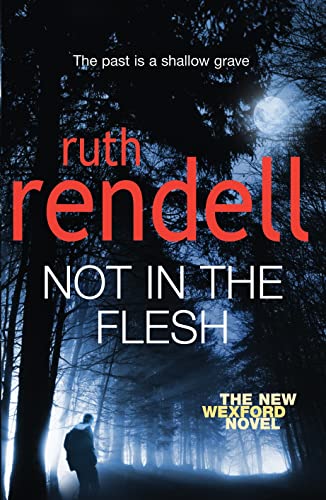
Searching for truffles in a wood, a man and his dog unearth something less savoury - a human hand. The body, as Chief Inspector Wexford is informed later, has lain buried for ten years or so, wrapped in a purple cotton sheet. The post mortem can not reveal the precise cause of death. The only clue is a crack in one of the dead man's ribs. Although it covers a relatively short period of time, the police computer stores a long list of missing persons. Men, women and children disappear at an alarming rate, something like 500 every day nationwide. So Wexford knows he is going to have a job on his hands to identify the corpse. And then, only about twenty yards away from the woodland burial site, in the cellar of a disused cottage, another body is found. The detection skills of Wexford, Burden and the other investigating officers of the Kingsmarkham Police Force are tested to the utmost to discover whether the murders are connected and to track down whoever is responsible.
"synopsis" may belong to another edition of this title.
About the Author
Ruth Rendell was an exceptional crime writer, and will be remembered as a legend in her own lifetime. Her groundbreaking debut novel, From Doon With Death, was first published in 1964 and introduced the reader to her enduring and popular detective, Inspector Reginald Wexford, who went on to feature in twenty-four of her subsequent novels. With worldwide sales of approximately 20 million copies, Rendell was a regular Sunday Times bestseller. Her sixty bestselling novels include police procedurals, some of which have been successfully adapted for TV, stand-alone psychological mysteries, and a third strand of crime novels under the pseudonym Barbara Vine. Very much abreast of her times, the Wexford books in particular often engaged with social or political issues close to her heart. Rendell won numerous awards, including the Crime Writers' Association Gold Dagger for 1976's best crime novel with A Demon in My View, a Gold Dagger award for Live Flesh in 1986, and the Sunday Times Literary Award in 1990. In 2013 she was awarded the Crime Writers' Association Cartier Diamond Dagger for sustained excellence in crime writing. In 1996 she was awarded the CBE and in 1997 became a Life Peer. Ruth Rendell died in May 2015. Her final novel, Dark Corners, is scheduled for publication in October 2015
From the Back Cover
Searching for truffles in a wood, a man and his dog unearth something less savoury. The body, as Chief Inspector Wexford is informed later, has lain buried for ten years or so, and the post-mortem can not reveal the precise cause of death.
Wexford knows it will be a difficult job to identify the corpse. Although it covers a relatively short period of time, the police computer stores a long list of missing persons. People disappear at an alarming rate hundreds each day.
When another body is found nearby, the detection skills of Wexford, Burden and the other investigating officers of the Kingsmarkham Police Force are tested to the utmost to discover whether the deaths are connected and to track down whoever is responsible.
Compulsively readable The Scotsman Rendell never fails to come up trumps Irish Times
Wexford is as solid and reliable as ever Birmingham Post
As ever, Rendell writes both literately and perceptively about her characters and the world they live in Spectator
Reviews
Starred Review. In addition to solving two long-ago murders, Chief Inspector Wexford is troubled by female genital mutilation in the local Somali community. The temptation would be to cut the subplot, but this abridgment retains the richness of the novel. Tim Curry's performance is splendid, even better than Daniel Gerroll's excellent performance of Rendell's End in Tears. Curry does a particularly marvelous job with the minor characters, such as the two wives-in-law of a local author, who cackle at the sexual innuendos of their own jokes. Then there's 84-year-old Irene McNeil, alternately supercilious and weepy. Throw in the obsessive Grimbles, on whose land the bodies were found; some migrant fruit-picking Roma; Wexford's family; Somali immigrants; and Curry somehow sounds like a full-cast audio. If only Wexford sounded less like his assistant Burden, the performance would be absolutely perfect. A Crown hardcover (reviewed online). (July)
Copyright © Reed Business Information, a division of Reed Elsevier Inc. All rights reserved.
Rendell, winner of three Edgar Awards, has two primary approaches in her acclaimed crime fiction: edgy novels of psychological suspense and more traditional police procedurals starring Chief Inspector Wexford of Kingsmarkham, Sussex. Where Rendell’s suspense can leave the reader deliciously unsettled, the Wexford novels place the reader on solid, sometimes overly familiar, ground. For example, Rendell overrelies on the old “see who cracks when the police visit” convention, using the questioning of witnesses/suspects in their homes as a launch pad for scathing comments on home decor and the occupants’ physical attributes—after the fourth or fifth visit, the formula starts to creak. But Rendell works feverishly within the form to deliver some surprises, starting here with the discovery of a human hand by a dog trained to hunt for truffles in the woods. The remains, according to the pathologist, have been buried for almost a decade. Wexford centers his investigation on the owners of the land where the hand was found, a contentious couple, greatly caught up in land disputes. When a second body is found in a basement wood pile, the action takes off. Rendell keeps the suspense going nicely, even if Wexford remains something of a cardboard character, and the procedure is mostly rooted in the past. For devoted fans of the series, of whom there are many, this will be much anticipated and, as always, satisfying; for others, only so-so. --Connie Fletcher
Excerpt. © Reprinted by permission. All rights reserved.
Chapter One
Tom Belbury died in May and now that summer was over his brother missed him more than ever. Neither of them had married, so there was no widow and no children, only the dog, Honey. Jim took Honey to live with him; he had always liked her and it was what Tom had wanted. When he knew he hadn’t long to live he worried a lot about Honey, what would happen to her after he was gone, and though Jim assured him repeatedly that he would take her, Tom said it again and again.
“Haven’t I promised over and over?” Jim asked. “You want me to put it in writing and get it witnessed? I will if that’s what you want.”
“No, I trust you. She’s a good dog.”
Tom’s trust hadn’t been misplaced. Jim lived in the cottage that had been the brothers’ parents’ home and there Honey went to live with him. She was no beauty, owing her ancestry to an apparent mix of spaniel, basset hound, and Jack Russell. Tom used to say she looked like a corgi and everyone knew corgis were the Queen’s dogs, having so to speak the royal seal of approval, but Jim couldn’t see it. Nevertheless, he had grown attached to Honey. Apart from fidelity and affection, she had one great virtue. She was a truffle dog.
Every September, at the beginning of the month, Tom and Honey used to go into one patch of woodland or another in the neighborhood of Flagford and hunt for truffles. A lot of people scoffed. They said truffles couldn’t be found in Britain, only in France and Italy, but there was no doubt Honey found them, was rewarded with a lump of meat, and Tom sold the truffles to a famous London restaurant for £200 a pound.
Jim disliked the taste but he liked the idea of £200 and pos- sibly more. He had never been truffle-hunting with Tom but he knew how it was done. This was why a mild and sunny morning in late September found him and Honey in what their neighbors called the posh part of Flagford where Flagford Hall faced Athelstan House across Pump Lane, each amid extensive grounds. They had no interest in these houses or their occupants. They were heading for Old Grimble’s Field that filled the corner between the gardens of Athelstan House and two identical detached houses called Oak Lodge and Marshmead.
Like the Holy Roman Empire, which Gibbon said was neither holy, Roman, nor an empire, this open space wasn’t a field, nor was Grimble particularly old or really called Grimble. It was an overgrown piece of land, about an acre of what estate agents describe as a corner plot. Due to years of inattention, saplings had grown into trees, shrubs into bushes, roses and privet and dogwood into hedges, and trees had doubled in size. Somewhere in the middle of this burgeoning woodland stood a semiderelict bungalow that had belonged to Grimble’s father, its windows boarded up, its roof slowly shedding its tiles. Tom Belbury had been there truffle- hunting with Honey the year before and pronounced it rich in members of the genus Tuber.
Because Tom had carried the rewards for Honey unwrapped in the breast pocket of his leather jacket, he usually smelled of meat that was slightly “off.” Jim hadn’t much liked it at the time, but now he recalled it with affection. How pleased dear old Tom would be to see him and Honey heading for Old Grimble’s Field in close companionship, following his old pursuit. Perhaps he could see, Jim thought sentimentally, and imagined him looking down from whatever truffle wood in the sky he found himself in.
Honey was the director of operations. Tom used to claim that she was drawn to a particular spot by the presence of truffle flies hovering around the base of a tree, and now she led Jim to a mature tree (a sycamore, he thought it was) where he could see the flies himself.
“Get digging, girl,” he said.
The irregular warty lump, about the size of a tennis ball, which Honey unearthed, she willingly relinquished in exchange for the cube of sirloin steak Jim took out of a plastic zipper-lock bag he had brought with him.
“This old fungus must weigh a good half-pound,” he said aloud. “Keep on with the good work, Honey.”
Honey kept on. The truffle flies annoyed her and she snapped at the swarms, scattering them and snuffling toward where they had been densest. There she began digging again, fetched out of the rich leaf mold first a much smaller truffle, then one about the size of a large potato and was rewarded once more with pieces of sirloin.
“There’s a lot more flies buzzing about over there,” Jim said, pointing to a biggish beech tree which looked a hundred years old. “How about moving on?”
Honey had no intention of moving on. So might a diamond prospector refuse to abandon the lode where gems worth a fortune had already come to light, until he was sure the seam had been exhausted. Honey sniffed, dug, slapped at the flies with her paws, dug again. No more truffles were foraged and the object that she had unearthed was of no interest to her. It lay exposed on the chestnut-colored soil, white, fanlike, unmistakably what it was: a human hand.
Or, rather, the bones of a human hand, flesh, skin, veins, tendons all gone.
“Oh, my lord, girl,” said Jim Belbury, “whatever have you gone and found?”
As if she understood, Honey stopped digging, sat down, and put her head on one side. Jim patted her. He put the three truffles in the plastic bag he had brought with him for that purpose, placed the bag inside his backpack, and removed from it his mobile phone. Jim might be an old countryman, once an agricultural laborer and living in a cottage with no proper bathroom and no main drainage, but still he would no more have gone out without his mobile than would his fifteen-year-old great-nephew. Unaware of the number of Kingsmarkham police station, he dialed Information.
From the Hardcover edition.
"About this title" may belong to another edition of this title.
Search results for Not In The Flesh

Stock Image
Not in the Flesh
Seller: AwesomeBooks, Wallingford, United Kingdom
Seller rating 5 out of 5 stars

hardcover. Condition: Very Good. Not in the Flesh This book is in very good condition and will be shipped within 24 hours of ordering. The cover may have some limited signs of wear but the pages are clean, intact and the spine remains undamaged. This book has clearly been well maintained and looked after thus far. Money back guarantee if you are not satisfied. See all our books here, order more than 1 book and get discounted shipping. Seller Inventory # 7719-9780091920593
Buy Used
US$ 3.91
US$ 3.36 shipping
Ships from United Kingdom to U.S.A.
Ships from United Kingdom to U.S.A.
Quantity: 2 available
Stock Image
Not In The Flesh
Seller: New Legacy Books, Annandale, NJ, U.S.A.
Seller rating 4 out of 5 stars

hardcover. Condition: Good. The pages show normal wear. Fast shipping and order satisfaction guaranteed. A portion of your purchase benefits Non-Profit Organizations, First Aid and Fire Stations! Seller Inventory # mon0000047011
Stock Image
Not In The Flesh
Seller: ThriftBooks-Dallas, Dallas, TX, U.S.A.
Seller rating 5 out of 5 stars
Hardcover. Condition: Very Good. No Jacket. May have limited writing in cover pages. Pages are unmarked. ~ ThriftBooks: Read More, Spend Less. Seller Inventory # G0091920590I4N00
Stock Image
Not in the Flesh
Published by
Cornerstone, United Kingdom, London, 2007
ISBN 10: 0091920590
ISBN 13: 9780091920593
Used
Paperback
Seller: WorldofBooks, Goring-By-Sea, WS, United Kingdom
Seller rating 5 out of 5 stars
Paperback. Condition: Very Good. The twenty-first book to feature the classic crime-solving detective, Chief Inspector Wexford. Searching for truffles in a wood, a man and his dog unearth something slightly less savoury - a human hand. The corpse, as Chief Inspector Wexford is informed later, has lain buried for ten years or so, wrapped in a purple cotton sheet. The post mortem can not reveal the precise cause of death. The only clue to solving this mysterious murder is a crack in one of the dead man's ribs. Wexford knows it will be a difficult job to identify the dead body. Although it covers a relatively short period of time, the police computer stores a long list of missing persons. People disappear at an alarming rate - hundreds each day. And then, only about twenty yards away from the woodland burial site, in the cellar of a disused cottage, another body is found. The detection skills of Wexford, Burden and the other investigating officers of the Kingsmarkham Police Force are tested to the utmost to discover whether the murders are connected and to track down whoever is responsible. The book has been read, but is in excellent condition. Pages are intact and not marred by notes or highlighting. The spine remains undamaged. Seller Inventory # GOR000508555
Buy Used
US$ 2.64
US$ 7.55 shipping
Ships from United Kingdom to U.S.A.
Ships from United Kingdom to U.S.A.
Quantity: 5 available
Stock Image
Not in the Flesh: (A Wexford Case)
Seller: Ammareal, Morangis, France
Seller rating 5 out of 5 stars
Hardcover. Condition: Très bon. Ammareal reverse jusqu'à 15% du prix net de cet article à des organisations caritatives. ENGLISH DESCRIPTION Book Condition: Used, Very good. Ammareal gives back up to 15% of this item's net price to charity organizations. Seller Inventory # G-271-602
Stock Image
Not in the Flesh: (A Wexford Case)
Seller: Ammareal, Morangis, France
Seller rating 5 out of 5 stars
Hardcover. Condition: Très bon. Ancien livre de bibliothèque avec équipements. Ammareal reverse jusqu'à 15% du prix net de cet article à des organisations caritatives. ENGLISH DESCRIPTION Book Condition: Used, Very good. Former library book. Ammareal gives back up to 15% of this item's net price to charity organizations. Seller Inventory # G-167-992
Stock Image
Not in the Flesh
Seller: Bahamut Media, Reading, United Kingdom
Seller rating 5 out of 5 stars
hardcover. Condition: Very Good. This book is in very good condition and will be shipped within 24 hours of ordering. The cover may have some limited signs of wear but the pages are clean, intact and the spine remains undamaged. This book has clearly been well maintained and looked after thus far. Money back guarantee if you are not satisfied. See all our books here, order more than 1 book and get discounted shipping. Seller Inventory # 6545-9780091920593
Buy Used
US$ 5.94
US$ 5.38 shipping
Ships from United Kingdom to U.S.A.
Ships from United Kingdom to U.S.A.
Quantity: 2 available
Stock Image
Not In The Flesh
Published by
Hutchinson January 2007, 2007
ISBN 10: 0091920590
ISBN 13: 9780091920593
Used
Hardcover
Seller: R Bookmark, Youngtown, AZ, U.S.A.
Seller rating 5 out of 5 stars
Hardcover. Condition: Used - Good. Dust Jacket Condition: Good. Boards have shelf wear Dust jacket has shelf wear. Seller Inventory # 227177
Stock Image
Not in the Flesh: (A Wexford Case)
Seller: AwesomeBooks, Wallingford, United Kingdom
Seller rating 5 out of 5 stars
Hardcover. Condition: New. Not in the Flesh: (A Wexford Case) Brand new item sourced directly from publisher. Packed securely in tight packaging to ensure no damage. Shipped from warehouse on same/next day basis. Seller Inventory # 1111-9780091920593
Buy New
US$ 5.43
US$ 6.73 shipping
Ships from United Kingdom to U.S.A.
Ships from United Kingdom to U.S.A.
Quantity: 1 available
Stock Image
Not in the Flesh
Seller: Better World Books Ltd, Dunfermline, United Kingdom
Seller rating 5 out of 5 stars
Condition: Good. Former library copy. Pages intact with minimal writing/highlighting. The binding may be loose and creased. Dust jackets/supplements are not included. Includes library markings. Stock photo provided. Product includes identifying sticker. Better World Books: Buy Books. Do Good. Seller Inventory # 40957396-20
Buy Used
US$ 6.27
US$ 6.74 shipping
Ships from United Kingdom to U.S.A.
Ships from United Kingdom to U.S.A.
Quantity: 1 available